


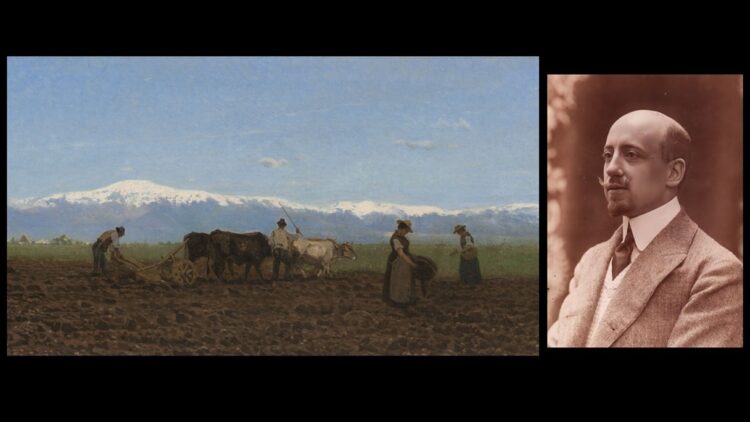
The Sowers
by Gabriele D’Annunzio (1863-1938)
translated from Italian by Joseph S. Salemi
Strong lads drive the docile oxen through
The field. Behind them open furrows steam
As plowshares tear the ground in preparation
For the sowers’ casting of the grain.
Then with a sweeping gesture of their arms
Grown men strew the seed, while honest elders
Lift up to heaven supplicating prayers
For a rich harvest’s yield, should it please God.
Deep human thankfulness, almost devout,
Honors the Earth today, when all is done.
In the subdued glow of the sun at twilight
The mountains, as a snow-clad temple, rise.
Men’s voices raise a soft song: in that act
There is a priest-like dignity and awe.
Original Italian
I Seminatori
Van per il campo i validi garzoni
_guidando i buoi da la pacata faccia;
_e, dietro quelli, fumiga la traccia
_del ferro aperta alle seminagioni.
Poi con un largo gesto delle braccia,
_spargon li adulti la semenza; e i buoni
_vecchi, levando al ciel le orazioni,
_pensan frutti opulenti, se a Dio piaccia.
Quasi una pia riconoscenza umana
_oggi onora la Terra. Nel modesto
_lume del sole, al vespero, il nivale
tempio de’monti inalzasi: una piana
_canzon levano li uomini, e nel gesto
_hanno una maestà sacerdotale.
Translator’s Note
Gabriele D’Annunzio (1863-1938) lived the kind of madcap energetic life that most poets dream about, but lack the strength or wherewithal to pursue. He was a first-rate poet, but also a playwright, journalist, essayist, politician, and combat officer in World War I. In his own time he was a famous celebrity, and an acknowledged major voice in Italian literature, and his reputation went far beyond the shores of Italy.
D’Annunzio liked spectacular gestures, such as his wartime flight over the enemy capital of Vienna, to scatter Italian propaganda pamphlets. He even led squadrons of soldiers (when the war was over) to capture the city of Fiume in 1919, proclaim it an independent republic under his personal command, and then declare war on Italy for refusing to recognize his claim.
He was friends with Mussolini, but his own politics was a bizarre mix of fascism, aestheticism, revolutionary socialism, corporativism, and fanatical Italian patriotism. Despite his activist lifestyle he was essentially a man of letters, and his poetry is valued as a startling compound of decadence, symbolism, and aestheticism. The poem that I have translated above (“I Seminatori”) is one of his more conservative sonnets in a variant of the Petrarchan model. I have not used rhyme, so as to stay as close as possible to the poem’s meaning.
Joseph S. Salemi has published five books of poetry, and his poems, translations and scholarly articles have appeared in over one hundred publications world-wide. He is the editor of the literary magazine TRINACRIA and writes for Expansive Poetry On-line. He teaches in the Department of Humanities at New York University and in the Department of Classical Languages at Hunter College.

















Joseph, I applaud you sticking as close as possible to the original in your translation. Looking at the Italian text provided there is an excellent rhyme scheme with rhyming words, but in this case, it makes sense to translate as you have done beautifully. As one who grew up on a farm until the age of 13, I was particularly enamored with the vivid imagery and prayers of supplication for the harvest to come. My family had similar prayers.
I like the religiousity of your translation, Joseph, giving the piece an almost medieval feel. The lack of rhyme and the various lengths of lines builds up a well-drawn, lyrical picture of an era past that is vivid, and somehow nostalgic – harvest festival was still a thing at my urban primary school when I was young(er).
The biography of Gabriele D’Annunzio was most interesting, too.
Thanks for the read.
Roy and Paul — thank you both for your comments. Italy was still a heavily agricultural nation when D’Annunzio was a child, so closeness to the earth was a powerful element in Italian perceptions, even for city-dwellers. The sonnet uses some deep religious imagery, even though D’Annunzio was one of those Catholics with a good, healthy streak of anticlericalism in him, which is sadly missing today even from Trad Inc. R&R Catholics.
Joe, thank you very much for making D’Annunzio’s vision of the sower accessible to us. I have always respected those who brave the might of nature to bring food to the table, and I am moved by the profoundly spiritual aspect of this poem. I like the way the closing line: “There is a priest-like dignity and awe.” elevates farming to a sacred vocation that binds humankind to earth and to heaven, and I especially like the line: “The mountains, as a snow-clad temple, rise.” – I can see the beauty and feel the majesty. At a time when governmental insanity is threatening farming and working to sever this ancient bond, the poem stands as a reminder of what is being lost – not just livelihoods, but a sacred relationship with the land. This beautiful poem makes my heart ache.
All small-scale, non-industrialized farming has a profound link to our humanity, and to the great powers that are beyond humanity. The rituals, the recurrent cycles of weather and seasons, the nurturing of fragile plants, the destruction of pests, the almost endless labor, and the great harvest and threshing — ever since agriculture began men have seen the earth as children see a mother. The Greek goddess of agriculture and fertility was Demeter (literally, “Earth-Mother”), and for that reason farming has always been connected to prayer and respect and intimacy with the divine.
Thank you for your comment, Susan. Yes, the entire twentieth century has seen a massive movement to destroy the free peasantry in every nation. It is all very deliberate.
Thank you, Joe, for this wonderful introduction to a fascinating poet with a fascinating life! Your biographical note is a (for me) somewhat surprising follow-up to a poem which struck me as deeply spiritual – perhaps even deeply religious.
Eschewing rhyme was a brilliant choice in your translation here since Italian rhymes easily and English with far more difficulty. Forcing rhymes into a translation often skew both the meaning of the original language as well as the original intent of the poet. Slavishly fighting for rhymes can sometimes work but it can also create a greatly stilted quality. Speaking for myself, it is rare that I consider the rhyme-scheme to be the most important aspect of the poems I write. Usually, the content dictates the form and that means – for me – that it is the content that is the important part. Usually.
I love the theme of the poem, the juxtaposition of bucolic farming with religious/spiritual imagery. The language is particularly evocative: supplicating prayers to heaven, thankfulness almost devout, the mountains as a snow-clad temple and the priest-like dignity and awe. It is, in fact, a heavy concentration of nature and religious imagery with the extra biblical ideas (perhaps) of turning swords into plowshares and the strewing of seeds. The latter reminded me of both the Parable of the Mustard Seed and the many writings of St. Terese of Lisieux. Sowing seeds has many, many religious associations. It is almost as symbolic as shepherd and sheep (also bucolic in nature.)
One last thing: I looked up the meaning of Seminatori (sowers) which struck me as extremely close in sound and structure to the English word seminary. It seems they are indeed cognate and – given the religious themes here – that can hardly be a coincidence. (Seminary in Italian is “seminario”.) Seminary and seminatori both derive from the Latin seminarium, which originally meant a “plant nursery” or “seedbed.” A very felicitious connection.
Brian, many thanks for the perceptive comments and positive reaction. I’m glad if I can translate a rhymed poem in a foreign language to an adequately rhymed one in English, but it isn’t possible in all cases. When my wife translated selected poems of Baudelaire, she wisely decided that certain poems simply couldn’t be put into rhyming English with any kind of plausibility, so she left those alone. It’s somewhat easier if you are translating non-rhyming poetry (like Latin and Greek) into rhyming English versions, where you have more leeway.
Seeds and sowing can have religious overtones. Christ’s parable of the seed that is sown on various grounds — some useful for germination and flowering, and others less so — is a good example. Yes, all the semin- words that you mention are Latin derivatives pertaining to a seed bed, from “semen, seminis” which can mean sperm, seed, or metaphorically “origin, beginning.” A “seminal” book is one that presents an important and new idea.
When I was young kid in religion class, the priest asked us if anyone knew what the word “seminary ” meant. One Irish boy stood up and said “It’s the place where they bury dead people.” The priest stifled a laugh, and explained to us that it was a school that trained young men to be ordained as priests.
I vacillated about whether the translation would have better rhymed. In the end, I trust your judgment: with d”Annunzio (and any Symbolist-adjacent poets), meaning is paramount, and no sacrifice can be made in that regard. You have chosen well because you capture the deep symbolism of the poem: the hard labor of sowing a field as both a sexual and a religious act, and how our bond with nature in that regard elevates even our humblest actions. Your translation captures this, and I think you properly kept your focus there. Nicely done.
Many thanks, Adam. I appreciate your comments. And yes — in some poems the meaning is central and determinative, and translators must stick close to it.
Who said that this wasn’t my kind of thing? Farmers fail every day, all the more a sign that we depend upon them. But keep your wild oats to yourself, unless you plan to attend the harvest.
I didn’t say it, Kip, nor would I ever. All your professional career has been in deep touch with the earth and its plants. I recall that a 19th-century American politician said something to this effect: “Tear down your cities, and within a brief time they will spring up again from the fertility of the earth and its farmers. But destroy your farms, and your cities will shrivel, die, and be forever fruitless like a cut vine.”
The only vines I cut these days, Joseph, are those of Japanese Bittersweet. Proper pruning is both a science and an art.