• Submit Poetry
  • Support SCP
  • About Us
  • Members
  • Join
Saturday, July 18, 2026
Society of Classical Poets
  • Poems
    • Beauty
    • Culture
    • Satire
    • Humor
    • Children’s
    • Art
    • Ekphrastic
    • Epic
    • Epigrams and Proverbs
    • Human Rights in China
    • Music
    • Performing Arts
    • Riddles
    • Science
    • Song Lyrics
    • The Environment
    • The Raven
    • Found Poems
    • High School Poets
    • Terrorism
    • Covid-19
  • Poetry Forms
    • Sonnet
    • Haiku
    • Limerick
    • Villanelle
    • Rondeau
    • Pantoum
    • Sestina
    • Triolet
    • Acrostic
    • Alexandroid
    • Alliterative
    • Blank Verse
    • Chant Royal
    • Clerihew
    • Rhupunt
    • Rondeau Redoublé
    • Rondel
    • Rubaiyat
    • Sapphic Verse
    • Shape Poems
    • Terza Rima
  • Great Poets
    • Geoffrey Chaucer
    • Emily Dickinson
    • Homer
    • Henry Wadsworth Longfellow
    • Dante Alighieri
    • John Keats
    • John Milton
    • Edgar Allan Poe
    • William Shakespeare
    • William Wordsworth
    • William Blake
    • Robert Frost
  • Love Poems
  • Contests
  • SCP Academy
    • Educational
    • Teaching Classical Poetry—A Guide for Educators
    • Poetry Forms
    • The SCP Journal
    • Books
No Result
View All Result
Society of Classical Poets
  • Poems
    • Beauty
    • Culture
    • Satire
    • Humor
    • Children’s
    • Art
    • Ekphrastic
    • Epic
    • Epigrams and Proverbs
    • Human Rights in China
    • Music
    • Performing Arts
    • Riddles
    • Science
    • Song Lyrics
    • The Environment
    • The Raven
    • Found Poems
    • High School Poets
    • Terrorism
    • Covid-19
  • Poetry Forms
    • Sonnet
    • Haiku
    • Limerick
    • Villanelle
    • Rondeau
    • Pantoum
    • Sestina
    • Triolet
    • Acrostic
    • Alexandroid
    • Alliterative
    • Blank Verse
    • Chant Royal
    • Clerihew
    • Rhupunt
    • Rondeau Redoublé
    • Rondel
    • Rubaiyat
    • Sapphic Verse
    • Shape Poems
    • Terza Rima
  • Great Poets
    • Geoffrey Chaucer
    • Emily Dickinson
    • Homer
    • Henry Wadsworth Longfellow
    • Dante Alighieri
    • John Keats
    • John Milton
    • Edgar Allan Poe
    • William Shakespeare
    • William Wordsworth
    • William Blake
    • Robert Frost
  • Love Poems
  • Contests
  • SCP Academy
    • Educational
    • Teaching Classical Poetry—A Guide for Educators
    • Poetry Forms
    • The SCP Journal
    • Books
No Result
View All Result
Society of Classical Poets
No Result
View All Result
Home Poetry Beauty

‘Westward, with Columbus’: A Poem for Columbus Day by Paul A. Freeman

October 14, 2024
in Beauty, Culture, Poetry
A A
19
poems 'Westward, with Columbus': A Poem for Columbus Day by Paul A. Freeman

.

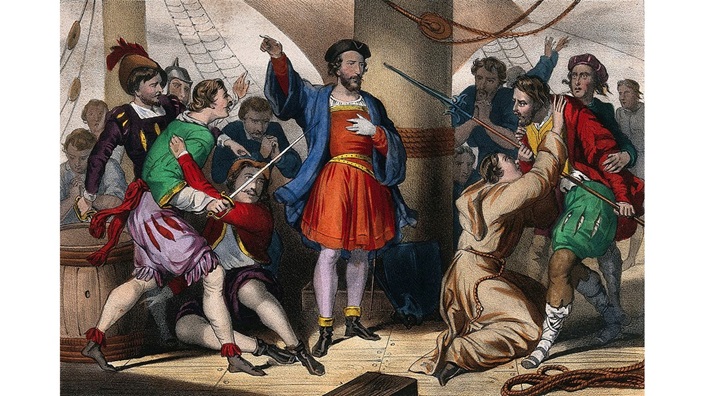
Westward, with Columbus

The North Atlantic Ocean was awash
with monsters and leviathans, or so
we fearfully supposed, and thought it tosh
by sailing west, to India we could go.
 
Then Christopher Columbus raised three crews.
From Spain we sailed. A westward route we took.
For sixty days no terra firma news—
we took our tight-lipped captain for a crook.
 
Then after spotting dolphins, we gained land,
an archipelago, large islands, too;
and with his glass, Columbus smugly scanned
the Indies—of the West!—but they would do.
 
We feared aquatic titans. None abound.
And lo, a brand-new continent we’d found.

.

.

Paul A. Freeman is the author of Rumours of Ophir, a crime novel which was taught in Zimbabwean high schools and has been translated into German. In addition to having two novels, a children’s book and an 18,000-word narrative poem (Robin Hood and Friar Tuck: Zombie Killers!) commercially published, Paul is the author of hundreds of published short stories, poems and articles.


ShareTweetPin
The Society of Classical Poets does not endorse any views expressed in individual poems or commentary.
Read Our Comments Policy Here

RandomPoems

‘The Magpie’s Chorus’ and Other Poetry by David Watt
Beauty

‘The Magpie’s Chorus’ and Other Poetry by David Watt

March 1, 2021

. The Magpie’s Chorus With sunlight at full power And silence in the air, I sought a shaded bower, A...

Review: Sonnets for Christ the King, Joseph Charles Mackenzie, 2017
Beauty

‘Eternal Rose’ by Shari Jo LeKane

January 30, 2020

  The autumn sun warming keeps rose bushes forming well into the days of December, but frost without warning one...

Next Post
‘Three Death Musings’: A Poem by Jeff Kemper

'Three Death Musings': A Poem by Jeff Kemper

‘Sudan, 2005—On the Death of Dr. John Garang’: A Poem by Paul A. Freeman

'Sudan, 2005---On the Death of Dr. John Garang': A Poem by Paul A. Freeman

‘Washington’s Armor’ from Andrew Benson Brown’s Mock Epic Poem

'Washington’s Armor' from Andrew Benson Brown's Mock Epic Poem

Comments 19

  1. Roy Eugene Peterson says:
    2 years ago

    This reflection of a crewmember on one of the ships of Columbus nicely commemorates Columbus Day.

    Reply
    • Paul A. Freeman says:
      2 years ago

      Thanks, Roy. It must have given you huge bragging rights to have been on Columbus’ first voyage.

      Reply
  2. Joseph S. Salemi says:
    2 years ago

    Now that the holiday has been degraded to Indigenous Flint-Chippers’ Day, I’m glad someone is still paying attention to the man and the sailors who opened up two huge continents to Western civilization.

    Reply
    • Paul A. Freeman says:
      2 years ago

      I doubt many could have fully realised the consequences of Columbus’ reaching the Americas. It took a lot of courage and determination.

      Reply
  3. Lannie David Brockstein says:
    2 years ago

    Paul, the publication of your “Westward, with Columbus” poem today is timely, in part because yesterday it was reported by Reuters that “The 15th-century explorer Christopher Columbus was a Sephardic Jew from Western Europe, Spanish scientists said on Saturday, after using DNA analysis to tackle a centuries-old mystery.”

    The Times of Israel (October 13th, 2024) – “Study finds Christopher Columbus was a Sephardic Jew from Western Europe”: https://www.timesofisrael.com/study-finds-christopher-columbus-was-a-sephardic-jew-from-western-europe/

    In the comments section of that article, username Just D wrote: “Papers I’ve read many years ago show that he delayed the travel to America due to Tisha B’Av, used and speculate his crew where jews he was saving from the inquisition.”

    That comment begs the question: Is the speaker in your poem a Jewish sailor who joined the crew of Columbus, in order to escape from the Spanish Inquisition pogroms? For what reason would non-Jewish sailors have been motivated to sail “The North Atlantic Ocean [that] was awash with monsters and leviathans”?

    Also in the comments section of that article, username doug.mann wrote: “Let’s remember the purpose of the voyage was to find a trade route to the East circumventing Islamic raider attacks along the Silk Road …..”

    That is similar to how in today’s day and age most cargo ships in the Middle East have stopped using the Red Sea route, in order to avoid being attacked by the Muslim supremacist Houthis terrorist organization.

    From Lannie.

    Reply
    • Paul A. Freeman says:
      2 years ago

      I submitted the poem a while back, so it is quite serendipitous that Columbus’ remains have been under investigation.

      Reply
    • Brian A. Yapko says:
      2 years ago

      I have now seen multiple tongue-in-cheek references on social media to this day now being considered a Jewish holiday.

      Reply
  4. Margaret Coats says:
    2 years ago

    You make it look so simple, Paul. Behind what you write is the truth that outcomes of following a leader characterized by determination and foresight, are usually different, and often greater than expected. Columbus is a magnificent example. You present well the fears of the sailors, their simple satisfaction at recovering terra firma, and the achievement of the expedition that no one at the time could evaluate.

    Thanks for the homage to this great man, who earned the gratitude of two worlds. As a supplement to Lannie David Brockstein’s information on Columbus as Jewish by ancestry, let me offer the fact that he may, in the future, be recognized as a Catholic saint. The canonization process was started in the 19th century, and during its course, Pope Leo XIII wrote the 1892 encyclical Quarto Abeunte Saeculo in praise of the explorer on the 400th anniversary of the discovery voyage.

    https://rorate-caeli.blogspot.com/2020/06/de-mattei-columbus-noster-est.html

    The article was written as statues of Columbus were toppled in United States riots of 2020. There is much to overcome before canonization, but slander is being capably refuted.

    Reply
    • Paul A. Freeman says:
      2 years ago

      The genesis of this poem is quite interesting, Margaret.

      In 1992, I was working in a rural high school, on a gold mine in Zimbabwe. The regional Ministry of Education sent out a flyer to all secondary schools in the province, informing us about a competition, sponsored by the postal service. To celebrate the 500th anniversary of Christopher Columbus reaching the Americas, schools were urged to get their students to pretend they were sailors on the first voyage and write a letter home describing the adventure.

      I got a group of interested students together, we discussed the voyage, brainstormed, and they went away and wrote up their competition entries.

      When I took their work to the regional ministry, it was ‘discovered’ that no other school had bothered to send any work in, to which I said, in that case my students win the 1st, 2nd and 3rd place prizes.

      Alas, since the people running the show thought the optics would be bad (i.e. they hadn’t followed up), they decided not to recognise my students’ work, nor carry their entries forward to the national competition. Can you imagine the message this sent to my students?

      Anyhow, I decided to write something myself along the lines of those letters all those years back, dedicated to the four students who put all that effort in and learned that the world isn’t fair.

      Reply
  5. Brian A. Yapko says:
    2 years ago

    This is a very clever poem, Paul, with an intriguing tone and a speaker who has been transported out of time into a higher plane where he can address not just the circumstances of the voyage itself but its consequences — an anachronistic awareness that they had not reached the East Indies and that they had discovered a new continent (or two!) I read this poem with enjoyment but puzzle at your intent behind the phrase “smugly scanned” when Columbus views his discovery. Is Columbus smug because he has proven that he was right? Or is there more?

    Reply
    • Paul A. Freeman says:
      2 years ago

      Hi, Brian. Thanks for commenting.

      I imagine Christopher Columbus would have been smug at being proved right when so many doubted him (though he did think himself in the vicinity of India. He did grossly underestimate the circumference of the Earth, and there were reports that a lookout was the first to spot land and that Columbus too credit for that. But then these are small things considering how monumental his First Voyage proved to be.

      Reply
  6. Mike Bryant says:
    2 years ago

    Wow! Very well constructed sonnet on a worthy subject. The comments have my head spinning. Is it really possible that this worthy gentleman was a Jew helping other Jews to escape the Inquisition? Could he also be under consideration for Sainthood?

    Truth really is stranger than fiction.

    Perhaps some time traveler may land on the deck of the Santa María face to face with our hero and remark, “Non preoccuparti, Capitano, un giorno sarai conosciuto come San Cristoforo Colombo!”

    (Thanks, Google Translate)

    Reply
  7. Cheryl Corey says:
    2 years ago

    Because we live in a shrunken world, it’s difficult for the present-day mindset to fully grasp the magnitude of what Columbus discovered. He returned to Europe, the Old World, not only with knowledge of new lands, but also of navigation. Imagine those men, dressed in their woolens, experiencing a climate of tropical flora and fauna for the first time! He opened both worlds to the Columbian Exchange–fruits, vegetables, animal life, you name it.

    Reply
    • Paul Freeman says:
      2 years ago

      As I mentioned in one of the comments, on the 500th anniversary of Columbus reaching the Americas, I researched the First Voyage.

      Perhaps the main reason sailors never ventured West, was fear of the monsters inhabiting the vast and mysterious Atlantic Ocean. What a surprise was in store for those first explorers.

      Reply
      • Joseph S. Salemi says:
        2 years ago

        Most people do not know this, but in 1477 Columbus had sailed to Iceland (in addition to earlier trips to England). In Iceland he is sure to have heard stories about lands far to the west, since the Icelanders would have memories of the voyages to Greenland and to Vinland by their Scandinavian forebears. In fact, the Scandinavian settlements in Greenland were only just about dying out at that time.

        Reply
      • Paul Freeman says:
        2 years ago

        Interesting! I never knew that.

        Reply
  8. Daniel Freeman says:
    2 years ago

    This is a wonderful poem, with so much to like. The focus on Columbus is refreshing and timely, and I especially appreciate the image of spotting dolphins and gaining land, as well as the memorable line, “the Indies—of the West!—but they would do.” Bravo!

    Reply
    • Paul Freeman says:
      2 years ago

      Thanks for your positive take on a poem I hoped would circumvent controversy and look primarily at Columbus’s great achievements.

      Reply
  9. Paul A. Freeman says:
    2 years ago

    It’s sad that such bitterness pervades that no one seems to celebrate the excitement of a bunch of Europeans voyaging into the unknown and discovering a continent (two continents these days) previously unknown to the ‘Old World’.

    As for the recent revelation from scientists and experts that Christopher Columbus was Jewish, I’m left wondering why the great man was known as ‘Christopher’. But then that’s not what the poem was about. Nor was it about cleansed native populations, or ‘Indigenous Flint-Chippers’ as one poet referred to the First Nation people of the Americas in this thread.

    Reply

Leave a Reply Cancel reply

Your email address will not be published. Required fields are marked *

  1. Jan Mennite on ‘My Pyjamas!’ and Other Poems by Susan Jarvis BryantJuly 18, 2026

    Susan, I always feel that my poetic intelligence increases while I read your work. I laughed and learned and felt…

  2. Cynthia L Erlandson on ‘The Gold Star Mother’: A Poem by Gerard MaritatoJuly 18, 2026

    I don't know how anyone could read this without tears. It's just beautiful.

  3. Susan Jarvis Bryant on ‘My Pyjamas!’ and Other Poems by Susan Jarvis BryantJuly 18, 2026

    C.B., please know that laughter is beneficial to one's health and temper. Suing me will undoubtedly cause you immense stress,…

  4. Jan Mennite on National Poetry Month Limerick ChallengeJuly 18, 2026

    Cass There once was a teacher named Cass who expelled much malodorous gas. One day after starting, she couldn't stop…

  5. Susan Jarvis Bryant on ‘My Pyjamas!’ and Other Poems by Susan Jarvis BryantJuly 18, 2026

    Adam, thank you very much for your appreciative and encouraging words. I hope your children enjoyed "My Pyjamas." I believe…

Subscribe to Daily Poems

Enter your email address to subscribe to this blog and receive notifications of new posts by email.

Join 1,594 other subscribers

Recent Poems

  • Winners and Rankings of The Great American Poetry Competition
  • ‘The Gold Star Mother’: A Poem by Gerard Maritato
  • ‘An American Dash’: A Poem by Linda Ellis
  • ‘The Anonymous Soldier’: A Poem by Lucy Lind
  • ‘For Those We Never Meet’: A Poem by Aneesh Agarwal
  • ‘Ben Franklin’s Copper Fugio Cent’: A Poem by Geoffrey Smagacz
  • Three Brief Poems by Luxorius, Translated by Joseph S. Salemi
  • ‘The American Spirit’: A Poem by Dusty Grein
  • ‘The Ballad of Zebulon Pike’: A Poem by M.D. Skeen
  • ‘We Are the Ones’ and Other Poetry by Cheryl Corey
  • ‘My Pyjamas!’ and Other Poems by Susan Jarvis Bryant
  • ‘A Snowy Egret’: A Poem by Bruce Dale Wise
  • ‘The Swearing-in of Calvin Coolidge’: A Sonnet by Robert W. Crawford
  • ‘Ballad of the Sequoia’: A Poem by Lauren V. Leon
  • ‘The 51st State’: A Poem by James Sale
  • ‘La Uva’ (The Grape): A Poem by Michael Pietrack
  • ‘There’s Blood that Flows Within the Stripes’: A Poem by Lauren V. Leon
  • ‘Birdsong’: A Poem by Jeffrey Essmann
  • ‘The Melody That Lingers On’ and Other Poetry by John McPherson
  • ‘American Dreams’: A Poem by Adam Sedia
  • ‘An American Fabius’: A Poem by John Hernandez
  • ‘Vernal Clinic’ and Other Poetry by C.B. Anderson
  • ‘Omaha Beach’ and Other Poetry by Bradford Skow
  • ‘Music to Part the Veil’: A Poem by T.M. Moore
  • ‘A Gentleman’s Guide to Losing a War’ and Other Poetry by Arnon Peterson
  • ‘Black Shuck’: A Poem by Martin Briggs
  • ‘When the Last World War II Veteran Passes Away’: A Poem by N.S. Boone
  • ‘A Fallow Year at Worthy Farm’: A Poem by Paul A. Freeman
  • ‘Outstanding in Afghanistan’: A Poem by Jared S. Chang
  • ‘250 More’: A Poem by Miguel Moreno

Categories

  • Acrostic
  • Alexandroid
  • Alliterative
  • Art
  • Best Poems
  • Blank Verse
  • Chant Royal
  • Classical Poets Live
  • Clerihew
  • Covid-19
  • Deconstructing Communism
  • Educational
  • Epic
  • Epigrams and Proverbs
  • Essays
    • Interviews with Poets
    • Poetry Reviews
  • Featured
  • From the Society
  • Great Poets
    • Dante Alighieri
    • Edgar Allan Poe
    • Emily Dickinson
    • Geoffrey Chaucer
    • Henry Wadsworth Longfellow
    • Homer
    • John Keats
    • John Milton
    • Robert Frost
    • William Blake
    • William Shakespeare
    • William Wordsworth
  • Human Rights in China
  • Limerick
  • Love Poems
  • Music
  • Pantoum
  • Performing Arts
  • Poetry
    • Beauty
    • Children's Poems
    • Culture
    • Ekphrastic
    • Found Poems
    • High School Poets
    • Humor
    • Riddles
  • Poetry Challenge
  • Poetry Contests
  • Poetry Forms
    • Curtal Sonnet
    • Haiku
  • Poetry Readings
  • Rhupunt
  • Rondeau
  • Rondeau Redoublé
  • Rondel
  • Rubaiyat
  • Sapphic Verse
  • Satire
  • Science
  • Sestina
  • Shape Poems
  • Short Stories
  • Song Lyrics
  • Sonnet
  • Symposium
  • Terrorism
  • Terza Rima
  • The Environment
  • Translation
  • Triolet
  • Video
  • Villanelle

Quick Links

  • About Us
  • Submit Poetry
  • Become a Member
  • Members List
  • Support the Society
  • Advertisement Placement
  • Comments Policy
  • Terms of Use

Welcome Back!

Login to your account below

Forgotten Password?

Retrieve your password

Please enter your username or email address to reset your password.

Log In
No Result
View All Result
  • Poems
    • Beauty
    • Culture
    • Satire
    • Humor
    • Children’s
    • Art
    • Ekphrastic
    • Epic
    • Epigrams and Proverbs
    • Human Rights in China
    • Music
    • Performing Arts
    • Riddles
    • Science
    • Song Lyrics
    • The Environment
    • The Raven
    • Found Poems
    • High School Poets
    • Terrorism
    • Covid-19
  • Poetry Forms
    • Sonnet
    • Haiku
    • Limerick
    • Villanelle
    • Rondeau
    • Pantoum
    • Sestina
    • Triolet
    • Acrostic
    • Alexandroid
    • Alliterative
    • Blank Verse
    • Chant Royal
    • Clerihew
    • Rhupunt
    • Rondeau Redoublé
    • Rondel
    • Rubaiyat
    • Sapphic Verse
    • Shape Poems
    • Terza Rima
  • Great Poets
    • Geoffrey Chaucer
    • Emily Dickinson
    • Homer
    • Henry Wadsworth Longfellow
    • Dante Alighieri
    • John Keats
    • John Milton
    • Edgar Allan Poe
    • William Shakespeare
    • William Wordsworth
    • William Blake
    • Robert Frost
  • Love Poems
  • Contests
  • SCP Academy
    • Educational
    • Teaching Classical Poetry—A Guide for Educators
    • Poetry Forms
    • The SCP Journal
    • Books

© 2025 SCP. WebDesign by CODEC Prime.