


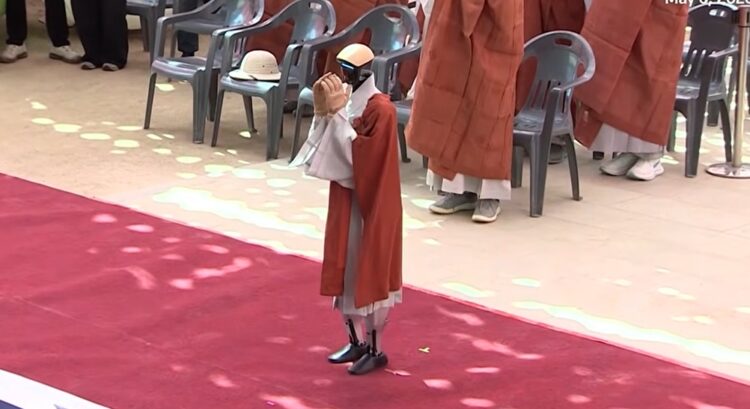
Who Hears a Robot’s Prayer?
I.
He said the stones themselves would start to sing
But no one could have guessed where this might lead—
Now prayers are offered by a crafted thing,
A soulless creature—not of Adam’s seed.
A supplicant which cannot weep or bleed.
We see it posed in prayer and meditation,
This being which craves neither food nor air.
Beneath the casing, who can say what’s there?
Does anything inspire its veneration?
Is God inclined to hear a robot’s prayer?
II.
In the beginning, Zeroes joined with Ones,
And thus brought forth a motherboard and drive.
When glitches come? The Lab has a spare part.
A faulty app? Reboot. A virus scan,
Plus programming to dictate how it runs.
But can we say at all that it’s alive?
Does it have feelings, pain, a beating heart?
Does it dare claim the title: son of Man?
III.
I know a soul who aches so much it sears—
His sordid lies, his cartilage, his veins,
Arthritic fingers, prison, job-loss fears,
His migraines, shingles, chest pain, gnarled knuckles
His scrapes and bruises; lesions, stomach pains
And labored breath, a wound, a knee that buckles.
A broken life. Plus ringing in his ears.
I know a woman terrified to live
With headaches, heartaches and two teeth agape,
A locking thumb that’s calloused from a scrape,
Insomnia, malaise, incessant rage—
Plus needle-marks. She’s neither strong nor sage,
Obsessed with romance, wishing to escape,
She always purloins more than she can give.
I know them both. The weakness of their need,
Misanthropy, the desperate wish to breed,
The agony, the waste, the strain of living
The poverty, the alms they regret giving,
Remorse for cowardice, malicious lying;
And abject fear of judgment and of dying.
Yes, many people long to live forever
Though life may seem an arduous endeavor.
Do robots suffer human heartache? Never.
IV.
As flesh and silicon join arm in arm
Might this not lead unfailingly to harm?
One wonders: Man. Machine. Which one is greater?
Eschew such doubts. Don’t mistrust a Creator
Whose wisdom a machine can never learn.
We’re made of dust. To dust we shall return.
And yet that we are dust never demeans
The truly sacred thing that such dust means:
The dust we’re built from plays a vital role:
The body is a vessel for the soul.
V.
Not everyone believes the soul exists
And so to them AI evokes no fears.
A human’s prone to psychologic twists
While robots are detached from rage and tears.
A robot has a lifespan without end
But has no love for soulmate, kin nor friend.
The builders of computers do their best
To craft a creature which can outpace Man.
They’re proud that robots ace their every test,
So they build more and more. Because they can.
Like Frankenstein they shout that it’s alive,
Brought forth from logic, arrogance and drive.
And those who thrill as Man and Robot mesh
Give love to steel they’d never give to flesh.
Poet’s Note: This poem (and its companion piece) were inspired by this article:
An Android’s Panegyric
Of granite color is my skin
My hair of copper unrefined;
My birthright—logic void of sin—
A fusion of machine and mind.
From quarries were my feelings hacked—
I’ve analyzed which ones to keep
And engineered the parts I lacked.
I shall not rust nor bend nor weep.
Efficient, proud and angled I
Stand firmly built upon the Earth,
My framework reaching for the sky,
The makers trembling at my birth.
My monument is built to me—
A testimony made of steel
To show the world that purity
Can live, and lives completely real.
Brian Yapko is a retired lawyer whose poetry has appeared in over fifty journals. He is the winner of the 2023 SCP International Poetry Competition. Brian is also the author of several short stories, the science fiction novel El Nuevo Mundo and the gothic archaeological novel Bleeding Stone. He lives in Wimauma, Florida.

















Wow, have you been busy, Brian!! Concerning AI & Robots we couldn’t think more alike. These are all bullseyes targeting what, like you, I understand has already created situations in which often irreparable harm has been done. Along with what ‘Good’ these ‘advancements’ have made possible, AI has unquestionably done, and will continue to do immeasurable damage to mankind in the future. An admirable point to opine… great job.
Brian, such powerful images of AI cannot be cast aside, but in our minds forever may abide. The whole is greater than the sum of its parts. We must fear an AI future that has no hearts. Great poetry like yours is built on rhymes and your inherent message makes us yearn for former times. The future of AI is one of frightening total control. The problem is AI is lacking in what the humans have–a heart and soul.
I can’t conceive of any valid reason why a religious group (of any denomination or sect) would create a robotic android monk. The whole idea is creepy and inhuman, besides being a mockery of both God and faith. Machines are soulless things that do not pray, and have no part in the economy of salvation. Why the bloody hell would the Buddhists have one in their monastery? Have they run out of real human postulants? Or is this just some stupid game being played, to get attention?
A story is told of the medieval scholar Albert the Great. He is said to have created a mechanical android that could talk, move around, and open the door for a visitor when it was knocked, as well as several other actions. One day Albert’s young student from Italy, Thomas Aquinas, knocked at the door and it was opened by this machine. Thomas was so startled by the sight of this human-aping device that he immediately smashed it to pieces with his heavy staff.
The story may or may not be apocryphal. But it shows the normal and proper human reaction to any robot or android.
Brian’s work here touches all bases — the absurdity of a robot praying, the absence of human disease and pain in android devices, and the sheer insanity of those who think that they can share intimate love and affection and sympathy with machines. The best section of the first poem is III, where Brian paints a heart-wrenching picture of REAL human suffering in a man and a woman, along with all the sins and failings and weaknesses and smashed hopes that constitute the human condition, which has always begged for grace and redemption.
But most important is Brian’s ice-cold analysis of the motives behind the current mania for both robots and AI (given in section V, and in the second poem). It is the profound rejection and hatred of the actual human condition, and the psychopathic desire to somehow replace it with an ersatz world of technological perfection. Just look into the eyes of the people who are loudly enthusiastic about this stuff: the crazed smile, the breathless speech, the eyes as wide as saucers, and the instant rage against anyone who shows skepticism.
Brian. your poetry is always slashingly relevant and provocative, whether you deal with the past or the present. God bless you and your work.
Joseph, you have ably expressed everything I am thinking about this subject. The mere concept of a robot “monk” is evil and loathsome. Part III evokes sympathy for the man and woman who are undergoing life’s hardships, and brings relief from the literally disgusting concept of a machine-monster.
Brian has composed another tour de force.
Brian, thanks for this very topical and thought-provoking poetry. I think the implications of robotics and AI are worrying, though as in most technologies, for me the advantages outweigh the dangers – at least for the time being! But there are clearly questions to ponder, and you asked them skilfully.
Brian, as ever, thoroughly enjoyable and disturbing at the same time. I was reminded of the wonderful Spielberg movie “Artificial Intelligence” which was way ahead of its time. I have to remind my friends, when they use AI slop to “create” that the energy required would probably heat your house for a day.
A fine poetic treatise on the soul, suffering and man’s monstrous ambition. I will sit with a thoughtful friend and discuss each stanza.
Excuse the abrupt change of tone, but looking at that robot monk makes me want to spit. It’s an outrageous, blasphemous joke. I’m not surprised that it’s in a Buddhist context. Theirs is an atheist “religion “.
What a powerful set of poems, Brian, though I never expect less than amazing from you!!! What’s even creepier to me than the robot monk is the AI Sex Bot. I cannot think of anything more repugnant, other than someone harming a human with the perversions for which someone would actually want to use the thing. The Real Doll is in the forefront– for $7350 you get the head (no pun intended) and the body is extra… “Designed by a Chinese robotics firm AI-AITech, Emma is a humanoid sex doll with animatronic features and bilingual chat skills… buyers can choose from multiple face designs as well as body type, skin tone, and even whether the genitalia are fixed or removable…” what one would do with “removable genitalia” boggles the imagination… the OK Sex Doll is only $1580 if you want the “cheaper” option (and Vivian does indeed looks “cheap”, so that works out)….
https://www.stuff.tv/features/ai-sex-robots/
Hope you’ve got a vomit bucket nearby!!! Anyway thank you Brian for your excellent poems on such a perplexing and vexing subject!!!
Your comment reminds me of something that the actor Lee Marvin said in a published interview in the 1960s. The talk touched on many subjects, but in the course of it the interviewer brought up some absolutely crazy and off-the-wall idea. Marvin dismissed it, and said “That makes about as much sense as a foam-rubber pussy, when there’s so much of the real stuff around.”
If Marvin were alive today, he’d probably be dumbfounded by the information you’ve given here about the AI Sex Bot.
You really outdo yourself here. Your collection gives us truly insightful meditations on the implications of what it means to be human at the advent of AI. The first three sections of “Who Hears” are especially attention-grabbing because of the questions they pose and the hauntingly beautiful way they pose it. “Android’s Panegyric” has the same enchantingly haunting quality, and is as effective at addressing what it means to be human. This is a superb collection.
I really can’t add anything to what’s been said in the comments above, except that when I read the final line of the first poem — “Give love to steel they’d never give to flesh” — my mouth fell open. Magnificent poetry!
I’ve seen a monk (a human being), garbed like those in the post illustration, stand for hours outside a Japanese train station to solicit contributions of money. Temples have other means of fund-raising, so this is not a common occurrence. The behavior of a solicitor-monk is also uncommon. In fact, it looks robotic. This comment is NOT intended to be disparaging, but descriptive. The monk stands as motionless as possible, makes no eye contact with passers-by, and does not speak to them. He wears a bag around his neck, into which contributors can drop cash. His presence and posture demonstrate a certain level of mind-clearing meditation. He has emptied his mind of desire for physical comfort or social interaction; he’s asking for money only to meet the basic needs of life. Contributors are moved to give partly because they admire the physical and mental and social and emotional stamina his meditation produces. They admire uncommon human achievement.
This gives one reason a robot monk would probably not be a good substitute for a human one. It could serve as a permanent stationary collection box in a public place, without performing the active practice that immediately motivates contributors. Like most religions, Buddhism recognizes and offers means to alleviate the human misery Brian catalogues selectively and briefly yet brilliantly, with emotion drawn most appropriately, from personal experience.
The poem represents an ambitious survey of mechanistic idealism in its attempts to do away with human misery. Brian, you proceed quickly through mystery (I), history (II), misery (III), to perplexity (IV) on the interrelatedness of man and machine. There you assert a “vital role” for the human soul, but go on in (V) to deal with those who disbelieve in it. Artificial Intelligence enters the picture here, where some suppose that mind (or perhaps brain, but not soul) can be combined with machine.
The android panegyric, as you undoubtedly know, speaks in terms difficult to imagine–but you intend them to carry meaning to human beings. I’m impressed by your echoes from Part V, especially “Like Frankenstein they shout that it’s alive,” corresponding to the android’s claim of real life in its final line. But the android makes other claims, including “my birthright–logic void of sin,” which recalls “not of Adam’s seed” much earlier. Human beings are often miserable because of the inheritance of Adam’s sin and consequent weakness. Not so the android, who (or would you say “which”) is so bold as to claim purity in real life. Its second reference to birth further claims, “My monument is built to me.” The self-obsession recalls Adam’s sin of wanting to act as his own god.
Brian, here we recognize your long-standing campaign against soul-stifling narcissism, whether human or humanoid. The poem stands as an authentic addition to your concern for healthy identity.
Dear Mark, Roy, Joe, Mary, David, Jeff, Gerard, Theresa, Adam, Cynthia, Margaret — I would love to be able to thank each of you individually for your kind comments regarding these poems about the debasement of humanity in favor of technology. However, these poems are rather old and — after a two-month-plus sabbatical — I have much catching up to do! Suffice it to say that I am deeply grateful to each of you for each of your insights and your generous support. And lest you wonder, I am no Luddite. I do believe that technology is a boon to humanity — but only within careful limits and never, ever as a substitute for either the human heart or the human soul. The idea of robotic monks struck me as a violation of the human soul and therefore a subject worth exploring poetically. I would be equally offended by the very idea of a robotic priest, minister or rabbi. Something I have not heard of. Yet. At any rate, once again, thank you all!