• Submit Poetry
  • Support SCP
  • About Us
  • Members
  • Join
Sunday, September 6, 2026
Society of Classical Poets
  • Poems
    • Beauty
    • Culture
    • Satire
    • Humor
    • Children’s
    • Art
    • Ekphrastic
    • Epic
    • Epigrams and Proverbs
    • Human Rights in China
    • Music
    • Performing Arts
    • Riddles
    • Science
    • Song Lyrics
    • The Environment
    • The Raven
    • Found Poems
    • High School Poets
    • Terrorism
    • Covid-19
  • Poetry Forms
    • Sonnet
    • Haiku
    • Limerick
    • Villanelle
    • Rondeau
    • Pantoum
    • Sestina
    • Triolet
    • Acrostic
    • Alexandroid
    • Alliterative
    • Blank Verse
    • Chant Royal
    • Clerihew
    • Rhupunt
    • Rondeau Redoublé
    • Rondel
    • Rubaiyat
    • Sapphic Verse
    • Shape Poems
    • Terza Rima
  • Great Poets
    • Geoffrey Chaucer
    • Emily Dickinson
    • Homer
    • Henry Wadsworth Longfellow
    • Dante Alighieri
    • John Keats
    • John Milton
    • Edgar Allan Poe
    • William Shakespeare
    • William Wordsworth
    • William Blake
    • Robert Frost
  • Love Poems
  • Contests
  • SCP Academy
    • Educational
    • Teaching Classical Poetry—A Guide for Educators
    • Poetry Forms
    • The SCP Journal
    • Books
No Result
View All Result
Society of Classical Poets
  • Poems
    • Beauty
    • Culture
    • Satire
    • Humor
    • Children’s
    • Art
    • Ekphrastic
    • Epic
    • Epigrams and Proverbs
    • Human Rights in China
    • Music
    • Performing Arts
    • Riddles
    • Science
    • Song Lyrics
    • The Environment
    • The Raven
    • Found Poems
    • High School Poets
    • Terrorism
    • Covid-19
  • Poetry Forms
    • Sonnet
    • Haiku
    • Limerick
    • Villanelle
    • Rondeau
    • Pantoum
    • Sestina
    • Triolet
    • Acrostic
    • Alexandroid
    • Alliterative
    • Blank Verse
    • Chant Royal
    • Clerihew
    • Rhupunt
    • Rondeau Redoublé
    • Rondel
    • Rubaiyat
    • Sapphic Verse
    • Shape Poems
    • Terza Rima
  • Great Poets
    • Geoffrey Chaucer
    • Emily Dickinson
    • Homer
    • Henry Wadsworth Longfellow
    • Dante Alighieri
    • John Keats
    • John Milton
    • Edgar Allan Poe
    • William Shakespeare
    • William Wordsworth
    • William Blake
    • Robert Frost
  • Love Poems
  • Contests
  • SCP Academy
    • Educational
    • Teaching Classical Poetry—A Guide for Educators
    • Poetry Forms
    • The SCP Journal
    • Books
No Result
View All Result
Society of Classical Poets
No Result
View All Result
Home Poetry Beauty

‘Yarran and Myaree’ by David Watt

February 26, 2020
in Beauty, Culture, Love Poems, Poetry
A A
10
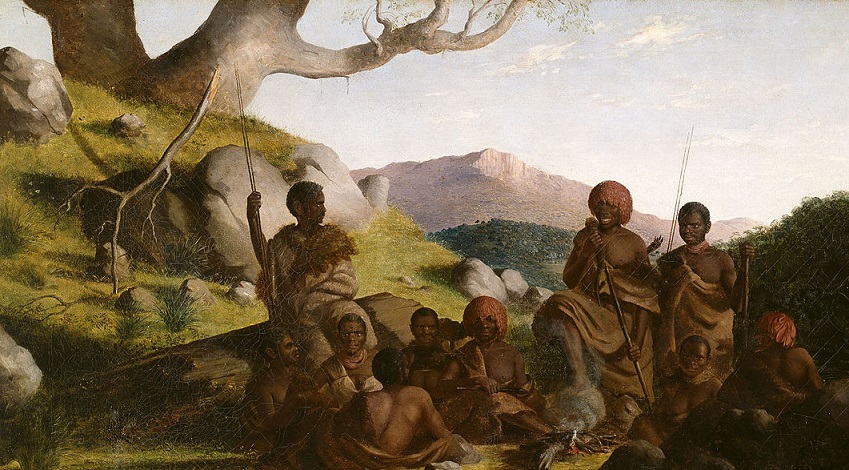
poems 'Yarran and Myaree' by David Watt


In a time long ago, where the high myrtles grow,
Lived a tribe of the Bellenden Range.
While below, on the plain, in their tropic domain
Lived a tribe known for hostile exchange;

They had hatchets and spears, paint from eyebrows to ears,
And a sliver of bone through their nose.
Thus arose a taboo that all mountain folk knew—
Never mix with those underworld foes!

But a youth hunting prey scaled their mountain one day;
He was Yarran—a fierce sight to see!
There he came face to face with a vision of grace
In the person of sweet Myaree!

Each and every curl formed an ebony whirl
As they flowed to her brown shoulders bare;
And the force of her smile set a spell to beguile
Yarran’s heart through a radiance rare.

They were struck from the first by unquenchable thirst
For each other, although it was wrong.
But as anyone knows, Love is ever disposed
To repeat the same sensuous song.

So they met on the sly, when the moon lit the sky,
As their meeting was easier then;
For the sinuous sweep of the tangled path steep
Was a test for the bravest of men.

As the moon waxed and waned they were: active, restrained,
In a cycle as fixed as the tide;
Until one night in May they were ‘given away’
By an elder who happened beside.

There was trial by kin over matter of sin
Between Yarran and bold Myaree.
The decision, soon made, absolutely forbade
Further contact (by tribal decree).

But the moon grew to full and proceeded to pull
On the lovers, and wouldn’t relent;
Until each made their way to the shared hideaway,
Where their pent-up emotions were spent.

Sealed by many a kiss, what transpired was this:
An agreement to always be true;
And there followed the thought that their future was fraught
With a consequence late to undo.

Early morning rays found the two lovers close-bound
By a string of the blue Native Flax;
Having leapt from the spur of Mount Bellenden Ker
In their last, and most tragic of acts.

Let this lesson be known: No law ought to condone
Views unfair that doom love from the start;
And it’s better by far to leave things as they are
When it comes to affairs of the heart.


Poet’s Note: Mount Bellenden Ker is the second-highest mountain in the Australian state of Queensland. The rain gauge at the summit records an annual average rainfall of 317.07 in, making it the wettest meteorological station in Australia. Named after the botanist John Bellenden Ker Gawler, the mountain peak is composed of resistant granite. Leptospermum wooroonooran, family Myrtaceae, is endemic on the summit of Mount Bellenden Ker. It is a compact shrub or small tree bearing white flowers. Dianella revoluta is known as Native Flax or Blueberry Flax-Lily. This Australian plant has a blue flower and a purple fruit. The leaf fiber is very strong, and was used to make cord.

Meaning of Aboriginal names
Myaree: foliage
Yarran: Acacia tree


David Watt is a writer from Canberra, the “Bush Capital” of Australia. He has contributed regularly to Collections of Poetry and Prose by Robin Barratt. When not working for IP (Intellectual Property) Australia, he finds time to appreciate the intrinsic beauty of traditional rhyming poetry.


ShareTweetPin
The Society of Classical Poets does not endorse any views expressed in individual poems or commentary.
Read Our Comments Policy Here

RandomPoems

Two Riddles by Jack DesBois
Poetry

Two Riddles by Jack DesBois

July 2, 2022

. Riddle This tiny thief Has ground to grief Many a mighty poem, No wiser for The learned lore He nibbles,...

poetry/woodruff/culture
Culture

Can Long Poems Still Work? A Discussion Topic from Julian Woodruff

August 17, 2023

. A Discussion on Long Poems by Julian Woodruff  In her second comment to the thread trailing my recent poem...

Next Post
‘On Hearing of Hosni Mubarak’s Death, 25 February 2020’ by Kevin Blankinship

'On Hearing of Hosni Mubarak’s Death, 25 February 2020' by Kevin Blankinship

‘Kneeling’ by Sean Galli

'Kneeling' by Sean Galli

Two Poems on the Coronavirus by Evan Mantyk and Damian Robin

Two Poems on the Coronavirus by Evan Mantyk and Damian Robin

Comments 10

  1. C.B. Anderson says:
    7 years ago

    Nice anapests, David, and, I think, an interesting retelling of Romeo & Juliet from down under.

    Reply
    • David Watt says:
      7 years ago

      Thank you C.B. To my knowledge there haven’t been any other versions of Romeo & Juliet placed in an Australian aboriginal setting.

      Reply
  2. Joseph S. Salemi says:
    7 years ago

    An interesting and articulate piece, but when you are writing in this kind of tripping meter you need to be ABSOLUTELY smooth and fluent. You can’t simply count syllables. Syllable counting does not guarantee fluency.

    I suggest changes in four lines:

    Quatrain 4, first line:

    You have: Each and every curl formed an ebony whirl…

    Since the word “every” usually has only two syllables in normal pronunciation, this skews the meter. Try this instead:

    Each lustrous curl formed an ebony whirl…

    Quatrain 8, first line:

    You have: There ensued trial by kin over matter of sin…

    This is hard to scan properly. The problem is the word “ensued.” Try this instead:

    There was trial by kin over matter of sin…

    Quatrain 9, third line:

    You have: Until each made their way up to shared hideaway…

    This just doesn’t sound like proper English. Omitting the article “the” at the end make the line Pidgin-ish. Try this instead:

    Until each made their way to the shared hideaway…

    Quatrain 12, first line:

    You have: Let this lesson be known, that no law ought condone…

    Omitting the “to” from an infinitive isn’t allowed in standard English. You can solve the problem with a minor change in punctuation. Try this instead:

    Let this lesson be known: No law ought to condone…

    Reply
    • David Watt says:
      7 years ago

      Thank you Joe S. for taking the time to read and comment on my poem.

      In Quatrain 4, first line I read the word ‘every’ as three syllables, probably because I made a rhyme with ‘ebony’ and took the liberty of assuming that others may choose to read it the same way. I do agree that the word ‘every’ is normally pronounced as a two syllable word. In short, your comment is valid.

      The three other suggested changes constitute definite improvement to the meter or phrasing. I think that if Evan was kind enough to make these changes it would be beneficial.

      Reply
      • The Society says:
        7 years ago

        These have been updated, David.
        -Evan

        Reply
  3. Amy Foreman says:
    7 years ago

    David, this ballad was wonderfully done. The anapestic meter makes the narrative tumble along most effectively.

    The story of Yarran and Myaree reminds me of a similar legend near my old home in Hannibal, MO, where two hopeless young native lovers once plunged to their death off a high bluff over the Mississippi River. Today, that cliff is called “Lover’s Leap,” in remembrance of those desperate young sweethearts. But it’s famous in my own mind for the afternoon when my own sweetheart took me there to propose! I suppose we took a leap of our own that day, but in a much happier direction! 🙂

    Reply
    • David Watt says:
      7 years ago

      Amy, I am really glad you enjoyed my anapestic ballad.

      Your leap of love was definitely made in a much better direction than that of your hometown lovers! A leap of faith surely takes no less conviction than that of a leap into oblivion.

      Reply
  4. Evan Mantyk says:
    7 years ago

    David, thank you for the poem! Another Romeo and Juliet story you may not have heard of, from China (Amy’s comment reminded me of it): https://www.shenyunperformingarts.org/explore/view/article/e/9l9X3DLo6BA/story-of-liang-and-zhu

    Reply
    • David Watt says:
      7 years ago

      Thank you Evan. I enjoyed reading ‘The Story of Liang and Zhu.’

      Reply
  5. Monty says:
    7 years ago

    Good stuff, David, and a good idea for a poem. Apart from that, the form it’s in gives it a constant flow, which makes it a pleasure to read. The strength of rhyme throughout also deserves a mention. Well played.

    Reply

Leave a Reply Cancel reply

Your email address will not be published. Required fields are marked *


  1. Jonathan Graver on ‘Victory’: A Poem by Jonathan GraverSeptember 5, 2026

    Paul, thank you! - JG

  2. Jonathan Graver on ‘Victory’: A Poem by Jonathan GraverSeptember 5, 2026

    Roy, I am honored and humbled. Thank you. - JG

  3. Maria Guia Lopez de Leon on The Society of Classical Poets 2026 Haiku CompetitionSeptember 5, 2026

    tin basin at night moonlight quivers on the wash hands wait in the dark ~~~ soft belly of spring gold-threaded…

  4. C.B. Anderson on ‘The Estuary’: A Poem by Jeff EardleySeptember 5, 2026

    Joe is right. As it stands, the sentence is run-on.

  5. C.B. Anderson on ‘Legend of the Griffin’: A Poem by Iryna HallSeptember 5, 2026

    Exquisite diction, superb control of meter, and a resonant theme. Who could ask for more?

Subscribe to Daily Poems

Enter your email address to subscribe to this blog and receive notifications of new posts by email.

Join 1,636 other subscribers

Recent Poems

  • ‘Victory’: A Poem by Jonathan Graver
  • ‘The Cristero Centennial’: A Poem by Margaret Coats
  • ‘A Potpourri of Aphoristic Verses’ by C.B. Anderson
  • ‘The Estuary’: A Poem by Jeff Eardley
  • ‘A World Without the Wednesday Child’: A Poem by Kimberly Fore
  • The 2026 Society of Classical Poets International Poetry Competition
  • The 2026 SCP International High School Poetry Competition
  • ‘Realistic Reflections’ and Other Poetry by Anna J. Arredondo
  • ‘China Made’: A Poem by Theresa Werba
  • ‘The Savage Moon’ and Other Poetry by Brian Yapko
  • Poetry Book Review: Love Found, Yearned For, and Lost by James A. Tweedie
  • ‘When Opportunity Knocks’: A Poem by Roy E. Peterson
  • ‘Legend of the Griffin’: A Poem by Iryna Hall
  • ‘Government Issue’ and Other Poems by Joseph S. Salemi
  • ‘Chaucer Announces His Desire to Retire’: A Poem by Paul A. Freeman
  • ‘Advantages of Restaurants’ and Other Poems by Russel Winick
  • ‘Bone China’: A Poem by Mary Gardner
  • ‘On the Death of One Too Young to Die’: A Poem by Jeffrey Essmann
  • ‘This Too Shall Pass’ and Other Poetry by Justin Dasher
  • ‘Humdrum and Harum-Scarum’: A Lecture on Free Verse, by Robert Bridges (1922)
  • ‘Unrest On the Floodplain’: A Poem by Bhikkhu Nyanasobhano
  • ‘Latitude and Loss’: A Poem by Martin Briggs
  • ‘Act III’ and Other Poetry by C.B. Anderson
  • ‘God’s Funeral’: A Poem by James Sale
  • ‘Star Festival’: A Poem by Margaret Coats
  • ‘Song of the Frog Princess’: A Poem by Scharlie Meeuws
  • ‘The Odyssey: Nolan and Solot Compared’: An Essay by Michael Curtis
  • ‘Solitude’ and Other Poems by Mary Jane Myers
  • ‘The River Not Taken’ and Other Poetry by Brian Yapko
  • ‘Totentanz’: A Poem by James A. Tweedie

Categories

  • Acrostic
  • Alexandroid
  • Alliterative
  • Art
  • Best Poems
  • Blank Verse
  • Chant Royal
  • Classical Poets Live
  • Clerihew
  • Covid-19
  • Deconstructing Communism
  • Educational
  • Epic
  • Epigrams and Proverbs
  • Essays
    • Interviews with Poets
    • Poetry Reviews
  • Featured
  • From the Society
  • Great Poets
    • Dante Alighieri
    • Edgar Allan Poe
    • Emily Dickinson
    • Geoffrey Chaucer
    • Henry Wadsworth Longfellow
    • Homer
    • John Keats
    • John Milton
    • Robert Frost
    • William Blake
    • William Shakespeare
    • William Wordsworth
  • Human Rights in China
  • Limerick
  • Love Poems
  • Music
  • Pantoum
  • Performing Arts
  • Poetry
    • Beauty
    • Children's Poems
    • Culture
    • Ekphrastic
    • Found Poems
    • High School Poets
    • Humor
    • Riddles
  • Poetry Challenge
  • Poetry Contests
  • Poetry Forms
    • Curtal Sonnet
    • Haiku
  • Poetry Readings
  • Rhupunt
  • Rondeau
  • Rondeau Redoublé
  • Rondel
  • Rubaiyat
  • Sapphic Verse
  • Satire
  • Science
  • Sestina
  • Shape Poems
  • Short Stories
  • Song Lyrics
  • Sonnet
  • Symposium
  • Terrorism
  • Terza Rima
  • The Environment
  • Translation
  • Triolet
  • Video
  • Villanelle

Quick Links

  • About Us
  • Submit Poetry
  • Become a Member
  • Members List
  • Support the Society
  • Advertisement Placement
  • Comments Policy
  • Terms of Use

Welcome Back!

Login to your account below

Forgotten Password?

Retrieve your password

Please enter your username or email address to reset your password.

Log In
No Result
View All Result
  • Poems
    • Beauty
    • Culture
    • Satire
    • Humor
    • Children’s
    • Art
    • Ekphrastic
    • Epic
    • Epigrams and Proverbs
    • Human Rights in China
    • Music
    • Performing Arts
    • Riddles
    • Science
    • Song Lyrics
    • The Environment
    • The Raven
    • Found Poems
    • High School Poets
    • Terrorism
    • Covid-19
  • Poetry Forms
    • Sonnet
    • Haiku
    • Limerick
    • Villanelle
    • Rondeau
    • Pantoum
    • Sestina
    • Triolet
    • Acrostic
    • Alexandroid
    • Alliterative
    • Blank Verse
    • Chant Royal
    • Clerihew
    • Rhupunt
    • Rondeau Redoublé
    • Rondel
    • Rubaiyat
    • Sapphic Verse
    • Shape Poems
    • Terza Rima
  • Great Poets
    • Geoffrey Chaucer
    • Emily Dickinson
    • Homer
    • Henry Wadsworth Longfellow
    • Dante Alighieri
    • John Keats
    • John Milton
    • Edgar Allan Poe
    • William Shakespeare
    • William Wordsworth
    • William Blake
    • Robert Frost
  • Love Poems
  • Contests
  • SCP Academy
    • Educational
    • Teaching Classical Poetry—A Guide for Educators
    • Poetry Forms
    • The SCP Journal
    • Books

© 2025 SCP. WebDesign by CODEC Prime.