


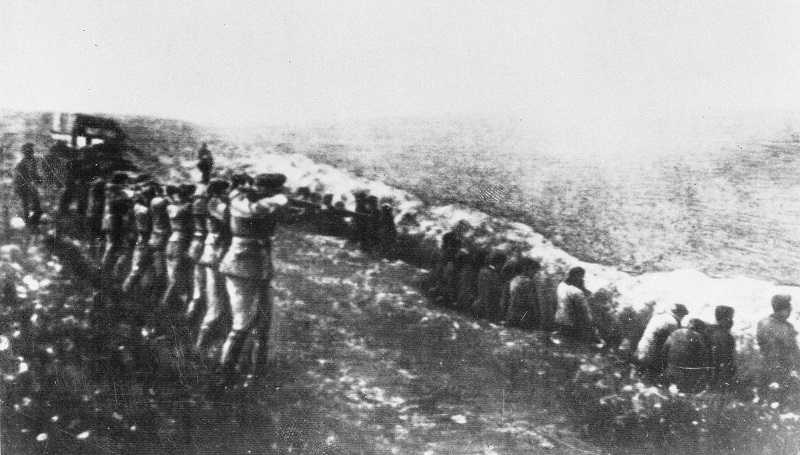
Over 100,00 people were killed at Babi Yar between September 29, 1941 and November 6, 1943.
Oh, come and gather round to hear
This story from afar,
As I unfold the tragedy,
The tale of Babi Yar.
It happened in the time of war,
And not to be outdone,
Aggression reared its ugly head
In 1941.
For Germans drove the Russians out
Of Kiev in Ukraine;
And there they set up their command:
Ruthless and inhumane.
For after Russian bombings of
The city, vengeance grew;
The Germans found their answer—this
Was what they chose to do:
“The Yids, they are responsible!
Those Jewish Bolsheviks!
We know we must retaliate
Against their cunning tricks!”
For there, outside the city, was
This natural ravine,
Which then became a killing field,
Macabre, a nightmare scene.
“All Yids in Kiev must report,
And if you don’t, you will
Be shot; make sure you do as told
Or else we’re sure to kill.”
And so, naively, all Jews came
And waited on the day
Unknowingly, to meet their end
As they were hauled away.
“Strip off your clothes, and put your things,
Your valuables in a pile,
And line up here—do as you’re told,
And wait a little while.”
Then one by one, they, line by line
Approached the precipice;
And naked told to face it
While they gazed at ghastliness.
For every row of Jews was shot
And face down they did fall
Into the ever-growing pile
Of bodies. One and all,
Well over thirty thousand souls
Would perish in two days,
Machine guns filling the ravine.
And when their bloody ways,
Their bloodlust wasn’t satisfied,
They came for the insane–
The hospital was emptied. Plus
The gypsies from Ukraine,
As well as Russian soldiers captured,
Kiev citizens,
Communists and ordinary
Soviet denizens.
Nude bodies struck, the women raped,
They buried the half-dead;
Or stepping on the bleeding pile
Would shoot to kill instead.
The little children, babies, were then
Hurled into the air,
Over the edge, into the pit,
Before their mothers there.
And then, they tried to shield their crime
In 1943,
By disinterring every corpse,
And in some secrecy
Would burn away the evidence.
And so for forty days
A hundred thousand dead or more
Became as ashen haze.
But this was all in vain because
In time the world would know
What happened in that deep ravine
Those many years ago.
For it indeed behooves us that we
Learn from this, and then
No more repeat the ugly past,
No never, not again.
And so, memorials today
Remind us, insofar
As we maintain the memory of
The dead of Babi Yar.
Theresa Rodriguez is the author of Jesus and Eros: Sonnets, Poems and Songs, Longer Thoughts, which has just been released by Shanti Arts, and Sonnets, a collection of sixty-five sonnets which has also just been released by Shanti Arts. Her work has appeared in such journals and publications as in the Wilderness House Literary Review, the Midwest Poetry Review, Leaf Magazine, Spindr











Theresa, the madness going on at the moment is no comparison to what happened here. Thank you for a moving, poetic education on an event of pure evil and wickedness.
I was moved beyond words by this. Thank you.
Thank you Jeff, I am so glad it was so moving to you. That means more to me than anything. That was the goal I was trying to achieve.
A well-written reminder of the horror that happened those years ago. Thanks you.
Thank you, David, very much. I am glad the poem is serving its purpose as a reminder of what happened in that ravine all those years ago.
It is a strange phenomenon to read something and be drawn in by the lulling, hypnotic effect from the rhythm of the lines, at the same time that an uneasy pit in one’s stomach develops from the discomfort caused by the subject matter, and the imaginative sympathy for the victims. I am reminded of Aristotle’s discussion of why people enjoy watching actors suffer onstage, though with stuff like this I don’t experience catharsis so much as I am moved from sadness to anger. Aristotle based his theory of catharsis on one viewing fictional or mythic events, rather than art based on historical events (though the distinction between myth and history was admittedly blurry with the Greeks). With a subject like the Babi Yar massacre, a purge of emotions would seem an inappropriate thing to occur in the reader…hence, the question of ‘why do people enjoy art about suffering’ is perhaps more of a conundrum than Aristotle thought, but the last two stanzas of the poem provide the answer.
I know people who are holocaust deniers (ironically, all anti-semites), and it drives me crazy the way people ignore evidence and cherry-pick facts to construct their insane paranoid worldviews.
Excellent stuff, Theresa!
Thank you, Andrew. I am glad that the poem produces “beauty through suffering” so to speak.
A telling and a moving tale; though reasonably well informed about the Nazis in the USSR during the WW2, I did not know of this specific incident. Horrific indeed and you tell this story extremely well – it builds and it builds. I am reminded of Theodore Dalrymple’s remark: ‘And thus the obvious truth – that it is necessary to repress, either by law or by custom, the permanent possibility in human nature of brutality and barbarism – never finds its way into the press or other media of mass communication.’ In abandoning convention, law, custom and what we might call ‘decency’, and insisting on ‘do whatever you want – be free’, we get closer and closer to allowing the possibility that these evils could return. Truly, in the CCP it appears that they have.
Thank you so much, James. When I was young, we had the book “Babi Yar” in my house– the name always stuck with me, but I didn’t know about the details of the massacre until recently. I have since obtained my own copy. I honestly have had a hard time reading through it, I’ve gotten about a third of the way through. Very dense and very disturbing. I had felt the urge to write about the massacre in the form of a ballad; as you say, it was “the Muse” who inspired me!
Always good to be inspired by the Muse, Theresa!!!
Indeed, James!
I agree with all of the above comments, Theresa. You have used ballad as a form of memorial and, as the poem says in the last verse, memorials are crucial if we are not to repeat historical evils.
Thank you Cynthia. I am so glad the ballad itself has become a memorial. I am glad the form that I chose to use has accomplished this goal!
Theresa, I had heard of this evil massacre, and it is a truly gut-wrenching incident. This ballad must have been difficult to write. Thank you for a well written reminder of what should never be repeated.
Thank you very much, David. It was indeed painful and difficult to write, but I am grateful for the inspiration I was given to write it. It really was gnawing at me until I had it done! I could hear the songlike quality of the rhymes in my head before setting down to write. I am glad it is a reminder of what happened, and what should never be repeated.
As per Rus Ciel Badeew:
“I think Ms. Rodriguez’ poem is important for one main reason, which especially occupies my mind now in America: To understand the present day world of rampant, tyrannical communism around the Globe, fed maniacally by the Chinese communists, I keep resorting to Russian poets and poetry of the 20th century, and how they had to endure such cruelty under the communist regime.
“So, of course, Ms. Rodriguez’ poem, which takes up the same topic as many Russian writers did, none more famous than Yevgeny Yevtushenko’s poem of 1961 “Babi Yar”, which spoke of both Nazi and Communist atrocities, in relationship to the Jewish people and others. Though Yevtushenko’s poem is in Russian free verse, I recommend it to SCP readers, even in translation. We must be vigilant in the face of this garish, nightmarish onslaught.”
Thank you BDW, for your comments and reflections, and for sharing info about Yevgeny Yevtushenko’s poem “Babi Yar.” It is a beautiful and poignant poem. I am honored to be in the company of someone else who has written so compellingly about this tragedy.
Theresa, I think I was too horrified by the effect of this poem to comment when it first came out. The ballad meter is such a seemingly light contrast to the gruesome historical details you gradually reveal. But you give more than those details, by reflecting on motives of German soldiers who committed the atrocity. In fact, there’s a progression of motives, beginning with wanting to blame someone for adversity suffered in battle. That’s a natural human response, and in war, it’s also natural to decide on retaliating by inflicting similar injuries. When the Germans decide on blaming local Jews, however, that moves beyond the rational, even though it’s true that Jews in the area may have been likely to be bolshevik communist types. They were political as well as military enemies, but Nazi anti-semitic hatred appears. The decision to massacre all Jews in the vicinity makes the Babi Yar event a war crime against non-combatants or a crime against humanity. And when you move on to describe the apparent determination to fill the ravine with dead bodies, and even apparently to take pleasure in a game of tossing babies and mothers into the unfilled cavity of the earth, you’ve moved from human motives to the mystery of evil. These perpetrators seem to be acting the part of demons.
Evan Mantyk chose to categorize the poem as “Deconstructing Communism,” despite the fact that those who commit the crime are not Communist Party affiliates, but rather military foes of the Communist Soviet state. It’s their actions that make them communist. That’s important. Acts of this kind tend to emerge from, and/or imitate the totalitarian leftist stance of violence disregarding human values. Your poem’s development, Theresa, delineates how humanity comes to impoverish itself by “progress” in devaluing persons and culture in favor of ideology that enslaves persons.
Sorry Margaret, once I again I did not place my reply under “reply” but it is nevertheless here on this thread!!!
Thank you so much Margaret for taking the time to re-read “The Ballad of Babi Yar” and comment on it. I was able to read it at this year’s and last year’s celebrations of Tisha B’Av at a local synagogue (this holiday commemorates the destruction of the First Temple in 586 BC and the Second Temple in 70 AD, as well as other tragedies suffered by the Jewish people).
There were no doubt Jewish “Bolsheviks” in the 1940’s. I can however attest that Judaism was and is very wide and diverse, and even a hundred years ago, there were socialist/communist/Bolshevik Jews (who most often were secular), highly devout (Haredi) Jews and ultra-Orthodox Jews (Chassidim), who largely were/are apolitical, and mainly focused on their religion. It is always fascinating to see how broad the spectrum actually is.
I do feel a kindredness in spirit from “Babi Yar” to your excellent poem “The Cristero Centennial” and I am linking it here for easy access by future readers of this thread:
https://www.classicalpoets.org/the-cristero-centennial-a-poem-by-margaret-coats/
Many thanks again for your engaging thoughts and perspective!!!
Theresa, I’ve read and re-read your Babi Yar poem and the comments – particularly the most recent ones from a few weeks back. First, Theresa, thank you for writing this brave poem addressing a subject which is anything but poetic and deeply painful. The poem is highly polished and deeply meaningful. I’m proud of a fellow poet for tackling a deeply upsetting subject. I think it is an important poem.
I have been debating whether to comment on a poem that was published several years ago, but with the upcoming anniversary of October 7th, I think I would rather err on the side of doing so than not. I hope you will indulge me. Since I suspect I bring more of a Jewish perspective to the table than most of your commenters, I would like to offer some additional insights and context to your historical poem – primarily because Jewish history is being revised and erased now on a daily basis and I think it important to bear witness to the truth.
The first thing I think which needs to be said is that the Jews of Babi Yar were not murdered because they were somehow seen as complicit with the Soviets in fighting Nazi Germany. They were not seen as any kind of realistic threat whatsoever. What occurred at Babi Yar must be placed in the larger context of the Holocaust. Yes, the Nazis despised Bolsheviks and saw them as an existential threat. They did indeed label many Jews as Bolsheviks. And some were. But this was secondary to Nazi antisemitism – a justification not the cause. Hitler did not build Death Camps like Auschwitz-Birkenau or Treblinka or the many other murder factories to kill communists. He built them to perpetrate a genocide of Jews. This was the “Final Solution” enacted at the Wandsee Conference to deal with “the Jewish Question:” — to coordinate and streamline the systematic mass murder of an estimated 11 million European Jews across Axis-controlled Europe. Understand how deeply important this mission was to the Nazis: even when Germany was being invaded by the Russians on the Eastern Front and the Americans on the Western Front, Hitler made it his priority to keep the Death Camps running and the trains making their ghastly delivery of future victims – so as to continue in his mission to murder Jews even at the expense of the lives of his own people! Antisemitism is as peculiarly passionate as it is irrational and the most deeply-rooted of all hatreds in a wide range of religious and political arenas.
That is the context in which the massacre of the Jews at Babi Yar took place. This was not a one-time thing. Yes, many others were murdered there as well, as you rightly point out. But – like the Death Camps themselves – the Jews were the REASON for their construction of the whole industrial complex of systemic mass murder. My own poem “Mercedes Benz Makes a Corporate Decision” addresses the complicity of numerous public corporations in the creation of the Death Camps. https://www.classicalpoets.org/mercedes-benz-makes-a-corporate-decision-and-other-poetry-by-brian-yapko/ Murdering Jews was an extensive, Continent-wide collaborative effort by government AND industrial private sector – something which has not been seen before or since. It is thus that Jews – simply for existing — were the reason for the mass murder at the ravine. Understanding the absence of causation is imperative. The Jews of Babi Yar were not murdered because they were communists or socialists or because the Germans transferred frustration concerning the war effort to the Jews and then somehow overreacted. They were murdered because they were Jews as part of Hitler’s stated intent to make Europe “Judenfrei.” Whether they were communists or socialists or democrats or fascists or capitalists is irrelevant.
The great distinction concerning antisemitism versus other forms of hate is the fact that it begins with Jew-hatred and then seeks justification AFTER the fact. The poem itself and some of the commentary which follows suggests answers for Babi Yar along with the Holocaust itself – answers which try to impose rationality on the irrational such that it reverses causal reality of what happened. As a general matter, the Nazis accused Jews of being communists. But they also accused Jews of being capitalists. Or of being poor and dependent. They hated Jews for owning important businesses and for being overrepresented in the arts and at universities. They made up things to hate Jews over such as the infamous blood libels which go back to the time of the Crusades. (By the way, Judaism is the theological source of ENDING child sacrifice. And Judaism’s kosher laws make the consumption of blood a huge sin.) The antisemites accused Jews of any horrendous thing you can invent. To try to find explanation for the horror of Babi Yar – or Auschwitz, Treblinka, Dachau, or any of the death camps as an “overreaction” to a natural fear of communism is a red herring and gets nowhere in our understanding of the fundamental issue. The fact of the matter is the Jews were targeted because they were JEWS not because of any political ideology or other cover. It is now much the same and it is a great temptation to say oh, the Jews are only being targeted now because Israel did this or Nethanyahu did that. No. That is merely an excuse du jour for the ability to despise Jews with some socially-acceptable cover. Again, an attempt to find a rational answer to something that is inherently irrational. And all you have to do is look at history PRIOR to 1948 to see how many massacres Arabs perpetrated on the Jews of the Holy Land through the centuries. October 7, 2023 was only the latest of dozens of such massacres.
Yes, there are definitely similarities between the massacre of Cristeros and the Holocaust. And I greatly respect and mourn those Cristeros who were murdered, and have written about them myself. I don’t wish to compare tragedies for they were both horrendous. But the numbers are vastly different. Estimates of 50,000 faithful dead in Mexico versus 6,000,000 Jewish lives lost in the Holocaust show vastly different scales. A further difference is that a Cristero could renounce his faith and survive. No Jew had that luxury. Whether a Jew renounced his faith or heritage was irrelevant. He was murdered as a Jew whether he believed in Judaism or whether he renounced it or was even antisemitic himself. His Jewishness could not be revoked, negotiated or excused. It was an unappealable death sentence.
It would be well for anyone interested in the subject to read Dennis Prager’s intense but thoroughly-researched and well-analyzed book “Why the Jews?” https://www.amazon.com/dp/0743246209?lv=shuf&channelId=500&plpRedirect=mhFallback This excellent book explores the intensity and the many causes of Jew hatred, through the Classical and Hellenistic Periods, through Christianity, through Mohammed’s petulant feud with the Jews of Arabia, through the Crusades, the blood libels of the Middle Ages and beyond, the disdain of Enlightenment thinkers for Judaism, and all the way through the present. It is an ugly, ugly history which few have the courage to become more than casually educated about.
Again, Theresa, do not mistake my discussion here. I admire your poem greatly and I’m glad you wrote it. It needs to be read and shared. But, as a mentioned above, these are evil times in which Jewish history is being cancelled, rewritten and/or revised by antisemites. I just wanted to make sure that what I identify as an important poem by an important poet is properly placed into context and I wanted to make sure that the record was clear concerning the “why” as well as the “what.”
As an aside, I’m glad you read this poem as part of a Tisha B’Av observance. As you know, it’s a very solemn time for remembering multiple tragedies which have befallen the Jewish People. I would therefore suggest that it is “observed” rather than “celebrated.”
One last thing regarding antisemitism and the diversity of Jewish presence in Europe before World War II. It is worth noting that the pre-World War II population of Jews in the world was 18,000,000. It is now between 15 and 16 million – 0.2 percent of the world’s population (that’s 2 Jews out of every 1000 people.) One third of world Jewry was wiped out in the Holocaust and even now, 80 years later, those dead have not been replaced. That is what an authentic genocide looks like.
Brian, thank you so incredibly much for your comment about “The Ballad of Babi Yar.” I just wanted you to know I have read it and I plan to respond. In fact I plan on reading your comment several more times with great consideration and writing a response in Word so I can prepare it adequately before pasting it here. Just wanted you to know it is forthcoming!!!
Thank you so much Brian for taking to time to write such a thoughtful and thought-provoking, detailed comment. I hope I can adequately address the many points you have brought up.
I appreciate so much for your clarification regarding the background and reasons for the Babi Yar massacre, and indeed, the Holocaust itself. When doing my research for the poem before writing it, I did come across statements that the Nazis were killing Jews because of political alignments in some cases, and that the Babi Yar massacre was in part a result of that motivation. At the time I was also reading Babi Yar by A. Anatoli Kuznetsov, so I was trying to convey what was going in 1941 in Kiev, and what happened in the massacre itself. I am therefore profoundly affected by your reminder that the antisemitism of Nazi Germany went far deeper than politics— as it still does today. Your information and clarifications have compelled me to add an additional stanza or stanzas to “Babi Yar,” so that I can clarify and emphasize the sheer irrational hatred of Jews as THE motivation for the Jewish genocide of the Third Reich, including the massacre of Babi Yar. I am deeply grateful to you for giving me the inspiration and motivation and imperative to do so.
I follow an Israeli travel guide on YouTube named Oren, in conjunction with Miller Studios he recently created this brilliant satirical cartoon song/video entitled “Lay It On Me”—it echoes resoundingly the reality that Jews can be hated for being communists, capitalists, or anything else that needs a scapegoat. I couldn’t recommend watching it enough, and sharing it:
https://www.youtube.com/watch?v=vxl-9jLvlzQ
I thank you for the much-needed finer comparison between the Cristeros massacre and the Holocaust. I felt that my poem had echoes in Margaret Coat’s poem, because Babi Yar and Cristeros were both massacres—my autistic brain is always finding links and patterns and comparisons between things!!! But certainly the situations and numbers of the dead were completely different in each case. I had no intention of creating some kind of moral equivalence by referring to it!!!
Thank you for the recommendation of Dennis Prager’s book, I just ordered a copy at betterworldbooks!!! Thank you for your noting about my using “celebration” rather than “observance” regarding Tisha B’Av, you were right to point it out, I meant no disrespect or frivolity, but I will be more careful going forward.
It is more and more apparent that the “horseshoe effect” is being played out among not just the Far Right, but the Far Left, in regards to antisemitism today. I am astonished that so many “woke” people I know are on the hating-Jews bandwagon, cloaking it in a condemnation of Bibi Netenyahu, or the IDF, or whatever else. It stupefies and astounds me. In this case, the far left and the far right are comfortable bedfellows..
Again, thank you so very much for the time you have taken to share your profound insights and perspectives with the readership of “The Ballad of Babi Yar” and for giving me the motivation and imperative to add to the poem.
Theresa, thank you so much for this deeply thoughtful reply and for the additional information. Again, I am so glad you wrote the Ballad of Babi Yar and my only concern was that it be placed within the larger context of the Holocaust. I also wanted to explore more deeply the motivations for the massacre — particularly as it related to the Holocaust. There’s so much more than either of us have written, you know. Many lengthy books have been written on the subject and even with that said, I’m not sure anyone can really get to the heart of what is essentially irrational. Antisemitism is a dragon with many heads, some of which are theological, some philosophical, some economic, some political, some racial, some historical and some purely Machiavelian. And every group that hates the Jews has a different basis. So I certainly do not blame you for looking at the political motivations which were real. The thing is, they were also expedient and only one aspect of many.
The Dennis Prager book may help bring some clarity to the conversation. I’m really glad that you ordered the book. I’m guessing that it will be a real eye-opener. It was for me, and I’m not exactly unschooled on the subject. I’ve lived unhappily with the subject of antisemitism all my life — particularly since my German mother was raised under Hitler and yet ended up marrying my Jewish father even as she served as a document translater for the Nuremberg trials. The horrors of World War II and the Concentration Camps is something I was raised on in a very real, visceral way.
And yet it is now Leftists, Progressives and the Woke that I fear above all others — especially now that they have prostituted themselves into an alliance with Islamists who actually represent everything that they despise in the world of social justice. Yes, that “horseshoe effect” has actually taken me be surprise. Wierdly, though, there is still a huge chunk of American Jewry that think that Trump and far right Nationalism is the problem. They have become so brainwashed that they can’t even see the evil on the Left that is choking them like a snake.
Thank you for the YouTube video. I’ve actually followed Oren off and on for many years. My partner and I were supposed to go to Israel in April of 2020 and had watched most of his videos at that point — only to have Covid intervene to make that trip impossible. I’ll start watching him again. I’m stiill hoping to make that trip someday. And Oren offers valuable social-political-historical insight.
I’m absolutely thrilled that you have added to your Babi Yar poem. I’m honored that my comment inspired such a deeply meaningful thing. Thank you, Theresa! That is one of the great things about poetry — we, the poets, get to edit, revise and improve however and whenever we wish. Wordsworth did it and so did Yeats. Thank you for having the heart and conscience to engage with this subject. It’s a hard one. Today being October 7th, I’m particularly attuned to this.
You have my best wishes and much respect.
Thank you also for linking to your poem “Mercedes Benz Makes a Corporate Decision”– I now know more fully how those specific companies and corporations had their hand in making money off the Holocaust!!
That’s the thing about corporations. They are venal and concerned about nothing except the economics. They will follow the mob every time. Lately, some of them have learned that it may be better to stay neutral. The whole “go woke, go broke” phenomenon have caused some real problems for companies like Jaguar, Cracker Barrel, Nike. Target finally learned that catering Pride products to little children was no longer a viable merchandising strategy. Good.