• Submit Poetry
  • Support SCP
  • About Us
  • Members
  • Join
Friday, July 31, 2026
Society of Classical Poets
  • Poems
    • Beauty
    • Culture
    • Satire
    • Humor
    • Children’s
    • Art
    • Ekphrastic
    • Epic
    • Epigrams and Proverbs
    • Human Rights in China
    • Music
    • Performing Arts
    • Riddles
    • Science
    • Song Lyrics
    • The Environment
    • The Raven
    • Found Poems
    • High School Poets
    • Terrorism
    • Covid-19
  • Poetry Forms
    • Sonnet
    • Haiku
    • Limerick
    • Villanelle
    • Rondeau
    • Pantoum
    • Sestina
    • Triolet
    • Acrostic
    • Alexandroid
    • Alliterative
    • Blank Verse
    • Chant Royal
    • Clerihew
    • Rhupunt
    • Rondeau Redoublé
    • Rondel
    • Rubaiyat
    • Sapphic Verse
    • Shape Poems
    • Terza Rima
  • Great Poets
    • Geoffrey Chaucer
    • Emily Dickinson
    • Homer
    • Henry Wadsworth Longfellow
    • Dante Alighieri
    • John Keats
    • John Milton
    • Edgar Allan Poe
    • William Shakespeare
    • William Wordsworth
    • William Blake
    • Robert Frost
  • Love Poems
  • Contests
  • SCP Academy
    • Educational
    • Teaching Classical Poetry—A Guide for Educators
    • Poetry Forms
    • The SCP Journal
    • Books
No Result
View All Result
Society of Classical Poets
  • Poems
    • Beauty
    • Culture
    • Satire
    • Humor
    • Children’s
    • Art
    • Ekphrastic
    • Epic
    • Epigrams and Proverbs
    • Human Rights in China
    • Music
    • Performing Arts
    • Riddles
    • Science
    • Song Lyrics
    • The Environment
    • The Raven
    • Found Poems
    • High School Poets
    • Terrorism
    • Covid-19
  • Poetry Forms
    • Sonnet
    • Haiku
    • Limerick
    • Villanelle
    • Rondeau
    • Pantoum
    • Sestina
    • Triolet
    • Acrostic
    • Alexandroid
    • Alliterative
    • Blank Verse
    • Chant Royal
    • Clerihew
    • Rhupunt
    • Rondeau Redoublé
    • Rondel
    • Rubaiyat
    • Sapphic Verse
    • Shape Poems
    • Terza Rima
  • Great Poets
    • Geoffrey Chaucer
    • Emily Dickinson
    • Homer
    • Henry Wadsworth Longfellow
    • Dante Alighieri
    • John Keats
    • John Milton
    • Edgar Allan Poe
    • William Shakespeare
    • William Wordsworth
    • William Blake
    • Robert Frost
  • Love Poems
  • Contests
  • SCP Academy
    • Educational
    • Teaching Classical Poetry—A Guide for Educators
    • Poetry Forms
    • The SCP Journal
    • Books
No Result
View All Result
Society of Classical Poets
No Result
View All Result
Home Poetry

A Poem in Praise of Schubert, by Zumwalt

March 14, 2026
in Poetry, Beauty, Music
A A
10
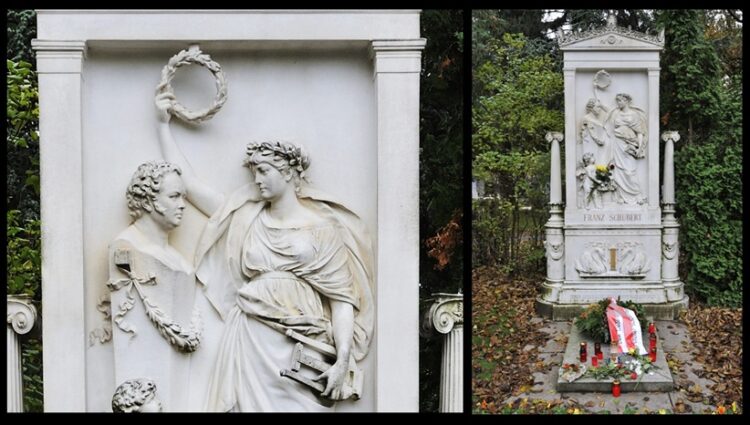
Franz Schubert's grave in the Vienna Central Cemetery (public domain)

Franz Schubert's grave in the Vienna Central Cemetery (public domain)


Cycle of Song

O Schubert! Praise with Song your blessed Birth;
With youthful Skill, no mortal Feats surpass,
You crafted Lieder of the highest Worth
And matched with Harmonies of the finest Class.
Poets’ Words took flight, lifted by your Art,
And ancient Sorrow sprang through vaulted Air;
You drew the deepest Truths from your Mortal Heart
And clothed our World with Melodies so rare.

As those great Bards in hallowed Odes would strive
To seize Sublime, and hold it, True in Pitch,
So you, great Master, keep the Flame alive
Through Winter’s Grief; with Spring’s new growth enrich
The Lovers’ sighs; in Summer paint skies blue;
In Autumn darken Leaves with final Breath;
Through every Season sing out your Voice so True
Until an early Winter brought your Death.

Sleep soft, young Genius, whom we lost too soon,
Torn from your Time before your Fame had grown!
Yet Truth found Voice in every haunting Tune,
And through all Lands your glowing Light is known.
The Songs you made remain, and I move on
And face my End without Regret or Fear;
For Beauty prospers still, though I am gone,
As long as others have your Songs to hear.


Zumwalt was recently nominated for Ink Sweat & Tears’ “Pick of the Month” and is a repeat contributor to The New Verse News and other publications. His website is here: https://wordpress.zumpoems.com/tag/zumwalt/

Continue Reading
ShareTweetPin
The Society of Classical Poets does not endorse any views expressed in individual poems or commentary.
Read Our Comments Policy Here

RandomPoems

‘Time for the B.S.:  Susie and Johnny Go to College’ by Amy Foreman
Culture

‘Time for the B.S.: Susie and Johnny Go to College’ by Amy Foreman

January 7, 2019

a sequel to “Let’s Take the Other Bus” Welcome, young friends, to this great university. I am your counselor, Dr....

poetry/homeschooling/teachers guide
Educational

Learning Poetry: A Guide for Students, Teachers, and Homeschoolers

May 31, 2021

. For teachers seeking a quick solution, see 10 Great Poems for Teaching in High School Classrooms. Introduction to Poetry...

Next Post
‘Mass Destruction’: A Poem by Susan Jarvis Bryant

'Mass Destruction': A Poem by Susan Jarvis Bryant

A Letter from Incarcerated Poet D.T. Holt to the SCP

'Will the Sentence Get the Death Sentence' and Other Short Poems by Paul Millan

‘The Sons of Issachar’: A Poem by Alec Ream

'The Sons of Issachar': A Poem by Alec Ream

Comments 10

  1. Roy Eugene Peterson says:
    5 months ago

    As an admirer of Schubert, this is a fine tribute to a talented musical meister.

    Reply
    • Zumwalt says:
      5 months ago

      Always great to meet a fellow admirer of Schubert. Just listened to D. 111 last night, a revision of D. 77, a setting of Schiller’s “Der Taucher” written when Schubert was only 16.

      Reply
  2. Margaret Coats says:
    5 months ago

    Fine last stanza of praise for a composer whose beautiful music can defy regret and fear in his listerner!

    Reply
    • Zumwalt says:
      5 months ago

      Margaret,

      Thanks!

      Reply
  3. BDW says:
    5 months ago

    It was in his German years, the late 1970s, when Ewald E. Eisbruc was brought under the spell of German musical composition. In that Realm, i. e., the transition from the Classical to the Romantic, Beethoven’s, and secondarily, Schubert’s, music overwhelmed his ill-formed mind. [Mozart’s and Hadyn’s music would come later.]

    Although more interested in the symphonies of Schubert, at that time in Baden-Württemberg, his favourite Lied was “Der Erlkönig” that Franz Schubert had composed @ 18. Even decades later, here, now, in the Spring of 2026, it still remains as such, and still retains that height, but now, mainly due to Goethe himself.

    Reply
    • Zumwalt says:
      4 months ago

      BDW,

      Thanks for the comment. I first heard “Der Erlkönig” in 1972 as a high school senior taking classes at the college across the street from the high school. The instructor was the talented cellist, Terry King. (https://www.kingcello.com/)

      One student commented after Mr. King played “Der Erlkönig,” that he didn’t see what was special about it — it was just an ordinary song. Mr. King was very patient with the student and just replied very nicely, “Oh, but it is more than just another song.” I remember that like it was yesterday.

      Reply
  4. Mary Jane Myers says:
    5 months ago

    Dear Zumwalt:

    Lovely work! Thank you.

    Schubert is my favorite composer. I have a medium-sized bust of Franz near my piano. At the moment, I am learning his 1827 Intermezzo Op 90 D 899 No. 1, which (honestly) is a tad beyond my skill level. The melodies of course are sublime. But even more fascinating, from a musical standpoint, are the sudden “shifts in tone”, a kind of “wobbliness” that is tricky to master. There is a slightly “disorienting” feel to Schubert because of these tonal shifts. Another performance factor: Schubert did not compose or play on our modern pianos. Lately, scholars and pianists have been building authentic replica instruments so we can better understand musically what our genius himself “heard” as he composed and played.

    In any event, ‘nuff said about my own enthusiasm! I like this poem very much. You have written 3 stanzas of 8 lines each. Each stanza is composed of 2 quatrains of iambic pentameter. You use exact cross-rhymes in each quatrain. The capitalization of the nouns captures the “look on the page” of early 19th century German.

    The narrator addresses Schubert, and praises his skill. The narrator thanks Schubert for bequeathing us his lieder. The second stanza has lovely references to the emotional tones of the four seasons, and concludes with a sad reference to the composer: “Until an early Winter brought your Death.” The narrator ends on a poignant note: he (the narrator) will die without regret, because Schubert’s songs remain, and “Beauty prospers still.”

    If you want to retain exact iambic pentameter (and this comment only applies should you wish the iambs to be exact throughout)—I note the following lines have a slight “blip” in the meter and could be tweaked slightly: Stanza 1, lines 4, 5 and 7; Stanza 2 line 7.

    Sincerely,
    Mary Jane

    Reply
    • Zumwalt says:
      4 months ago

      Mary Jane,

      Thanks for the comments and glad to hear you are tackling Op 90 #1 — this is an incredible set of impromptus as is the D. 935 set (I played D. 935 #2 in college and play it now and again — I need to learn the others.)

      Very well spotted on the iambic deviations, from that opening (“O” gets heavily stressed!) to those that follow. Just as you correctly noted the capitalization of words giving it a Germanic flavor, so too does the handling of meter. This was written while listening to the lieder Schubert composed in 1814 and 1815 (lieder set to quite a range of poets that start with a “K” like Klopstock and Körner, and poets like Kenner, Kalchberg and Kosegarten, and some much better known poets like Goethe and Schiller) — and I decided to work within an iambic pentameter framework, something that could be set to music, but in a Romantic mode of metrical freedom rather than strict Augustan regularity. My intent was to convey an exultant, early Romantic vibe.

      Reply
  5. Paul Freeman says:
    4 months ago

    A haunting piece about an exceptional person gone too soon.

    Thanks for the read, Zumwalt.

    Reply
    • Zumwalt says:
      4 months ago

      Paul,

      Thanks! Appreciate the comment!

      Reply

Leave a Reply Cancel reply

Your email address will not be published. Required fields are marked *


  1. Margaret Coats on ‘Warfare by Remote Control’: A Poem by Paul A. FreemanJuly 31, 2026

    Piling up threatening perspectives in the octave, and questions in the sestet, makes an effective and memorable war sonnet, Paul.…

  2. Margaret Coats on ‘The Passing’: A Poem by Margaret BrintonJuly 31, 2026

    "The Passing" sings its way to the Beyond in lovely metrical fashion, Margaret B. Itself a breath, a sigh, a…

  3. Adam Sedia on ‘The Lessons of Lot’: A Poem by Adam WasemJuly 31, 2026

    This is a wonderful piece, a retelling of one of the most familiar Genesis episodes in a fresh and compelling…

  4. Margaret Brinton on ‘Of Webs and Whispers’: A Poem by Susan Jarvis BryantJuly 31, 2026

    Susan, your spinning together of references to politics, society, state of the world, etc. brings to mind a phrase by…

  5. Carole Stevens on ‘The Passing’: A Poem by Margaret BrintonJuly 31, 2026

    Another classic Margaret. Lovely. Having been born raised and educated near the ocean so it must be my wish to…

Subscribe to Daily Poems

Enter your email address to subscribe to this blog and receive notifications of new posts by email.

Join 1,593 other subscribers

Recent Poems

  • Four Love Sonnets by Adam Sedia
  • ‘Rasputina Confers with Her Cohorts’: A Poem by Joseph S. Salemi
  • ‘Warfare by Remote Control’: A Poem by Paul A. Freeman
  • ‘The Passing’: A Poem by Margaret Brinton
  • ‘Of Webs and Whispers’: A Poem by Susan Jarvis Bryant
  • Poetry Book Review: Petrarch’s Canzoniere, Translated by A.M. Juster
  • ‘What Folly Dares’ and Other Love Poems by James A. Tweedie
  • ‘Allegrezza’ and Other Poetry by Rob Griffith
  • ‘The Lessons of Lot’: A Poem by Adam Wasem
  • ‘Prophecy and Divine Intervention in Virgil’s Aeneid’: An Essay by Kaitlyn Brown
  • ‘The Last Voyage of Barnaby Bear’: A Poem by Tashvi Reddy
  • ‘Impressions’ and Other Poems by Russel Winick
  • ‘The Reveal of the Rocks’: A Poem by Kyle Fiske
  • ‘Art Work’: A Poem by T.M. Moore
  • ‘A Strange Sun’: A Poem by Patricia Rogers Crozier
  • ‘Shave Off Those Whiskers’: A Poem by Roy E. Peterson
  • ‘The Man from China’: A Poem by Evan Mantyk
  • ‘The Ballad of the Ghost Mountain Boys’: A Poem by Rachel Lott
  • ‘The Threat of Virtue’: A Poem by Zumwalt
  • ‘A Poet at the Tower’ and Other Poetry by Michael C. Paul
  • ‘Florence Foster Jenkins’ and Other Poetry by Brian Yapko
  • Winners and Rankings of The Great American Poetry Competition
  • ‘The Gold Star Mother’: A Poem by Gerard Maritato
  • ‘An American Dash’: A Poem by Linda Ellis
  • ‘The Anonymous Soldier’: A Poem by Lucy Lind
  • ‘For Those We Never Meet’: A Poem by Aneesh Agarwal
  • ‘Ben Franklin’s Copper Fugio Cent’: A Poem by Geoffrey Smagacz
  • Three Brief Poems by Luxorius, Translated by Joseph S. Salemi
  • ‘The American Spirit’: A Poem by Dusty Grein
  • ‘The Ballad of Zebulon Pike’: A Poem by M.D. Skeen

Categories

  • Acrostic
  • Alexandroid
  • Alliterative
  • Art
  • Best Poems
  • Blank Verse
  • Chant Royal
  • Classical Poets Live
  • Clerihew
  • Covid-19
  • Deconstructing Communism
  • Educational
  • Epic
  • Epigrams and Proverbs
  • Essays
    • Interviews with Poets
    • Poetry Reviews
  • Featured
  • From the Society
  • Great Poets
    • Dante Alighieri
    • Edgar Allan Poe
    • Emily Dickinson
    • Geoffrey Chaucer
    • Henry Wadsworth Longfellow
    • Homer
    • John Keats
    • John Milton
    • Robert Frost
    • William Blake
    • William Shakespeare
    • William Wordsworth
  • Human Rights in China
  • Limerick
  • Love Poems
  • Music
  • Pantoum
  • Performing Arts
  • Poetry
    • Beauty
    • Children's Poems
    • Culture
    • Ekphrastic
    • Found Poems
    • High School Poets
    • Humor
    • Riddles
  • Poetry Challenge
  • Poetry Contests
  • Poetry Forms
    • Curtal Sonnet
    • Haiku
  • Poetry Readings
  • Rhupunt
  • Rondeau
  • Rondeau Redoublé
  • Rondel
  • Rubaiyat
  • Sapphic Verse
  • Satire
  • Science
  • Sestina
  • Shape Poems
  • Short Stories
  • Song Lyrics
  • Sonnet
  • Symposium
  • Terrorism
  • Terza Rima
  • The Environment
  • Translation
  • Triolet
  • Video
  • Villanelle

Quick Links

  • About Us
  • Submit Poetry
  • Become a Member
  • Members List
  • Support the Society
  • Advertisement Placement
  • Comments Policy
  • Terms of Use

Welcome Back!

Login to your account below

Forgotten Password?

Retrieve your password

Please enter your username or email address to reset your password.

Log In
No Result
View All Result
  • Poems
    • Beauty
    • Culture
    • Satire
    • Humor
    • Children’s
    • Art
    • Ekphrastic
    • Epic
    • Epigrams and Proverbs
    • Human Rights in China
    • Music
    • Performing Arts
    • Riddles
    • Science
    • Song Lyrics
    • The Environment
    • The Raven
    • Found Poems
    • High School Poets
    • Terrorism
    • Covid-19
  • Poetry Forms
    • Sonnet
    • Haiku
    • Limerick
    • Villanelle
    • Rondeau
    • Pantoum
    • Sestina
    • Triolet
    • Acrostic
    • Alexandroid
    • Alliterative
    • Blank Verse
    • Chant Royal
    • Clerihew
    • Rhupunt
    • Rondeau Redoublé
    • Rondel
    • Rubaiyat
    • Sapphic Verse
    • Shape Poems
    • Terza Rima
  • Great Poets
    • Geoffrey Chaucer
    • Emily Dickinson
    • Homer
    • Henry Wadsworth Longfellow
    • Dante Alighieri
    • John Keats
    • John Milton
    • Edgar Allan Poe
    • William Shakespeare
    • William Wordsworth
    • William Blake
    • Robert Frost
  • Love Poems
  • Contests
  • SCP Academy
    • Educational
    • Teaching Classical Poetry—A Guide for Educators
    • Poetry Forms
    • The SCP Journal
    • Books

© 2025 SCP. WebDesign by CODEC Prime.