


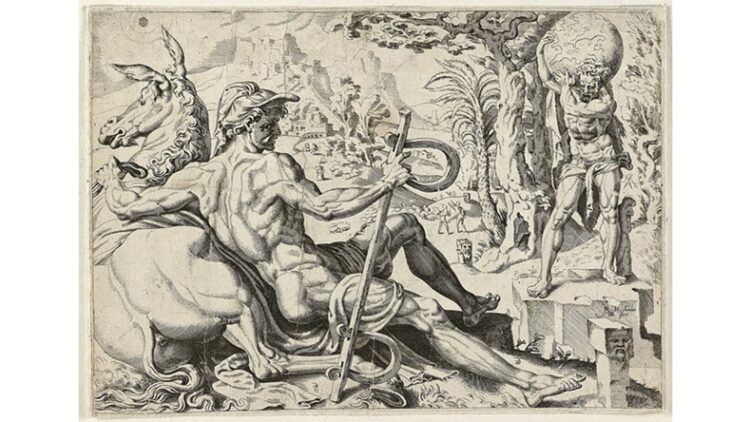
The Sons of Issachar
“The Sons of Issachar understood the times in
which they lived, and knew which way Israel
should go.” —I Chronicles 12:32
I tilled the soil, and worked and thought,
And listened, as the country fought.
I walked my furrows, planting seed,
My brow not furrowed, glad indeed.
From time to time, I’d scan the sky,
Humbled that this man, named “I,”
Should understand these times of strife,
When all I’ve done is live my life.
Alec Ream is a writer living in Virginia. His poetic work and creative fiction have been widely published. A member of the Demosthenian Literary Society at UGA, he wrote on Lookout Mountain, and continued to write, lecture and work for Delta Kappa Epsilon HQ. He was first published reading to the pledge class of Michigan DKE, in Ann Arbor in 2008. Recently, his poem Green Fire was read at the Washington Literary Society & Debating Union at UVA.


















Alec, this is a sharply perceptive trenchant poem relevant to those times and these perilous ones, as well, for those not engaged directly in battle.
Thanks Col Roy.
What a beautiful conceit. I love the way your poem entwines the Biblical allusion to the Sons of Issachar—those discerning men who “understood the times”—with agricultural labor. I especially like the speaker’s “furrows” – both literal ploughing tracks and figurative lines of thought. To know that even as “the country fought,” the speaker’s work remains patient and life-giving, is especially heartening to me after writing my latest poem on war. I am starting to appreciate the benefits of wisdom rooted (pun intended) in humble purpose. Alec, thank you!
SJB – thank you for reading and enjoying the poem and for the insights you provided. Whenever I work the weeding at the farm, the furrows in my brow disappear. Whenever I’m distracted, I either clean the floor or I wash dishes. Tolkien made this clear in the Lord of the Rings: small people with small tasks help defeat great evil.
Alec, thank you very much for your reminder of Tolkien’s take on defeating evil. It’s so encouraging to those of us who feel they are too small to make a difference. Those closest to me always know when I’m stressed – the house gleams, the stove bubbles with ambrosial aromas, and (most important of all) my muse is extra busy. We’ve been eating delicious meals in pristine surrounds of late… and my muse is wilting with exhaustion.
What’s it like when the muse cranks, SJB?
With me, I’m distracted unless I start physical labor, and then I naturally start writing.
Fighters depend on farmers for survival. The tribe of Issachar had especially fertile land, and a reputation for strength as well as good judgment. Alec, you create a strong tribal character with that excellent line, “Humbled that this man, named ‘I.'” It’s individualistic (first person singular), but meant to apply to all the Issachars with “I” as initial for their names, and for Company I in the supply lines of the Israelite forces. Humility often comes from being of service, yet the virtue teaches understanding of one’s place within the whole. Living a life (last line of your poem) is never just fulfilling a function, but as you say in the first lines, thinking and listening. And indeed, being glad to live and work.
Thanks Margaret – Dr Susan Olzak gave me the only A in 5 years at the University of Georgia. The anthropology of the tribes in the Bible delivers fascinating clues to life’s questions. Finding one’s place within the whole of life? Well, that’s a whole life’s quest. Good point you provoked; thanks again.
A fine and thoughtful poem, full of honest sincerity.
Thanks Paul – yes, you’re right about the sincerity. When I spend time planting / weeding / harvesting at the hotel farm? Tough to describe the epic, also real, benefits. Some combo of clarity, perspective, gratitude – plus a definite sense of place. The poem you compliment took two chunks of time: 1) a lifetime and 2) 30 or so minutes.
Thanks for sharing the biblical poem. I enjoyed how you employed different meanings for the word furrow. Have a good week.
Paul, thank you for the remarks and the grace extended. I hope you have a fine week as well, Brother. Springtime dragged its feet this year, but the gold and red potatoes are in the ground at the hotel farm. We open in a week. I told President Evan to round up a crew, then let’s all convene to listen for what God has to communicate on the shores of the Rappahannock River and Carter’s Creek. This hotel raises its own oysters, by the way, and they bake ’em up really skillful.
There is something in this poem that sticks to the mind. Commonplace daily chores bring us closer to the truth than almost anything else. How strange it is that every one of us is that person named “I.” Thanks for these thoughts.
You’re welcome CB – glad it stuck. Whenever I’m distracted, I take to the chores. Appreciate the regards, coming from an accomplished writer such as yourself.
A poem of our times.
Thanks for the read, Alec.
Paul,
thanks for the compliment. The Sons of Issachar understood, didn’t they. Genesis 49 says that in their contemplation, they resorted to physical labor. Which has been my trajectory, and it’s served me well.