


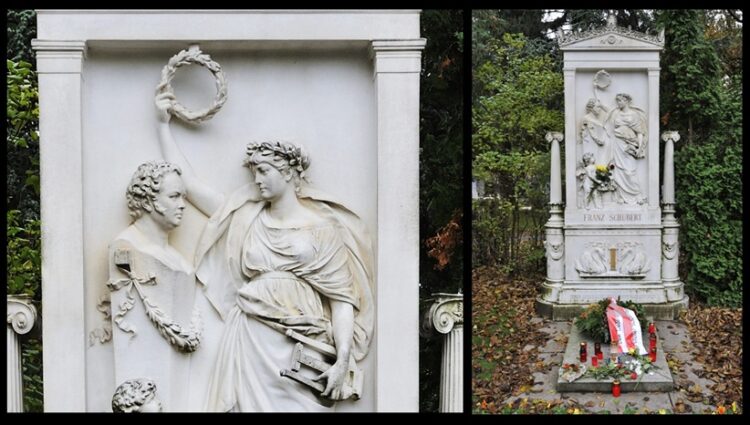
Cycle of Song
O Schubert! Praise with Song your blessed Birth;
With youthful Skill, no mortal Feats surpass,
You crafted Lieder of the highest Worth
And matched with Harmonies of the finest Class.
Poets’ Words took flight, lifted by your Art,
And ancient Sorrow sprang through vaulted Air;
You drew the deepest Truths from your Mortal Heart
And clothed our World with Melodies so rare.
As those great Bards in hallowed Odes would strive
To seize Sublime, and hold it, True in Pitch,
So you, great Master, keep the Flame alive
Through Winter’s Grief; with Spring’s new growth enrich
The Lovers’ sighs; in Summer paint skies blue;
In Autumn darken Leaves with final Breath;
Through every Season sing out your Voice so True
Until an early Winter brought your Death.
Sleep soft, young Genius, whom we lost too soon,
Torn from your Time before your Fame had grown!
Yet Truth found Voice in every haunting Tune,
And through all Lands your glowing Light is known.
The Songs you made remain, and I move on
And face my End without Regret or Fear;
For Beauty prospers still, though I am gone,
As long as others have your Songs to hear.
Zumwalt was recently nominated for Ink Sweat & Tears’ “Pick of the Month” and is a repeat contributor to The New Verse News and other publications. His website is here: https://wordpress.zumpoems.



















As an admirer of Schubert, this is a fine tribute to a talented musical meister.
Always great to meet a fellow admirer of Schubert. Just listened to D. 111 last night, a revision of D. 77, a setting of Schiller’s “Der Taucher” written when Schubert was only 16.
Fine last stanza of praise for a composer whose beautiful music can defy regret and fear in his listerner!
Margaret,
Thanks!
It was in his German years, the late 1970s, when Ewald E. Eisbruc was brought under the spell of German musical composition. In that Realm, i. e., the transition from the Classical to the Romantic, Beethoven’s, and secondarily, Schubert’s, music overwhelmed his ill-formed mind. [Mozart’s and Hadyn’s music would come later.]
Although more interested in the symphonies of Schubert, at that time in Baden-Württemberg, his favourite Lied was “Der Erlkönig” that Franz Schubert had composed @ 18. Even decades later, here, now, in the Spring of 2026, it still remains as such, and still retains that height, but now, mainly due to Goethe himself.
BDW,
Thanks for the comment. I first heard “Der Erlkönig” in 1972 as a high school senior taking classes at the college across the street from the high school. The instructor was the talented cellist, Terry King. (https://www.kingcello.com/)
One student commented after Mr. King played “Der Erlkönig,” that he didn’t see what was special about it — it was just an ordinary song. Mr. King was very patient with the student and just replied very nicely, “Oh, but it is more than just another song.” I remember that like it was yesterday.
Dear Zumwalt:
Lovely work! Thank you.
Schubert is my favorite composer. I have a medium-sized bust of Franz near my piano. At the moment, I am learning his 1827 Intermezzo Op 90 D 899 No. 1, which (honestly) is a tad beyond my skill level. The melodies of course are sublime. But even more fascinating, from a musical standpoint, are the sudden “shifts in tone”, a kind of “wobbliness” that is tricky to master. There is a slightly “disorienting” feel to Schubert because of these tonal shifts. Another performance factor: Schubert did not compose or play on our modern pianos. Lately, scholars and pianists have been building authentic replica instruments so we can better understand musically what our genius himself “heard” as he composed and played.
In any event, ‘nuff said about my own enthusiasm! I like this poem very much. You have written 3 stanzas of 8 lines each. Each stanza is composed of 2 quatrains of iambic pentameter. You use exact cross-rhymes in each quatrain. The capitalization of the nouns captures the “look on the page” of early 19th century German.
The narrator addresses Schubert, and praises his skill. The narrator thanks Schubert for bequeathing us his lieder. The second stanza has lovely references to the emotional tones of the four seasons, and concludes with a sad reference to the composer: “Until an early Winter brought your Death.” The narrator ends on a poignant note: he (the narrator) will die without regret, because Schubert’s songs remain, and “Beauty prospers still.”
If you want to retain exact iambic pentameter (and this comment only applies should you wish the iambs to be exact throughout)—I note the following lines have a slight “blip” in the meter and could be tweaked slightly: Stanza 1, lines 4, 5 and 7; Stanza 2 line 7.
Sincerely,
Mary Jane
Mary Jane,
Thanks for the comments and glad to hear you are tackling Op 90 #1 — this is an incredible set of impromptus as is the D. 935 set (I played D. 935 #2 in college and play it now and again — I need to learn the others.)
Very well spotted on the iambic deviations, from that opening (“O” gets heavily stressed!) to those that follow. Just as you correctly noted the capitalization of words giving it a Germanic flavor, so too does the handling of meter. This was written while listening to the lieder Schubert composed in 1814 and 1815 (lieder set to quite a range of poets that start with a “K” like Klopstock and Körner, and poets like Kenner, Kalchberg and Kosegarten, and some much better known poets like Goethe and Schiller) — and I decided to work within an iambic pentameter framework, something that could be set to music, but in a Romantic mode of metrical freedom rather than strict Augustan regularity. My intent was to convey an exultant, early Romantic vibe.
A haunting piece about an exceptional person gone too soon.
Thanks for the read, Zumwalt.
Paul,
Thanks! Appreciate the comment!