


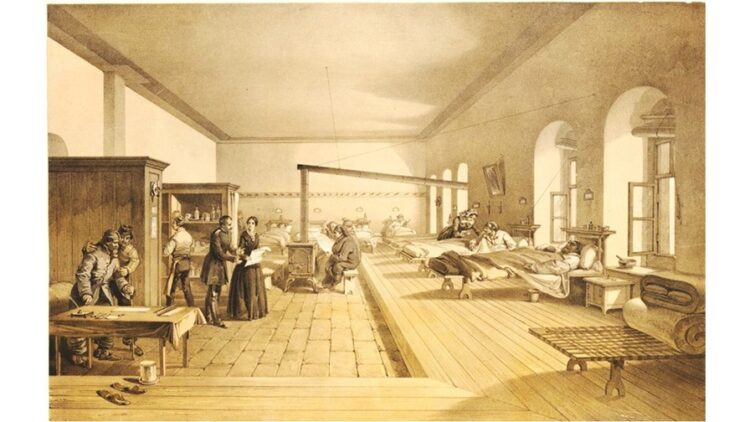
A Hospital Drawing
She sketched the world upon a sheet of white—
A hospital with corridors of beds.
Two nurses running, sleeves a blur of blue;
A doctor in a coat too loose and long
Walked on, his stethoscope hung dark against his coat,
Towards a child whose stuffed ape faced the air
Of things not yet imagined, scarcely named.
To fill the spaces: mothers, infants, chairs.
She drew until the daylight thinned and cooled,
Then ate with Gran, a Saturday routine.
By Sunday more beds drawn, more lives appeared:
A heavy man confined to wheels, beside
A guide dog large and patient as a wall;
A woman with a white stick testing space,
As if the air might answer where she stood.
She opened windows: sky in quiet blue,
A greenish pigeon smudged in fading light;
Blue flowers drowned beneath excess of green—
An effort towards order gone astray.
Grandparents seated by the narrow bed;
She drew red roses where her mother lay;
Placed the cat Barney softly at her feet,
Drawn close, as if to guard her and to stay.
In one left corner Paul the postman smiled,
His bicycle near ringing into sound;
Above, a uniformed and gentle guard
Who gave her sweets and listened while she asked
What Daddy did to Mummy when he shot,
And where the gun had gone, and why it hurt.
With Grandad then she rode the waiting bus
And carried there, obedient, contained,
The white sheet folded in her small, tight grasp,
To where it must be handed over, gone.
A silent man received it from her hand
With, “Thank you, Gemma,” then he smiled and said,
“That looks so pretty.” Nothing more to say.
Scharlie Meeuws, a poet born in Germany, began writing at a young age. She studied in Spain and France, writing poems in Spanish and French before settling in England, where she co-owns Thorntons Bookshop, the oldest in Oxford. Scharlie’s poetry has been featured in magazines and anthologies, including the Guardian. Her work was recognized by Nobel Prize winner Vicente Aleixandre. Her most recent book is The Emotional Robot and Other Poems. Her poetry book Outbranching was published by Cerasus, London in 2021 and is available on Amazon.
















I appreciated how the poem lets the child’s drawing do the emotional speaking, revealing the trauma indirectly through careful, concrete details rather than overt explanation; the restraint makes the final revelation about the shooting land with far greater force. The catalog of patients and figures feels like a child’s attempt to impose order on a shattered world, and the image of the folded white sheet being handed over…met with a polite but shallow response…quietly indicts the adult systems that fail to see what she is really communicating.
Thank you, Michael, for perceiving the deeper message lying behind this simple narrative. I am grateful to you and any reader who reads in between the lines.
Sharlie, this is such a sensitive topic and poem that stirs emotions. I especially liked the drawing of the cat as if to guard the wounded mother and the flowers around the bed signifying love and devotion.
Brilliant, what else can i say mum. xxx
A poem grounded in our times, Scharlie. As so often happens in these polarising times, it’s the children that suffer.
Thanks for the read.
The closer one reads this poem, the more one’s brain is attacked. I’ve rarely seen (read) so much accomplished with such economy. It must be innate, since exterior explanations are neither available nor viable.
A very full poem, Scharlie. Full of colors, things, persons, and feelings elicited gradually–even when the reader reaches the shocking lines that suggest far more beneath the surface of the drawing. This is a story thoughtfully left untold, in accord with the probable emotions of the young artist. You require the reader to be more imaginative than the shockingly unsympathetic receiver of the drawing. Your work slowly and subtly brings forth natural human sympathies, along with agonizing despair at the impossibility of doing anything for the many children (including those now grown) who have such drawings in their backgrounds.
Thank you Margaret for your thoughtful response. Such “childish” drawings can hide a lot of things, unspoken, but exposed by their colourful drawings. Police uses this technique to get the truth out of things, gently, without coercion…
I wanted to show this from the view of a child, innocent and happy…. The policeman at the end does not want to shatter her world., by telling her she had done well.
Thanks, Scharlie, for explaining the attitude of that policeman at the end. I will trust him to protect the child’s innocence as much as possible, while needing the information she provides.