• Submit Poetry
  • Support SCP
  • About Us
  • Members
  • Join
Thursday, September 3, 2026
Society of Classical Poets
  • Poems
    • Beauty
    • Culture
    • Satire
    • Humor
    • Children’s
    • Art
    • Ekphrastic
    • Epic
    • Epigrams and Proverbs
    • Human Rights in China
    • Music
    • Performing Arts
    • Riddles
    • Science
    • Song Lyrics
    • The Environment
    • The Raven
    • Found Poems
    • High School Poets
    • Terrorism
    • Covid-19
  • Poetry Forms
    • Sonnet
    • Haiku
    • Limerick
    • Villanelle
    • Rondeau
    • Pantoum
    • Sestina
    • Triolet
    • Acrostic
    • Alexandroid
    • Alliterative
    • Blank Verse
    • Chant Royal
    • Clerihew
    • Rhupunt
    • Rondeau Redoublé
    • Rondel
    • Rubaiyat
    • Sapphic Verse
    • Shape Poems
    • Terza Rima
  • Great Poets
    • Geoffrey Chaucer
    • Emily Dickinson
    • Homer
    • Henry Wadsworth Longfellow
    • Dante Alighieri
    • John Keats
    • John Milton
    • Edgar Allan Poe
    • William Shakespeare
    • William Wordsworth
    • William Blake
    • Robert Frost
  • Love Poems
  • Contests
  • SCP Academy
    • Educational
    • Teaching Classical Poetry—A Guide for Educators
    • Poetry Forms
    • The SCP Journal
    • Books
No Result
View All Result
Society of Classical Poets
  • Poems
    • Beauty
    • Culture
    • Satire
    • Humor
    • Children’s
    • Art
    • Ekphrastic
    • Epic
    • Epigrams and Proverbs
    • Human Rights in China
    • Music
    • Performing Arts
    • Riddles
    • Science
    • Song Lyrics
    • The Environment
    • The Raven
    • Found Poems
    • High School Poets
    • Terrorism
    • Covid-19
  • Poetry Forms
    • Sonnet
    • Haiku
    • Limerick
    • Villanelle
    • Rondeau
    • Pantoum
    • Sestina
    • Triolet
    • Acrostic
    • Alexandroid
    • Alliterative
    • Blank Verse
    • Chant Royal
    • Clerihew
    • Rhupunt
    • Rondeau Redoublé
    • Rondel
    • Rubaiyat
    • Sapphic Verse
    • Shape Poems
    • Terza Rima
  • Great Poets
    • Geoffrey Chaucer
    • Emily Dickinson
    • Homer
    • Henry Wadsworth Longfellow
    • Dante Alighieri
    • John Keats
    • John Milton
    • Edgar Allan Poe
    • William Shakespeare
    • William Wordsworth
    • William Blake
    • Robert Frost
  • Love Poems
  • Contests
  • SCP Academy
    • Educational
    • Teaching Classical Poetry—A Guide for Educators
    • Poetry Forms
    • The SCP Journal
    • Books
No Result
View All Result
Society of Classical Poets
No Result
View All Result
Home Poetry Beauty

A Poem on Riots Across America: ‘Ethics Lesson 101,’ and Others by Bruce Dale Wise

October 3, 2020
in Beauty, Culture, Poetry
A A
6
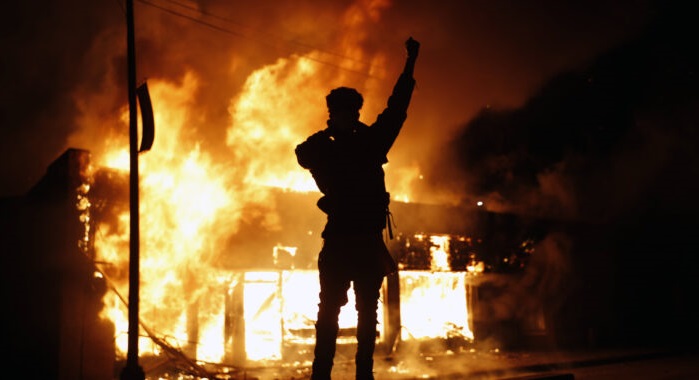
A check-cashing business burns Friday, May 29, 2020, in Minneapolis. Protests continued following the death of George Floyd, who died after being restrained by Minneapolis police officers on Memorial Day. (AP Photo/John Minchillo)

A check-cashing business burns Friday, May 29, 2020, in Minneapolis. Protests continued following the death of George Floyd, who died after being restrained by Minneapolis police officers on Memorial Day. (AP Photo/John Minchillo)


Ethics Lesson 101

by Caud Sewer Bile

Kenosha, Portland, Oakland. Minneapolis, New York:
Don’t blame their Democratic mayors; they don’t have a cork.
Chicago and Seattle, Albuquerque, Denver too:
Don’t blame their Democratic mayors for their points of view.

Don’t blame Antifa for the riots, nor blame BLM.
Don’t blame the looting or the burning or the hate on them.
Don’t blame Antifa for the violence, or BLM.
Don’t blame the deaths on them; that is not their planned stratagem.

We know who is to blame. It isn’t party activists,
not nihilists, not anarchists, nor jihad terrorists.
Don’t blame the High-Tech money-grubbers or their censor crews.
Don’t blame the Mainstream Media; they just report the news.

Don’t blame coronavirus on the Chinese Communists.
Don’t blame the economic lockdown on the Socialists.
Don’t blame the drug cartels for gangland violence today:
St. Louis, Boston, Dallas, Washington DC, LA.


Hope

“et spatio brevi/ spem longam reseces” —Horace, “Book I, Ode XI”
“Yet—never—in Extremity// It asked a crumb—of me” —Emily Dickinson, “‘Hope’ is the thing with feathers”

by Wilbur Dee Case

At times it seems that all one has, when one is feeling low,
is hope, hope for a chance, a change in circumstances, oh,
hope for a better place to be amidst heartache and pain,
hope for a bit of happiness, hope for less stress and strain,
hope for an anchor in the turbulence of wind and storm,
hope for a dove to fly above, hope for a touch of warmth,
hope for an olive branch that falls down from an olive tree,
hope for a glass of wine beside some candles flickering,
hope for the strength allowing one to manage and to cope,
hope for more love, and hope that one not ever will lose hope.



ShareTweetPin
The Society of Classical Poets does not endorse any views expressed in individual poems or commentary.
Read Our Comments Policy Here

RandomPoems

The Top-Ten, Best, Most Popular Poems of Emily Dickinson People Should Read at Least Ten Times
Beauty

A Poem for Emily Dickinson, and Other Sonnets by Tamara Beryl Latham

December 13, 2021

. Tamara to Emily for Emily Dickinson We viewed the lighted houses well below, whose roads ran serpentine through mounding...

Poetry

‘Instead of Sominex’ and Other Poetry by Meryl Stratford

January 30, 2013

Instead of Sominex Write a sonnet tonight before you go to bed. Just fourteen lines before you fall asleep. Something...

Next Post
‘Spindle, Shuttle, Loom’ by Joseph S. Salemi

'Spindle, Shuttle, Loom' by Joseph S. Salemi

‘A Sonnet?’ by Carly Britt

'Sonnet Sonnet' by Theresa Rodriguez

‘The City-Bird’ by Michael Curtis

'The City-Bird' by Michael Curtis

Comments 6

  1. Joe Tessitore says:
    6 years ago

    Well done, Mr. Wise.
    Your poetry left me smiling.

    Reply
    • BDW says:
      6 years ago

      Mr. Robin’s “Stealth Warfare” utilizes many sound poetic devices, repetition, as in the rhetorical openings, the metrical drumbeat of balladry, a wealth of example, a villainous rationalization, which is a similar approach to that used by Mr. Bile in ”Ethics 101”, etc.

      Poetic flaws are there as well, some of which are also visible within a poem, like Mr. Case’s “Hope”, as, for example, careful ordering. [I have for decades “admired” Pound’s slashing of Eliot’s “The Wasteland”.]

      The poetic offerings of this last decade, which I have read, in free verse, jazz rhyme, or experimental and traditional metrical verse, reveal that New Millennial poetry is not that dissimilar to, say, Romantic or Modernist poetry. There is, as Matthew Arnold said of the Romantics, poetry of having “proceeded without having its proper data, without sufficient material to work with”. In short, they “did not know enough”, the force of whose truth hits me, like “Maxwell’s silver hammer”. Our era’s standards are not high enough. Why?

      Reply
  2. Margaret Coats says:
    6 years ago

    Since Ethics 101 courses, these days, are usually forthright in telling what one should blame, your reader searches the poem for that information, never finding it. The irony is, of course, that you are forthright, and he has missed every detail in a vain search for something more obscure to blame.

    The most intriguing “Hope” image is “hope for an olive branch that falls down from an olive tree.” Because an olive branch, to symbolize peace, must be presented by someone desiring peace, the fallen branch looks hopeless. It conveys nothing. But the rest of the long line draws attention to the branches remaining on the tree, each of them still potentially serving peace. This, like all of the smaller hopes, supports the final wish “that one not ever will lose hope.” They all invite careful attention to the many varieties of hope!

    Reply
    • BDW says:
      6 years ago

      Although I do not share Ms. Coats’ poetic stances or attitudes, I think she is the critic who best understands my poetic outlook. I’m not quite sure why; but in prose she occasionally hits the inner landscape of my poetic practice. I like her observations more, I think, because she neither likes my poetry or my criticism that much, and she does not share my poetic vision. (After all, who would, could or should?).

      The two poems, accepted by Mr. Mantyk are both touched by various flaws. Ms. Coats points out one of the main flaws of “Ethics 101”. The “reader searches the poem for that information, never finding it.” Though the tone is obviously ironic, the actual absence of anyone or anything ethical is glaring. I have to admit the purpose in writing the poem was to list a series of cities, as T. S. Eliot did in “The Wasteland”, showing their dissolution. In this respect I failed; I merely got in pet peeves of the moment, not terribly poetically. Rhymes, meter, and topics do not necessarily a good poem make. Though the urban listing is Miltonic, the result is more Guthriesque.

      The artistry of “Hope” is limited in scope. It was a poetic topic I was asked to write on by an editor, needing it that very day. This is one of the reasons I like the tennos; it can be as spontaneous as needed; its metrical basis is formed by half a millennium of English poetic practice. That’s why I think it works well in docupoetry.

      Although already published twice, prior to here, the poem is embarrassing when compared to the two poems quoted, that by Horace and Emily Dickinson. Both writers distill superior ideas of hope quicker and more poetically, which tells me that I should rewrite this poem with completely different symbols and/or placements and with greater concentration. In his “Carpe Diem” ode, I like how Horace notes that hope should not be greater or longer than life itself, and I like how Dickinson, with remarkable imagery makes the abstract concept real.

      Still, “Hope” isn’t without some poetic value: the slant rhymes with their meanings, the natural diction, surprising alliteration, the sustained tone and topic, the rhetorical devices, and the conclusion of the last line.

      Because I am so focused on plastic poetic structures and an open voice, as well as an elastic line, I am prone to the same flaws seen in writers as diverse as Shakespeare and Whitman, imperfect writing. Its value is this: it is a hope-filled style. Its negative quality is its acquiescence to nature. It is hard to achieve a balance between tradition and revolution, the conservative and the liberal, the old and the new, the enduring past and the dynamic future; and yet…

      Reply
  3. Daniel Kemper says:
    6 years ago

    I confess that I was fairly far along in the poem before I caught on, not because of anything lacking in the writing, but the general context that I’ve come from lately– inundation of news and conversation of friends at great lengths from each other on the political spectrum. I think the irony layers in nicely, very nicely. It made me think: Who was it that answered the question, “What is wrong with the world?” with “I am”? I mean, “Don’t blame me!” 😉

    Reply
  4. BDW says:
    6 years ago

    Mr. Kemper’s remarks remind me of several things, and how one may relate to poetry.

    1. Readers come from varied “contexts”, and they will relate to poetry and prose from their differing perspectives; hence, a writing of layered-in irony will affect readers in different ways. Mr. Mantyk frequently wants to alter words I use in my poetry and prose, because, as an good lyric editor, he thinks rightly that such writing can be misleading to readers. I remember vividly a wonderful mother recoiling at the possibility of her son having to read Jonathan Swift’s “A Modest Proposal”. [As an aside, as well as her understanding of French poetry, in general, I suspect that Ms. Coats is as perspicacious as she is to my poetry, because she is an “inveterate editor”.]

    2. Mr. Kemper brings up the actual ethical question of “What is wrong with the World? a question worthy of philosophical exploration; but which could easily be reversed with the question: What is right with the World?

    3. It is Mr. Kemper’s own career as a systems analyst and poet, which intrigues me as well. He has come to the sonnet in works, such as “News of the Revolution” or “Before the Plague”. I know the latter poem brought to my mind how differently I wash my hands now, compared to how I did before the Chinese Coronavirus hit. Since then, hand-washing has become more frequent and involved (partly because my wife is a nurse). Obviously, one’s circumstances and career can have a profound influence on the topics and the outlook of a poet. And it is that variety, I find so invigourating in New Millennial poetry. Just as, having been in the military, where I studied fixed-wing aircraft and worked as a Pershing missile crewman, reminds me always that New Millennial poets must embrace modern technologies as much as we can, no matter how bracing. I know, having studied early computer programming (and even teaching Basic), makes me more receptive to a work, like Mr. Kemper’s “Through the Windshield, the Road”, which, despite its random metric, I like more than his sonnets, because he is attempting more. T. S. Eliot’s clerking, Wallace Stevens’ banking, and WCW’s baby doctoring certainly infused their own poetries.

    Reply

Leave a Reply Cancel reply

Your email address will not be published. Required fields are marked *


  1. Justin Dasher on ‘This Too Shall Pass’ and Other Poetry by Justin DasherSeptember 3, 2026

    Margaret, thank you! I appreciate how detailed your reading is (and that you picked up on the cor ad cor…

  2. Justin Dasher on ‘This Too Shall Pass’ and Other Poetry by Justin DasherSeptember 3, 2026

    Thank you Paul!

  3. Justin Dasher on ‘This Too Shall Pass’ and Other Poetry by Justin DasherSeptember 3, 2026

    D.R., thank you for reading! I love that image as well, the phrase used for sleep in the Genesis passage…

  4. Justin Dasher on ‘This Too Shall Pass’ and Other Poetry by Justin DasherSeptember 3, 2026

    Thank you for the kind words!

  5. Roy Eugene Peterson on ‘The Estuary’: A Poem by Jeff EardleySeptember 3, 2026

    Jeff, this is one of those perfectly attuned poems comparing the seemingly far off tides with life.

Subscribe to Daily Poems

Enter your email address to subscribe to this blog and receive notifications of new posts by email.

Join 1,634 other subscribers

Recent Poems

  • ‘The Estuary’: A Poem by Jeff Eardley
  • ‘A World Without the Wednesday Child’: A Poem by Kimberly Fore
  • The 2026 Society of Classical Poets International Poetry Competition
  • The 2026 SCP International High School Poetry Competition
  • ‘Realistic Reflections’ and Other Poetry by Anna J. Arredondo
  • ‘China Made’: A Poem by Theresa Werba
  • ‘The Savage Moon’ and Other Poetry by Brian Yapko
  • Poetry Book Review: Love Found, Yearned For, and Lost by James A. Tweedie
  • ‘When Opportunity Knocks’: A Poem by Roy E. Peterson
  • ‘Legend of the Griffin’: A Poem by Iryna Hall
  • ‘Government Issue’ and Other Poems by Joseph S. Salemi
  • ‘Chaucer Announces His Desire to Retire’: A Poem by Paul A. Freeman
  • ‘Advantages of Restaurants’ and Other Poems by Russel Winick
  • ‘Bone China’: A Poem by Mary Gardner
  • ‘On the Death of One Too Young to Die’: A Poem by Jeffrey Essmann
  • ‘This Too Shall Pass’ and Other Poetry by Justin Dasher
  • ‘Humdrum and Harum-Scarum’: A Lecture on Free Verse, by Robert Bridges (1922)
  • ‘Unrest On the Floodplain’: A Poem by Bhikkhu Nyanasobhano
  • ‘Latitude and Loss’: A Poem by Martin Briggs
  • ‘Act III’ and Other Poetry by C.B. Anderson
  • ‘God’s Funeral’: A Poem by James Sale
  • ‘Star Festival’: A Poem by Margaret Coats
  • ‘Song of the Frog Princess’: A Poem by Scharlie Meeuws
  • ‘The Odyssey: Nolan and Solot Compared’: An Essay by Michael Curtis
  • ‘Solitude’ and Other Poems by Mary Jane Myers
  • ‘The River Not Taken’ and Other Poetry by Brian Yapko
  • ‘Totentanz’: A Poem by James A. Tweedie
  • ‘In God Is Our Trust’: A Poem by Roy E. Peterson
  • ‘Confession’: A Poem by Jeffrey Essmann
  • ‘Religious Poetry, and Religionist Poetry’: An Essay by Joseph S. Salemi

Categories

  • Acrostic
  • Alexandroid
  • Alliterative
  • Art
  • Best Poems
  • Blank Verse
  • Chant Royal
  • Classical Poets Live
  • Clerihew
  • Covid-19
  • Deconstructing Communism
  • Educational
  • Epic
  • Epigrams and Proverbs
  • Essays
    • Interviews with Poets
    • Poetry Reviews
  • Featured
  • From the Society
  • Great Poets
    • Dante Alighieri
    • Edgar Allan Poe
    • Emily Dickinson
    • Geoffrey Chaucer
    • Henry Wadsworth Longfellow
    • Homer
    • John Keats
    • John Milton
    • Robert Frost
    • William Blake
    • William Shakespeare
    • William Wordsworth
  • Human Rights in China
  • Limerick
  • Love Poems
  • Music
  • Pantoum
  • Performing Arts
  • Poetry
    • Beauty
    • Children's Poems
    • Culture
    • Ekphrastic
    • Found Poems
    • High School Poets
    • Humor
    • Riddles
  • Poetry Challenge
  • Poetry Contests
  • Poetry Forms
    • Curtal Sonnet
    • Haiku
  • Poetry Readings
  • Rhupunt
  • Rondeau
  • Rondeau Redoublé
  • Rondel
  • Rubaiyat
  • Sapphic Verse
  • Satire
  • Science
  • Sestina
  • Shape Poems
  • Short Stories
  • Song Lyrics
  • Sonnet
  • Symposium
  • Terrorism
  • Terza Rima
  • The Environment
  • Translation
  • Triolet
  • Video
  • Villanelle

Quick Links

  • About Us
  • Submit Poetry
  • Become a Member
  • Members List
  • Support the Society
  • Advertisement Placement
  • Comments Policy
  • Terms of Use

Welcome Back!

Login to your account below

Forgotten Password?

Retrieve your password

Please enter your username or email address to reset your password.

Log In
No Result
View All Result
  • Poems
    • Beauty
    • Culture
    • Satire
    • Humor
    • Children’s
    • Art
    • Ekphrastic
    • Epic
    • Epigrams and Proverbs
    • Human Rights in China
    • Music
    • Performing Arts
    • Riddles
    • Science
    • Song Lyrics
    • The Environment
    • The Raven
    • Found Poems
    • High School Poets
    • Terrorism
    • Covid-19
  • Poetry Forms
    • Sonnet
    • Haiku
    • Limerick
    • Villanelle
    • Rondeau
    • Pantoum
    • Sestina
    • Triolet
    • Acrostic
    • Alexandroid
    • Alliterative
    • Blank Verse
    • Chant Royal
    • Clerihew
    • Rhupunt
    • Rondeau Redoublé
    • Rondel
    • Rubaiyat
    • Sapphic Verse
    • Shape Poems
    • Terza Rima
  • Great Poets
    • Geoffrey Chaucer
    • Emily Dickinson
    • Homer
    • Henry Wadsworth Longfellow
    • Dante Alighieri
    • John Keats
    • John Milton
    • Edgar Allan Poe
    • William Shakespeare
    • William Wordsworth
    • William Blake
    • Robert Frost
  • Love Poems
  • Contests
  • SCP Academy
    • Educational
    • Teaching Classical Poetry—A Guide for Educators
    • Poetry Forms
    • The SCP Journal
    • Books

© 2025 SCP. WebDesign by CODEC Prime.