


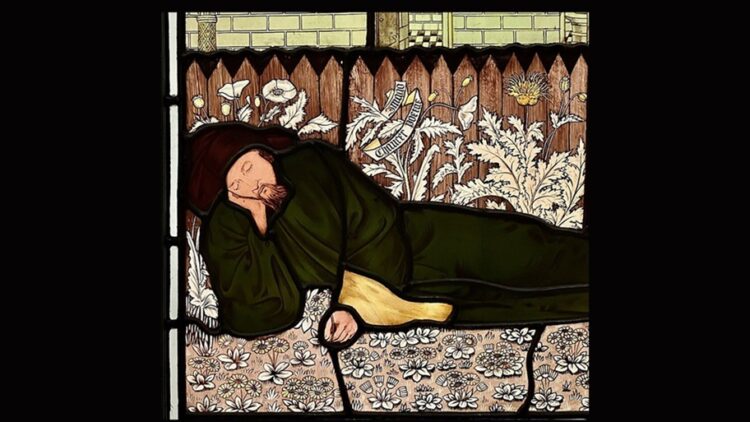
Chaucer Announces His Desire to Retire
Whan that passing years and Father Time’s
made difficulty in my finding sounds… rhymes!
that to the ear are similar; and ere
a line’s complete I place an eye-rhyme here
to mark its termination, but end up—oft seems—
with six iambic feet, not five, while reams
of paper I’ve expended; ’tis perverse
not to retire before I face the curse
of
writing
(in
iambic’s stead)
free verse—
and also throuplets,
not couplets.
Paul A. Freeman is the author of Rumours of Ophir, a crime novel which was taught in Zimbabwean high schools and has been translated into German. In addition to having two novels, a children’s book and an 18,000-word narrative poem (Robin Hood and Friar Tuck: Zombie Killers!) commercially published, Paul is the author of hundreds of published short stories, poems and articles.

















Paul, this is a fascinating poem about Chaucer’s patterned rhymes like the metrical rhymed couplets used in the “Canterbury Tales.” He also wrote in “rhyme royal” with seven-line stanzas of ababbcc, ballades, octosyllabic couplets and other medieval formalized structures. Regardless of what others may say, unrhymed metrical blank verse would not appear in English until the mid-1500’s and true free verse in the 19th century. Medieval poets judged poetry by its adherence to metrical discipline, not expressive freedom.
Thanks for the reality check, Roy. I did write it not literally, but as a bit of satirical fun. Alas, I seem to have missed the mark.
As you may have noticed, Chaucer is one of my heroes.
Anyhow, thanks for the feedback
Chaucer retire? Well, sure — everybody does eventually. But once you’ve left a corpus of brilliant poetry behind you (as Geoffrey certainly did), it hardly matters. The stuff is there forever.
Chaucer was lamenting that the rhymes no longer came as easily as they once did which I guess all poets feel as they get older – which was the inspiration for this poem.
Paul, this is delightful wordplay and meter-play. Easily I imagine ending up with six iambics rather than the desired five. I’ve done it myself. It must be frustrating for poor Chaucer, and for you. But bear up bravely, there are still some rhymes to be found that will please the reader, as you’ve done right in this poem. My compliments!
Thank you, Bhikkhu Nyanasobhano. The poem doesn’t seem to have hit the mark as I hoped, but that’s the nature of poetry, sometimes.
Cute idea, Paul, with well-illustrated difficulties that might move a writer with beginning dementia. I would suspect that arthritis (if a scribe could not be hired) or the cost of writing material (that you mention) came earlier. There is one story of skipping the preliminary work of reading:
On bookes for to read I me delight,
And to them I give faith and full credence,
And in mine heart have them in reverence
So heartily that there is game none
That from my book maketh me to goon,
But it be seldom on the holyday,
Save certainly when that the month of May
Is come, and that I hear the foweles sing,
And that the flowers gynnen forth to spring,
Farewell my book, and my devotion!
I love this one because he goes out to meet the Marguerite!
Thanks for reading, Margaret. For me the main problem associated with writing has been power cuts during extreme desert heat – I wrote a poem about it by torchlight.
The extreme power outages seem to be past, but the voltage is down so air conditioners and hair trimmers aren’t working
Hope the torchlight provided some atmospheric inspiration. Looks like it might be best to write during the golden hours of the morning. And at that time of day, you may not be so tempted by the retiree tendency to nap.
I generally work better in the mornings, but have to adapt to any time.
Currently I’m in the pre-prohibition lounge of a hotel in Nouakchott doing some work on my latest novel because of these pesky power cuts.
By the way, the quotation above, roughly modernized by me, comes from the prologue to Chaucer’s Legend of Good Women.
I was wondering at the quotation.
Paul
I’m laughing out loud all the way through this clever poem. I love the way the genius Chaucer feels completely defeated by his aging brain’s lack of its former agility. Of course, even in old-age, geniuses anticipate the next new-new big thing. He’s stumbled into the glorious realm of ‘free verse,’ and also with his vibrant facility with words has created the new-new word (based on an old-old pagan practices) ‘throuplets.’
We should bring back the word ‘ere’— a supple Middle English word that rhymes with a whole glorious universe of words, and lands softly on the ear!
Sincerely Mary Jane
Thanks, MJ. Appreciated.
Able was I ere I saw Elba.
Another use for ‘ere’, in the sentence above that reads the same backwards and forwards.