


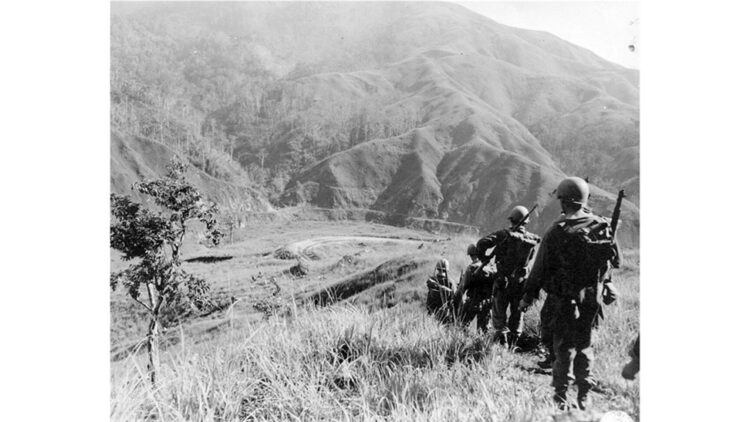
The Ballad of the Ghost Mountain Boys
—to the “Ghost Mountain Boys” of World War II—
especially the Iowa farm boy who was my grandfather.
Prologue
There was a day that unawares
awoke the world from sleep
and sent it witless out to fight
with devils in the deep.
There was a day the sun rose red
across a sickly east,
and all the ghosts of hell made war
on oceans named for peace.
The sun rose red, and where it rose
the greed of hell rose farther.
It grasped at every eastern shore:
the first to fall, Pearl Harbor.
The sun rose red. The ocean’s pearls
lay pallid in its beams:
hapless Burma, little Guam,
the priceless Philippines.
The sun rose red. The ocean’s pearls
turned crimson in its shade,
until Australia looked alone
across the waters red with foam
and knew it needed aid.
A single island shaded it
from those red-rising hosts:
a no man’s land, a devils’ land,
with mountains green as ghosts.
Part I: The Summons
In Iowa the corn was gone.
The fields were pale as snow
when in Bachelor’s Paradise
the summons came to go.
The bachelor was the farmer’s son.
He’d been as well content
with all the folks and cows at home.
But when he heard, he went.
He was of the humble sort—
his people were so poor
and not the type to cast their pearls
before the swine of war—
but other things than paradise
were dear to them and him.
They only hoped him back that year
to bring the harvest in.
Part II: The Letters
In Iowa, in Iowa,
the stocks go up & down,
the corn is short, the corn is tall,
the seed’s still in the ground,
and some are out and some are in,
and few can keep their poise,
but everyone awaits the mail
for letters from the boys.
In Iowa they do not write
of barns burned down to rubble
(for in Iowa they know
a man is born to trouble)
nor of the women with their sons
who bear a heavy cross
(for in Iowa they know
a woman’s born to loss)
but of the cows and sheep and ducks
and what the corn is doing,
and every farmer’s son writes back
of chow and chocolate pudding,
but not about the sickly beach
uneasily in sight
with fungus clinging to the trees
in greens that glow by night.
The brass had met with paper maps
(sometimes not even these)
and charted out a paper plan
through paper swamps and trees—
not knowing of the sucking mud,
the scythes of razor grass,
the ridges scarred with hogback tracks
the natives would not pass,
the biting of the thousand things
that swarm from head to heel,
the shivers of malaria,
the ulcers that don’t heal.
All this and more—for need is need,
though hell be so much hell—
the brass said “Do.” The soldiers did.
The farmer’s son as well.
And in between he briefly writes,
when mail gets through again,
that he is well, and all is right,
though he can’t make it homeward, quite,
to bring the harvest in.
Part III: The Battle
Down from the mountain paths
they’d said no man could pass,
down from the razorbacks
the soldiers came at last.
Down to a crimson foe
more keen to die than flee,
down through infernos of mud
they battled for the sea.
Themselves more ghosts than men
from hells no man had guessed,
the boys who looked and lived to tell
on the faces of devils, sick with hell,
laid all their foes to rest.
Themselves more men than ghosts
as the hosts of the red sun fled:
they stopped the rise of the crimson swell
on the shores of the land at the doors of hell,
and laid to rest the dead.
Epilogue
In Iowa the corn was young,
the fields had flooded twice
when the farmer’s son came home
to Bachelor’s Paradise.
He watched the cornrows grow again
with what the mud had hid.
He met a woman with a son.
He said, “I do,” and did.
In Iowa, in Iowa,
the ears are thin or fat,
the corn is short, the corn is tall,
the wind is where it’s at,
and some are up, and some are down,
as all will be again,
but still my humble people work
to bring the harvest in.
And far away, from western shores
to islands in the east,
where they have laid their labors by,
my people, humble people lie.
There may they rest in peace
until a harvest day arrives
the angels work for too—
until a higher voice than theirs,
waking the world at unawares,
says “Rise up,” and they do.
Rachel A. Lott holds a PhD in medieval philosophy from the University of Toronto. As an online tutor for gifted children, she leads group sessions and 1:1 advanced tutorials in language arts, Latin, logic, and math. Her work has appeared in First Things, Christian Century, America Magazine, Classical Outlook, New Verse Review, and the children’s magazine Cricket.


















This is a marvelously-wrought ballad. It is deeply moving. It tells the sad yet inspiring story of people who are plain, yet heroes, with beautiful poetic phrases and characterizations that seems deceptively simple, evoking believable pictures of these people and places in the reader’s mind.
Some of the amazingly poetic phrases that made me stop and read them again: “…all the ghosts of hell made war / On oceans named for peace.”; your naming of the small islands as “the ocean’s pearls” after the naming of Pearl Harbor; your insightful biblical allusion in “to cast their pearls before the swine of war” (also the one about man being born to trouble); “he said, ‘I do,’ and did.” And your final stanza is so very poignant.
Thanks so much for the kind words, Cynthia, and especially about the allusions! I’m so glad they stand out. Faith was a source of strength when few other things could help. It is amazing how many trials the soldiers and their families went through, and yet they managed to live quiet and gracious lives despite everything. “Plain, yet heroes” is an apt way of putting it!
This is clearly a labor of love, Rachel. Brilliant work. You take us back in time, entwining us in two disparate worlds. Though this is WWII, I can hear parts of this set to 1930s dust bowl ballad music. Or read over a 1930s Aaron Copeland score! True Americana!
Ooo, yes to Copeland! I love Rodeo and often play snippets as intro music for the classes I teach. But I’m embarrassed to admit I had to google “dust bowl ballads.” Are they all Woody Guthrie, or did they turn into a whole genre? They weren’t even on my radar. Thanks for the tip!
A ballad with artistically diverse feelings in the different sections, though all join for the story. I particularly like the colors of the descriptive prologue. In much of the story, Rachel, you maintain a “common touch” perspective–and indeed you as narrator stay with the characters to explain why these persons notice or speak or write as they do. This helps render the battle landscape as strange as it would certainly have been to your grandfather and his buddies (with plant and insect enemies as well the human foes). Simple virtues come to the fore unobtrusively. Well done. Congratulations as one of the top-tier finalists in the Freedom 250 competition!
Many thanks, Margaret! And yes to the plant and insect enemies! I was actually thinking of the island itself as the worst “devil” of the piece (following James Campbell’s phenomenal book about the New Guinea campaign), along with its awful heat and malaria / dysentery. In earlier drafts the island took up more space. But I ultimately had to trim out everything that wasn’t directly narrative, since 130 lines is somehow shorter than it seems. I’m glad a glimpse of it still comes through!
The first time I read this wondrous ballad, the cadence swept me along like soldiers on a quick march. I appreciate it more each time I read it. I could see, hear and even feel the details of the foot soldier and the farmer’s daily life.
The selfless resolve of the farmers’ sons and their family’s sacrifice fills our hearts with awe. I hope, Rachel, that your students read this poem. Mine will. With the vivid imagery and language, it would be much more meaningful and memorable than several chapters in a history book.
Gerry, that is high praise! I don’t know of any students who have read my poetry before, but I’d be honored to supplement a classroom lesson. The idea reminds me of Aristotle classifying poetry alongside history, with the caveat that poetry is more philosophical. Very different from the modern view that poetry is merely ornamental. (And therefore dispensible!)
Rachel, what a wonderful ballad! When I saw the word “ballad” in the title I worried about my attention span, but this held me from start to finish. I appreciate the juxtaposition of the everyday and ordinary with the hellish and heroic, all in the same matter-of-fact yet vividly descriptive tone. Poignant and captivating!
Anna, this comment makes my day! I’m a fan of ballads myself but am only too aware of the “burnout” factor after about 40 lines (when it kicks in for me, anyway). When I realized I would hit 130 lines for this one, I tried to quicken the action while splitting it up into manageable chunks. It’s great that something worked there. Thanks for staying with the boys to the end!
Rachel
Brava! What a wonderful poem. I’m in tears. The ballad form is perfect for this material.
The five Parts tell the story, in chronological order, of the Iowans who served in New Guinea in World War II, and specifically, those involved in the 32nd Infantry Division. Prologue; I he Summons; II The Letters; III The Battle; Epilogue. You have chosen the traditional form: 4 line stanzas, with stress counts of 4/3/4/3. Lines lines 2 and 4 rhyme. You use effective 5-line substitutions in Stanza 11 of Part II; stanzas 3 and 4 of Part III; stanzas 5 & 6 of Epilogue. In these 5-line stanzas, the stress counts are: 4/3/4/4/3. The rhyme scheme for these 5-line stanzas is: x/a/b/b/a; in stanza 11 of Part II there is one additional rhyme: a/b/a/a/b.
The ballad is 770 words, plus a 25-word title and epigraph. Of these 795 words, 91 words are repeated to wonderful effect:
Words Repetition
Iowa: 10x
red/corn: 8 x
war/ hell 7x
ghost/son 6x
land/boys 5x
farmer/harvest 4x
bachelor/devils/ocean/paper/need/crimson 3x
You capture the quiet dignity and sense of duty and mettle of these Iowa farm boys and their families back home. I’m a generation older than you—my now-deceased father, whose sister’s family still farms in Anthon, Iowa (near Sioux City) was stationed in the Far East in MacArthur’s army, though he did not experience the brutal march of the Ghost Mountain Boys. I have a treasured black-and-white photo of him, the quintessential GI, perched on the back of a streetcar in Tokyo. His older brother Bob (my uncle) was in the navy, and survived Pearl Harbor and the rest of the war, only to be killed in a tragic car accident when he returned back home in 1945.
I love especially Part II: “The Letters”—and what they do and do not do in Iowa: they never complain, but talk about all the daily “country things”: ‘cows and sheep and ducks and what the corn is doing.’ So as not to worry his family back home, the soldier never mentions the horrible conditions of war, but simply ‘writes back about chow and chocolate pudding.’ The stanzas about the brass, with their ‘paper maps and paper plans’, artfully remind us that the higher-ups aren’t the ones who know of ‘the sucking mud, the biting of the thousand things, the shivers of malaria.’ ‘The brass said “Do.” The soldiers did.’ And then the wonderful resonance of what soldiers “do” in the Epilogue: the soldier returns to his farm and ‘He met a woman with a son. He said, “I do,” and did.’ The final two stanzas are a heartfelt tribute to ‘my people’, the narrator’s people. The final three lines gesture poignantly toward the resurrection from the dead of all these humble Iowa people: ‘ … until a higher voice than theirs, waking the world at unawares, says “Rise up,” and they do.’
This poem could be set to a lovely ballad tune—do you have any musical friends who might compose one for you?
Most sincerely,
Mary Jane (Myers)
Wow, Mary Jane! This looks like the type of numerical analysis that only a tax-specialist-turned-poet could do. I’d love to see your analyses of Edgar Allan Poe.
How serendipitous that you’re also Iowa-connected. It alternately breaks my heart and warms it to hear of your uncle and your father. That black-and-white photo from Tokyo is a genuine treasure. Was your father with the 32nd (the Red Arrow division)? I know it was big and some went to New Guinea while others made it to Japan, but so many other divisions were involved as well.
One of the things I love most about farming communities is their down-to-earthness. We’re living in rural Ontario now and it’s a similar culture. Someone should write a song about “we’re all Iowans”!