


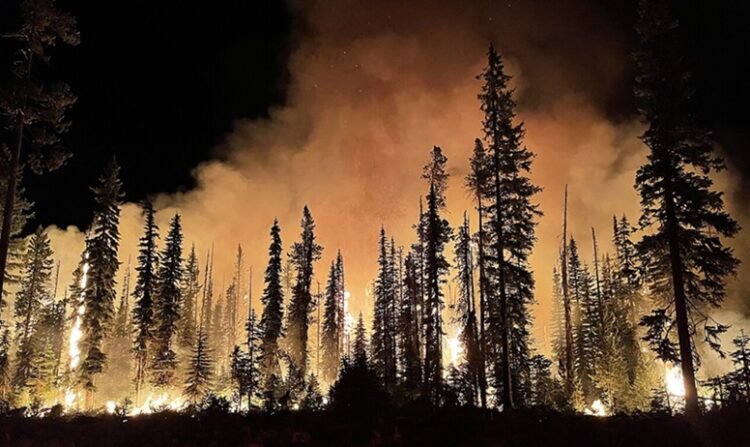
Forest Fire Fantasy
—a trenta-sei
The smoke from summer fires filled the air,
A lightning storm had been the cause of most.
Entire forests went up like a flare
As ecosystems were turned into toast.
To fight the flames came men with skill and pluck,
With air support and good old-fashioned luck.
A lightning storm had been the cause of most,
As searing bolts set underbrush ablaze
From Puget Sound to West Port on the coast,
Enshrouding Western Washington in haze.
Cool winds could not prevent the fires’ spread,
But, like a bellows, fanned the flames instead.
Entire forests went up like a flare
As flames licked rapidly from crown to crown.
The trees left lifeless, totems charred and bare,
Gray silhouettes against a sky of brown.
Their ghostly limbs thrust out like beggars’ hands,
Their withered roots entombed by withered sands.
As ecosystems were turned into toast
The forest creatures fled in disarray
Together, on the ground, a nightly host
Of fox and hare, of predator and prey.
While in the air each frightened bird took flight,
To seek a new and safer nesting site.
To fight the flames came men with skill and pluck,
Equipped with shovels, courage, brawn and brains.
They came by car, by bus and fire truck
To risk their lives and pray for cooling rains.
They faced infernos fueled by heat and drought
But did not leave until the fires were out.
With air support and good old-fashioned luck
They fought the fight until, at last, they won.
And when they left, they took a well-earned buck
Or two as a reward for what they’d done.
And where the devastating fires had burned
A seed-sprung shoot appeared and hope returned.
Poet’s Note: Trenta-sei is Italian for “36.” It is a form invented by the 20th century American poet, John Ciardi, with his one example first published in 1989, four years after his death. It contains six sestets with each sestet after the first beginning with the lines of the opening sestet in turn with an ababcc pattern throughout.
James A. Tweedie is a retired pastor living in Long Beach, Washington. He has written and published six novels, one collection of short stories, and four collections of poetry including Sidekicks, Mostly Sonnets, and Laughing Matters, all with Dunecrest Press. His poems have been published nationally and internationally in both print and online media. He was honored with being chosen as the winner of the 2021 SCP International Poetry Competition.

















James, what a great poem on forest fires of all things including the devastation seared into our minds but with an inspired ending of hope for the future. I know from your bio that you live in the State of Washington. The impactful intensity
of the fire and those who fought it must have been etched into your mind as you lived on the periphery and must have prayed for relief of the victims and cessation of ecosystem destruction. Thank you for sharing your feelings of such an event or events with sensitivity and superb rhyme scheme of “36” which you introduced to me in your note.
Well done, James. As far as I can see, the trentasei has interested mainly forms cataloguers. It seems complex enough and too long to inspire many formalist poets. You’ve made some good points about your subject. Cool breeze can increase the destructiveness of fires anywhere. Considering the remarkable things they are able to accomplish in searing conditions, firefighters are generally satisfied with small rewards. And it is astounding how quickly nature begins to heal from fiery disasters.
I really love the poem, the story and the form. I like the way that the first verse is an outline for the rest of the poem. You really had to think the whole poem through as you composed that verse.
The form is a Retourne, Italian for return, on steroids! While the Retourne is four quatrains, the first a sort of outline, the Trenta-sei is, of course, six sestets. So I suppose a Retourne could be called a Sedici.
Forest fires, as it happens, are an essential component of the eco=plan found in many arboreal biomes. Once the canopy has been destroyed, the new light encourages more edible species of plants to flourish, which is a great benefit to herbivorous animals. Modern forestry includes the idea of controlled burnings to eliminate flammable underbrush. The good folks running California seem to have forgotten this important lesson, preferring to blame the recurring holocausts there on global climate change rather than on their own negligence.
You have the gift.
James, I remember C.B.’s challenge to write a trenta-sei when I first joined the SCP… your poem impressed me then and it impresses me now… so much so, you’ve inspired me to try my hand at another. Great stuff!
Nicely done, James. Some wonderful imagery. ‘totems charred and bare’, and the beggars’ outstretched hand were two of the more striking. And a great hook at the end, with Nature’s shoots bringing back life.
Thanks for the read. Inspiring.