


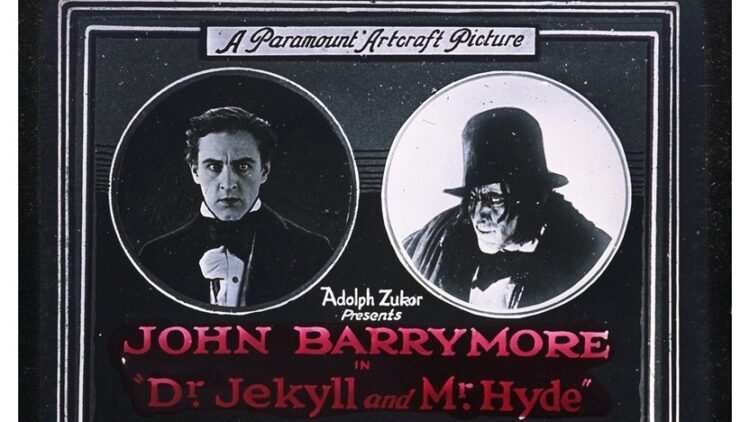
Jekyll and/or Hyde
When we observe what seems to us to be
phenomena that should not co-exist,
but somehow do so paradoxically,
our brains freeze while our thoughts contort and twist.
We’ve seen light act like particles and waves,
which we have proved, but still can’t understand.
We’re smart enough to fathom what behaves
as “either/or,” but struggle with “both/and,”
We’ve tried and tried, but our minds still can’t bend
enough to grasp facts when they contradict,
so we clasp onto one and then pretend
we never saw the one that stayed unpicked.
When anybody dares to look within,
and contemplate the murkiness inside,
they tend to see their virtues, not the sin,
and think they’re Dr. Jekyll, without Hyde.
Our Hyde and Jekyll natures fight all day,
and sometimes, Jekyll seems right on the verge
of triumphing and sending Hyde away,
but then Hyde wakes some hidden, primal urge.
So, we do what we do not want to do,
which really should help us to understand
the folly of our narrow point of view.
No one is “either/or,” we’re all “both/and.”
Yet almost every one of us insists
they’ve won the fight and somehow banished Hyde.
But, when we live denying he exists,
like Jekyll, we’ll see Hyde get amplified.
Poet’s Note: The book The Strange Case of Dr. Jekyll and Mr. Hyde was written by Robert Louis Stevenson in 1886. It tells the story of a respected London doctor, Henry Jekyll, who creates a potion that transforms him into Edward Hyde, a separate identity that indulges every impulse Jekyll represses. At first, Jekyll believes he can control the transformations, but Hyde grows stronger and begins acting independently. As the boundary between them collapses, Jekyll loses the ability to return to his original self. In the end, Hyde becomes permanent, and when Hyde dies, Jekyll dies with him.
Warren Bonham is a private equity investor who lives in Southlake, Texas.









Warren — this is a superb poem! It has an excellent, universal message, told with outstanding rhyme and meter, and the perfect tone. Great job!
Thank you! I first heard this story when it was told to me by my grandfather with his Scottish/Canadian mixed accent and was always drawn to it. I’ve been battling Hyde for a very long time, with very mixed success.
Warren, I think you’ve perfectly captured the essence of Stevenson’s tale: the duality which exists in every one of us, and which only the greatest of Saints can escape. There’s profound truth in “No one is ‘either/or’, we’re all ‘both/and.” A thoughtful and – let us hope – salutary piece, which deserves to be read repeatedly. Thank you.
Thank you very much. Human brains seem very good at taking shortcuts. We see only Jekyll in ourselves and our friends, and only Hyde in our enemies. It makes life very simple in the short term, but it creates enormous problems in the long term.
“…but somehow do so paradoxically,
our brains freeze while our thoughts contort and twist.”
These lines landed very incisively – well and aptly put. Thanks.
I once thought that the study of Physics was for me, but when we studied all of those particle/wave experiments in High School, I found the brain freeze sensation to be too uncomfortable to continue. I hate to admit it, but since then I’ve been stuck mostly in “either/or” mode.
I really enjoy a poem which exposes the strange paradoxes of the human mind. This is a particularly good one. Well done, Warren.
I’m glad you enjoyed this one! The human mind is fertile ground, while also being uncomfortable to examine.
This is extremely clever — I love it! It very concisely explains human nature, and I think R.L. Stevenson would approve of this poem.
And I love “contradict/picked”, and “Hyde/amplified.”
Thank you so much. My Scottish grandfather drilled Stevenson (and Robert Burns, which is apparently appropriately pronounced as Rabbie Burns) into me. I think RLS nailed it with this particular story.
Stevenson himself said that the subject of his Jekyll-and-Hyde story had percolated in his mind for a very long time before he actually took up his pen to compose it. He saw the idea as upsetting, troublesome, disturbing, and too shocking to put into words. But he finally did so, with great effort.
The late nineteenth century was a time when the recognition of a darker, unconscious side of every human personality (sometimes called “the shadow”) was beginning to be explored by psychologists, who were termed “alienists” back then. It took the coming twentieth century to show us — spectacularly — that civilization is only a thin crust on top of hidden savagery.
That’s a great way to put it – “a thin crust on top of hidden savagery”. With all of the knowledge we’ve accumulated, it makes our savagery much more dangerous.
Warren, this poem speaks to the very core of me. There is so much good-versus-evil material to unpack that I am amazed that you managed to fit it all into one brief, thoroughly entertaining and eye-opening poem. Your powerful closing stanza holds a stark warning. I ache for a world where we all grab our hidden Hyde, drag him into the glaring sunlight, and tell him to quit his s%*t. But first we must admit to hiding our Hyde… in our current narcissistic era, that’s a tall order. Thank you very much indeed!
… and Joe, I just love your “civilization is only a thin crust on top of hidden savagery.” – it explains everything!
Every time I think I’ve got Hyde tucked safely away, he manages to find some clever trick to escape once again. My Jekyll-self isn’t as smart, virtuous or powerful as I tell myself he is.
Warren, your work is always incisive, but this one is amazingly so!
Yes, we are all both/ands… even the either/ors… but none of us have been charged with the sorting.
The either/ors are pretty easy to spot, though.
I completely agree with you. I’d like to think those people are in the minority, but they sure do make a lot of noise and create a lot of problems for everyone else.
‘Hyde wakes some hidden, primal urge’, says it all.
Unfortunately, it takes only one Hyde moment to put all the years of Jekyll-ness in the shade.
Thanks for the thought-provoking read.
I don’t know the origin of the acronym, but Hyde seems to know it’s best to attack when we’re Hungry, Angry, Lonely or Tired (HALT). When he’s successful, there are so many examples of years of Jekyll’s work being wiped out in an instant. All it takes is one small lapse of vigilance.
Warren, you make an excellent presentation of the dilemma of good and evil in the human psyche. It’s refreshing that you begin with contrasts in nature, like the wave/particle duality of light or quantum physics. These demonstrate your basic concept of innate contradiction. Jekyll and Hyde take it into moral depths, but these too offer nothing new, as you show by allusion in stanza 6 to the profound teaching of Saint Paul, who struggled while doing what he didn’t want to do (Romans 7).
You make the wisest possible conclusion. It’s not that human beings simply need to keep up the moral struggle, or that they should stay on the lookout for temptation around or within themselves. Rather, the worst savagery happens when the option for evil is denied. This comes about often. We assume good intentions everywhere, and trust ourselves as we assert our rights to self-expression.
I’m glad you saw my clumsy allusion to Romans 7. In terms of the conclusion, I just thought of a possible continuation:
Perhaps, by seeing this, we’ll understand
the flaws in the façade to which we cling.
We need the One who is the great “both/and”,
who’s both a lowly shepherd, and our King.
As John Lennon (almost) said: The one thing you can’t hyde is when you’re crippled inside. Outstanding poem!