


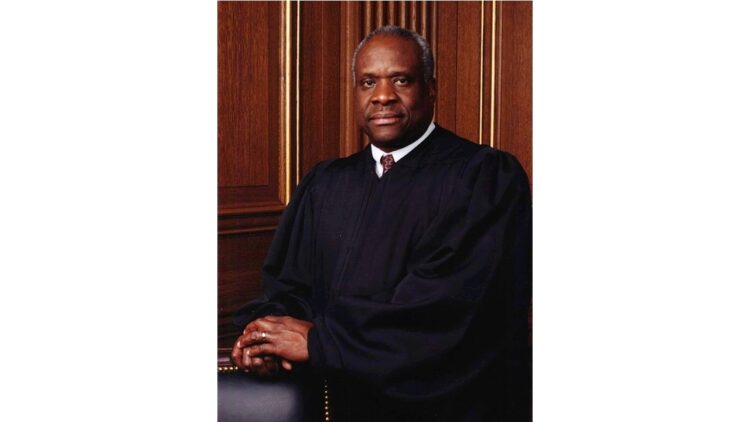
Clarence Thomas, American Hero
“The mob I now faced carried no ropes or guns. It s weapons were
smooth-tongued lies spoken into microphones and printed on the
front pages of America’s newspapers. It no longer sought to break
the bodies of its victims. Instead it devasted their reputations and
drained away their hope. But it was a mob all the same, and its
purpose—to keep the black man in his place—was unchanged.”
—Justice Clarence Thomas
Surrounded by a mob with verbal arrows
And spears all aimed to keep him in his place—
A black man who had had the nerve to raise
Himself from poverty—he felt dark shadows
Of bigotry: they leered as if a gallows
Were right outside. New slave-masters, their goal
Was “high-tech lynching”: microphones and all
The media presenting them as heroes
(So they assumed), and him as villain. Masked
In lies, they warped the hearing to a trial,
Accused him, without evidence, of vile
Acts he’d never done. They glared, and asked,
And slandered. Assumed guilt served as lynching-ropes,
Their sword-sharp tongues to rip his reputation.
They tried to drain his dreams and hard-earned hopes,
To chain him in their up-to-date plantation,
To rob him of fair judgment—slavery
In sinister disguise. They’d use this man
To show that any black American
Who won’t submit to meek dependency
Upon the dubious “help” of government
Could be humiliated on TV,
Instead of being hung up in a tree,
Deprived of any prospect of improvement.
He knew this was insidious enslavement,
A modern bondage. “Welfare” was illusion,
A swiftly-escalating segregation
That built no wealth, becoming permanent.
Entitlement disguised as charity
Restrained the people’s chance to use their talents.
These policies did not make sense to Clarence;
Such schemes would not abolish poverty.
Some of the senators, to their disgrace,
Fumed at his refusal to abide
Their unjust judgment. No-one of his race,
They thought, could be permitted any pride
For an achievement that he didn’t owe
To them. They wanted him still in the ghetto
That they—supposed superiors—had created.
His crime: not needing them to be supported.
Blacks were all supposed to think the same.
They were expected to be full of rage,
Told that non-black people were to blame.
Such rage, he knew, would bring us to the edge
Of civil war again. This proud cabal
In front of him, he knew, did not allow
Him to possess his own thoughts. Even now,
“The beast of rage kept gnawing at my soul,”
As he would write. To keep it in its cage
Was what he must do, he had learned. Obsession
With anger only led to more oppression.
Not hating back, had made him fit to judge
Impartially. Through life’s frequent frustrations,
He’d never come to hate his native nation.
And now, he faced the mob. In some expressions
He read hostility. Through all their questions
He kept his beast-like rage controlled as they
Tried, with insulting claims, to make him say
Something yielding his integrity—
To no avail. He spoke confidently
As the entire nation watched and heard.
Denying charges, weighing every word,
He showed by self-control that character,
Not color, counted. They had caricatured,
Abused and accused him on national TV
As a warning to “uppity blacks” that this committee—
Although it could not hang them from a tree—
Could wreck their lives. This was a travesty,
He said, after which he now was here
Not for a seat on the Court, but for his name.
He’d never been ambitious for mere fame;
His conscience and his principles were clear.
He stood for what was right, and would not bow
To their old order, or to those who said
All blacks must think alike. That segregated
People by race again. He’d not allow
His mind to be chained, for no-one in this free
Country should give up their liberty
To think or speak their mind; no-one should be
In bondage to a new captivity.
Successfully, he held the raging beast
Within him, and the roaring mob, at bay.
America has been profoundly blessed
By those like Justice Thomas, who display
Virtue, truth, and love of our own nation.
These are things that call for celebration.
Poet’s Note: the above is based on My Grandfather’s Son: A Memoirby Clarence Thomas, and specifically the part recounting his 1991 hearing in front of the Senate Judiciary Committee.
Cynthia Erlandson is a poet and fitness professional living in Michigan. Her third collection of poems, Foundations of the Cross and Other Bible Stories, was released in July, 2024 by Wipf and Stock Publishers. Her other collections are These Holy Mysteries and Notes on Time. Her poems have also appeared in First Things, Modern Age, The North American Anglican, The Orchards Poetry Review, The Book of Common Praise hymnal, The Catholic Poetry Room, and elsewhere.












Yep, and they’re at it to this day, now assailing Thomas for his dissenting opinion in this week’s birthright citizen decision, or more technically, for his refusal to pretend that the 14th Amendment’s pivotal qualifier — “and subject to the jurisdiction thereof” — has no meaning. How dare he! Thanks, Cynthia, for covering an important subject.
Thank you so much, Russel, and for referring to his very recent expressed opinion in the birthright citizenship case (alas, not a majority opinion). He is indeed a man to be admired, although I imagine he is too humble to think of himself as a hero. His book is extremely moving.
Yes, there is certainly more than one kind of bondage or captivity, and in praising one man you have eloquently shown up the attitudes of his detractors. How hard it is, indeed, to see one’s own faults, and the mob in this case is especially incapable. And to the mob, as you have shown, the best responses are dignity and self-control–rare and difficult virtues. A well done poem of illustration and explanation.
Your observations are so true, and well-expressed, Bhikkhu. Thank you so much for your thoughtful comments.
Very nice to see your poem honoring Justice Thomas, who I believe will go down in history as one of, if not the, greatest conservative Justices.
Thank you very much, Cheryl, and I heartily agree with your prediction.
I very much enjoyed reading this tribute to Clarence Thomas, Cynthia. He is a great man who has exceptional legal acumen and good boundaries. He has faced so much vitriol and yet stands tall and with great dignity. An American to be proud of. Well done both in the crafting of the poem and the choice of subject.
Thank you, Brian, so much. I am happy that you, too, admire his virtues and, as an attorney yourself, also admire his legal acumen. We need more like him. I highly recommend “My Grandfather’s Son”.
“A modern bondage” indeed! Cynthia, you have captured this “American Hero” in your powerful and heart-touching poem that doesn’t flinch from addressing the evils of racism. Clarence Thomas is a man of integrity and grit who refused to be enslaved. He has a wealth of wisdom we should learn from in this hateful age. Thank you very much for your hard-hitting and thought-provoking poem.
Thank you, Susan, for your supportive and thoughtful comment. I can’t imagine going through anything like that dreadful, publicly broadcast “high-tech lynching” he endured.
You further energize Thomas’s stirring memoir with your compelling poetic skills. Thanks for this timely gift, Cynthia.
Thank you so much, David. His book is such a beautifully-written memoir.
I think he has things to be humble about. I believed Anita Hill, though I was embarrassed for her, publicly claiming she took that 1980s stupid-public-school-kid humor as serious personal harassment. But some of us who were stupid kids in the 1980s have become respectable adults by now. Justice Thomas is a splendid shining example.
Thank you, Priscilla.
Cynthia, your choice of theme makes Clarence Thomas not just a champion against racism, but a champion against that beast of rage within himself. The racism was real, but the inner rage was what he needed to defeat in order to rise. This speaks to everyone. And as Russel Winick pointed out above, Justice Thomas to this very day sees more clearly than many about vital American issues. He continues to display heroism in his recent dissent.
I agree, Margaret; thank you for your comment. I think his autobiography portrays this morality, heroism, and clear-sightedness very well.
A fitting tribute to one of the real titans of the present age. One thing that makes me respect Justice Thomas is his remaining mostly quiet during oral arguments. He calls them a “charade” or something similar. Having given many oral arguments, I agree; it’s largely an opportunity for the judges to pontificate. That he doesn’t stoop to that level speaks to his character.
There’s an old Latin saying that is apropos here: Verba volant, scripta manent (“Spoken words fly, written things remain.”)
Oral arguments are often just a lot of wind — but a judge’s written opinion is serious stuff. The attitude of Clarence Thomas shows that he recognizes the truth of that.
That’s a great saying, Joseph; thank you for making us aware of it.
Thank you, Adam, for your lawyer’s perspective on one of Thomas’ virtuous character traits.
A fine tribute Cynthia to a man who knows suffering and how to rise above it. I remember the look on his lovely wife’s face during the hearings: bewilderment and disgust. The same look we all had watching that kangaroo court.
Blessings,
Gerry