


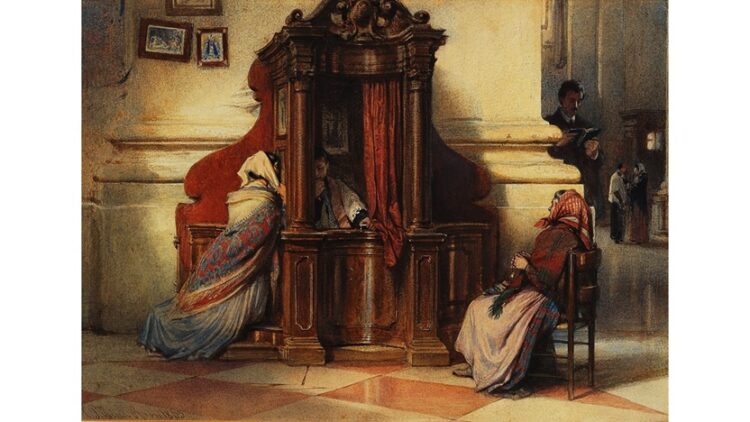
Liturgical Loopholes
I. Scheduling Redemption:
The Pious Musings of a Serial Sinner
I must confess when I transgress
I keep my conscience squeaky-clean.
A swift disclosure lessens stress.
A sinner’s innards burn and roil.
I keep my conscience squeaky-clean.
A word of mercy quells the boil.
I’m quick to seek a saintly ear.
I keep my conscience squeaky-clean
In boxes built with walls that hear.
When vices soar and virtues slide
I keep my conscience squeaky-clean.
Admission buys a guiltless ride.
No ball. No chain. No cell. No blame.
I keep my conscience squeaky-clean
By spilling guts and shedding shame.
Success will bless a murderess
Whose hands are red and lips are keen
To trill of ills that make a mess.
My squealing keeps my conscience clean.
II. Mass Delusion
A gilded spectacle of earthly pomp,
A granite vision built on rocky ground,
Harbors cassocked swindlers from the swamp
Where quintessential predators are crowned.
The gem-embellished chalices are raised.
The mystic ring awaits its ritual kiss.
The lauded dead are lifted up and praised.
The reek of rot is masked with misty bliss.
He told them that His Father longs for hearts
To brim with love that flows for Him, then kin.
The core is where the glory story starts,
Not on the tongues of ministers of sin—
Those lofty scoffers selling all that’s holy
While thieving from and treading on the lowly.
Chiaroscuro
The darkest corners cloister rays of light.
The soil that swallows splintered bones and blood
Feeds the fields of lilies, blazing white—
Their gaze lit up by beams above the mud.
The bleakest sweep of ebon cradles stars
To guide bewildered mice when raptors glide.
A golden glimmer streams through prison bars—
An astral splash where hope and spiders hide.
This dusk and dawn domain of spark and spite,
This sphere of tears and cheers, this orb of murk,
Is blessed with something beautiful and bright.
It lurks in shadows (melancholy’s perk)
For souls who seek the mercy and the might
Of sunshine in the grim abyss of night.
first published in Snakeskin
Susan Jarvis Bryant is a poet originally from the U.K., now living on the Gulf Coast of Texas.















1. They say confession is good for the soul but being squeaky clean most likely lies in one’s perspective.
2. Your second poem reminded me of Jesus and the moneychangers in the temple.
3. Despite the darkness surrounding us, you have given us a poem with a glimmer of light.
Your contextual imagery as always is striking and stirs the soul. “Chiaroscuro,” which you borrowed from the Italian artist technique for “light contrasting with dark,” is certainly an inspired title for the poem, since that is what you accomplished in your description.
Roy, thank you very much indeed for your careful readings of my poems and your interpretations. I am most grateful for your appreciation and encouragement.
Susan,
Chiaroscuro frames the light/darkness image in a new and striking way, drawing us into the forgotten corners where equally forgotten people yearn for hope amidst their hopelessness.
I live on an off-street cul de sac in a wooded, rural neighborhood adjacent to a Pacific Ocean beach. Yesterday I stepped outside my house to take a long-neglected walk on that beach but never got there. To my surprise, there was a beat-up old model car with a flat tire stopped in the middle of the street just beyond my driveway. I spent the next two hours with the young woman (homeless) helping to get her back on her way with a gallon of ethanol-free lawn mower gas and an on-site tire repair from one of our local towing service saints. The woman did not stop crying the entire time, both from drug use, but also from yearning to find a ray of hope in the darkness that was consuming her life. There were also tears of gratitude for having found a nonjudgmental person she could trust in her moment of helpless frustration and dark despair.
I only mention this because your poem captures this woman’s situation in a powerful and profound way. Your skill with words is unmatched and in this case, your read on our fallen human condition was spot on.
I did, in fact, find myself deeply moved by all three of your poems, and if I ever find myself “squeaky clean” or “pure and spotless” it will only be by the grace and mercy of the only One who has the power-wash that can make me “whiter than snow.”
James, thank you very much for sharing this heartbreaking yet heartening story, which does indeed capture the essence of Chiaroscuro. Your story reminds me of how far many of our churches have turned from the very essence of what it means to follow the Way and the Truth and the Life. Your story reminds me of the parables Jesus told to help his disciples understand the true significance of His purpose. I just love your power-wash/whiter than snow observation. It illuminates all in a brilliant image that has me nodding and smiling.
Susan, I’ve long greatly resented the idea that merely confessing a sin absolves a culprit of their crime, and I have to wonder if – & if not, why – the savvier ‘perps’ don’t simply make their ‘Confessions’ BEFORE they commit their evil deeds :-)!
I’m definitely with Roy on the wonderful 2nd piece.
And I gather you’re somewhat of an art expert after reading no. 3. What a unique & interesting concept to pen a sonnet on!! The alliteration’s just a tad weak in all 3, but you’re definitely improving, young lady. 🙂
Mark, you have a great point on the confessing sins front. I’m no “expert” in the art field, but I know what I like and I certainly know the difference between art and an unmade bed – which isn’t considered an asset these days, sadly. As for my alliterative bent – it seems to have morphed into an immutable trait I’m compelled to embrace. As ever, thank you very much indeed for your appreciation of my poetry and for making me smile.
Beautiful sonnets, Susan. I had to look up ‘Chiaroscuro’ — now it makes sense! Your light/dark contrasts are rich with interesting vocabulary and thought-provoking imagery. As always, wow!
Paul, what a beautiful comment coming from a sonneteer I have much respect for. Thank you very much indeed!
The first poem seems a variant of the villanelle, which may take forms other than the one I’m most familiar with. It’s a great poem about the issue of repentance — when you confess a sin, are you supposed to never commit it again (what drug addicts call “going cold turkey”), or can you just keep on relapsing into the sin and trusting to your subsequent repentance? The Catholic philosopher and Thomist scholar Frederick D. Wilhelmsen once wrote that some sins are so deeply ingrained by habit that one can only keep on repenting of them, since the channel of grace called “Penance” is always open and never runs dry. Therefore Susan’s poem can be read in two different ways. It may be seen as a sarcastic comment on those who repent regularly, in the same way that they regularly brush their teeth; or it might be read as an expression of gratitude for the constant availability of forgiveness.
The second poem has the sharp sting of anticlericalism (something we sorely need more of today, when clergy of all denominations seem to have become spokesmen for left-liberal Wokeness). The attack is an Equal-Opportunity one:
Susan’s first seven lines focus on Catholic clergy, while her last seven lines direct fire at Protestant “ministers of sin.”
“Chiaroscuro” is a beautiful poem, though I find its interpretation not immediately accessible (precisely what the poet is aiming to do in the piece, I surmise). It moves from the soil to the fields to the mud to the stars in five packed lines, and then we get mice, raptors, streams, prisons, and spiders. The last part focuses on pairs: dusk and dawn, spark and spite, tears and cheers, beautiful and bright, mercy and might. And the last line gives us the ultimate contrast — sunshine, and the “grim abyss of night.” As has been suggested above, I think the poem may have been inspired by an actual painting
Joe, I am thoroughly appreciative of your close reading – all three poems are a little deeper than they first appear, and you have picked up on this with excellent and engaging observations that I am most grateful for. I don’t want to give too much away (I always like to leave room for the reader) but the sing-song villanelle variant (well spotted) purposefully undermines the gravity of the subject matter and poses many questions.
You are right when you point out that “The second poem has the sharp sting of anticlericalism” and it is directed at “clergy of all denominations” – those who continually look to the self-serving kingdoms on earth for guidance through moral minefields and not the Kingdom of Heaven.
I’m thrilled you enjoyed “Chiaroscuro”, my favorite of the three. I believe despair and hope occupy the same frame – that radiance matters most where and when it is least expected, and that transcendence without cost is a lie. Darkness is not a flaw in this composition – it is the very reason the illumination means anything at all. I would love to say my poem is an ekphrastic inspired by an exquisite painting by Caravaggio. It isn’t… but it is an ekphrastic of sorts. It is based on a scene etched on my heart. At one of the darkest moments of my life, I had a meeting with a pastor in his office. He drew up a third chair “for Jesus” and at that very moment a shaft of sunlight burst through the window, drenching the whole room in the light that was missing from my life.
Joe, thank you for your fine eye and your understanding.
Three wonderful pieces, Susan. I imagine you had a particular place in mind when writing Mass Delusion: it certainly reminds me of somewhere specific (I’m not telling). But of the three, it’s Chiaroscuro that affected me most deeply: it’s comforting, vivid and all-embracing. The image “stars / To guide bewildered mice” is beautiful. Thank you so much.
Thank you very much, Martin. I’m so pleased you enjoyed my bewildered-mice line. I am one of those “bewildered mice” so I’m particularly thrilled to stand out among the lilies and the spiders.
My “Mass Delusion” observations begin with one church – a church I worked for as a secretary for years; a church that decided social-justice was far more important than God’s justice. I have a lot to thank that church for. It opened my eyes and pointed me towards the narrow path to redemption – a much harder and more rewarding journey. The fact that its dark stance has inspired a fair few poems, means my gratitude is ongoing.
These were all fantastic! I was most drawn to Mass Delusion. It made my mind wander to the 7 Woes that Jesus used when describing the hypocritical religious leaders in Matthew 23. “Brood of vipers” and “whitewashed tombs” were always my favorites. You have some equally good zingers of your own. “Cassocked swindlers from the swamp” was my favorite.
Warren, thank you so much for your comment – a comment which points out the brutally honest and challenging words of Jesus that most ignore in our flinch-from-the-stark-truth, hate-speech era. Things haven’t changed one jot.
I like all three masterfully composed poems. But I think the third one is my favourite… it really deserves a place of its own. But in a way it also serves as hope in the face of hopelessness by it being placed last… last but not least by any means. I had to get the first two poems out of my head and read it several times to fully grasp its beauty. On reading my comment so far I hope it does not come across as disparaging to the first two poems. I mean they are so powerful it was difficult concentrating on the third. Hope that makes sense. Thank you, Susan, as usual your poems are jam packed with poetic skill, with words and ideas that could fill a book to say the least.
Maria, it’s always a pleasure to hear from you and I thoroughly appreciate the challenge these three poems pose. “Liturgical Loopholes” purposefully avoids a beautiful message – it aims for an unpalatable but necessary truth. And the closing sonnet, as you quite rightly observe, “serves as hope in the face of hopelessness” – I put it at the end of “Loopholes” because I wanted all who read this series to know there is always hope. It’s in us and all around us. Maria, you are spot on with your analysis and I thank you wholeheartedly for your close reading and appreciation of my work.
These three poems deeply move me, Susan — especially Chiaroscuro, which is a beautiful meditation on the ever-present existence of evil balanced (and hopefully outweighed) by the resilience of good. It takes only one little candle to bring light to the darkness.
Liturgical Loopholes is brilliantly conceived and crafted — rarely have I seen tercets (perfect choice) used to such fine effect. And I love the contrast between the self-reflective sinful but honest speaker in this poem versus the hypocrisy observed in the “lofty scoffers” in Mass Delusion. Your eyes are open, your craftsmanship is impeccable and your integrity is not only laudable but inspiring. Some of your poems may make the day a little sadder, but, frankly, that’s because you are awake. More importantly, your work — even when critical — is always tempered with artistry, hope and the undeniable effect of making us a little bit wiser.
Brian, it’s always lovely to hear from you. I thoroughly appreciate your fine eye, and particularly like your “one little candle to bring light to the darkness” observation… that is all it takes to spread golden strands of hope through the dismal expanse of darkness we face during times that afford little respect for anything but subjective truth.
I am aware these poems are pretty miserable. I believe the stark reality of life is quite depressing. I also believe that one can only find true pleasure in the gifts we have been blessed with – those within and all around us – from an honest standpoint. If the dark corners are flooded with artificial light, we will never experience pure joy… the best there is. The truth matters! I must stop at this point… I’m diving a little too deep for my own good. Brian, as ever, thank you very much indeed!
Susan, these poems are beautiful. I am no interpreter of poetry or anything else, but as I read your words I couldn’t stop thinking about Saul. He was a respected Pharisee acting against the followers of “the Way”. He believed that his acts were sanctioned by the Creator Himself.
He believed that he was casting light into the darkness. He believed that the Law, which had been interpreted, expanded and enforced for over a millennium by people just like him was the truth of salvation. But the actual Truth, the Light and the Way, the Son of the Creator, straightened Saul out, and he became Paul.
Paul wasn’t perfect but he knew that light shines through imperfect people, not man-made structures, temples or systems. His authority did not come from any moral superiority or institutional alignment, but directly from the Truth.
Thank you, Biggest Fan! Your spot-on observations are dear to my heart and I couldn’t have written this without the conversations we have – conversations that light up and shed light on my life.
Need I say more than what has already been said? Only this: You stand tall because you stand on your own shoulders. My mother always used to tell me that honesty is the best policy. She would have been proud of you.
C.B., your mother was absolutely spot on, and I am over the moon a woman of such integrity would have been proud of me. I will do my very best to keep her wisdom alive (and kicking) in my poetry. Thank you for these beautiful words of encouragement. I will treasure them, always.