


.
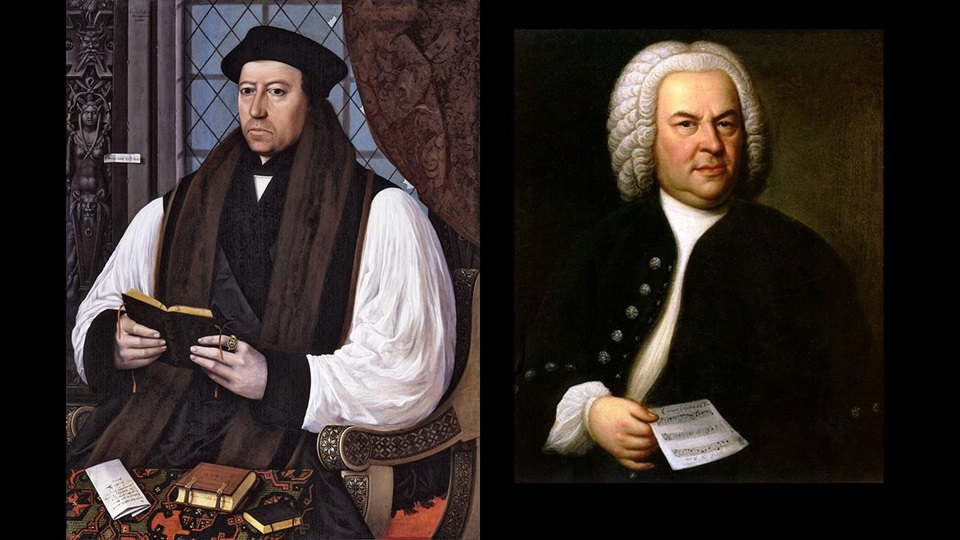
March 21st, Saints Cranmer and Bach
Archbishop Thomas Cranmer, burned at the stake March 21, 1556
.
Johann Sebastian Bach, born March 21, 1685
Johann Sebastian Bach, born March 21, 1685
.
“Upon them hath the light shined.” —Isaiah 9: 2
.
The shadows of two saints come to my mind
As smoke from two extinguished candles rises
To end the service on this twenty-first
Of March. I visualize their smoke entwined:
.
The crackling flames that climaxed Cranmer’s crisis
Were music to the men who thought him cursed—
Poetic justice (at his martyrdom,
He claimed his death would light the earth.) But from
His rhythmic prayers, a fireproof book has come,
And burned into the Church’s memory
Its common prayer of lyric liturgy
That keeps igniting worship, as it kindles
Our faith, rising like smoke from altar candles.
.
To bring to birth his never-dying work,
Bach often had to write his masterpieces
By candlelight, with insufficient rest
From grueling days. Composing after dark—
Soli Deo Gloria—his Masses,
Celestial chorales for earthly choirs,
Concerti, anthems, fugues, he penned his vast
And ever living corpus that expresses,
In prayerful music, unextinguished fires.
.
Like flames, their words and music light the dark.
Pray for us, Saint Cranmer and Saint Bach.
.
.
.
.
Cynthia Erlandson is a poet and fitness professional living in Michigan. Her second collection of poems, Notes on Time, has recently been published by AuthorHouse, as was her first (2005) collection, These Holy Mysteries. Her poems have also appeared in First Things, Modern Age, The North American Anglican, The Orchards Poetry Review, The Book of Common Praise hymnal, and elsewhere.

















Cynthia, you always compose beautifully in your favored area of “lyric liturgy.” This poem is no exception.
Thank you so much, Margaret. It is an honor to have you, and everyone at SCP, as readers. I am deeply indebted to the Book of Common Prayer for its exquisite poetry.
I’m so moved by this poetic tribute to two outstanding historical Christians (one Anglican, one Lutheran) who you are justified in describing as saints. I especially love how you use fire as the image to link them, segueing smoothly from Cranmer (Henry VIII’s Archbishop of Canterbury who became a Protestant martyr being burned at the stake on order of Bloody Mary) to the contrastingly gentle image of J.S. Bach composing music by candlelight. Both men prepared masterpieces for the glory of God, one the Common Book of Prayer used throughout the Anglican Communion, including the Episcopal Church here in America, and the many works of genius composed by Protestant Bach, including multiple Catholic masses. Fire links them together because they are both the bearers of light. A superb gift, Cynthia, on this anniversary of Bach’s birth and Cranmer’s martyrdom.
I’m grateful for your comments, Brian. When I saw that Cranmer’s saints’ day was the same as Bach’s birthday, I knew they could be placed together somehow. They have both inspired me so much, and I know my writing has been strongly influenced by them for a long time.
This is wonderful, Cynthia. I too fully subscribe to the sainthood of Bach (which reminds me I still need to listen to the St. Matthew Passion sometime in the next week…), but, in my Catholic myopia, I was unfamiliar with Cranmer. though I actually owe him a great debt. During my time away from the church, I nonetheless prayed the Office every day, using the Book of Common Prayer, and it was that experience of prayer–and experience of language–that ultimately “brought me home.” So thank you for adding a saint to my personal Communion thereof.
Also, if you ever want to make this into a triptych, March 21 is also the feast of the death of St. Benedict, to whom, as you know, I also owe a great debt. I don’t know that there’s a specific candle link to his passing, but hey, it was the 6th century: there must’ve been candles all over the place. Again: marvelous, beautiful work! God bless.
Hi, Jeffrey …
I love your story of praying using the BCP during your time of absence from the church! It lifted my spirits.
-Paul
Thank you very much, Jeffrey. Your comments are inspiring. I think that (along with the King James Bible, of course) the Book of Common Prayer is about the greatest literary work in the English language, and I (like Paul) am so happy that the BCP has been instrumental in your life as well. The BCP “brought us home” to the Anglican church more than 30 years ago, and having it embedded in our spirits over these years has been such an amazing blessing in our lives. I do need to learn more about St. Benedict — thank you for letting me know that this day is also attached to his name.
Saint Benedict has a strong connection with English Christian tradition, because Saint Augustine of Canterbury (head of the mission band sent to England in 597 by Gregory the Great, and first Archbishop of Canterbury), was a Benedictine monk. The abbey he founded at Canterbury the following year functioned as a Benedictine monastery until its sad dissolution 940 years later. In the monastic calendar, Saint Benedict has two days: March 21 is his “quies” (which as Jeffrey says, is the anniversary of his death or “rest”), and July 11 is his “dies,” or “day” when Benedictines have more of a celebration, because the “quies” always happens in Lent. There is a Latin sequence for Benedict entitled “Laeta dies magni ducis” (“Happy day of the great leader”), which is sung on March 21 as “Laeta quies.”
Thank you for the wonderful information, Margaret! I’m a Benedictine oblate, so I knew of the two feasts (I renew my oblation [i.e., promises rather than vows] every year on July 11), but was totally unfamiliar with the sequence, which I’ll have to ask my brothers at the monastery about when I see them this summer. (I’ve never heard them sing, it but then, I’ve never been there in March). And, speaking of English Benedictines–and of Canterbury–the name I took when I first made my oblation is Brother Anselm. Thanks again!
Sent the text of the sequence just now to your public e-mail, with my suggestion for use as tune.
Well, gawsh darn! I have my own copy of the BCP right at hand, with my Confirmation Certificate duly signed by Bishop Tsu in the year of our Lord 1962. We never had a Latin mass, but I always hated how this literary monument was modernized in later years. “It is meet and right so to do” became “It is meet and right to do so.” Yech! Give me the archaic forms and usages any day.
Absolutely— I agree, C.B.! We are so glad to be in a parish that uses the 1928 B.C.P. liturgy. (“Vouchsafe” is still a good word.)
I agree with you, C.B. But that change is far from the worst. I was recently in attendance at the Consecration of an ACNA bishop. And THIS is what they tried to pass off on us as the Oblation:
“We celebrate the memorial of our redemption, O Father, in this sacrifice of praise and thanksgiving, and we offer you these gifts.”
And here, for comparision, is that same prayer from the 1928 BCP. It is possibly the most glorious English sentence I’ve ever come across:
“WHEREFORE O Lord and heavenly Father, according to the institution of thy dearly beloved Son our Saviour Jesus Christ, we, thy humble servants, do celebrate and make here before thy Divine Majesty, with these thy holy gifts, which we now offer unto thee, the memorial thy Son hath commanded us to make; having in remembrance his blessed passion and precious death, his mighty resurrection and glorious ascension; rendering unto thee most hearty thanks for the innumerable benefits procured unto us by the same.”
Cynthia, what a powerful and telling poem. I have The Book of Common Prayer given to me by my godmother. I cherish it, as I do the music of Bach. To me, this poem serves to prove that ideologies in whatever area they’re based (politics, science, art, religion – take your pick) slaughter truth and beauty. As in the times of Cranmer, those in today’s society, who strive to bring truth and beauty to a world thirsty for hope, are condemned. Cynthia, thank you!
Susan, thank you so much! You are such a gifted wordsmith; your comments always mean a great deal to me. I have no doubt that we who have delved into the literary treasures of the Bible and the BCP are at a great advantage when we pick up our pens. Last night at Cranmer’s saint’s day service we heard the sickening story of his condemnation, torture, and death. The world owes him so much gratitude.
Beautiful poetry – I would never have made the connection between Cramner and Bach! I love the final rhyme – seems so perfect as Bach was/is clearly a master of sound and a counterpoint to the ‘dark’! Great stuff.