


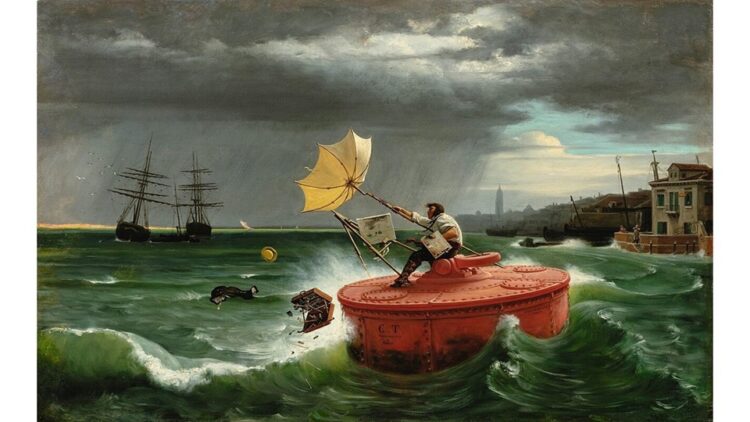
May a Smile Be Your Umbrella
May a smile be your umbrella
And the wind blow you away.
May a purple hippopotamus
Carry off your car today.
May lightning strike your house
For what you’ve said and done.
May you drown in your own tears,
With nowhere left to run.
May the pot of gold you find
At the end of that big rainbow
Be mac and cheese instead
In a broth of toxic Draino.
May you lose your lottery ticket
With the winning number on it.
May you see a four-leaf clover
Falling off the Cliffs of Dover.
May the horse you bet upon
Stumble at the starting gun.
May your exes get together,
Causing you more stormy weather.
May the IRS discover
Money you hid under cover.
May these wishes come to you
Once our divorce is through.
And hopefully once you suffer
You’ll turn a new leaf over
And pretty soon you’ll find
Being “happy’s” a state of mind.
 LTC Roy E. Peterson, US Army Military Intelligence and Russian Foreign Area Officer (Retired) has published more than 7,300 poems in 102 of his 125 books. He has been an Army Attaché in Moscow, Commander of INF Portal Monitoring in Votkinsk, first US Foreign Commercial Officer in Vladivostok, Russia and Regional Manager in the Russian Far East for IBM. He holds a BA, Hardin-Simmons University (Political Science); MA, University of Arizona (Political Science); MA, University of Southern California (Int. Relations) and MBA University of Phoenix. He taught at the University of Arizona, Western New Mexico University, University of Maryland, Travel University and the University of Phoenix.

















Turning things upside down, Roy? The smile/umbrella image sets a theme, but the purple hippopotamus turns the tone to huge humor. Exes getting together approaches the poetic situation, finally revealed in the next-to-last “our divorce” stanza–as the speaker identifies himself. The divorce is the only thing that’s “ours” in this second-person poem addressing “you” in the subjunctive mood, with a host of curses inflicting enough imaginary suffering to change the addressee’s state of mind and hopefully relieve that of the speaker. But the power of the word in cursing may backfire, and you the poet undoubtedly know that, as you complete your picture of the misfortunate man in a well-finished, generally applicable way.