


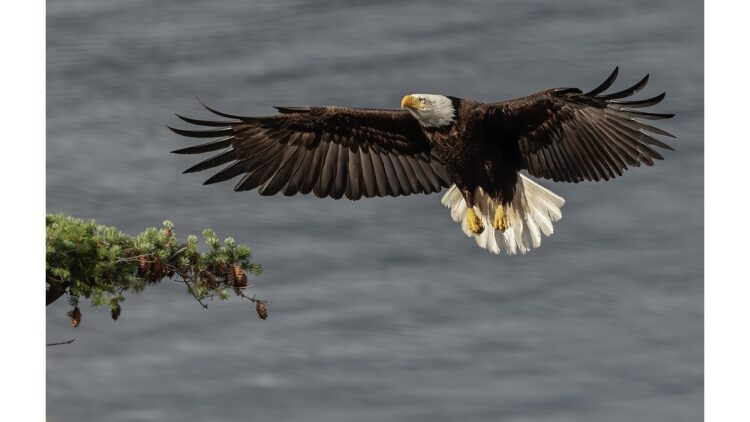
The Eagle
He flies… so quickly, cutting the air’s depth with tawny wings,
the messenger of Zeus—the eagle—bold, his thunderings,
relying on his mighty strength, the wide lord covering
the sky, beyond where other birds refuse such hovering.
The great Earth’s mountain peaks do not hold him, in his paths, back,
nor do the hills keep him from kills, at ease along his tracks,
nor do the tireless sea’s rough-tossing waves keep him from flights
along the West Wind’s breezes manifested in men’s sight.
Within those vast expanses of the heavens, far from stars,
he guides his fine, sleek plumage underneath the sway of Mars;
and all those countless paths of his, above both hills and seas,
have led him even to those heights neared by Bacchylides.
Bacchylides: an ancient Greek lyric poet from 5th century B.C.
Bruce Dale Wise is a poet and former English teacher currently residing in Texas.















This is a skilled rendering about eagles with touches of mythology from Zeus to Bacchylides. I have an affinity for eagles and writing poems about them in part because my cousin Kurt Alt was in charge of the eagle watch program under the Fish and Wildlife Department for the State of Montana and then Director of International Programs for the Wild Sheep Foundation.
As Americans, there is no reason not to indulge “in writing poems about them [the eagles]”, as Mr. Peterson has suggested. In my younger years, a little over forty years ago, when I lived in the small town of Rosburg, Washington, eagles nested in and flew around our ramshackle trailer house; and so a sighting of lots of eagles and seagulls was nearly a constant. Here is just one poem from that distant era in the form of a bilding [sic]:
Distant, always distant—they fly above: the eagles,
as far from the near star as both you and I are,
yet, far from us also, as well as the seagulls.
Theirs is another realm; though the same isobar
marks where they and we dwell. Theirs is another fate,
vertebral, and, though avian, the avatar
is neither a care nor a concern they carnate.
They fly. We do not; that is, at least not without
mechanical contrivances. We lucubrate.
They do not; that is, they do not reason about
aerial dynamics or read traffic signals.
But when the thunder connects, they, we, all turn, scout.
Now I live in the Metroplex, where I am much more likely to see northern cardinals, mockingbirds, robins, swallows, starlings, scissortails, even the occasional roadrunner; but along our lanes and roads, it is the clean-up crew I frequently observe: the crows, the vultures, and the varied hawks. I am more likely to see a red-tailed hawk sitting on my fence, as I did this week, looking out for prey, to eat and leave bones in my yard, like rabbits, rats, and other nearby inhabitants, than ever sighting an eagle. In fact, I don’t think I’ve seen an eagle since I moved to Texas.
But, of course, I have different reasons entirely for this poem “The Eagle”. This eagle has only recently been “sighted” by me, and not “visually” at all, as most of the early eagle poems of my past, where I looked at them symbolically and/or realistically.
A marvellous poem, Bruce. The mention of heavenly bodies and mythological figures bolsters the strength, character, and great abilities of an eagle. Also, it’s good that you told us about Bacchylides. I had no knowledge of him. Thanks for sharing this.
I can see how the “mention of heavenly bodies and mythological figures bolsters the strength, character, and great abilities” of the eagle, as Sri Banerjee has pointed out; and I am sure that was in Bacchylides’ mind when he wrote some of these words in Greek; but from my point of view, it also diminishes the eagle’s power comparatively, if excitedly, placing this “small modern” eagle in such a cataclysmic cosmos. What I admire about such a work is the magnificence and grandeur of the vista that contains the eagle, and that for me is what one could call marvelous.
Against this dodeca, let me place the following tennos of nine years ago.
The longest bridge in India, concrete and heavenly,
was opened on May 26th, in 2017,
and links Arunachal Pradesh with silk-and-tea Assam,
the Dhola-Sadiya across the Lohit’s rushing swamp.
At over nine kilometres, it carries trucks and cars,
as well as battle tanks, if needed in a time of war.
Here at the birthplace of Sudhakantha the balladeer,
the North has suddenly appeared to be much closer, near,
the home of Vishnu incarnate, Srimanta Sankardev,
Assam, the land where one can hear devoted borgeet rev.
Sree Daw Ibecul is a poet of things Indian, particularly its spices, colours, and food. The Dhola-Sadiya beam bridge has been named the Bhupen Hazarika Setu after Assamese poet, musician, and film-maker widely known as Sudhakantha.
Lovely description of the movements of eagles, especially “cutting the earth’s depth” with their wings.
The phrase Ms. Erlandson referred to “cutting the air’s depth” likewise struck my mind when I wrote this iambic dodeca. However, not in my mind when I wrote the poem, in retrospect, I am reminded of two 19th century poems, the opening of Gerard Manley Hopkins (1844-1889) “The Windhover” and the conclusion of Emily Dickinson’s (1830-1886) “A Bird Came Down the Walk”; both poets showing the excitement discussing the most simple of events developed for greater thematic concerns.
Here is a poem of this last Sunday (June 7th, 2026) that likewise shows this:
A Snowy Egret
by E. “Birdcaws” Eule
While driving down the road one day, in the pouring rain,
a snowy egret flew above him, like a mighty crane.
He saw its giant underbelly and great wing-span soar;
it was not anything that he had ever seen before.
He wondered why it bade its time, while flying with no care,
like a white muslin shroud upon a pond up in the air.
He wondered what it meant that he had seen that bird as such.
Was it an omen like the Romans saw near hearth or hutch?
Was it a saint seen on this Sunday seeking peace or prey?
It was so beautiful against the grave and wat’ry gray.
Was he a king due to be crowned, a ghostly albatross?
a purity and surety, shaped like a flapping cross?
E. “Birdcaws” Eule is a poet of birds.
Unexpectedly Greco-American, Bruce. The eagle in flight tends to transcend itself, even when diving for the kill, as you show in the swoops of this piece. Your earlier poem makes an almost scientific contrast with human beings. Both maintain a sweeping air. My own experience of eagles is a mere nest in a Florida cypress swamp; more of a close-up.
I really am not as Ms. Coats writes “Unexpectedly Greco-American”; for, for more than half a century I have been struggling with the Classical World of Greece, from Homer through the Hellenistic era, and not only in poetry, but also in philosophy, from the preSocratics through Aristotle, and mathematics, from Thales to Euclid, and so much more; and then in the Classical World, Hebrew and Latin as well.
Here is a recent example:
A Stasimon
by Esiad L. Werecub
You wild goddesses, who dart across the distant skies,
by seeking vengeance for the murders that you so despise,
We beg you, furies, please free Agamemnon’s son from hate.
Relieve his raging fury, let his madness, o, abate.
He sought revenge from his hard mother’s deed. We share his grief.
Grant him relief, for happiness in mortals’ lives is brief.
Release this boy from mania, from anguished sorrow’s din,
since it swoops down upon life’s sloop, like a swift gust of wind,
and leaves it tossing on the ocean, there wherein it sinks.
Let him, o rest at ease and peace. Seek sound Euripides.
Esiad L. Werecub is a poet of Ancient Greeks and Greece.
Of course, in the modern era there are so many other poetic battles as well, from India, China, and Japan, as well as Italy, France, Spain, Germany, Russia…and the list goes on. What chance does any individual have? Just this week I came across Cyprian Kamil Norwid (1821-1883), a Polish Romantic-Realist poet and proset, from whom I drew these words.
Through solitary wars are future readers only won,
you will not dwell in Temple halls in choices of your own.
You will not own a private portal—one will unlock yours—
and what in life were wide wings flying, history devours.
Today’s loud screaming boasts you take for trumpet blasts are not;
they are votes being cast, and silence, is the ballot count.
He certainly understood the battle–at least partially.
Unexpected only to me, Bruce, though I know your wanderings through cultures. For myself, it’s partly the familiarity with the languages, which comes and goes as you walk in those ways. Haven’t had my Greek paths out recently–since I lost an intriguing rarity mid-reading, and couldn’t find it again. And with each change of language there is both labor and joy. Very much enjoy Cyprian Kamil Norwid’s contrast between “screaming boasts” and “trumpet blasts.” Too bad so many poets act out the screaming without listening to themselves, and then use silence against others who would listen–but for the hostility. Keep battling when you must, but remember your own remark, “What chance does any individual have?” Surveillance by an eagle eye helps!
Bruce, As your former neighbor in southwest Washington I continue to see Bald eagles on a regular basis, the most recent being one seen two days ago soaring over Highway 30 near Knappa, on the Oregon side of the Columbia River. They are beautiful to see whether in the air, when sitting in a tree, on an “eagle pole” at the beach, or while on the beach itself scavenging with other eagles along with a swarm of squawking gulls waiting their turn to dine. Your poem captures the eagle’s flight well, with your poetic hyperbole equally matching our national bird’s inherent over-the-top majesty!
All the best and thanks for continuing to share with us.
quickly’, ‘cutting’, ‘Zeus’, ‘thunderings’, ‘peaks’, ‘kills’, ‘stars’, ‘Mars’ – the language of strength and loftiness sparkle in this poem.
Thanks for the read, Bruce.
Do they actually sparkle as Mr. Freeman suggests?
Ms. Coats is on target when she states, “Surveillance by an eagle eye helps”. She, too, also notes, with each change of language there is both labor and joy.”
What does the epic look like in the NewMillennium? Why would one even go near it? To touch that realm is madness, as Homer knew quite well; and he had so much less to deal with than a poet does today. [Ezra Pound is an American who felt the impulse to touch epic, and failed utterly.] In a world that is so divided into countries and tribes within those countries, the very idea of one communal language that records a language’s history and entertains cultural concepts seems preposterous. First of all, there are so many languages. Some say mathematics is the universal language; yet mathematics, as breathtaking a view as it is, is no more universal than, say, music. For writers like Hesiod or Homer to embrace a moral Universe in those times, seems to me [emst], so much easier; but it was their creations that suggested the way forward in their language—Greek. And so they went forth.
But as one approaches the Classical era in Ancient Greece, new lines of poetry are developed. Lyric poetry takes up one aspect, and here is where we find Bacchylides and Pindar in the 5th century BC, odes that are developed for particular social occasions.
“The Eagle” is part of a larger ode that shows the focus upon power and strength, seen, for example in the Olympic challenges. It is that vusion I am working on in that excerpt, which likens Bacchylides himself to that power of language [his ode] enduring two-and-a-half-millennia.
Then, too, Greek drama at the same time evolves out of traditional religious celebrations, and that is where one would find writers, like Aeschylus, Sophocles, and Euripides, hence in “A Stasimon” from Euripides’ Ὀρέστεια, which takes just a brief choral transition from that play, and places Euripides himself within the tennos, here attempting [however crudely: maybe I should have used the Greek charichord “translator”—Crude Abe Lewis], to argue with Euripides about the beauty and mastery of his language through this meager, but extraordinary, vehicle: English.
And finally, the prose onslaught of philosophy (e.g., Plato and Aristotle), history (e.g., Herodotus and Thucydides), and mathematics (e. g., Anaxagoras and Archytas), etc. which will take over through to the NewMillennium. Striving after new vistas in such an enormous language as English is itself madness; yet, nevertheless, it is a worthy project
that I do have to remind myself time and again.
Of “The Eagle”, though Mr. Tweedie has suggested it “captures the eagle’s flight well, with…poetic hyperbole matching our national bird’s inherent over-the-top majesty,” I am not quite sure that is so.
Having recently read Mr. Tweedie’s “Trip to Italy”, I am reminded people view things differently.
Trips to Italy do elicit various views.
1. Pompeii
In Seventy-nine, Mount Vesuvius
erupted, and destroyed Pompeii, keeping
it ironically impervious
to nature’s inevitable sweeping
away of the past. Lava made it last
far beyond the ravages of savage
time. Into eternity it was cast,
and salvaged for use in a later age,
as a store of knowledge for life back then,
hardly what its inhabitants wanted,
though no one has been able to ask them.
Most had answered by running the gauntlet,
except for perhaps the elder Pliny,
who wanting data, didn’t get any.
2. Rome
It wasn’t built in a day. There’s too much to see.
Oh, where does one begin? the Ancients? the Changeless?
the early centuries of Christianity?
Wherever one begins, the view rearranges
itself around another era, an eon…
the Renaissance, the Baroque? One steps through ages.
the Enlightenment? or the Risorgimento?
One passes through time’s portals. The Modern turns again.
One comes up to the Colosseum, Pantheon,
the Forum, so many museums, churches…then,
as in the Piazza Navona, Bernini,
the fountains, the hills, and the mountains of chagrin,
Saint Peter’s, Michelangelo, classic, antique.
3. Dante in Florence
The statue of the poet Dante Alighieri
in Piazza Di Santa Croce, Florence,
shows him atop a pedestal and wearing
a toga draped around his hard stone shoulders,
falling in wrinkled torrents o’er his torso;
he has a look of hatred or abhorrence
upon his face which makes him seem a bold force,
and, with a laureled, slightly lowered forehead,
formidable, perhaps, no, even more so.
An eagle at his feet is looking upward
at the idolized writer, as if both were
upon an aerie at the top of the world.
Below, at each statue’s corner, are other
symbols of power, four ferocious lions,
with gazes as amazing as the poet’s
extraordinary and austere defiance
that rises up into, against the airy
blue, a paean raised up from the Renaissance.
4. Postcards From the Fatal Triangle and Napoli
“See Naples and die? Yes, but to see Venice, die first.”
—Régis Debray
Shimmering in bright gold and white is Venice, bathed
in sunlight, paved in blue water. Along the Grand
Canal, Santa Maria della Salute,
azure-backed sky, beyond intricate, elegant
apartments, above the gondolas and taxis
passing colorful, striped poles, near, but distant, stands
on one-hundred-thousand wood piles at the axis
with Bacino di San Marco on the Lagoon.
The great, domed Longhena-designed basilica
was built, because of a blessed and beautiful boon,
Venice was saved from the throes of a raging plague,
in mid-17th century’s slow-waning moon.
Earth has so many things to show so fair, so far,
like old Napoli, polished in twilight at dusk,
crepuscular, from its square central business husk
up to the heaven’s first appearance of a star.
The beauty of the evening, shimmering in car,
ship, building, taxi, castle, church, airplane or bus,
lies open to the bay and Mount Vesuvius,
a jeweled strand that glitters in the azure air.
This panoramic city and its setting are
hung in an atmosphere, as is moist mist or musk,
a curving, ivory-white elephantine tusk
is carved along its wharves, and caves into the har-
bor, like a dimly-lighted restaurant and bar
where people come to drink away the daylight’s fuss.
So close to greatness!
In reference to Mr. Anderson’s comment. This is exactly how I feel whenever I am in the presence of the best of the Ancient Greeks—“so close to greatness”; and so the fresh vision, even “translated”, that comes from such a writer is pronounced; I feel it—and deeply—as in “The Eagle” or “A Stasimon”, a dodeca and a tennos. And this also happens with English writers; so though Shakespeare is far from each of those two poems, a single phrase, like “in men’s sight” from the first poem, or “tossing on the ocean” from the second show that Shakespeare’s influence, too, is deep in my words. In the case of Napoli, Wordsworth dominates within a rhyme scheme of abba/abba/abba/ab. For me such works profoundly inform comparisons and stylistic differences between the pieces; and that is part of what I am looking at in “The Eagle” or “A Stasimon” as well.
I very much enjoyed the majestic, even stately heptameter, and the peppering of Classical allusions (which were never gratuitous). The majesty of the eagle is reflected in the tone of the work.
Mr. Sedia notes that the iambic heptameter is capable stately topics; one example suffices:
Ben Lewis Solomon
by War di Belecuse
He was a US Army dentist during World War II,
assigned a front-line surgeon in the Battle of Saipan.
When Japanese began to overrun his hospital,
he pressed the fast evacuation of his wounded care.
No hope for his survival, he…grabbed an M1 Garand,
and stood the enemy assault into his set-up tent.
He stayed nearby, where men had died at their machine gun site,
proceeding then to kill some ninety-eight before he died,
his body having taken seventy-six bullet shots,
as well as twenty-four or more knife stabs while still alive.
Ben Lewis Solomon received his country’s top award
for heroism, after it was due—Two-Thousand-Two,
when his whole family was dead. His parents never knew.
But we who love America recall the brave, and few.