


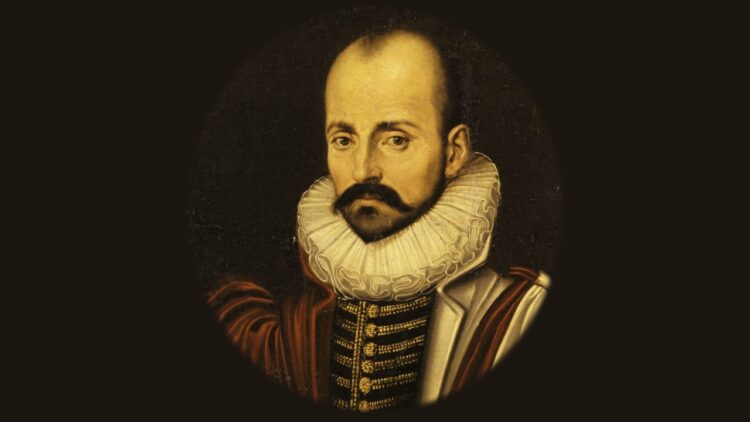
Montaigne and Us
He holed up in his tower of stone, alone,
Sickened by what he saw had overcome
All France: religious wars, the worst they’d known.
Was Paris worth a mass grave? Yes, said some.
His library well stocked, his pen in hand,
His essays surveyed his own life to say:
What did he know? He strove to understand,
Locked in that stronghold of his mind each day.
And now, America sorts itself out:
One side moves here, the other side elsewhere.
We ponder: Leave our cities’ plague of doubt
And move to fresher, freer, country air?
Perhaps. Still, Montaigne asks: What do we know?
His question tolls no matter where we go.
New Barber? Beware!
My last one quit and I am in despair,
Anxiously squirming in this barber chair.
This new man is a stranger. Do I dare
Complain? Oh, no, for we must form a pair,
Bound by secrets I must quietly share.
My cowlick, for example, I’ll declare
To him alone. Each snip we’ll fully air
With care, so he will know to be aware
Of any glares of scalp I’ve noticed flare
Where, per Gertrude Stein, “There is no there there.”
Should he unbare them with some strands of hair?
Or should he slick it back like Fred Astaire?
To calm my scare, I say this prayer: O God,
Please let this barber not be Sweeney Todd.
Steven Peterson is the author of Walking Trees and Other Poems (Finishing Line Press, 2025). He divides his time between downtown Chicago and northern Wisconsin.

















Steven, I recently found some statistics about Texas that relate to your last verse of “Montaigne.” as a partial answer. The triangular region framed by the cities of Austin, Dallas–Fort Worth, Houston, and San Antonio is experiencing a wave of growth of historic proportions more than anywhere in the world. The Texas Triangle contains five of the 20 largest cities in the U.S. (City of Dallas, City of Fort Worth, City of Austin, City of Houston, and City of San Antonio.) The Texas economy is on fire. The state added 660,000 new jobs last year – more jobs than any other, and twice the number of new jobs compared to its historical average. With Dallas by far leading the growth with 50,000 jobs a month (almost 2,000 jobs a day). I thought this might be on interest and relate to your first poem.
Your second poem was fun to read for those of us in particular dealing with similar hair challenges. What an ending with Sweeney Todd, the “Demon Barber of Fleet Street” character that used a razor to decapitate the heads of his customers.
The almost complete monorhyme of the “Barber” poem suits its comic purpose, and the addition of more such rhymes internally (“cares,” “glares,” “unbares,” “scare”) hammers the humorous nail home. I love the reference to Gertrude Stein and one of her best know comments.
The sonnet on Montaigne is perfectly composed, though I sense a certain disconnect with contemporary America’s state. Montaigne wanted the isolation of his home and library to escape the troubles of France, and many of us now feel the same way about the places where we live, if they are subject to riotous disorder. But “Let’s escape to the countryside” doesn’t work under modern conditions — the crazed left-liberal ideologists who are the source of our suffering are now EVERYWHERE, and their passion to impose their will upon us is as ferocious in rural hamlets as it is in big cities.
I love the two references that are embedded in this sonnet: King Henry’s comment that “Paris was worth a mass,” and Montaigne’s “Que sais-je?” Montaigne nourished a kind of mild irenic skepticism that made him a good politician and negotiator, but that stance isn’t helpful for us today. We DO know what the problem is — and what we need it the will to hunt it down and kill it, not hide in our tower.
Montaigne and Us is an interesting take on civil disorder and in France of yore and contemporary America, though extreme politics fuelled by algorithms (not Al Gore) is in the modern mix. Unfortunately, both sides of the equation claim they are in the right, leaving no middle ground.
Like a barman, the barber is often confided in – so beware.
I loved the lines: ‘Should he unbare them with some strands of hair? / Or should he slick it back like Fred Astaire?’
Thanks for the read, Steven.
The French seem unable to refrain from social criticism. Compare, for instance, La Rochefoucauld.