


Murder at the Stocker Mansion
A Poetic Noir Whodunit
—San Francisco. 1948.
1. Prologue
The Stocker mansion sits upon a cliff
Which overlooks a rocky, wave-tossed shore;
Victorian—and derelict as sin.
Within the parlor—could there be a whiff
Of something sharp which wasn’t there before?
A touch of hemlock in the Master’s gin?
A stormy night illumined by dim votives;
A family of scarcely-felt affection;
A patriarch who breathes his final breath;
A crime-scene of suspicion and dark motives
Plus clues suggesting greed and misdirection—
Which one of them arranged Drew Stocker’s death?
The widow wails, “I Ioved him”—with a smirk.
The mistress says he liked to call her “Honey.”
The spendthrift son will never have to work.
The troubled daughter has great need for money.
The lawyer warns that there’s a missing will.
The doctor claims there was a risk of stroke.
The butler buttles with a sneering chill.
The housemaid winks as if all were a joke.
The murderer is at the Mansion still.
Each one denies it. Which of them is lying
And waiting for another chance to kill?
The Private Eye must solve this—or die trying.
2. Ward Dexter on the Scene
We’re closed. I need a drink, but faithful Trish—
The best Gal Friday that I’ve ever hired—
Feels sorry for the lady. Sure, I’m weary.
But then I see her! Legs for days. Dark eyes.
Yup, I’ll make time for this one. What a dish!
Mink stole, a ruby pin… My mind is fired
With bedroom thoughts. I’m flush (and slightly leery.)
It’s clear I’ve hit the jackpot. What a prize!
A sultry voice. “Sir, I need a detective.”
I look her up and down. She’s pale. She’s rich.
She tells me that her life is on the brink—
Her husband’s drink was poisoned. Now he’s dead.
“Alright,” I say. “There’s no one more effective.
Ward Dexter at your service. Crime’s my niche.”
She sobs. “Please help me! The policemen think
I killed him!” Both her eyes—and lips—are red.
A murder suspect. Yup. She’ll soon get booked.
She shifts her legs. She lights a cigarette.
I clear my throat. “So tell me, Mrs. Stocker—
Your husband. Did you kill him? Yes or no?”
Those pursing lips, those sloe eyes… Yeah, I’m hooked.
A woman draws me in when she’s a threat.
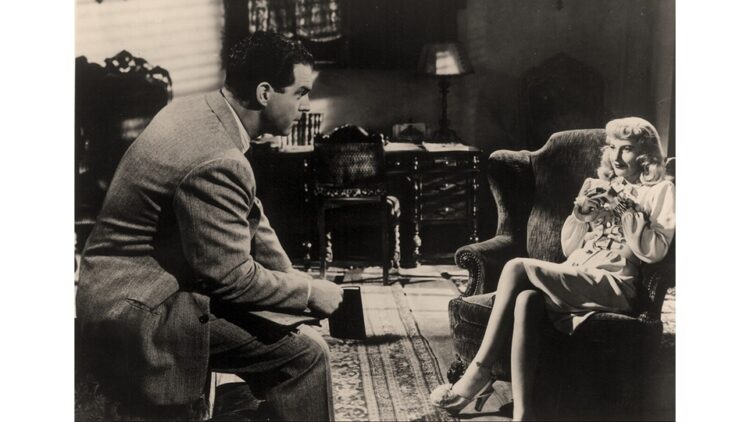
She pouts like Barbara Stanwyck. No great shocker.
She sighs, exhales some smoke, then speaks real low:
“I’m innocent. I’d never hurt my spouse—
My saintly husband!” Now I have to scoff.
I’ve been around the block. This dame is lying—
And I won’t play the fool when death’s at stake.
“A saint?” I chide. “Or was he just a louse?
Why else would someone want to bump him off?”
Her weeping act ain’t working. She stops trying.
“You’re right, of course. My husband was a snake.”
“So he had enemies?” I ask. “A few,”
She says. “But I could never be disloyal.”
She falters when she sees my doubting stare.
She says she tried to act the faithful wife
But Stocker was a miser and untrue
Up to the day he shed his mortal coil.
“My daughter, stepson, others who were there…
Just ask! They’ll swear I’d never take his life!”
I hold her eye. “But are you glad he’s dead?”
She sighs the martyr, like I’ve hurt her feelings.
“I’ll take the job,” I say. “I’ll solve this case.
Five hundred bucks—no refunds, win or lose.”
But is she innocent? So the dame said.
But I’ve seen way too many double-dealings.
She signs the contract. Next step—scope her place;
I’ll check the scene for witnesses and clues.
3. His Girl Friday (A Brief Diversion)
The boss woos every doll in town
Except the gal who types his junk.
A private dick of scant renown
Who never thinks of me. The skunk!
He gets in trouble, I’m the one
He calls but never thanks… or pays.
My heart skips when he calls me “Hon.”
I ought to quit. Or get a raise.
Ward Dexter. What a selfish Joe…
I’m sweet on him—head over heels!
I’d tell him I’m in love… but no.
It won’t affect the way he feels.
4. The Dame
I visited the Stocker family manse.
I met the dame alone. She seemed compliant
And innocent—until she rubbed my pants.
But I won’t dance the rumba with a client
Not even when she makes my heart beat hard.
She’s danger in a dress. A dream-filled fever.
But I’m on top. I hold the winning card:
Although she’s lured me in, I don’t believe her.
5. A House of Clues
The shamus won’t yield to the dame’s temptation.
He runs a bona fide investigation:
The careful hunt for clues, interrogation,
The probe to pierce through witness obfuscation
While entertaining serious mentation.
As Dexter stumbles forth to revelation,
His secretary, Trish, types his dictation:
Eight suspects saw Drew Stocker lose his life:
The secretary, daughter, stepson, wife,
The doctor, lawyer, butler and the maid.
Each one was there—a murderous parade.
At 9:10 Stocker drank the poisoned gin;
The killer must have spiked it from within.
There’s hemlock stored inside the shed nearby
Which anyone could get to on the sly.
The dame had seen the lawyer leave the shed.
Her stepson, too, who saw her and then fled.
They all were present when Old Stocker died,
And not one thought his death unjustified.
The daughter has a pricey habit: hash.
With Stocker dead she’d get that needed cash.
The Old Man’s son’s a playboy and big spender;
With Stocker dead, he’d glut on legal tender.
The secretary was the Old Man’s side.
With Stocker dead, she might buy back her pride.
The butler and the maid were both caught stealing.
With Stocker dead—poof!—no proof of self-dealing.
The doctor suffered from inebriation;
With Stocker dead, he’d keep his reputation.
The lawyer slept in Mrs. Stocker’s room.
With Stocker dead, could furtive romance bloom?
The shyster and that sultry dame? Bum chance.
I saw the dame and doctor steal a glance.
The dame. The femme fatale. The victim’s wife.
With Stocker dead, she’s free and set for life.
The Will says she and both the kids inherit.
Is there a second will? None I can ferret.
And as for Stocker’s health, I need to mention
His heart was weak from booze and hypertension.
One other oddball thing. I found a pill
Upon the rug when I perused his Will…
6. The Police Sergeant’s Warning
(A Second Brief Diversion)
Scram, Dexter, leave the homicide to us
And take a nice long walk on a short pier.
The corpse is at the morgue. No blood, no pus—
We know the guy was poisoned. And it’s clear
That someone close to him preferred him dead—
Enough to risk the chair or lethal gas.
I can’t share what the witness statements said.
Vamoose before I kick your nosy ass!
Go take some undercover photographs
Of wayward wives or husbands who are cheating.
Or sleuth some missing persons just for laughs.
But step on my toes, bub, you’ll take a beating.
Don’t test me, Dexter—you’ll end up in jail.
And I’ll make sure you can’t afford the bail!
7. Which One of Them?
Come on now, Dexter, focus on the clues.
You’re here to find the truth. Not help the dame.
She paid you cash. It’s not like you will lose
A single dime if you find she’s to blame.
So let’s be fair. Eight suspects. And each one
Had some good reason the Old Man should die.
But why not simply use a knife or gun?
Was poisoning the gin somehow more sly?
The dame. She claims she saw things that would seem
To implicate her stepson and the lawyer.
The stepson gets to live his playboy dream;
The lawyer’s free to shtup his new employer.
The dame said she saw both men near the shed —
The shed where hemlock had been stored away.
But if the lawyer shares the widow’s bed,
Why would she implicate the guy that way?
The dame! Those eyes! She’s got me in a haze.
I need some coffee. A quick bite at Pops.
A smoke and maybe think outside the maze.
I need to solve this case before the cops!
The dame. The gin. The pill found in the rug.
But hearts don’t stop because of one lost drug…
Or do they? What if…?! That’s the explanation!
Okay! Let’s get forensic confirmation.
8. The Solution
Sit down, my friends, it’s time you sit a spell.
For once you’ll listen. I have dirt to tell
About a son, a daughter and a medic
A lawyer and a mistress and a wife,
Two servants—plus a guy who lost his life.
There’s nothing in this house that’s copacetic,
And no, there won’t be any absolution.
Just justice as I tell you the solution.
First Stocker’s son—You all know him as Louie,
A guy who smells of perfume and Drambuie.
He likes to spend. So with this gal named “Red,”
He shoplifts jewels. They’re hidden in the shed.
He likes nice things. Bright nights of drink and dance.
Could he be Stocker’s killer? Not a chance.
The Will would short him on what he could spend.
With Stocker dead, his gravy train would end.
And next the daughter. Lovely, troubled Mary.
The lawyer, Sharp, says Mary likes to fawn
On handsome men, the kind she’d never marry
(Though she might keep a gift that she could pawn.)
She’s hooked on pricey drugs to help her cope.
But with Pop dead, her money’s stuck in Trust.
Old Stocker paid her bills. Why would she hope
To dry her source of cash up “dust to dust?”
And then, of course, the butler and the maid.
They both had access. And they both had means.
But what’s the point if neither would get paid?
Why flirt with prison for a hill of beans?
It’s true that neither one of them mourns Stocker,
But nonetheless, I’m cutting these two loose.
Each one was helpful and a candid talker.
From where I stand, they don’t deserve a noose.
Four suspects left, my friends. Let’s start with Kay—
The “secretary” Stocker would call “Honey.”
How often did they drive down to L.A.
To share a tryst? Did Kay kill him for money?
I’m not so sure. I read through the whole Will—
(The only will!) No mention. But, of course,
If Stocker hadn’t died she might well fill
The role of wife—if there was a divorce.
As for the lawyer… could Sharp be a shill?
He hinted Stocker’s mistress might get paid
According to a nonexistent will—
A premium, he said, for getting laid.
But friends, this was an act of misdirection.
The evidence reveals the lawyer lied.
But why? Obsessive love led to deflection.
He wanted Mrs. Stocker as his bride.
But not as much as Doctor David Mills!
A killer? Well, he craved the victim’s wife—
Enough to give the victim phony pills!
A stroke—not poison—took the victim’s life!
The hemlock in the gin was a distraction.
You see, I found this pill dropped on the rug.
It’s sugar! Hence a terminal subtraction:
The murder weapon was a withheld drug!
Now cue the grieving widow, Stocker’s wife:
The one who wept, who seemed to have such need.
She called the shots on how to steal his life
And thus tricked Dr. Mills to do the deed.
She also conned the lawyer; and she tried
Seducing me, to trap me in her lair.
Yup, she’s the reason that Drew Stocker died.
She’s earned her seat on the electric chair.
The wife and doctor, now who would have thought ‘em?
But that placebo pill I found has caught ‘em.
The doctor never saw how he’d been used,
His blind devotion fatally abused.
He may not be as greedy or as jaded
But he’ll die with the widow that he aided.
Each killer that I capture always fumbles.
And that, my friends, is how the cookie crumbles.
9. A Confession
Amazing, Mr. Dexter! Quite insightful.
You’ve got the details right. But not the “why.”
You cannot grasp a husband who was spiteful,
A hostage-taker with a roving eye.
You figured out the truth right from the start.
It’s David—Doctor Mills—who has my heart.
And still that tells you nothing of my pain
Or anything about this grave endeavor.
Poor David and I nearly went insane.
My husband sneered and smirked. He said he’d never
Give me my freedom. He’d grant no divorce.
And so he left us with no other course.
You’ve never been a partner in name only—
A mere convenience, as if bought on sale,
Then mocked and shamed. My life has been so lonely—
David’s, too. We’d rather both face jail—
Or worse—than one more night upon this cliff.
I’ve no regrets. My husband’s finally stiff.
But something you should know about this “slaughter”:
A glitch arose. When the policemen came
They thought the guilty party was my daughter.
Her past crimes made her logical to blame.
So I played temptress to get you involved.
I knew you’d prove me guilty. Murder solved.
Had I confessed, I wouldn’t be believed.
A mother might say anything to shield
A child whose loss would leave her doubly grieved.
Now, Mr. Dexter, all our fates are sealed.
I know my daughter’s safe. She will stay free.
And we will face the law, David and me.
10. Epilogue
The Stocker mansion sits like a museum
Upon a cliff above a wave-tossed shore;
Its Master rests now in a mausoleum
While sirens fast approach outside the door.
The gumshoe holds the killers with his gun;
The murderers fix Dexter with a stare.
Within mere minutes the arrests are done.
Might crimes like this earn the electric chair?
A Court of Law will aim for justice served.
Still, socialites have sometimes dazzled juries
And not all get the verdicts they’ve deserved.
Ward Dexter shrugs. For now, no cashflow worries—
His fee’s secure despite his client’s sins.
But Rio’s out, and so is Argentina—
He has to testify when court begins.
Another broken heart. Plus, a subpoena.
A quick note on the undiscerning cops
Who couldn’t figure out this homicide:
The sergeant gets reduced to traffic stops
And wishes Dexter’d choke on cyanide.
Just one more thing: since Dexter took a loss
On romance, now he’ll play it safe—but good.
Trish Smith, the smart Girl Friday, lands her boss:
A happy ending fit for Hollywood.
THE END
Brian Yapko is a retired lawyer whose poetry has appeared in over fifty journals. He is the winner of the 2023 SCP International Poetry Competition. Brian is also the author of several short stories, the science fiction novel El Nuevo Mundo and the gothic archaeological novel Bleeding Stone. He lives in Wimauma, Florida.


















Why only last night I was re-watching the TV production of Poirot’s The Third Girl: I love these sort of murder mysteries, and you tell this brilliantly well – more Raymond Chandler than Agatha Christie, but perfect in context. Well done: this is a really accomplished and sustained piece of writing. Narrative poetry can be truly exciting!
Thank you very much indeed, James. I have long been a fan of film noir with special attention to The Third Man, Key Largo and The Maltese Falcon. (Of course, my favorite is Casablanca, which is considered “film noir adjacent.”) I appreciate your mention of Raymond Chandler since my Ward Dexter character is indeed loosely based on Sam Spade. I would also like to mention Dashiell Hammet who Thin Man” (along with the witty William Powell-Myrna Loy film series) was a major influence here. I agree with you — narrative poetry has great potential.
Impressive and enjoyable! Though there clearly must have been significant work to craft this, you’ve created something that reads effortlessly. I enjoyed your unobtrusive use of rhymes and incorporation of noir cliches. Thanks for starting my morning off with a wonderful, well-written work of fiction set in motion by your creative and poetic skills.
Thank you so much, Zumwalt! I am so glad it looks effortlesss because — trust me — it was not! I especially worried about how to create a group of suspects which the reader could follow. But the problem-solving was tremendous fun. And I loved identifying and incorporating noir tropes as well as 1940s lingo into this piece.
Brilliant! Absorbing! Absolutely breath-taking noir! There are too many great uses of words and phrases to even attempt to select a favorite. Including Barbara Stanwyck sharpened the image to a magnificent degree for me. Your rhymes were impeccable and alluring with their superb words and variations. Sustained suspense kept me riveted to the flow and pace as the detective worked his way through the criminal case with panache and deductive skills. I cannot overemphasize my admiration nor quell my enthusiasm for this seminal masterfully written poem-noir.
Thank you so much, Roy! I’m so glad you enjoyed this narrative piece. Yes, I threw Barbara Stanwyck in there to properly clarify the idea of the “femme fatale.” Your generous assessment of this poem has really made my day!!
Brian, this beautifully conceived and wonderfully woven pastiche is a real accomplishment, and I appreciate the amount of work you have put into this to produce the noir atmosphere, the comic suspense, and especially the intricate plot, revealing itself seductively and wittily. I just love the private-eye patter, and the social satire, and the way the change in tone and form serve to propel this perfect piece along with poetic aplomb, keeping it airy and arresting (excuse the pun) at the same time – most theatrical!
Ward Dexter is magnificent! His tenacious chatter and punchline closes kept this reader hooked. And that cinematic imagery – wow! The gothic, cliff-top mansion, the stormy night, the cigarette smoke… and all those secrets, the hemlock, the poisoned gin… the house is a dark stage of murky morals where no one is safe from scrutiny.
Every line of this poem is a winner, but if forced to choose, my two favorites are: the atmospheric and hilarious, “Victorian – and derelict as sin.” and “Each killer that I capture always fumbles. / And that, my friends, is how the cookie crumbles.” which mixes cynicism with showmanship wonderfully. And the sheer buoyancy and musicality of the language make we want to flounce off to the West End and see it in all its poetic and musical glory on stage! Bravo, Brian, Bravo!… Encore! Encore!
Susan, I’m absolutely thrilled by your reaction to this poem! Thank you! I had a great deal of fun writing this poem, including all that “private eye patter” and down to getting the names just right. I’m especially glad that you see it in theatrical terms since this is something of a poetic screenplay with dialogue and monologues and close-ups and fade outs and changes of point of view. That “cookie crumbles” line is something I could imagine William Powell saying to a cast of all-star suspects in one of the Thin Man movies. I love you hearing musicality in the language. Each one of the poems in this set is something of a “number.” So why not? And, by the way, I’m especially proud of the poem 6 — The Police Sergeant’s Warning. You may not have noticed, but it’s a Shakespearian sonnet… but used (I believe) in a way that few sonnets are ever used.
Mannnn, Brian, this is fantastic. This poem is pretty close to a being a complete screenplay. It felt just like film noir!
I am definitely a fan of the 50’s and your poem took me back there.
Thank you so much, Mike! I really did visualize it in screenplay terms so I’m glad that came across in the poetry sequence. There were definitely some great 1950s noir films, starting with my personal decade favorite: Sunset Boulevard!
Man, oh man, what a tour de force. Brian Yapko is showing a side of his creativity that is brand-new to us.
I love the rhymes, and the way in which the pattern shifts from section to section, and even within a section. This gives the poem a truly cinematic feel, as when a scene shifts in a film. The reader actually feels as if he is in a film noir, and all the stereotypical accoutrements of the genre are there — the hard-boiled shamus, the femme-fatale widow, the unsympathetic victim, the sexual undercurrents, the plain-Jane girl friday, the adversarial police, and the multiple possible suspects. (This last thing reminded me of “Murder on the Orient Express,” the supreme Poirot tale.) This poem was written by someone who is steeped in film noir!
American film noir was essentially the cinematic version of many pulp-fiction detective stories from the 1930s. Critics didn’t take it seriously at first. The movies were just whodunits on the screen. It was the French who perceived how great they were, and how they constituted a new genre in film.
Once I started reading, I couldn’t stop. That is one of the signs that a poem is solidly successful: it holds the reader’s interest, its language is effective and compelling, it is not reticent about anything, and it doesn’t presume to teach you any goddamned lesson.
Thank you, Brian!
Joe, I am so deeply grateful for this appreciative review. I respect your critical eye greatly and so to know that you consider this a “tour de force” — and an interesting one at that! — means the world to me. You have grasped exactly what I was aiming for in terms of the pattern shifts. I suppose this piece should be regarded as a “sequence” in which the various poems advance the plot but do so by way of shifting points of view, starting an ending with an objective, third party narrator, but also telling the story by way of dramatic monologues with the points of view of Dexter, the Girl Friday, the Police Sergeant and Mrs. Stocker. This way I was able to use some cinematic technique — the close-up, the dissolve, actual snippets of dialogue, the establishing shot. I have long seen a sympathy between poetic technique and cinematic technique and decided with this “Murder” sequence to see what might happen if I really tried to blend these artforms further.
I am indeed an aficionado of film noir — especially when it involves Humphrey Bogart and Lauren Bacall. Bacall, of course, was one of the suspects in the original “Murder on the Orient Express” (the 1974 version with Albert Finney) which is, I believe, not only the greatest of all Poirot tales but the greatest ensemble cast in cinema history. It is not film noir but there is a substantial overlap between noir tales and good mysteries.
Lastly, I’m really glad you find this piece to be readable. I fretted quite a bit about whether the cast of suspects was too long and too incomprehensible. I worried about whether or not readers would have the attention span to get through what I’ve timed as a 13 to 14 minute read. It’s a total of 297 lines (much less than T.S. Eliot’s “The Waste Land” and about 30 lines less than Robert Browning’s “Fra Lippo Lippi.”) I like to think that a 13 minute read is not too taxing for a reader if the piece moves quickly and is (I hope!) a fun read. But, of course, attention spans for poetry in the 21st Century are not what they were in centuries past. So “Murder” was a risk. I’m deeply glad that it paid off.
What clever use of form!
Thank you very much indeed, Dr. Tedesco!
This is so unique, even as it draws on all the standard genre tropes. Have not read anything quite like this. Like Joe and others, I couldn’t stop once I started and it doesn’t seem as long as it is. I also applaud the variation in structure and how with the diversions, couplets, sestets, and different rhyme schemes keeps the reader on their toes, mirroring the turns of the plot.
This really shows the endless possibilities of formal verse and how a poet can draw on other mediums to bring freshness to the discipline. Since film rose to dominate the culture at the same time that traditional narrative verse fell into obscurity, there remains so much untapped potential for interpenetration. You’ve done something new in the long history of verse, Brian. Could this noir whodunit be your magnum opus?
Thank you so much, Andrew! I am really pleased that this poem — a poetic sequence, really — pleased you and kept you reading! It seemed important to me to vary the forms from section to section both to maintain interest and attention as well as to reflect the personalities of different characters in the narrative. A form of characterization, as it were.
I’m especially glad that you see this poem as demonstrating some of the perhaps unexpected possibilities of formal verse. I had indeed hoped to stretch the artform a bit to see if it could accomodate something cinematic like this. I think that it certainly has possibilities — particularly in using poetic parallels to cinematic techniques — changes of point of view, the use of dialogue, close-ups, fade-outs, etc. I love the idea of doing something new and am truly grateful that this is your perspective of my work. Is it my “magnum opus”? I don’t know. I’m not sure the poet has the right to make that assessment of his own work. But as for me, I certainly think it might be my most ambitious.
Brian, your creation of Noir Verse is fantastic! The plot is very engaging, keeping one’s interest throughout. And it is so atmospheric I can smell the cigarette smoke and hear Sydney Greenstreet laughing in the background.
Thank you so much, Jerry, not just for your generous comment but for your unfailing support and keen eye. You got to see this piece in its infancy and you believed in it enough to encourage me to move forward. I’m very grateful. I love the idea that I may have created a new genre. Noir Verse has a really nice ring to it. I think Sydney Greenstreet would approve. Peter Lorre, too!
As major fans of 30s – 50s B&W mysteries, Brian, this full length film noir in verse is a real treat for Connie and I. Narratives are my absolute favorite to pen, but this, my friend, is the longest 21st century example I’ve enjoyed to date, and laying it out in varying rhyme schemes makes it, I dare say, slightly more intriguing. By the way, super-star, what are you taking for your writer’s cramp?
Thank you so much, Mark! You and Connie are very generous! Those B&W mysteries are amazingly fun and most hold up well. On that note, we recently finished the entire Basil Rathbone and Nigel Bruce “Sherlock Holmes” films from the 30s to late 40s. And while we’re on the subject of noir, I should also give a special shout-out to The Third Man.
As for that writer’s cramp… I can’t even imagine what it was like to write something lengthy back in the days before computers — or the electric typewriter I went through college with. Longhand using a quill for pages and pages by candlelight. It sounds romantic but I bet many a great poet nursed carpal tunnel syndrome.
Cue the theme songs from “Laura” to “The Bad and the Beautiful”. I heard them all through-out this, your most outrageously decadent, beyond hysterically funny poetical tirade yet. Laughed out loud at the thousand gems: “What a dish…bump him off…my husband was a snake…a quick bite at pops”. And the divine “You all know him as Louie, A guy who smells of perfume and Drambuie.” You never cease to amaze me with such brilliance, Brian, you sly dog, naming the lawyer “Sharp”. Indeed, Sir. Your creative aptitude knows no bounds. And that, my friend, is why your cookies will never crumble.
What a delightful comment, Laura! I’ve enjoyed hearing the song from the movie which shares your name (hopefully that’s the ONLY thing you and the movie share). “Laura” is actually a terrific mystery film starring Gene Tierney, a rather young Dana Andrews and a jaw-dropping Clifton Webb. I digress. Thank you for your kind words about some of the lines in the poem. That “Drambuie” line is also one of my favorites. But since you’ve opened the door, I would love to confess that I’ve always wanted to use “cyanide” “mausoleum” and “copacetic” in a poem. My personal favorite line is the detail about Mrs. Stocker which Dexter observes: “Both her eyes — and lips — are red.”
What a unique and fun idea for a poem! I especially loved your faithful recreation of noir-era dialogue. I could picture the scenes as I read them. I can tell you had as much fun writing this as I did reading it.
Thank you so much, Adam! I’m extremely pleased that you found this to be a fun read! I did indeed have great fun recreating noir-era dialogue — basically 1930s and 1940s usage that I’ve picked up from the movies and musicals of the era. The subject of period language is really interesting to me because the wrong word can ruin the mood of something if it sounds anachronistic.
I can’t think of the last time I’ve heard someone in real life say that she was “sweet on” some guy.
Bollywood! Loved the final word, but your preference is showing, Brian. Noir soir et blanc matin. Even the guilty get together, with the femme fatale having sacrificed self for daughter, and gotten every dollar’s worth from the private eye, who goes dexter to marry the loyal mistreated woman in his life. It’s true that the questionable next generation inherits, but they have time and freedom as well as money and motivation to merit. The length of the poem is only a sketch to screenplay, but stretches out enough that I was thinking I wouldn’t read again, once I’d seen the solution. Now I’m interested by the tiny traces you held to have it all happen so happily. Sugar tonic for hemlock-laced gin and more.
Thank you for your entertaining comment, Margaret. I read your reference to “Bollywood” as a typo for “Hollywood” and note the respective fates of the several suspects as well as the loyal Girl Friday and her chagrined yet triumphant boss. This is California in the 1940s and no one is quite deserving nor is anyone quite what he or she seems. You’ve just made me realize that there’s a little “Chinatown” to this poem. As for “tiny traces,” the little details of period and speech are, I hope, what make the poem. In the end, I wanted atmosphere to be paramount — to actually achieve a synthesis of cinema and poem. Noir.
Brian, you are more of an entertainer than I, which is why I love how you end this poem, declaring your work “fit for Hollywood.” But I did deliberately type “Bollywood,” to recognize your poem in praise of Bollywood, where you assert your preference for final satisfaction of a popular sense of justice in Indian films, that is often lacking in contemporary American movies. The ending is happy because everything turns out as viewers would wish. You create a noir atmosphere at the Stocker mansion, with vices and voices, and Laura and Jerry give you full credit. Maybe I can add to that sense of noirenesse by pointing out that you expect the guilty to get off. You suggest that the widow’s socialite glamor will acquit her when she and the doctor “face the law” together. She could be rich after all, and even the doctor may go free to marry her, as he did nothing to kill her husband. There was no murder. Death was due to natural causes, a stroke, that perhaps the doctor could have prevented with medication for which he substituted sugar pills. He may get his medical license revoked for malpractice, but while he has malevolent motives, it would be difficult to prove legally that omission of treatment resulted in death as it occurred. In our own time, Michael Jackson’s doctor had to actually provide him with dangerous meds to be convicted of involuntary manslaughter.
There may, then, be two weddings to conclude the Stocker mansion mystery. One is always a fine way to relieve tensions and signal The End with a beginning. But Bollywood happiness in justice occurs as you describe in your final stanza. Ward Dexter (“Guardian of Right”), though he is mightily attracted by the seductive widow, resists her for the honest motive of earning his fee, as well as for the mental challenge of doing his work carefully and discovering The Solution. He is rewarded when a “safe but good” woman wins him by her loyalty. And the incompetent, threatening, and overbearing police detective gets demoted to traffic cop. Viewer thumbs up!
Thank you very much for these additional thoughts and insights, Margaret. The world of noir is one of deep moral ambiguity often penetrated and exposed by a protagonist who is often an antihero — somone who is lacking in a certain amount of virtue, yet someone who has enough devotion to the truth to serve the plot and bring down the bad guys. For me, Humphrey Bogart epitomizes this character in almost every movie that he made. He is often disreputable in some respect, yet there is a core of integrity which shines through in everything from the noir classics “Maltese Falcon” and “Key Largo” to “Casablanca” which is not really noir but has many noir elements.
As for the legal system making the right decision, I’m reminded of OJ Simpson, or the musical “Chicago.” Justice is often denied because of wealth and celebrity. Sadly, it would seem that whichever side puts on the best show wins. But I can’t imagine the widowed Mrs. Stocker and the doctor ever getting married. I see her getting acquitted while he ends up in prison for the rest of his life. But you never know.