


A Very Early Taste of Poetry
by Joseph S. Salemi
The earliest and most important steps in attaining literacy are not usually remembered. I liked drawing with a pencil on paper when I was a toddler, and I would fill up each blank page with rows and rows of the letter “O,” the only one that I had mastered. I knew that adults wrote things on paper, and I wanted very much to do the same.
In 1952, when I was four, I was at my maternal grandparents’ home, busily writing a page of O’s. My grandfather asked to see what I was doing, and when I showed him my paper, he told me that there were many other letters besides O. He patiently drew each one of them for me, and made me copy them out carefully. Within two hours I knew the entire alphabet (in Roman capitals) and could draw each letter when it was named.
That was my start in literacy. When I got to my first-grade class with Mrs. Leonard in 1953, I was already reading simple English texts. My mother read to her two sons constantly, and we loved looking at illustrated books. I guess you could say that I learned to read by osmosis.
With poetry it was different. Poetry I learned by ear, hearing it recited to me by my grandfather and my parents. It never occurred to me to write a poem down, since I just assumed that it was something you heard and memorized. The fact that a poem could be on a page was clear to me when I listened to someone read it aloud from a book, but my primary reaction was to poetry’s sound and structure, and the pure pleasure that they gave.
My earliest taste of verse, however, came not from my grandfather or my parents but from a group of inebriated men who were singing. Here’s how it happened.
My father ran a fruit and vegetable store called the Broadway Fruit Center in Queens County, New York. Two or three times a week, at 4 A.M., he would drive his truck to Washington Market in lower Manhattan to buy fresh produce to stock his store’s bins and display shelves. In 1953 he took me along with him several times, even though I was only five.
The Washington Market had existed since the early 1800s, but with urban renewal in the early 1960s its activities were transferred up to the Bronx. In 1953 it was nearly 150 years old, and as dark and haunting as some antebellum ruin.
I was deeply rattled by the visits we made there, usually from 5 to 6 A.M. The huge market was a sprawling, noisy, labyrinthine place, filled with hurried movement and strong smells. The persons in the market (both buyers and sellers) were all male, all tough working-class, very savage in their speech and cursing, and prone to arguing and bickering over prices. Some were farmers from upstate New York, some were commercial suppliers, and many were proprietors of small grocery or produce businesses like my father. Most had trucks, but many had horse-drawn wagons.
The horse-drawn vehicles scared me. These were pulled by big, heavy-draft animals, close to fifteen hands high, sweating profusely and pissing and shitting directly on the cobblestone streets. At 5 A.M., when it was barely light, the stamping and neighing of these animals were terrifying. All this, along with the smell of fruits and vegetables, added to that of rotting vegetation and wet earth, made an indelible impression on me.
Going to Washington Market at 5 A.M. with my father, and being with him as he walked around buying produce for our store in Queens, was one hell of an experience. My dad was on familiar terms with every guy he spoke to. He had been making trips to Manhattan even back in the 1930s, when he and his father ran the family produce store in Woodside. But I didn’t know anyone, and I felt profoundly out of place.
Kids remember curious things. I recall one morning when an older guy came up to my dad, and said “Sal, look at these—pure candy!” And he opened up a small oblong box of beautiful white mushrooms nestled in excelsior. My father answered “Nah, I can’t use ’em… too expensive for me to make a profit.” Later on that morning he bought oranges, onions, potatoes, and a strange-looking box of Belgian endive (something I had never seen before).
My dad also stocked some unusual—for that time—produce that would only be bought by the older Italian women who came to his store. They were uncommon things like radicchio, broccoli rabe, dandelion greens, finocchio, cardune, and small plum tomatoes. Years later he told me that he never really made any significant profit on those items, but it was good business to offer them because it kept the old Italian ladies coming, and then they would also buy other stuff. How ironic that radicchio and broccoli rabe became trendy items for yuppies in the 1970s, and flew up in price! The plum tomatoes were the traditional ingredient for making tomato sauce in Italy, and it was still being done that way by these older Italian women, who had emigrated to America in the beginning of the twentieth century.
But let’s get to my inebriated introduction to recited poetry.
Besides buyers and sellers, Washington Market also had a large number of laborers for hire. They were of all ages, and usually did heavy-duty tasks like carrying crates and baskets, piling up sacks of onions, or loading purchased goods onto someone’s truck or wagon. They were paid small sums right on the spot for each job done. This kind of work could hardly provide a living, and the men were either temporarily unemployed, or chronic drunks who just needed a few bucks to buy a bottle. One cold morning I heard the following song, loudly bawled by a bunch of these bedraggled, half-drunken guys hanging out by a wagon that sold hot coffee and beers. I guess this was one of my first experiences with extensive verse, recited (or sung) aloud. Here goes:
Jolly Old Bums
Jolly old bums, jolly old bums,
_Jolly old bums are we!
We hang around the corner
_As happy as can be.
The other day we met a man
_We never met before—
He asked us if we wanted a job
_Shoveling iron ore.
We asked him what the wages were;
_He said “Fifty cents a ton.”
We told him to keep his lousy job
_’Cause we were on the bum.
Sleeping in the pushcarts,
_Loafing by the walls,
Watching the roaches and bedbugs
_Having a game of ball.
The score was forty—nothing,
_The roaches were ahead—
The bedbugs hit a homer
_And knocked me out of bed.
Seven o’clock in the morning
_The midget came around.
She had a rotten tomato
_That nearly weighed a pound.
The coffee tastes like tobacco juice,
_The bread is hard and stale.
And that’s the way they treat the boys
_In Staten Island jail!
Hearing grown men sing in loud, raucous voices scared me, and their intoxication was also unnerving. But I couldn’t help being fascinated by this song of theirs, which they sang several times as they hung around waiting to be hired for some small job.
On our ride back home, I asked my father about the men and their song. He smiled and said “They’re just a bunch of bums who help lift things, and they always sing that song when they’re not at work.” And then he recited the lyrics to me, singing with the same melody and intonation as the men. Pretty soon the lyrics were fixed in my mind, and I began to sing the song at home. My mother was appalled.
Arthur Mortensen, the webmaster at Expansive Poetry Online, located a number of versions of this song (some whole, some partial, some markedly different). It’s clear that it is an old composition that has passed through many hands and been sung by many voices. There even was an upscale, fancy version of it recorded by the singer Polly Bergen in 1958.
One thing that intrigued this five-year-old about the song was its mystery. What were “bums”? What did it mean to be “on the bum”? What did “shoveling iron ore” refer to? What was “tobacco juice”? And who was this female midget, walking around with a huge rotten tomato? I knew Staten Island because we had several relatives who lived there, but it was a rather sleepy semi-rural place back in 1953 and I couldn’t imagine why they had a jail.
But this is one of the important things about any poem: it has to be intriguing and interesting! And “Jolly Old Bums” presented me with strange images: insects playing baseball, someone being knocked out of bed, sleeping in a pushcart. Of course the mystery was there because I was so young at the time. But that’s one of the reasons why nursery rhymes from Mother Goose are beloved by children—they often present material that is strange and inexplicable on the surface.
Even more important were the meter and its stresses. The first line is composed of two choriambs:
_/___ x_ x___ /____ / _x__ x___/
JOL- ly old BUMS, || JOL-ly old BUMS…
When you have a pounding rhythm like that, it commands attention. In fact the entire song demands a very solid stress on every accented syllable, almost like the hard but measured blows of a fighter practicing on a punching bag. This rhythm held my attention, and was probably the reason that I found it so easy to memorize the lyrics.
Another thing about the song is harder to explain, and that is its insouciance.
This is a hard word to define precisely—it can mean carefree unconcern, flippancy, freedom from worry (sans souci in French), or a general lack of interest in what the reaction of others may be to something you say or do. “Jolly Old Bums” is pure insouciance. It is about bums who don’t give a damn about anything, who refuse jobs, who sleep and loaf, and who are content to observe small facets of life (midgets with tomatoes, bad food in jail, vermin in one’s bedding).
Note that the second and third quatrains are a small, self-contained narrative. They just tell how the bums were offered a job and refused it. But the refusal is done with contempt and disdain, showing the speakers to be men of self-respect, with a strong sense of what their labor is worth. They tell the man to “keep his lousy job.” That is true insouciance.
The fourth and fifth quatrains offer another narrative—that of the baseball game between bedbugs and roaches. This is ostensibly comic, but its real purpose is to be overtly offensive and “in-your-face,” to use a modern idiom. No one likes roaches and bedbugs, so speaking of them in a familiar, friendly way is challenging and possibly upsetting to some readers. And the final quatrain about the Staten Island jail is one of complaint, but one spoken with happy and fierce defiance, as if to say “We’ve been to that jail, and we know how bad the damned place is!” Notice also the grammatical parallelism of the fourth quatrain, which is composed solely of present participles governing noun phrases. That makes for a tight, clipped narrative. There is no main verb to tell us so, but it is perfectly clear that this is to be understood as a self-description of the bums.
I may not have understood everything in the song back in 1953, but I knew one thing for sure—these bums were independent, unafraid, willing to shout out loud what they were thinking, and totally oblivious to what others may have thought about them. And the way they hammered out their words like blows on an anvil (very much like early Latin Saturnian verse) made the whole business irresistible. I loved its force, its energy, its willingness to ruffle feathers, and its sheer “I-don’t-give-a-bloody-damn” attitude. I learned early that one of poetry’s tasks was to kick ass.
If this experience provided any other preliminary lessons for me, they were most likely these: 1) A really effective poem has to grab you by the throat, and it doesn’t matter how the poet manages it. 2) Sound and rhythm are crucial in a poem, and you had better make the reader aware of both of them. 3) If you are worried about reader-response to your poem, you are already on the way to failure. I probably did not formulate those three maxims until much later on, but the seeds of them were planted in my mind at the Washington Market.
Note:
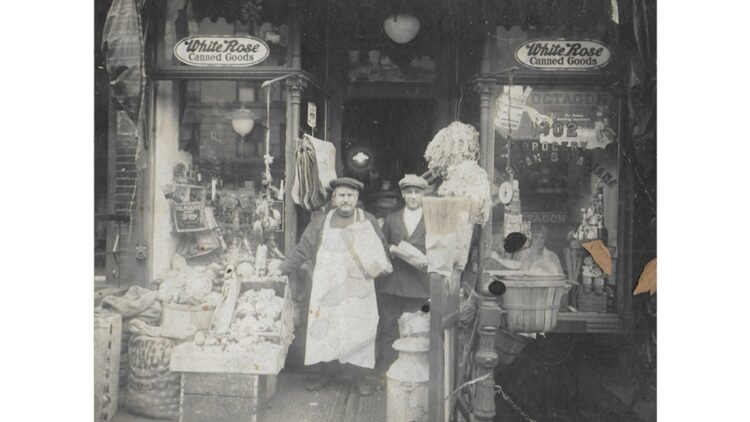
The photograph illustrating this essay is from about 1926. It shows the entrance to my paternal grandfather’s grocery and produce store in Yorkville, Manhattan. The figure on the left is my grandfather Giuseppe Salemi (1879-1970) with his eldest son, my Uncle Damiano (1909-1989).
Joseph S. Salemi has published five books of poetry, and his poems, translations and scholarly articles have appeared in over one hundred publications world-wide. He is the editor of the literary magazine TRINACRIA and writes for Expansive Poetry On-line. He teaches in the Department of Humanities at New York University and in the Department of Classical Languages at Hunter College.


















Joseph, I cannot thank you enough for your revelations and insight into your early life that instilled a sense of rhyme and rhythm in your impressionable young mind. I am one of those who loves to find out more about poets and their past from an autobiographical and historical perspective. I completely relate to your story, since my English teacher mother read to me virtually every night either from Mother Goose nursery rhymes, or other books like the Teenie Weenies. Since we lived on a farm and had no electricity until I was 11 years old, other than the battery-operated radio that my dad played at most 4 hours an evening including the national news and the one hour of Lawrence Welk polkas, I was absorbed by first hearing and then learning poetry. Thank you again for your intriguing story. By the way, I loved the picture. We need more such personal material both in essay form and in poetic narrative.
Roy, I’m very glad that you enjoyed the essay. Some persons have on occasion expressed skepticism about my ability to remember that far back, but in fact my earliest memories are the clearest. I was born in 1948, but I can recall a day in 1949 when I was in car with my uncle (the same one who appears as a young man in the photograph that accompanies this essay). I was so short that I stood up in the passenger’s seat next to him as he drove. I know it was 1949 because of certain circumstances pertaining to where we were going.
You seem to have a similarly sharp recall of the past. You are the only person I know who remembers the Teenie Weenies! I waited with anticipation for the Sunday color comics, where I could read another of their strange adventures as minute people in our gigantic-sized world.
That picture from 1926 was from the time our family still lived in Manhattan. We did not move to Queens until the early 1930s.
We have a lot in common especially with our memory, Joseph. My mom had a flour bin that opened from the sink part way to the floor. At the age of one, I managed to pull it down and decorate the kitchen. I also remember at the age of one being in my high chair, my mother singing to big band songs on the radio and putting clothes out on the line. I remember playing with my best friends, Nancy and Sandy, before I was 2. Sandy’s dad had several shelves of western paperback books in a hallway. My dad returned from the war a month before my 2nd birthday and I remember our moving to a farm from our small home in Bellevue, Nebraska. I sat in the front seat and talked with him, or at least he talked to me. So many more memories of my early age including toys.
Some wonderfully and vividly described memories.
Funnily enough, in 1974, my dad took me around Covent Garden Market which was about to close (I think he wanted one last look at the place as it was) after 300 years of operation. Its iconic main market buildings were preserved and are now a major London tourist attraction.
I must admit, your grandfather’s shop and the description of your father’s green grocer’s shop reminded me of the grocery store in the Italian quarter of New York in The Godfather II.
Thanks for the read.
Paul, I saw the old Covent Garden Market in 1970, on my first visit to England. It did make me think of Washington Market in Manhattan — big, bustling, noisy, and very earthy.
Yes, my grandfather’s fruit-vegetable-and-grocery store, and my father’s place, were very much like the place shown in The Godfather II, and there were similar stores in every Italian community in all the five boroughs of New York City. They carried specialty items that were not generally available in more mainstream outlets: the vegetables that I mentioned, olive oil, lard bread, imported cheeses, pizza rustica, caponata, Italian bread in all shapes and sizes, salami, sorpressata, giardinera, fennel sausage, dried pasta.
I’m glad you liked the essay, and thank you for commenting.
Hi Joe – great to see these early and formative memories: they shape one’s whole life. You may remember, since you kindly wrote a fabulous introduction to my DoorWay, that in Canto 6 I re-meet my great teachers; I testify to “Yes, my old English teacher, known as NAT” who introduced me to a. some great poets and b. the idea of writing poetry. Well, he died recently (well into his 90s) and I am going (to Kent) later this month to a big memorial/celebration service of his life; and I have been asked by his daughter to speak about his influence on me. As with your memories, these are such an important component of the poetic psyche: perhaps more should be written about these influencers. I have always taken the view that Mary Shakespeare – his mother – must have had an incredible early influence on William for him to be as good as he was/is – way more than is currently considered possible or even likely. It only goes to show: nobody really makes it alone, or is a self-raised ‘god’ – it’s others’ belief in us that makes all things possible.
Joe, I just love this essay. It’s chock-a-block full of the wonder of life and language and how the two melded beautifully (almost from the cradle) to create a fully-fledged poet. I am drawn to words that lift me from the page to magical moments that engage all my senses and have me hooked. Your words have that quality, and it’s a privilege to learn how words tempted you to dance with them.
I’m particularly taken with “Jolly Old Bums”. It made me think about the fun, awe, and mystery words weave until you’re in their spell. My dad wasn’t a highly educated man. He had a street intelligence and the gift of the gab. He loved to joke and adored words… how they sounded… the double meanings… the music of them. He often spoke in cockney rhyming slang. At the age of nine, I played the recorder in the school orchestra. “The British Grenadiers” (a 17th century marching tune) was our grand finale. It was extremely dull… until my dad taught me the words that lifted the music to greater heights, and made it impossible for all in the orchestra to play without suppressing laughter. Oh, the power of language! It went something like this:
There was a Scottish lander.
He came from Waterloo.
The wind blew up his petticoat
And displayed his cock-a-doodle-doo.
His cock-a-doo was dirty.
He showed it to the Queen.
The Queen took out her handkerchief
And she wiped it nice and clean.
Positively outrageous… at least for nine year olds! I was smitten with words long before the age of nine. At two I memorized the name of every bird in an adult birdwatching book… but only because my dad read them out to me on a daily basis. It was then I knew I had to stop badgering him and crack the word code so I that could read the names of the birds for myself. By the age of three I could write a sentence, and by the age of seven I had read all the Narnia books and was moving on to Lord of the Rings.
I am certain your vibrant and thoroughly entertaining essay will have every poet on this site looking back to see when their wondrous relationship with words began. Joe, it seems to me your excitement for words hasn’t waned a bit… I can see that wide-eyed boy in your enthusiasm for poetry now, and I thank you wholeheartedly for it!
I am so pleased you liked filth, Susan: you really are a Kentish lass. I was myself going to recount a really early memory of a ‘poem’ that stuck with me for years, but thought it too rough for the SCP. But as you have started, then … written on the latrine of a public toilet in the park and discovered when only 9: “When ye enter this marble hall / Use the paper not the wall / If no paper can be found / Wipe your a**e upon the ground.” Majestic? Love that ‘ye enter’!
James, thanks for this comment and the memory. Yes, we stand on the shoulders of giants, who made possible our achievements. About instructors — they have a unique ability to stay in a student’s mind for years and years. I can recall the names of every one of my grade school teachers: Brown, Leonard, Gelpar, Pfeffer, Alleyne, Blobstein, Stolley, Arevalo, Spiegler. And indeed, a mother who loves literature can have a profound influence on a child. I was blessedly fortunate in my parents and grandfather.
Joe, I very much enjoyed reading this autobiographical story and how it affected your lifelong love of poetry. You’ve said a mouthful. How does one make poetry not only well-crafted but interesting? We want people to read our work, after all. In some ways, this is the struggle of all art. How many films are there which get made but never seen because they are deadly dull? The same with the composition of symphonies and the penning of novels. The author/composer/poet may THINK they’re interesting becaused he wrote it. But there can often be a huge disconnect between the artist’s subjective judgment (and vanity) and the way it is received by an audience. There is simply no substitute for good taste — including an eye on what gets people interested. This is why I’ll always go for Coleridge over Wordsworth.
What your essay articulated particularly well for me was once thing: the importance of insouciance. You are so right! When you watch someone sing, the best singers don’t give a damn how people are reacting. They just fully commit and do it. The best artists don’t constrain themselves because they’re worried about other people’s reactions. They just do it. And so it should be for poets. We’re not building marble temples after all. We’re expressing ourselves and the more… The more “ unclenched” we are the better. Poetry needs to breathe. It needs to be muscular and vital. That is sorely lacking in some of the poetry we encounter these days. It is important for people to be reminded that we are human and not try to be statues. It is equally important not to write as if one is trying to get a good grade on an educational project. Poetry written solely to impress others is doomed to die young.
Brian, I’m very happy that the essay is both enjoyable and informative. Even prose has to grab the reader by the throat if it’s to have any chance to be read.
There is of course a frictional problem between the goals of being insouciant and at the same time holding the attention of a large audience. In the past, it wasn’t that big a problem. There was a vast array of shared values, educational background, and cultural history that poets in the West had with their potential readers. This is not the case today. So we may be able to grab some readers who are in sympathy with us, our style, and our heritage, and in that limited sense we can be successful. But there is a huge crowd of persons who do not share any of that identity, and others of our own background who have been deliberately trained to hate and despise that heritage and identity, and the artworks that emerge from that tradition. Nothing we do — no matter how accomplished it is — will attract any of those persons.
I don’t see any way out of this problem. We can have a niche market like the SCP, where we remain true to a heritage and a style, and be successful in that small way. But that smallness precludes the kind of larger influence that might bring about a wider restoration of cultural sanity. And if we “open up” (so to speak) to different or non-traditional approaches to poetry, we run the risk of being colonized by the vast crowds of enemies who would be happy to take over — just as we have had to very vigilant here to prevent the site’s takeover by a small cult of religionists.
Susan, you are right on target — when the love of language and wordcraft starts in a child, the spell remains potent and vibrant forever. Like your dad, I have long been utterly enamored of cockney rhyming slang! I was so pleased when I learned about it, that it became an unending interest. “Watch your loaf!” (loaf of bread) for your head; “tom” (tomfoolery) for jewelry; “bristol” (Bristol City) for titty — it was delightfully endless!
I can say this with rock-solid assurance — your poetry shows a deeply rooted love of English that goes very far back to childhood. It is profound, it is ingrained, it is an indelible and crucial part of your personality and being. I knew this as soon as I became acquainted with your work here at the SCP.
The story of the Scotsman made me laugh. If only poets today were more earthy in that manner! Here’s a related joke I heard many years ago when I was in the U.K. —
Young Jock asks young Meg if she would be willing to take a stroll with him at night, into the heather.
Meg answers “Nay Jock… nawt will I walk with ye to the heather.”
Jock says “What ails ye, Meg? Didya nawt like the gleam in me eye?”
Meg replies “Tis nawt the gleam in your eye that troubles me. Tis the tilt in your kilt.”
I’m glad the essay was pleasing. Like LTC Peterson, I also wish other poets would write about their early linkage to poetic understanding and endeavor.
I remember my own first literacy steps very well, mostly because it was a painful experience and I cried while having to do it. At age 4, my mom started me on McGuffey’s First Reader because we had moved and it was too late to start school. It contained a lot of short poems, certainly less fun than Jolly Old Bums, but appropriate. Even after I started school, mom still made me go through all the McGuffey readers in my spare time. I balked at the exercise, but it elevated my reading level above others my age and I tested well enough to get into an excellent private school. The public schools at that time were doing the whole ‘Open Concept’ thing, that disastrous progressive movement that emphasizes ‘collaboration’ in learning. Looking back, I realize those early steps were EVERYTHING.
My niece is 6 and still struggles with basic reading skills because the public school system here is terrible. I asked my mom to send me those old McGuffeys when I learned she still had them, and we’ve been looking at them.
Ok, I’m done sharing now.
Great piece, shared on our social media pages.
Half essay and half memoir, this piece is a delightful read. It prompted me to dredge up snapshots stored at the bottom of my memory that helped make me whatever I now am. No, I never heard workmen singing, but, many of my forebears and collateral relatives having been woodworkers, I can still hear the growls and whines of power tools. I grew up on graham crackers, pretzels and nursery rhymes.
Thanks, Kip — I wish you’d write a poem about those growls and whines of the power tools, and the woodworkers who used them. I recall that Frost wrote a poem (“Out, out…”) about a buzzsaw and a tragedy connected with it.
By the way, do you remember chocolate-covered Graham crackers? They don’t make them anymore.
Andrew, thank you for your appreciative words, and even more thanks to you for sharing. The story you tell about your niece and the corrosive effect of Deweyite progressivism and “collaborative learning” is deeply depressing. I have heard many other instances of it.
Call me a paranoid nut-case and conspiracy theorist, but I firmly believe this: the forces of left-liberalism want to re- create an illiterate peasantry locked into menial jobs, with no intellectual skills, no access to history and culture, no chance of professional status, and brainwashed into complete obedience and deference to their “elite” masters. This peasantry will be trained not to question anything that the elite says, or that elite-controlled media outlets report.
In short, they want what existed in the Middle Ages, and what the Nazis planned to establish in postwar Eastern Europe. As Heinrich Himmler said, “The Slavs will be taught to sign their names, to count up to 500, and to believe that obedience to Germany is the will of God.”
Your essay pack a lot into it. Horse-drawn carts and cobblestone streets in 1953 just shows how our synthetic, plasticized world is not that far removed from the real world known throughout most of human history. I see the same thing in the bums’ song: oral poetry at its best. Low-brow songs like these were what Confucius compiled into his Shijing, transforming them into literary classics. This is tradition.
Your memory also harkens back to a time when poetry was really for everybody – even the lowest classes. It is innate in all humanity. We just fail to recognize that today, and I lay the blame for that squarely at the feet of modernism, which purposely made poetry unrelatable and therefore irrelevant to anyone outside of a university professorship.
The principles you draw from the bums’ song are good guiding-stars drawn from what worked for centuries. Like a good Confucian, you draw abstract lessons from the instinctual realm of folk-song.
Adam, many thanks! It’s not every day that one gets compared with the great Confucius.
My essay was largely a memory piece, about the way that the world used to be.
Modernism did two evil things: it made poetry the domain of scholars, academics, and a little elitist clerisy of narcissistic types whose only real audience was each other; and it fostered an explosion of utterly shapeless emotional extrusions by everyone else.
Loved your essay, Dr. Salemi, and wish I had your memory.
Thank you for writing it.
Many thanks, jd. I’m sure I have forgotten a lot more than I remember!
Mr. Salemi,
I can’t tell you how much I enjoyed these precious memories. Thank you. Your experience with those very jolly bums immediately called to mind something I read about Heinrich Schliemann, the first to dig into Hissarlik, now believed to be site of ancient Troy. Very likely you know the story that when he was an impoverished and ill-educated youth, apprenticed to a grocer, a drunken miller visiting the shop gave him his first taste of Homer in Greek, the mere sound of which set such fire to his imagination that, so he said, his path in life was determined then and there. As Schliemann told the tale: “On the night in question he [the miller] recited to us no less than a hundred lines of the poet, with perfect rhythm and expression. Although I did not understand a single word, the melodious sound of the verses made the deepest impression on me. . . . Three times I made him repeat the divine lines, and recompensed him with three glasses of spirits, which I gladly paid for with the few pence that constituted my sole fortune. From that moment onwards I did not cease to pray to God that, by His grace, it might be my good fortune to be permitted to learn Greek.”
He went on to amass a considerable fortune in business–the same way Odysseus did, “by fair means or foul”–so that he able to finance his Anatolian excavations. As a mere amateur archaeologist he is in bad odor today with the professionals, but he was first on the spot, and it all began with the same three elements highlighted in your own charming reminiscence: a grocery, strong drink, and verse.
Michael Solot, many thanks for this addition to the discussion! I knew that Schliemann came from a working-class background and that he fought hard to get a good education, but his early introduction to Homeric Greek from a drunken miller I did not know. How perfectly appropriate — the discovery of Troy is due to a young man who was entranced by the sound of Homer’s Greek!
I’m glad you enjoyed my essay. And let me say that I have thoroughly enjoyed reading your new translation of the Odyssey — a translation that stands head and shoulders above some of the recent versions, in both its accuracy and its critical apparatus.