


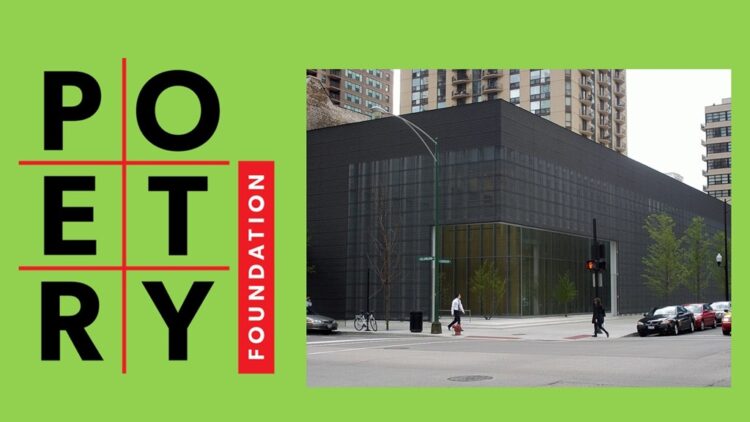
Last September, when the Society of Classical Poets, a non-profit organization, held a Poetry Symposium in the Chicago area, it requested a space for a public reading from the Poetry Foundation more than a month in advance and never received any acknowledgement of the request.
This may be part of a larger trend at the Poetry Foundation, which apparently intends to cancel public readings. Riley Yaxley recently wrote a criticism of the Poetry Foundation’s move in the Chicago Tribune:
Last October, a coalition of seven charitable organizations, including the Poetry Foundation, announced a new $50 million investment in the literary arts — the single largest funding initiative aimed at strengthening literary arts in the U.S. in decades.
However, less than a month later, the Poetry Foundation quietly announced it plans to discontinue public programming in order to transition into it …
Read the rest at the Chicago Tribune: https://www.chicagotribune.com/2026/02/25/opinion-poetry-foundation-grants-hurting-community-chicago/




















The Chicago Tribune article is available only to subscribers. They do offer one year’s subscription for one dollar, but the new subsriber must create an account and provide further information . . .
The link doesn’t lead anywhere for me; perhaps someone who has access to the article can copy and paste it in to AI and then provide a digest of what the information is: I would certainly like to read it.
Ok gang! Here is a CHAT GPT precis of the original article: Riley Yaxley argues that the Poetry Foundation’s decision to abandon public programming in favour of an expanded grantmaking role harms Chicago poets and cultural workers, despite being framed as a necessary strategic shift. Although the foundation helped announce a major $50 million national investment in the literary arts, it soon followed this with layoffs and the elimination of readings, workshops and a long-standing book club at its Chicago headquarters.
Yaxley welcomes increased funding for the literary arts, a historically underfunded field, but criticises grantmaking as slow, restrictive and largely inaccessible to individual poets. By contrast, public programming directly supported poets financially and professionally, particularly those from marginalised communities. Ending these programmes, Yaxley argues, removes a vital local lifeline while raising fears about future cuts to the foundation’s library or even Poetrymagazine.
The article situates the decision within the foundation’s recent controversies and leadership changes, suggesting that replacing public-facing work with grantmaking may also reduce exposure to criticism. While the foundation presents the cuts as financially necessary, Yaxley disputes this claim, noting its $200 million endowment from Ruth Lilly and minimal donor restrictions. Other options were available, such as modestly increasing annual payouts while maintaining public programmes.
Ultimately, Yaxley calls the situation a false dilemma: the Poetry Foundation could have expanded its national funding role without dismantling the local programmes that earned it its reputation and community trust. Reconsidering the decision, Yaxley suggests, would demonstrate a renewed commitment to poets rather than an austere protection of assets at a time of widespread need.
James, thank you for this precis of the article.
It makes quite clear that the decision of the Poetry Foundation was in complete accord with the general trend towards corporatizing every cultural activity, and making those activities dependent on bureaucratic oversight and the anonymous decision-making of committees and boards — anything, that is, that will keep the activity out of the hands of poets, and in the hands of corporate control.
The idea that the Poetry Foundation needs to save money is an absurdity, after a $200 million endowment from that daft Lilly heiress. What is happening here is the steady push for what James Burnham called “managerial control” over what is now a business concern, and not a cultural bulwark.
Strangely, in Mauritania, I just read the article without a hitch!
That they never even acknowledged the SCP request is all we need to know.
In years past, when Christian Wiman was its editor, Poetry regularly featured formal poems that were at least pretty damn good. Nowadays the fare there is as bad as anything you will now read in The New Yorker. Both publications have thrown out the baby and kept the bathwater in crystal decanters.
“kept the water in crystal decanters” – nice; I might use that in conversation, or at the Alumni-Undergraduate All Night Debate next year at the Demosthenian Literary Society, where we’ve impeached each outgoing President in a humorous roast. It’s debatable how many years the tradition’s been going on.
Thanks to The Society for making this known, not only in the gnostic/unspoken realm but stated print. Our trajectory in life is to reveal architecture, including the hardest working joists and slavish beams. This is Christological. With my father having read Robert Service to me as a boy, I’m unable to avoid castigating this Late-Act, fin de siècle, elephantine maneuver of the Poetry Foundation. It’s 2 things: unsurprising, and as prosaic as what they publish. Said the ice to the snow: “do i make myself clear?”
I live in the Chicago area, and have been writing poetry actively for seven years now. Virtually everyone who knows me knows that I do so, and they will fairly often mention a poet, publication, group, event or something else local that they know of in relation to poetry. However, prior to the recent Symposium here, I believe that I had only heard or read about the Poetry Foundation on one occasion, and that was merely in reference to the building which it owns in downtown Chicago. It seems like that organization is nonexistent!