


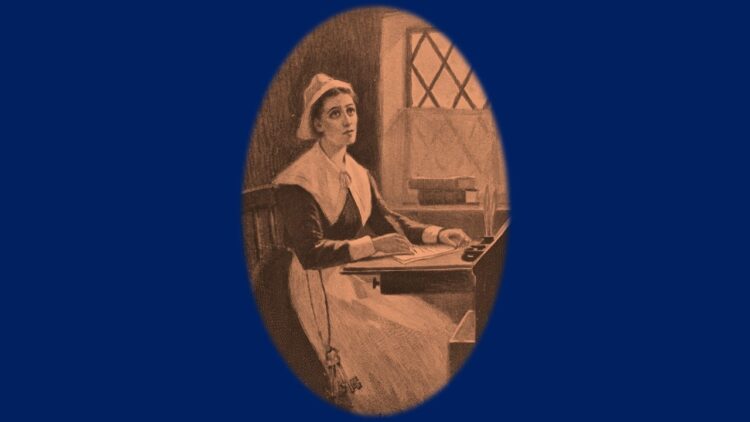
Extracted from a recent Epoch Times article by Tiffany Brannan:
In 1620, the Pilgrims landed at Plymouth Rock. In 1776, the 13 colonies declared their independence from England. This year, we’re celebrating the 250th anniversary of this momentous event. Between those dates, countless generations, families, and individuals lived, loved, and worked as the fledgling colonies grew into a vibrant new civilization.
People today regard life in the American colonies of the 17th century as harsh, bitter, and austere. Deadly illnesses, primitive living conditions, and rigid Puritan moral customs marked the time. However, it was also a time of deep thinking, meaningful spirituality, and inspiring faith, which was beautifully captured in the poetry of Anne Bradstreet.
One of the greatest poets of New England’s early days described every aspect of Puritan life—including marriage, children, nature, death, and faith—in rhyming couplets. This prolific writer was a wife and mother who found time to pen hundreds of verses along with caring for her husband and eight children in several settlements.
Anne was the first Puritan writer in American literature and indeed the first published author from the British Colonies in North America. Although an indisputable voice of early Americans, she was born in Northampton, England, to a prominent Puritan family in 1612; her birth name was Anne Dudley.
It’s a common misconception that most men of this era couldn’t read, let alone women. Anne was an example of a well-educated girl in Elizabethan England. Her father’s position as steward to the Earl of Lincoln gave her access to a vast library. She was tutored in the Classics, like languages, history, and literature.
Her father encouraged her education and appreciated her intelligence, so she dedicated many of her writings to him.
Anne emigrated to the New World with her parents and husband, Simon Bradstreet, in 1630, as part of the Winthrop Fleet. This fleet of 11 ships brought between 700 and 1,000 Puritan settlers to Salem in the Massachusetts Bay Colony. There, both Anne’s husband and father would eventually become colonial governors.
Over the next 22 years, the Bradstreets moved six times, and Anne bore eight children. She suffered from various illnesses throughout her life, and all her children survived infancy, which was unusual at the time.
An American Poetess
During her first years in America at the age of 19, Anne wrote her earliest known poem, “Upon a Fit of Sickness, Anno 1632 Aetatis Suai, 19.” In this stanza of the poem, one can already see her themes of faith amid struggles with mortality and the fleeting nature of human existence:
O Bubble blast, how long can’st last?
_that always art a breaking,
No sooner blown, but dead and gone,
_ev’n as a word that’s speaking.
O whil’st I live, this grace me give,
_I doing good may be,
Then death’s arrest I shall count best,
_because it’s thy decree.
Read the full article here.











This is a beautifully wrought excerpt concentrated on the harshness of life and the acceptance of eventual death.