


Prophecy and Divine Intervention in Virgil’s Aeneid.
by Kaitlyn Brown
The divine, represented through both the supernatural power of prophecy and through divine intervention, plays a very important role in The Aeneid, by Virgil (70-19 B.C.). Prophecy and divine intervention constantly influence Aeneas’s journey and there are many examples of this.
Prophecy
In the scene from Book I, lines 347-379, the king of the gods, Jupiter, prophesies the founding and future greatness of Rome. Jupiter calms the goddess Venus, who is distressed by the suffering of her son, Aeneas, and the Trojans. He reassures her that the destiny of Aeneas and the Trojans has not been changed (The Aeneid, 12). This shows that Aeneas’s and the Trojan’s destiny is divinely ordained. Aeneas will fight a massive war in Italy, beat down armies, and set up the city walls of Lavinium, and a way of life for the people there. Then, his son Ascanius will move his capital from Lavinium and found Alba Longa (13). Jupiter is tracing Rome’s lineage all the way back to Aeneas and Ascanius to show that Rome has heroic roots. Jupiter goes into further detail about Rome’s founding and greatness. Jupiter presents a grand, mythical tale about Romulus “building the walls of Mars” and calling his people the Romans. Jupiter emphasizes that this empire will be an “empire without end”—that is, the Romans will have great power over the world.
In the scene from Book III, verses 130-135, Apollo prophesies to Aeneas and the Trojans. Apollo’s prophecy gives Aeneas and the Trojans the instruction to look for their “mother of old” (68). This “mother of old,” which is Rome, is destined to be their home. Apollo’s prophecy further confirms that Aeneas’s descendants will create an empire that will “rule the world’s shores” throughout the years. This highlights the importance of Aeneas and his descendants, for they will fulfill the divine plan of founding Rome.
In the scene from Book III, verses 217-223, the Phrygian hearth-gods appear to Aeneas to explain the prophecy of Apollo. They reassert the supremacy of Rome. They tell Aeneas that he “must prepare great walls for a great race” (71). This prophecy refers to Aeneas and his descendants establishing the Roman Empire. The use of the words “great walls” and “great race” foreshadows the future greatness of Rome and the power of the Roman Empire.
In the scene from Book VI, lines 1015-1154, Aeneas’s father Anchises prophesies Rome’s future greatness. Anchises starts by revealing that the children in Aeneas’s line will be famous (186). He is revealing to Aeneas his future descendants, so that he can teach him his destiny. Anchises points out Aeneas’s descendant, Romulus, the founder of Rome (187). His seeing Romulus leads him to speak about Rome. He points out that “Rome will bound her power with earth” and her “spirit with Olympus.” He is revealing that Rome’s greatness will have both earthly power and divine guidance. He says that Rome is “fortunate in the men she breeds.” This means that Rome will bring forth strong, powerful, and successful leaders. These leaders will keep Rome successful and prosperous. Then, Anchises points out Aeneas’s descendant, Caesar Augustus (who commissioned Virgil to write The Aeneid), who will bring an “Age of Gold,” suggesting there will be a golden age in Rome.
In lines 1151-1154, Anchises further highlights Rome’s destiny. He says, “Roman, remember by your strength to rule / Earth’s peoples—for your arts are to be these: / To pacify, to impose the rule of law, / To spare the conquered, battle down the proud” (190). He is highlighting the values and ideals that Rome will stand for. The fate of Rome will be great with these values and ideals.
Divine Intervention
Moving on to divine intervention, in the scene from Book I, lines 171-200, Neptune intervenes by calming the storm. He quiets the waters, he drives the clouds away in the skies, and he brings the light of the sun back (8). By calming the storm, Neptune saves Aeneas and the Trojans. This divine intervention ensures that Aeneas’s journey to found Rome will continue and be fulfilled. This shows that the destiny of the establishment of Rome is divinely ordained. This also shows the future greatness of Rome because the gods are helping to fulfill its establishment. It can be assumed that the gods would not intervene if the Roman Empire were not meant to be great.
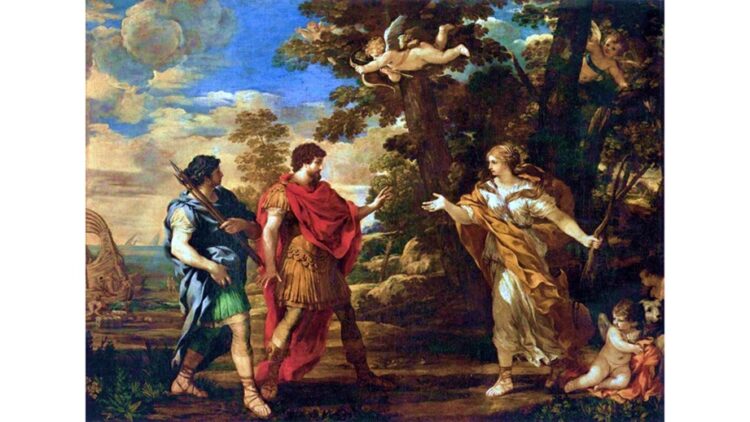
In the scene from Book I, lines 895-940, Venus intervenes by sending her son, Cupid, to ignite Dido’s passion for Aeneas. Venus wants Cupid to disguise himself as Ascanius (27). Then she wants him to make Dido infatuated with Aeneas. Venus is doing this to ensure that Aeneas is safe. She believes that Dido’s passion for Aeneas will keep him secure in Carthage. The safety of Aeneas highlights how the destiny of Rome is secure. He is saved by divine intervention so that he can fulfill his destiny and become the founder of Rome.
In the scene from Book IV, lines 300-375, Jupiter intervenes by sending Mercury to Carthage to Aeneas. Mercury goes to Carthage to Aeneas to remind him of his destiny (104-105). He rebukes Aeneas. He tells him to think of his son, Ascanius. The destiny of Rome depends on Aeneas and his son, Ascanius. Aeneas must leave Carthage to secure his family’s legacy and bring about the Roman Empire.
In the scene from Book VIII, lines 491-992, Venus intervenes for her son, Aeneas, by turning to her husband, Vulcan, who forges a shield for Aeneas, which depicts the future greatness of Rome. At first, Venus, who is frightened by the “menaces of the Laurentines and their hostile rising,” turns to Vulcan (242). She puts her “divine desire into every word” in her speech. This is so that she can persuade her husband to accept her request. She has never made him toil before (243). Then, in a cave, underneath the volcano, Aetna, Vulcan and his workers, the Cyclopes, forge the armor and shield (244). They shape a seven-layered, magnificent shield that will stand against all weapons (245). Vulcan, who is known as “Lord of Fire,” knows the prophecies and the future events of Rome (252). On the shield, he created scenes about the future events of Rome. The scenes highlight the triumphs of the Romans. They also highlight the wars that “Ascanius’ heirs” fought. The shield’s depictions foreshadow the founding of Rome, the rise of the Roman Empire, and the destiny of Aeneas’s descendants (252-255). Aeneas marvels at the shield. In lines 987-992, it reads, “All these images on Vulcan’s shield, / His mother’s gift, were wonders to Aeneas. / Knowing nothing of the events themselves, / He felt joy in their pictures, taking up / Upon his shoulder all the destined acts / And fame of his descendants” (256). These last lines highlight the connection between Aeneas’s mission and the destiny of Rome’s future greatness. They strengthen Aeneas’s role as a founder of Rome and an ancestor of the Roman people.
Each scene of prophecy and divine intervention adds to the captivating momentum of the epic poem. The scene between Jupiter and Venus is captivating in its foreshadowing of Rome’s future greatness because Jupiter is trying to tell Venus that Aeneas is a hero. She needed to know that Aeneas will live and be a founder of Rome and ancestor of the Roman people. The scene between Apollo, Aeneas, and the Trojans is captivating in its foreshadowing of Rome’s future greatness because the prophecy gives Aeneas and the Trojans a better sense of their destiny. They are destined to found the powerful Roman Empire. The scene between the Phrygian hearth-gods and Aeneas is captivating in its foreshadowing of Rome’s future greatness because of the symbolism of “great walls” and “great race.” The walls of Rome will be strong fortifications, and the Roman race will dominate the world. The scene between Anchises and Aeneas is captivating in its foreshadowing of Rome’s future greatness because Anchises is encouraging Aeneas. He is trying to show Aeneas that his journey and struggles are worthwhile.
The scene between Neptune, Aeneas, and the Trojans is captivating in its foreshadowing of Rome’s future greatness because it shows that the gods are working to fulfill Rome’s destiny. The scene between Venus, her son Cupid, and Dido is captivating in its foreshadowing of Rome’s future greatness because it shows how worried Venus is for her son and his destiny. She wants to keep him safe so that he can go through his journey. The scene between Jupiter, Mercury, and Aeneas is captivating in its foreshadowing of Rome’s future greatness because Mercury is making Aeneas prioritize his destiny as a founder of Rome. The scene between Venus and Vulcan is captivating in it is foreshadowing of Rome’s future greatness because Venus is doing all she can to keep her son safe. Vulcan, at the request of Venus, creates a shield that is more than just a weapon. It foreshadows the history of Rome. Aeneas is carrying the entire destiny of Rome on his shoulder.
Virgil’s The Aeneid is a great classic with vast influence. The themes of prophecy and divine intervention, which are the forces that shape the divine destiny of Rome in the epic poem, make The Aeneid a literary masterpiece. These themes are about the role of the divine in human life. They show that the divine shapes human history. This connection with the divine is what makes great poetry. This poem, with its themes of prophecy and divine intervention, gives the reader a feeling of transcendence and the spiritual. Perhaps this is why The Aeneid has endured for so many years.
Reference
Virgil. The Aeneid. Translated by Robert Fitzgerald. New York: Vintage Books, A Division of Random House, Inc, 1990.
Kaitlyn Brown lives in Tiltonsville, Ohio. She is a graduate student at Franciscan University of Steubenville.



















Thanks for writing this thoughtful essay. I took Latin in high school for four years and we read this classic work in Latin, phrase by phrase. So great to be reminded of this incredible experience.
I likewise had four years of Latin in high school – with five different teachers. I remember my second teacher as my favorite. She saw how deficient we were from the first teacher’s efforts, and volunteered to teach as many of us who wanted during summer break. About eight to ten of us met weekly at another student’s home, and Mrs. Lee came and tutored us that summer. She never charged a dime for her time. She was wonderful!
Thank you for your essay. I wish you continued success in your studies.