


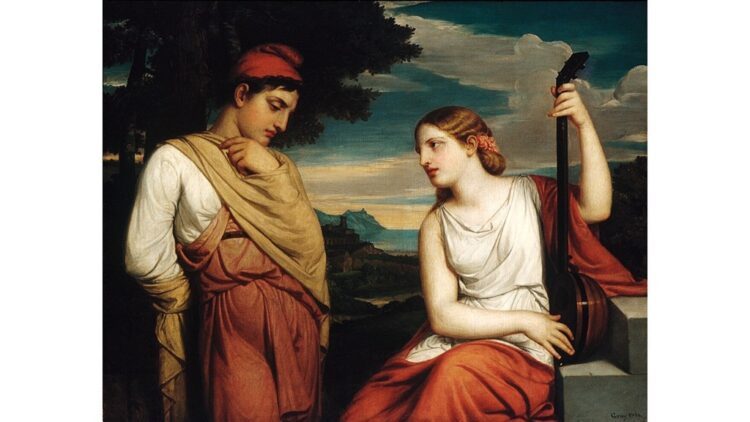
What Folly Dares
What folly dares inflict its spectral pow’r
To grieve my love and I who burn to love her?
For some deceit has in this bitter hour
Transformed me into a forsaken lover.
Where once the light and heat of love prevailed
Now darkened chill of scorn finds me betrayed.
Such scorn, as like a lance, leaves me impaled
And left to die, bewildered and dismayed.
Let truth rise up and smite the poisoned lie
That turned her tender heart away from mine.
And though she spurn me till the day I die,
My love I’ll ne’er surrender nor resign.
In troth I vow while faith and hope remain
To prove my love and win her heart again.
The Music of Love
As one who plays upon the lute is she
Whose tuneful touch plucks music from my soul
And weaves each note into a melody
Of love which twines two hearts into one whole.
In serenade I take her song and sing
It back to her with gentle kiss and sigh
As gasping, grasping, passioned love takes wing
And lifts us like an aria on high.
In fierce embrace and ardent ecstasies
We soar like angels on our upward flight,
Creating and performing symphonies
Of love that touch the stars and thrill the night.
Then joined as one, as close as two can get,
We sing our song of love as a duet.
We Kissed the Day We Met
We kissed the day we met along the way,
Two Oxford students at St. Giles’ Fair.
They said we were a scandal! Us! A fair
Long time ago! And yet I’m glad to say
The girl with whom I fell in love that day
Is still, to me, most beautiful and fair!
To think her less would not at all be fair,
Though forty years have e’er since passed away.
In weather foul or fair our love is true.
And whether fowl or hare our fare, we feast
Upon the love we share. To hope and dare,
To have and hold, to say that “I love you!”
A love as wide as west is from the east;
Our happy-ever-after love affair.
Poet’s Note: This poem repeats the word “fair” five times with each use owning a different definition. The word also appears as a homonym as well as being embedded in a larger word with yet another meaning. The tale itself is a fiction.
James A. Tweedie is a retired pastor living in Long Beach, Washington. He has written and published six novels, one collection of short stories, and four collections of poetry including Sidekicks, Mostly Sonnets, and Laughing Matters, all with Dunecrest Press. His poems have been published nationally and internationally in both print and online media. He was honored with being chosen as the winner of the 2021 SCP International Poetry Competition.















nice – from another angle, here’s a Sonnet of Monolithic Anger, which I wrote for purpose of comparison as an undergraduate when a remorse poem we were studying seemed a little too weak –
Deceitful wench! Are all the words that passed
Between us when our love seemed less unreal
Mere tatters now that thou mayest calmly blast
To nothing when thou so inclined dost feel?
May he who engineered thy late disgrace
Prove like a squash leaf at the crack of frost –
Turn black and shrivel; so faithless arms embrace
The shattered dead remains, forever lost;
And may’st thou in that faithlessness go on
To multitudes of lovers, whose delights
May all resolve to torments – may by dawn
Each have another mistress in his sights,
So that the love that thou hast killed in me.
Through scores of others may be slain in thee.
The one poem is clearly an echo of the other. Sadly, the theme is universal. And your closing couplet us genius.
The one poem is clearly an echo of the other. Sadly, the theme is universal. Your closing couplet is genius.
These three (in both style and subject) are all in the older sonnet tradition of love, pain, bliss, misunderstanding, and all the other facets of an amatory relationship. They hearken right back to origins of the sonnet in the Sicily of the Emperor Frederick, and its development among the troubadours of Provence.
The last sonnet, playing on the various meanings of the word “fair”, “fare”, and “affair”, brings to mind the famous 13th-century Occitan poem of Arnaut Daniel, that creates a curious poetic mix with the meanings of the word “ongla” (fingernail) and “oncla” (uncle).
The one poem is clearly an echo of the other. Sadly, the theme is universal. And your closing couplet us genius.
Joe, thanks for the descriptive comment. What you describe is exactly what I intended in the first two poems. The third simply serves as the vehicle for playing on the word “fair.” As for uncle’s fingernails, I see an opening for some more wordplay and a few smiles in the future.
If you had not said this was fiction, I would have presumed at least the last one was autobiographical. Still, they all involve heartfelt sentiments that stir the mind and the heart with welcomed emotion. I had noted your use of “fair” as I was reading it. You anticipated comments about it with your Poet Note. I am one of those who loves romantic poems and these are great ones–all three. This has encouraged me to send in a couple of mine in the near future. I have noted how rare love and romance sonnets appear here and in life these days.
I love these love sonnets, James! Your wordplay with “fair”, in the third one, is fun and creative; betrayal and true-heartedness are well portrayed in the first; and the second — “The Music of Love” — is my favorite, because of the way you’ve carried the musical metaphor through it to express the heights of passion.
Your three sonnets have helped tear me away for a few precious minutes from a month of intense work in the rainless desert of the British countryside.
A wonderful diversion reminding me of the more important things in life, and of course being a teacher of English your last sonnet bore an added interest in its wordplay.
Now to work my way through the backlog.
Hi James – I like those unobtrusive things that you subtly sometimes work into your poetry. For example, I am pretty damn sure you are alluding to Psalm 103: “As far as the east is from the west, so far hath he removed our transgressions from us” when you write “A love as wide as west is from the east;” The genius of the original is, of course, that God does not say as far as the north is from the south, because – if He did – that would have been a measurable quantity; whereas – strangely for a sphere – the distance from the east to the west is boundless. You invert east-west but still in doing so still create that tremendous sense of infinite love. Very, very nice indeed.
Little things such as allusions can have a multiplying effect as the allusion extends the meaning beyond the bounds of the poem. Not too long ago I slipped an allusion into a poem that interpolated a reference that contradicted the poems central point to the point of negation. But it sounded so good that no one caught it! Or how about twisting a familiar allusion into a new idea such as saying, “love as close as east is from the west.” What image would that conjure?!
Sonnets in the grand tradition. How fortunate is the loved one in the third poem to have a minstrel so attentive.
Thank you, Gerard. A poet can only hope that loving sentiments thoughtfully expressed in a well-written poem will be well received, strengthen the relationship and further the cause of romance.
James, these are indeed sonnets in the grand tradition. Some of the vocabulary, some of the situations, some of the kinds of lyric with regular places in many sequences, but just as much “original” in the personal and contemporary use you make of the material. “The Music of Love” plays especially well because the language is so imagistically discreet while the ardor is unrestrained. Petrarchan fluency in all three–which is much more the essence of the grand manner than straining at “uniqueness.” Still, each great sonneteer has his own style. For one comparable to these in English, I’d say Samuel Daniel. You won’t find poems like yours among his, just similar comfortable mastery.
Margaret, I am indeed honored for these sonnets to be associated with the phrase “grand tradition,” while being distinguished by having my “own style.” As for Samuel Daniel, you have pointed me in a direction worthy of further exploration. Thanks.