


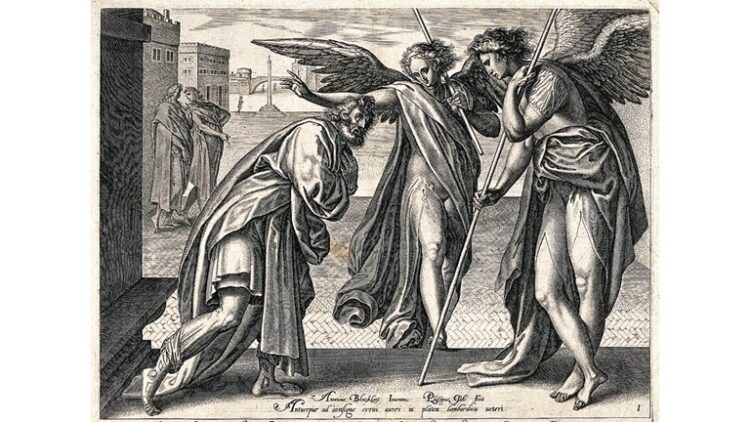
The Lessons of Lot
How long had my watch lasted at the city gate?
For days (or weeks? or months?) I’d scanned the endless fields
In search of some dim hope, some needed twist of fate
From what I knew was due, and soon would be revealed:
A fear I couldn’t share, not even with my spouse.
I’d been so mired so long, no light was left within—
In me, my wife, nor kin, in none of my whole house.
My lone last hope my watch, beyond the surrounding sin.
The stranger angels, I see now, were sent to test
And prove if that watch made me able to discern
God’s messengers, persuade the two at my behest
To let me keep them safe, and heed my dire concern.
Oh yes, I knew too well the dangers out at night,
Yet failed to see how much my neighbors had grown odd.
But the angel face of innocence made clear my plight.
Tonight I’d face a choice: to live with fear or God.
I’d known, deep down, our life in Sodom soon must end—
My daughters’, wife’s, and mine—yet pride obscured the fact.
But then, to see the mob, in torchlit rage, descend—
How does one go through that with sanity intact?
The butcher, innkeep, fellow councilors, the men
I thought my friends, their faces twisted in their lust,
Demanding, mocking, threatening; what a fool I’d been
To think these vicious beasts were neighbors I could trust!
I even offered them my daughters, whom they spurned,
Their baseness only maddened by their lovely grace.
Then all at once their vision soured to black. They turned
In blind confusion from my door; in that brief space
Strong arms encircled me and pulled me back inside.
The angels’ whispered warnings yet echoed in the room;
Sodom would be destroyed, wiped clean, and woe betide
The living thing that dared ignore this certain doom.
I slipped outside to warn my daughters’ two betrothed,
The two I’d sifted out as least disposed to sin;
They met my urgent knock disheveled, barely clothed;
My desperate pleas to leave with mocking, drunken grins.
Derisive laughter drove me back and out the door,
Admixed with the howls and barks of evil as it searched
For me as I slipped breathlessly from horror to horror,
Through awful scenes that in and out of torchlight lurched.
I never knew such feral sounds could come from men,
Nor knew, once home, just what it meant to freeze with fear,
Not daring move nor speak, our eyes transfixed on when
Dawn’s saving rays might on the windowsills appear.
The strangers rushed out first, we four in tow, their speed
And stealth was such we barely kept the pace. Outside,
Not even animals were spared their awful need;
Nor children. At last I understood in full what cried
To God for punishment. Beyond that cursèd gate
The strangers said to hurry, that only mountains’ might
Could withstand the hand of God, which now would not abate.
I knew I’d never reach them, and whimpered in my fright.
I lived God’s miracle of mercy that grim day;
A reprieve that gave leave for my city-softened legs to flee
To the one near town whose sin was small enough to stay
God’s execution: And all for me, to save just me.
“Don’t turn, don’t look!” I called, and then my voice was drowned,
As if the sun itself stooped down and smote the plain
With blasting heat and light, and one terrific sound.
The town around dissolved, bleached white as if with pain.
I’d reached the square before I dared the glare behind.
Against the fire, a pillared mound: my darling wife,
All that remained. Her dear sweet form to dust consigned
As with our flocks, our home, our once-respected life.
But hateful stares there showed we wouldn’t find relief.
We finally found, leagues past that town, a deep dark cave
Where we at last could rest, lay down our load of grief.
We all collapsed from days of having to be brave.
How long in our despair we hid, I couldn’t say.
I sank in loss, my daughters in their ended lives—
Ended before begun—from day to dark to day
Until we couldn’t tell if we were dead or alive.
My daughters finally gave me wine, to ease my pain.
I seemed to dream what couldn’t be: My wife returned,
But young and lithe, as when we met, before the rain
Of years and cares had bent us low. Before all burned.
My grief next day at how God’s line through me had ended
Brought wine again. Again I saw my wife appear
But this time with a hint my grief would be transcended,
a whisper: “Rise. Go on and live. There’s nothing to fear.”
And so we did: Rebuilt our lives, myself, my daughters
And sons born from my seed. So was their trick a sin?
They saw my loss. A child obeying what you taught her—
I can blame them no more than my own drunken chagrin.
I’d taught them both to act in love for family’s sake:
To use their wits to serve God’s plan despite the cost
So that, when left no choice, they’d find a choice to make,
and do what must be done for hope when all hope’s lost.
We’ve learned our lessons well: that pride in station blinds,
And evil not confronted will darken every door.
Yet God will save the righteous who’re watchful for his signs
And grant his saving mercy to those who humbly implore.
Adam Wasem is a writer and rare bookseller living in suburban Salt Lake City, Utah.















Adam, this is a great amplification of the story of Lot and the destruction of evil. We can pray the same thing will happen in these sin-filled days. Your imagery was striking in concept and detail.
Adam, in thinking about your poem, I have a few more thoughts. 1.) According to the Bible, Lot’s wife was turned into a pillar of salt, not dust, according to Genesis 19:26. 2.) I equate San Francisco and Los Angeles as being modern day Sodom and Gomorrah. 3.) I noted you are a book seller. You may find my book, “Demolishing the Demons: Theology and Poetry Preparing for the New Crusades,” a great source for how God encourages us to take action against evil in this world. The cover shows a depiction of Lot and family fleeing and the destruction coming from the heavens.
Thank you for your praise, Roy. My personal modern-day S & G are LA and New York, but honestly I think you could pick any two of America’s 20 largest cities and not be wrong. Re: Your book “Demolishing the Demons,” and its cover art of Lot, great minds think alike, it seems. You’ll have to let me know where to find it. As someone who has not that long ago escaped one of America’s 20 largest cities, I feel like many people are finding Lot’s story especially resonant right now. Re: your point 1) you’ll note I didn’t specify initially what the “pillared mound” was, and the phrase “to dust consigned,” was meant to be a play on the phrase “dust to dust.” I agree, it seems to have introduced some unnecessary confusion, but I couldn’t make “to salt consigned” ring no matter how I worked it. My fault for working with such an unforgiving rhyme scheme.
Adam, you can find my book on Amazon books. In the search it sometimes helps to add my name after the title.
It’s nice to see English alexandrines used well, especially when attention is paid to the caesura. The ABAB quatrains have excellent rhyme, all ending masculine except for two quatrains (20 and 21). I wonder if the poet did that deliberately, since those two quatrains recall the two glaring moral lapses of the Lot tale — the choice of the girls to commit incest with their dad, and by implication their remembered resentment of the fact that he had offered them to be gang-raped by the drunken mob in Sodom. It’s not a very edifying story.
Thank you, professor, for your praise of my alexandrine excursion, especially since I don’t relish trying to sustain something like that for that long ever again. I assure you that virtually all my metrical flourishes, feminine endings and, etc., are half-conscious happy accidents; e.g., a line regarding “daughters” naturally asks for a feminine ending, especially when I can cap the rhyme with “taught her” two lines later. I can’t say I quite agree that they were “moral lapses;” in my reading they were more akin to desperate times calling for desperate measures. Lot’s offering his daughters to the mob was a sign of his total devotion to God, akin to Abraham being willing to sacrifice his only son Isaac, and that Lot’s protection of the angels would extend to offering his own flesh and blood in their stead. Also, it seemed to me a last desperate, albeit failed, gambit to bring his neighbors back to their heterosexual senses. Similarly, as I tried to indicate, Lot’s daughters, in light of his suffering and their own husbandless plight, with the men of Zoar spared not because of their virtue, but because it was the only town Lot could reach, acted out of mercy, to him and them, and in furtherance of God’s plan that Lot’s line continue. So I also have to disagree about the story not being edifying, as I find the deeper I delve into Biblical heroics, the more edifying they become.
Well, we’ll agree to disagree. It’s still a very interesting poem.
This is marvelous, Adam. I love stories that delve into the minds of the characters more deeply than the original telling of the story has done, probing to portray what their thoughts and fears must have been. I am in awe of the great skill and insight you’ve shown in telling such a difficult story in this way. The stanzas revealing the unusual way that Lot continued his line, were especially wisely and well done, as were your description of the daughters’ betrothed men; the faces of the other residents of Sodom “twisted in their lust”; the “feral sounds” coming from people; and other imagery such as dawn’s rays appearing on windowsills, and “scenes that in and out of torchlight lurched.” How, indeed, “does one go through that with sanity intact?” And your conclusion that “Evil not confronted will darken every door” is well-derived. Great work!
Thank you for your high praise, Cynthia. As an habitual Bible reader, I too, often find myself wondering what was going through the characters’ minds in those stories, so what better way to deepen one’s understanding than writing about it? What skill and insight I displayed was the fruit of several years’ fixation on the story, having escaped my own awful urban mob rule situation in 2022. The fearful vividness of the imagery was not overly difficult to conjure after 2 years of Chicago’s COVID lockdown. Also, I’m gratified you found my approach to the incest wise and well-done. I have an attraction to especially charged subject matter, it seems, and I’m glad to hear the fear and trembling that went into those stanzas paid off. As for my great work, it’s not so hard to accomplish after all when you’re cribbing from the Divine.
Adam, I’m impressed with your description of Sodom’s end “as if the sun itself stooped down and smote the plain.” Reminds me of my consternation in military field training, when we were told if we should see a mushroom cloud (from an atomic bomb), we should hit the dirt, wait till the blast wave passed, then get up and carry on with the mission. Glad that never materialized as it did for Lot. I’m interested by your showing how slow he is (over and over) to understand “the surrounding sin.” He gets out of Sodom just in time, thanks only to angelic assistance, realizes he must leave Zoar too, and finally even in his cave refuge gets trapped into perversion by his own daughters and wine. It is rather touching that the drunken Lot seems to imagine that he is having licit relations with the wife whom he knows is dead. And then excuses himself (and his daughters who knowingly do perverted wrong (for the sake of family!) by the thought that God wants his line to continue. It is true that God allows the good of conception to occur in illicit sexual relations, but look who is conceived by this incest: the evil nations of Moab and Ammon. I would say the many lessons of Lot come down to one lesson of recognizing the surrounding evils and not waiting for divine intervention to save oneself from participating in them and perpetuating them. A difficult story to re-tell, but one worth extending with the emotion and imaginative skill you bring to it
You know, then, from your military field training that if a man-made nuke would be bad, how much better to know when to hit the deck when God’s wrath goes nuclear, eh? Or even better than that, to be nowhere near the blast radius. Indeed, Lot’s story is a good lesson on that alone. Because, as you’ve indicated, he is at the very least slow on the uptake regarding the character of his town. Why, then, did Abraham plead so fervently with God to spare him? Was it to preserve the future “evil nations” like Moab, which produced Ruth, the great-grandmother of King David, or Ammon, a princess of which married King Solomon? Speaking strictly textually, he is even more of a blameless naif than I have portrayed him, whose only real sin was being overly solicitous of his unreliable wife, who, as evidenced by her looking back in longing or regret in direct disobedience to God, was likely up to something in Sodom, and his daughters, who deceived him. My minor embellishments, I see now, were a nod to modern feminists, who, God knows, are always circling and ready to pounce. In that light, perhaps the lesson to be drawn is to never put too much trust in women, even those in your own family.
Thank you, Adam, for bringing to life an episode which I always felt was slightly under-played in “the original”. The narrative, imagery, sustained meter and, above all, the inherent morals, all make for an absorbing read. A singular achievement.
I agree, Martin, so many Bible stories are so rich with unstated implications, so ripe for narrative exploration, it’s always a wonder to me that more artists don’t delve into them. The only art school that truly comes to mind as doing any kind of sustained deep dive into the Bible are the Dutch Masters, at least in the absence of wealthy church patrons. And thank you for your generous praise; it just goes to show, singular obsessions can result in singular achievements.
Adam, it’s lovely to see you back with a striking and admirably crafted poem that has made me think… long and hard. I found myself drawn to the thread of mercy running through it. I especially like your closing couplet. Scripture frequently shows God accomplishing His purposes through people who are deeply flawed — God’s beloved David being a prime example — not because He approves of their sins, but because His grace is greater than their failures. Sin is real. Consequences are real. BUT grace is greater. I love fresh perspectives and, for me, your poem has brought with it a reminder that only God knows our hearts. What an interesting poem that has prompted and equally interesting discussion thread. Adam, thank you very much indeed!
Thank you, Susan, it’s lovely to be back. I admit, I’ve been a touch sidetracked lately with personal financial matters, as well as an erroneous belief that via social media I could somehow help pull America out of its current death spiral, but that’s a subject for another time. You’re right on, that my purpose was to show that God’s miracle of mercy can sustain us through the grimmest of days. And yes, the main theme I tried to express is that God’s grace is far greater than any sin or consequence of which we can conceive. Regarding the closing stanzas, those were nearly effortless–a gift from above, I prefer to think, for having persevered, like Lot, through the lengthy preceding trial. I’m deeply gratified to see you’ve had a real encounter with my poem; prompting a poet whose work you deeply admire and enjoy to themselves think, reflect, and enjoy is the best reward a poet can ask for. You are most welcome.
Adam, I am impressed and moved by this retelling of the story of Lot. I remember you mentioning that you were working on a Lot-themed poem in a comment on one of my poems awhile back and I have looked forward to reading your version ever since. I am particularly stunned by the way you have handled the incestuous relations between father and daughters. Having the father believe each daughter in turn is his poor wife (dead in a most traumatic way) is a smart poetic move to keep the main character sympathetic despite the “ick” factor. It is also a very human and humane psychological explanation for what occurred. Extremely well-considered.
Moab was never anyone’s favorite biblical nation. But Ruth is a beloved biblical character and she was Moabite. Beloved in her own right, beloved by Naomi, by Boaz and, as it happens, the ancestor of King David and — much later — Jesus Christ. Lot’s sin, though never forgotten, was apparently a destined and essential part of God’s plan.
I’m gratified you found it moving; I was moved myself, writing it. And I remember your comment, too; Your eagerness to read my take on Lot was a motivating factor in finishing it, so I’m afraid you’ll have to share some of the blame. Re: The incest sequences, I was stunned myself. For quite a while, I had no idea how I was going to get around that “ick” factor, even though, textually speaking, Lot’s sin was not consciously engaging in incest, but in submitting to drunken despair that allowed his daughters to take advantage. But our contemporary culture has decided that any sexual transgression is automatically the man’s fault, so it was a great challenge figuring out how to translate those episodes in a way that would retain sympathy for all involved. The inspiration for turning them into dream sequences with his dead wife felt like a bolt from the blue.
Re: Moab, Ruth, and God’s plan, I incline toward there being more in heaven and earth than are dreamt of in any of our philosophies. Judging historical figures by contemporary mores is one of the chief maladies currently befalling Western Civilization, and the Bible was carefully compiled and passed down over thousands of years as the combined wisdom of God’s chosen people. As a Christian, to condemn entire nations with complicated histories as evil despite St. Paul’s assurance that “every knee shall bow and every tongue confess” to Christ’s Lordship, for me is a bridge too far.
This is a wonderful piece, a retelling of one of the most familiar Genesis episodes in a fresh and compelling way — no small challenge, given the source material. A few features I liked best: first, it treats the whole story from Lot sitting at the gate all the way to his daughters conceiving Moab and Ammon by him; it adopts an internal viewpoint from Lot as a dramatic monologue, emphasizing the moral dimensions of the story; it presents the sin of the Sodomites in a realistic light (the detail about the sons-in-law being near-naked and disheveled is an insightful detail).
As usual with your work, the craftsmanship is excellent. Thank you.