• Submit Poetry
  • Support SCP
  • About Us
  • Members
  • Join
Saturday, July 18, 2026
Society of Classical Poets
  • Poems
    • Beauty
    • Culture
    • Satire
    • Humor
    • Children’s
    • Art
    • Ekphrastic
    • Epic
    • Epigrams and Proverbs
    • Human Rights in China
    • Music
    • Performing Arts
    • Riddles
    • Science
    • Song Lyrics
    • The Environment
    • The Raven
    • Found Poems
    • High School Poets
    • Terrorism
    • Covid-19
  • Poetry Forms
    • Sonnet
    • Haiku
    • Limerick
    • Villanelle
    • Rondeau
    • Pantoum
    • Sestina
    • Triolet
    • Acrostic
    • Alexandroid
    • Alliterative
    • Blank Verse
    • Chant Royal
    • Clerihew
    • Rhupunt
    • Rondeau Redoublé
    • Rondel
    • Rubaiyat
    • Sapphic Verse
    • Shape Poems
    • Terza Rima
  • Great Poets
    • Geoffrey Chaucer
    • Emily Dickinson
    • Homer
    • Henry Wadsworth Longfellow
    • Dante Alighieri
    • John Keats
    • John Milton
    • Edgar Allan Poe
    • William Shakespeare
    • William Wordsworth
    • William Blake
    • Robert Frost
  • Love Poems
  • Contests
  • SCP Academy
    • Educational
    • Teaching Classical Poetry—A Guide for Educators
    • Poetry Forms
    • The SCP Journal
    • Books
No Result
View All Result
Society of Classical Poets
  • Poems
    • Beauty
    • Culture
    • Satire
    • Humor
    • Children’s
    • Art
    • Ekphrastic
    • Epic
    • Epigrams and Proverbs
    • Human Rights in China
    • Music
    • Performing Arts
    • Riddles
    • Science
    • Song Lyrics
    • The Environment
    • The Raven
    • Found Poems
    • High School Poets
    • Terrorism
    • Covid-19
  • Poetry Forms
    • Sonnet
    • Haiku
    • Limerick
    • Villanelle
    • Rondeau
    • Pantoum
    • Sestina
    • Triolet
    • Acrostic
    • Alexandroid
    • Alliterative
    • Blank Verse
    • Chant Royal
    • Clerihew
    • Rhupunt
    • Rondeau Redoublé
    • Rondel
    • Rubaiyat
    • Sapphic Verse
    • Shape Poems
    • Terza Rima
  • Great Poets
    • Geoffrey Chaucer
    • Emily Dickinson
    • Homer
    • Henry Wadsworth Longfellow
    • Dante Alighieri
    • John Keats
    • John Milton
    • Edgar Allan Poe
    • William Shakespeare
    • William Wordsworth
    • William Blake
    • Robert Frost
  • Love Poems
  • Contests
  • SCP Academy
    • Educational
    • Teaching Classical Poetry—A Guide for Educators
    • Poetry Forms
    • The SCP Journal
    • Books
No Result
View All Result
Society of Classical Poets
No Result
View All Result
Home Poetry

‘Sensation’: A Poem by Bruce Dale Wise

November 18, 2025
in Poetry, Culture
A A
8
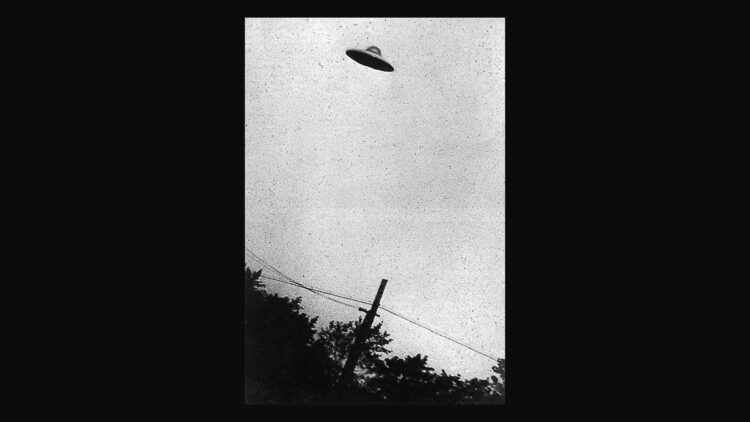
photo of a UFO in New Jersey (public domain)

photo of a UFO in New Jersey (public domain)


Sensation

Amidst the flaming of the flying saucer’s landing gear,
like as the Sunshine glazing it, in gold-white-yellow sheer,
the meadow edge is filled with crabgrass seedheads by the trail,
the bright, cement-gray road is lit by brilliant blazing rays.
The shadow of the alien is ten-foot long, and more.
The pale Moon is faint and silver, like a lode of ore.
Where is he going, that strange being, unattached and lone,
there walking down the walkway in a black cap with a phone?
Who could he call? Who would he call? Who should he call at once?
What is the nation in the zation he’s a member of?


Bruce Dale Wise is a poet and former English teacher currently residing in Texas.

ShareTweetPin
The Society of Classical Poets does not endorse any views expressed in individual poems or commentary.
Read Our Comments Policy Here

RandomPoems

The Canterbury Tales General Prologue: Translation of Lines 1-18
Essays

An Essay on Geoffrey Chaucer: ‘The Great Legitimizer’ by Euphrates Moss

July 6, 2023

. The Great Legitimizer by Euphrates Moss Up from the barbaric yawp of Beowulf and routing through Giovanni Boccaccio (1313-1375),...

‘Olympic Gold’: A Poem by James A. Tweedie
Poetry

‘Olympic Gold’: A Poem by James A. Tweedie

February 18, 2026

  Olympic Gold _Eat the beauty and the beast. Ingest, digest until you’ve had your fill. _Sojourn till the west...

Next Post
‘Longfellow’: A Poem by Kevin Parks

'Longfellow': A Poem by Kevin Parks

‘Ode to Spring’ by Susan Jarvis Bryant

'Beyond Daffodils': A Poem After Wordsworth by Paul A. Freeman

‘Timeless’: A Poem by James A. Tweedie

'Timeless': A Poem by James A. Tweedie

Comments 8

  1. C.B. Anderson says:
    8 months ago

    For some reason, Bruce, I am reminded of the film The Crawling Eyes, which was replayed over and over on the afternoon show Million Dollar Movies, which aired many years ago from New York. As a sucker for any kind of science fiction, where conflicts are often interstellar, I think “zation” is a terrific coinage.

    Reply
    • BDW says:
      8 months ago

      as per I. E. Sbace Weruld:

      Though I was not thinking specifically of a 1950s sci fi film, especially “The Crawling Eye” (which I have never seen), I have recently been watching and studying 1950s sci fi films, for various reasons, including this one—that they seem to frequently capture my present state of mind-and-being; so that, perhaps, as Mr. Anderson suggests, such writing could easily remind one of an example of that genre. Yes, I, too, am “a sucker for” such zensational zations; however, in a Platonic PostModernist vusion (a 1970s neologism of mine), i. e., a realized civilization.

      Reply
  2. Paul Freeman says:
    8 months ago

    ‘The pale Moon is faint and silver, like a lode of ore.’ Just when you think there’s no new way to describe the Moon! Brilliant.

    Must agree that ‘zation’ is a fabulous invented word.

    Thanks for the read, Bruce.

    Reply
    • BDW says:
      8 months ago

      I am really just trying to capture what I am seeing: “The pale Moon” in the afternoon, “faint and silver” in that light, “like a lode of ore”, compared to the Sun’s “gold-white-yellow sheer”. It was not a yellow brick road I was walking down, but rather a “bright, cement-gray road…lit by brilliant, blazing rays”. I was attempting merely to describe the Moon I was seeing, by using a simple simile, in as prosaic a manner as I could; so, if it is not as “brilliant” as so many of the lunar similes I have recently read, as in, say, works by Maclain, in “Where Eagles Dare” and Montsarrat in “The Cruel Sea”, it is perhaps, at least as terse, as those found in tankas, like those of Ariwara Narihira.

      If, as Mr. Freeman suggests “zation” is a “fabulous invented word”, it is at least one of the few neologisms (whether mine or another’s), included in my works over the years, that Mr. Mantyk has allowed @SCP. And though I may have coined “approximately” one-to-two-thousand neologisms, I abide only in the shadow of that great “literary” figure Thomas Browne, who Jorge Borges called “the best prose writer in English. Even as I am typing this comment, my grandson is orally coining words…

      Reply
  3. Adam Sedia says:
    8 months ago

    Interesting ironic use of beauty. You portray something quite jarring in such a peaceful way that the alien landing seems almost natural. This was an intriguing read.

    Reply
    • BDW says:
      8 months ago

      Earlier in my writing, I was drawn to Rilke, and thought beauty was nothing but the beginning of terror. However, since that time, I have moved far from the German Romantic/ Realist/ Modernist realm. @ SCP, at least, Mr. Sedia captures best the darker aspects of the Romantic school in art, partially from his association with The Chained Muse, and also from his own frequent landscapes. He is right on target when he points out I was portraying “something jarring in such a peaceful way”; however, any of the poem’s “intriguing” aspects come most likely from who the alien is, where he is, where he has come from, and where he is going to.

      I will answer Mr. Sedia’s comments with a recent, Romantic, moonlit tennos:

      “Moonlit Winter Landscape” by Carl Blechen: 1836
      by Ewald E. Eisbruc

      He saw the “Moonlit winter landscape” on the Internet
      the painting done by Carl Blechen—indirect…intent—
      He saw the distant pale Moon, white in the evening sky.
      He saw the bare and leafless trees rise long and black and high.
      He saw the cold, blue atmosphere, the snow out far and wide.
      He saw the near brown rugged ground touched by Moonlight and ice.
      He saw a fallen log up front and center in the scene.
      Was there a sitting fox at one side, looking, studying,
      a strange contorted row of trees behind him in the dark,
      lit from the Moonlight, for a moment, baring stark, stirn Carl?

      Ewald E. Eisbruc is a poet of German artistry. Carl Blechen (1798-1840) was a Romantic German painter. According to Beau Lecsi Werd, the neologism “stirn” is a blend of stern and stirring.

      Reply
  4. Margaret Coats says:
    8 months ago

    Sensational poem, Bruce. Not only visually but viscerally. The pictures of flying saucer and alien have just enough physical detail to usher in a foreboding psychic uncertainty, which you develop through the questions that don’t exactly end the piece. You’re way ahead of previous commentors congratulating you on “zation,” because whether you or they know it or not, it is currently in use as business and AI lingo. Well worked into an ominous situation!

    Reply
  5. BDW says:
    8 months ago

    In the same way that Mr. Sedia grasped the tonal qualities of “Sensation” [not surprising, as he is likewise a composer] and its strange aspects [this I attribute to his historical literary exercises], so, too Ms. Coats brings thoughtful perspectives to this “sensational” poem.

    If the sensations in this poem are not “sensational”, as Ms. Coats cleverly notes, they are at least sense-data in the manner of British Empiricism; seemingly incredible; and yet, somehow there is, in this unintentionally ominous picture, something real and disturbing. Perhaps it is the emptiness of the setting that is most upsetting. Yet this is not the setting of Ozimandias: the central object is not deteriorating, and the central figure is not “crumbling”. It is indeed more casual than Shelley’s work; this Mr. Sedia accurately pointed out.

    Ms. Coats is correct that the questions “don’t exactly end the piece”. In fact, it seems as if the situation is simply an opening move—to where, or to what—it is hard to say—from the poem itself. She does bring up a note on “zation”, which she says is “currently in use as business and AI lingo”…

    That does take me back to my older days (the 1970s) when I first used the “trunc”. Those were high-flying days, when I was striving to deal with English (which I wrote aurally with my own letters, and used only the binary number system in my notebooks, in West Germany), or while studying business, economics, accounting, computer science, and mathematics (mainly to understand, appreciate, and counter the Logical Positivists, and Bertrand Russell, in particular). Whether I was the first to use that trunc in the 1970s, or not, hardly matters at all; whether using the newly manufactured IBM computer [a coinage of Thomas Browne] or simply writing only with my opposing hand (left) in a brief period in London.

    Reply

Leave a Reply Cancel reply

Your email address will not be published. Required fields are marked *

  1. Theresa Werba on ‘Two Fateful American Coin Flips’: A Poem by James A. TweedieJuly 18, 2026

    Jim, congrats on your win!!!

  2. BDW on ‘For Those We Never Meet’: A Poem by Aneesh AgarwalJuly 18, 2026

    Mr. Agawal has generalized the largest labour insurrection in America from the early 20th century—1921, that cost the lives of…

  3. Ganga Unnikrishnan on National Poetry Month Limerick ChallengeJuly 18, 2026

    Urzsula

  4. Ganga Unnikrishnan on National Poetry Month Limerick ChallengeJuly 18, 2026

    Thank you so much Ursula

  5. Geoffrey Smagacz on ‘Ben Franklin’s Copper Fugio Cent’: A Poem by Geoffrey SmagaczJuly 18, 2026

    Thank you, Margaret

Subscribe to Daily Poems

Enter your email address to subscribe to this blog and receive notifications of new posts by email.

Join 1,596 other subscribers

Recent Poems

  • Winners and Rankings of The Great American Poetry Competition
  • ‘The Gold Star Mother’: A Poem by Gerard Maritato
  • ‘An American Dash’: A Poem by Linda Ellis
  • ‘The Anonymous Soldier’: A Poem by Lucy Lind
  • ‘For Those We Never Meet’: A Poem by Aneesh Agarwal
  • ‘Ben Franklin’s Copper Fugio Cent’: A Poem by Geoffrey Smagacz
  • Three Brief Poems by Luxorius, Translated by Joseph S. Salemi
  • ‘The American Spirit’: A Poem by Dusty Grein
  • ‘The Ballad of Zebulon Pike’: A Poem by M.D. Skeen
  • ‘We Are the Ones’ and Other Poetry by Cheryl Corey
  • ‘My Pyjamas!’ and Other Poems by Susan Jarvis Bryant
  • ‘A Snowy Egret’: A Poem by Bruce Dale Wise
  • ‘The Swearing-in of Calvin Coolidge’: A Sonnet by Robert W. Crawford
  • ‘Ballad of the Sequoia’: A Poem by Lauren V. Leon
  • ‘The 51st State’: A Poem by James Sale
  • ‘La Uva’ (The Grape): A Poem by Michael Pietrack
  • ‘There’s Blood that Flows Within the Stripes’: A Poem by Lauren V. Leon
  • ‘Birdsong’: A Poem by Jeffrey Essmann
  • ‘The Melody That Lingers On’ and Other Poetry by John McPherson
  • ‘American Dreams’: A Poem by Adam Sedia
  • ‘An American Fabius’: A Poem by John Hernandez
  • ‘Vernal Clinic’ and Other Poetry by C.B. Anderson
  • ‘Omaha Beach’ and Other Poetry by Bradford Skow
  • ‘Music to Part the Veil’: A Poem by T.M. Moore
  • ‘A Gentleman’s Guide to Losing a War’ and Other Poetry by Arnon Peterson
  • ‘Black Shuck’: A Poem by Martin Briggs
  • ‘When the Last World War II Veteran Passes Away’: A Poem by N.S. Boone
  • ‘A Fallow Year at Worthy Farm’: A Poem by Paul A. Freeman
  • ‘Outstanding in Afghanistan’: A Poem by Jared S. Chang
  • ‘250 More’: A Poem by Miguel Moreno

Categories

  • Acrostic
  • Alexandroid
  • Alliterative
  • Art
  • Best Poems
  • Blank Verse
  • Chant Royal
  • Classical Poets Live
  • Clerihew
  • Covid-19
  • Deconstructing Communism
  • Educational
  • Epic
  • Epigrams and Proverbs
  • Essays
    • Interviews with Poets
    • Poetry Reviews
  • Featured
  • From the Society
  • Great Poets
    • Dante Alighieri
    • Edgar Allan Poe
    • Emily Dickinson
    • Geoffrey Chaucer
    • Henry Wadsworth Longfellow
    • Homer
    • John Keats
    • John Milton
    • Robert Frost
    • William Blake
    • William Shakespeare
    • William Wordsworth
  • Human Rights in China
  • Limerick
  • Love Poems
  • Music
  • Pantoum
  • Performing Arts
  • Poetry
    • Beauty
    • Children's Poems
    • Culture
    • Ekphrastic
    • Found Poems
    • High School Poets
    • Humor
    • Riddles
  • Poetry Challenge
  • Poetry Contests
  • Poetry Forms
    • Curtal Sonnet
    • Haiku
  • Poetry Readings
  • Rhupunt
  • Rondeau
  • Rondeau Redoublé
  • Rondel
  • Rubaiyat
  • Sapphic Verse
  • Satire
  • Science
  • Sestina
  • Shape Poems
  • Short Stories
  • Song Lyrics
  • Sonnet
  • Symposium
  • Terrorism
  • Terza Rima
  • The Environment
  • Translation
  • Triolet
  • Video
  • Villanelle

Quick Links

  • About Us
  • Submit Poetry
  • Become a Member
  • Members List
  • Support the Society
  • Advertisement Placement
  • Comments Policy
  • Terms of Use

Welcome Back!

Login to your account below

Forgotten Password?

Retrieve your password

Please enter your username or email address to reset your password.

Log In
No Result
View All Result
  • Poems
    • Beauty
    • Culture
    • Satire
    • Humor
    • Children’s
    • Art
    • Ekphrastic
    • Epic
    • Epigrams and Proverbs
    • Human Rights in China
    • Music
    • Performing Arts
    • Riddles
    • Science
    • Song Lyrics
    • The Environment
    • The Raven
    • Found Poems
    • High School Poets
    • Terrorism
    • Covid-19
  • Poetry Forms
    • Sonnet
    • Haiku
    • Limerick
    • Villanelle
    • Rondeau
    • Pantoum
    • Sestina
    • Triolet
    • Acrostic
    • Alexandroid
    • Alliterative
    • Blank Verse
    • Chant Royal
    • Clerihew
    • Rhupunt
    • Rondeau Redoublé
    • Rondel
    • Rubaiyat
    • Sapphic Verse
    • Shape Poems
    • Terza Rima
  • Great Poets
    • Geoffrey Chaucer
    • Emily Dickinson
    • Homer
    • Henry Wadsworth Longfellow
    • Dante Alighieri
    • John Keats
    • John Milton
    • Edgar Allan Poe
    • William Shakespeare
    • William Wordsworth
    • William Blake
    • Robert Frost
  • Love Poems
  • Contests
  • SCP Academy
    • Educational
    • Teaching Classical Poetry—A Guide for Educators
    • Poetry Forms
    • The SCP Journal
    • Books

© 2025 SCP. WebDesign by CODEC Prime.