


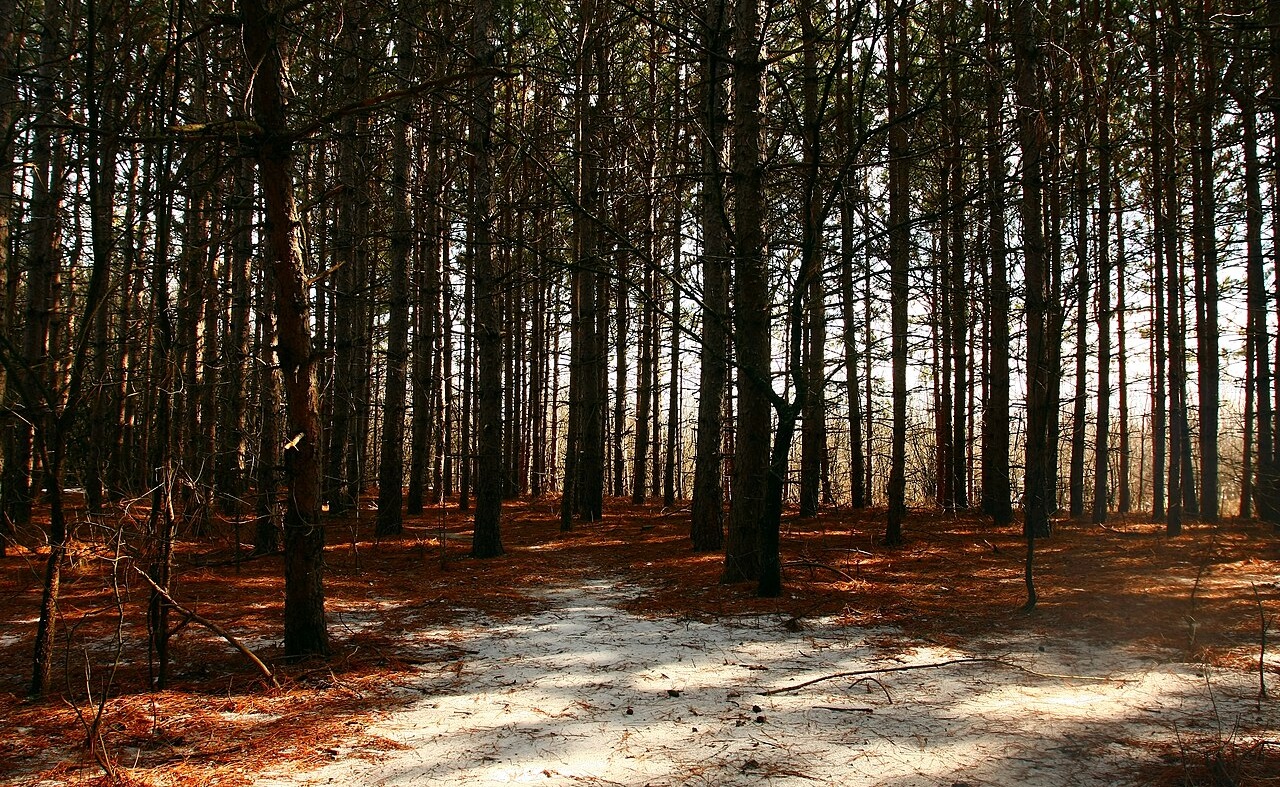
Tapiola
Tapio is the Finnish god of the forest; Tapiola is his home.
Only a fool disturbs my sylvan solitude.
_See how my vassal firs crowd all around you,
_Jostle you, silently surround you,
Erasing every trace of one who dared intrude.
Into my presence, shadowed by mortality,
_You have come, alone. My home, your tomb;
_My palace, your coniferous catacomb.
Welcome. Try my wintry hospitality.
Lost so soon? Already hopelessly astray
_Among the twilight of my mantling trees?
_I watch you shiver in the bitter breeze,
And as I step from nowhere – thus – to bar your way,
With eyes that mesmerise like haggard pagan moons,
_With sudden hoary face, with hair of frost,
_With brows of lichen, ancient beard of moss,
To offer you a hand of twisted woody bones,
I see the sweat freeze on you like a deathly mask.
_Bereft of reason you will flee in fear,
_Scattering ruined wits. No-one will hear.
Where you are, or who you were, no-one will ask.
For you are caged in my domain for ever more.
_In vain you blunder through the failing light:
_My silent laughter will snow down all night,
Covering your footprints on the forest floor.
Martin Briggs lives in Suffolk, England. He only began writing in earnest after retiring from a career in public administration, since when he has been published in various publications on both sides of the Atlantic.













Lost in the woods…brings back memories! You really capture the mood here, Martin. A forest can be frightening and beautiful at the same time.
Thanks Paul. Yes it can – especially in winter. And behind this piece is the idea that we all eventually disappear into a metaphorical forest and are not heard of again. Cheerful.
Martin, this is a great poem with inspired imagery of how we all shall someday surely stumble into such a forest and have our footprints erased by time. I love the concepts you ferret out of the Finnish god of the forests to tell this tale.
Thank you Roy. Yes, and I suppose this is another example of how myth and legend can be used to present the contemporary and the everyday in a different light (cf the recent exchanges on this site).
This is a very impressive piece — in structure, in diction, in imagery, and in story. The narrative is frightening, and even threatening. I do not know the god Tapio, but he seems to be something like Pan in the Greek tradition: a forest divinity whom it is dangerous to approach.
I like the way each quatrain starts and closes with an alexandrine. It suggests the notion of being caught in a trap that encloses you, just as the forest slowly entwines, captures, and kills its victim. And the very high level of vocabulary used here gives a certain cold majesty to the speaking god.
The unsaid part here is not being able to see the forest for the trees. The forests I have traveled through have always been kind to me, and, to whatever extent I was able, I to them. Trees have never seemed inimical to me; it’s the wolves one needs to worry about.
While trees may not be threatening, the forest becomes that way under certain wintry conditions. One may not believe in the malicious forest god, but he can rise into near visibility with the light fading and the temperature dropping. Confidence in getting back to camp or home may diminish with the winds or snow. A few persons every winter succumb; Tapio’s threat of no one coming to the rescue, these days, means simply the searchers arrive too late. And in the mortuary refrigerator, the deceased from the great outdoors are surrounded by many more cold bodies from hospital or nursing home. Very few pass on under the former ideal conditions of families or friends praying and offering comfort at the bedside. Your poem, Martin, lets us think about how mental processes are affected by the real or possible conditions of dying. It’s a scary scene you create, of trees and other things found in the forest as palace furnishings and animated attendants. I wonder about beeping medical machinery and blaring TVs or announcements. Not a pleasant poem but a thoughtful one.
Thanks to all the above for thoughtful responses to my little nightmare. Sorry to be morbid.
Enhanced by alliteration dropped in like falling leaves so as not to overwhelm the piece, there is an evocative, otherworldly feel to this poem.
Just as an aside, I had a friend called Tapio, a Finnish-American. His people settled in the Upper Peninsula, where the forests were thickest back in the day.
Thanks for reading it, Paul. A name like that gives you something to live up to….
Martin, thank you for this bewitching poem with some beautiful turns of phrase – the imagery and sibilant sorcery of the opening stanza drew me into the forest and had my spine tingling right up to the magical closing couplet. I used to revel in the eerie beauty of Kentish forests with carpets of spring bluebells and shafts of sunlight pushing through the darkness… until I had lived on the vast and sprawling coastal plains of Texas for a few years where there’s no hill or tree for miles and the sky appears to be on the ground. I simply couldn’t roam the wooded areas of my homeland without feeling the sense of menace, captured perfectly in your words.
Susan, your comments have started a train of thoughts in my mind.
In much Western mythology (going as far back as the Epic of Gilgamesh) forests are seen as danger-ridden and threatening. They represent the primeval and pre-human world, and are associated with powers that are mysterious and malign. They have witches and goblins and elves, ogres, chthonic spirits like leprechauns, werewolves, murderous females like the rusalka of eastern Europe, or the whirlpool nymphs who lure young men sexually in order to drown them. In “Sir Gawain and the Green Knight,” Gawain has to fight evil beings in the Wilderness of Wirral, a frightening place in northern England.
The other thing is their trackless expanse and thickness, and their towering darkness. It is said that when the Roman Emperor Julian first came face to face with the then nearly virginal forests of Germania, a cold dread swept over him like nothing he had ever experienced. They were huge, monstrous, and menacing.
And yet forests can also be tempting and lovely, like the woodlands of Kent that you experienced, or Sherwood Forest, or Shakespeare’s forest of Arden. I have always thought that the latter place-name shares a common root with the French Ardennes, and that both recall a pre-Indo-European word for “forest” — just as a pre-Indo-European word for “river” must have been “don,” since so many river names in European contain that root (the Don, the Danube, the Dnieper, and even London, which sits on a river.
One can’t help remembering Robert Frost: “The woods are lovely, dark and deep…”
Joe, thank you so much for this. I have always been fascinated by forests and spent much time skirting the fringes of their deeper dread, too afraid as a child of wandering far enough to be swallowed up by whatever evil lurked in the darkness… and I had a good idea of the shape of that wickedness. Hansel and Gretel had warned me. It is no wonder those with rampant imaginations are moved to put pen to paper by the fearsome mystery of that “towering darkness” – my Muse is stirring.
Thanks for the appreciation, Susan. I lived in Finland for two and a half years, and used often to give myself the creeps by stepping off the road into a wintry forest, knowing that there was no other living soul for many, many miles, and being enveloped by an almost tangible silence. It’s so easy to get swallowed up by nature if we’re willing.
Martin, your Finland experience captures the dark side of nature perfectly. The last time I got anywhere near a forest was at the edge of the Baltic in Sweden a couple of years ago – a breathtaking experience. The first time I felt the daunting power of nature and my own mortality was at the age of eight in the Highlands of Scotland. The vastness of the mountains. The savage chill of the wind. The threat it posed to a little girl who felt her inner tiger shrink to the size of a mouse. That day, I learned my place in the grand scheme of things.