


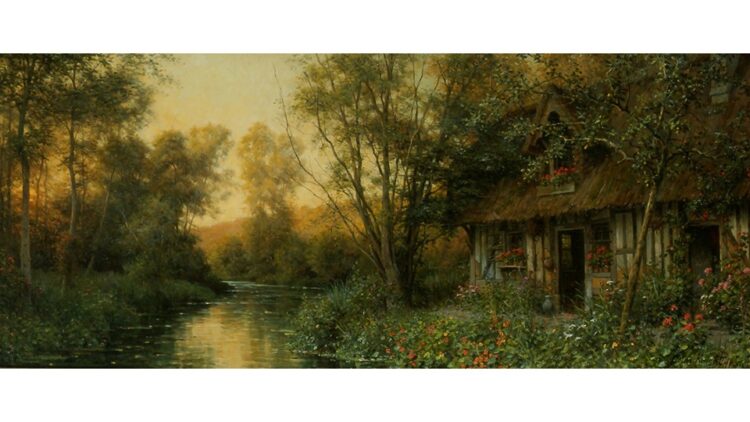
The Cottage on the Ridge
The gray mist lingers in the wooded vale
And drifts across the piney hills at dawn,
Infused with light, as daybreak sheds its pale
First rays upon a lonely ridge, whereon
A cottage sits in quiet solitude,
Amidst the ancient landscape lush and green.
It sends forth plumes that fire and flue exude
Into the sky, above that rustic scene.
The moss grows darkly on the wooden tiles
That clad its roof, and on its crumbling walls;
But through a window, light within beguiles
And porch light to the passing stranger calls.
I thank God for the beauty of this day
And nature’s wonders all around displayed;
But as I pause along my pilgrim’s way
Beside this dwelling, humble and man-made,
Drawn by its light and by its welcome mat,
I feel a rising joy in me to know
That soon, I’ll greet a fellow soul and chat,
Perhaps an hour or two, before I go.
Perhaps we’ll sit beside the fire and drink
A cup of morning tea as we converse;
Perhaps we’ll share old stories, as we think
Of ways to meet again, ere we disperse.
How rich I feel to walk this blessed day
Through woods and fields that fill my heart with praise.
But richer still to make friends on the way
Whose value that of rubies far outweighs.
For nature’s charms may shine with heavenly grace,
But none for beauty match a human face!
The Garden Hermit’s Confession
I thought that I would be so happy here
Just sitting in my hut beneath this tree,
Companion to the coney, fox and deer,
Each day enjoying sweet simplicity
And solitary sameness all the year;
And so I said, “the hermit’s life for me!”
But I was blind, as sadly now, I see.
I told his lordship that I didn’t mind;
I’d be his ornament and roam his grounds,
Dressed like a sage some dark age left behind,
A brooding Druid, making constant rounds
With staff in hand—that was my role, designed
To keep all human closeness out of bounds
And keep me near the horses, hares and hounds.
They stripped me of my human self-esteem
Although I did not see it at the time,
Nor did I note unkindness in the scheme,
Nor conscious cruelty nor any crime
In what was then proposed, while in my prime.
In fact, my lordship’s plan to me did seem
Delightful and enticing as a dream.
It seemed to suit my timid nature well,
My love of gardens and the out-of-doors,
My love of study, my desire to dwell
Alone, like some small merlin on the moors.
This hut, I said, will be my citadel
Of peace, which silence rules and time ignores,
Far from the rabble’s roar my soul abhors.
So willingly, I signed the written bond
To serve his lordship seven years, no less,
And dwell in this small hut, beside this pond
As his own hermit, sworn to faithfulness.
I vowed to persevere and not despond
Though days of rain or snow might bring distress
Or sickness prick my heart with loneliness.
I vowed to always stay on his estate
And never leave to haunt the local pub,
To shun all human company and wait
For guests to view me, cooks to bring me grub.
To keep my hair uncut, to abnegate
The right to trim my nails or even scrub
The dirt from off my body in a tub.
But worst of all, I could not fraternize
With any servant, gardener, or guest.
Though all might gaze at me with gawking eyes,
And laugh at how I looked or how I dressed,
I could not speak with them, rebut their lies,
Or say a word to get things off my chest—
I lived like some mute bird chained to its nest!
At first, things seemed to go as I had planned,
But as the days wore on, I grew to fear
The sight of guests approaching close at hand,
Their probing gaze, which pierced me like a spear,
Their haughty air, the smirks I could not stand,
The disrespect of all who ventured near,
Who came with shameless eyes only to peer.
Each passing year, I felt less like a man,
More like a beast held captive at the zoo,
To entertain those of the human clan,
Kept far enough away, yet within view,
At times, I thought, I’ve had all that I can
Endure of this sad life! What can I do
But mix fresh tears each morning with the dew?
I kept my pledge through countless griefs untold,
But chose to stay on here (I hear you gasp!)
The years have flown and now I am quite old,
No longer held in summer’s sultry clasp,
For autumn winds have blown, and now the cold
Of winter holds me in its icy grasp,
While death waits near to strike me, like an asp.
Have I regrets? No doubt, but then I think
What else could I have done then, seeing how,
Although my exile often made me sink
In deep despair beneath this drooping bough,
Each time I found myself upon the brink
Of leaving, cold sweat beaded on my brow.
I could not bear to be with mankind now!
I only pray that someday all will see
The great wrong in consigning men to roles
That rob them of their human dignity
As if they were mere objects without souls,
To keep men trapped in such captivity
Is like consigning whales to ocean shoals
Or pressing giants into pigeonholes.
If men want ornaments to grace their homes,
Then let them fashion statues out of clay—
Fantastic beings, like brownies, elves, or gnomes–
Well fit to guard men’s grounds by night or day,
But houses, not cold caves or catacombs
Are proper dwellings for real men, I say.
For without hearth and home, we waste away.
Poet’s Note: Garden hermits (or “ornamental hermits”) were individuals who were hired by wealthy landowners in the eighteenth century to live alone on their estates in huts, grottos, or artificial caves. Their sole function was to serve as picturesque, living “ornaments” of a landscape designed to feel wild, mystical and remote, in keeping with the romantic spirit of the age and a shift in fashion from the neat, manicured gardens which had been popular before. These hired recluses were often bound by strict rules that forbade all human interaction with guests and staff and required them never to wash, trim their hair or nails or leave the estate during the seven-year term of their contract. The practice of hiring garden hermits died out around the year 1830, as living performers were replaced by mannequins or by stone or ceramic statues of fantastical creatures, like elves or gnomes.
Martin Rizley grew up in Oklahoma and in Texas, and has served in pastoral ministry both in the United States and in Europe. He is currently serving as the pastor of a small evangelical church in the city of Málaga on the southern coast of Spain, where he lives with his wife and daughter.


















Martin, I thought how cruel and unusual the role of garden hermit (gnome) that must have been fictional until I read your Poet’s Note and discovered the reality of the situation you brilliantly described in such excellent classical detail. Historical and personal stories fascinate me the most. I loved your conclusion to “The Cottage on the Ridge” that valued seeing a human face over nature.
Thank you for your feedback, Roy. It is a fascinating piece of historical fact that in the 18th century, people were actually paid to play the role of hermits to give ornamental “character” to the landscape of country estates. Some of these, no doubt, felt an affinity for the rigors of hermetic life, but others were simply paid actors drawn by the promise of a secure life (including a lifelong pension upon completing the terms of their contract). According to the available records, many of these did struggle with severe psychological problems owing to the length of their contracts and the extreme conditions imposed by their terms of their employment– perpetual isolation, neglect of hygiene, etc. They were to look like “mystical ascetics” living in the wild, and to do that, they had to avoid the comforts and grooming habits of genteel society.
“The Garden Hermit’s Confession” is a fine dramatic monologue on an intriguing and obscure subject. I had read somewhere of the practice of having fake hermits or monks in a garden, but I believed it to be legendary until seeing this poem and the notes.
I like the seven-line stanza scheme, which breaks the monologue into more convenient units for reading. I think there is a spacing error in the layout here — the first stanza should end with the line “But I was blind, as sadly now, I see.” The two lines that follow it should be the start of the second stanza.
I’m partial to poems with unusual subjects or instances of curious historical facts. If anything, the practice of hiring garden hermits (and requiring them to live under rather unpleasant conditions) can be understood as an example of life imitating art — those eighteenth-century landowners had been entranced by the cerebral, poetically imagined notion of a wild garden of ruins, grottoes, and unkempt hermits in ascetic garments. So they decided to create such gardens in real life, and populate them with fictive anchorites.
One can see this as a perfect expression of how fictive mimesis can be wonderful or horrific. If you come up with some strange and compelling idea and put it into painting or sculpture or verse, you are an artist and we honor and praise you. If you take a strange and compelling idea and try to impose it on human beings in the real world, you are a narcissistic and arrogant monster. We rightly appreciate the true artist. We should hang the narcissistic monster.
Thank you, Joseph, for your feedback. “Fictive mimesis” is a new term for me. As I came across this little known fact about “ornamental” hermits in my reading, I was struck by what seemed to me the inhumanity of using people as mere ornaments and tempting them to live in really harsh conditions by placing a carrot on the stick before them– the promise of a lifelong pension after living in solitary confinement out of doors without company or proper hygiene for seven years of their life. There was a huge dropout rate in the number of those willing to carry through with this charade to the end. Many would sneak off to the pub and became alcoholics in response to their isolation, resembling more in the end the “garden drunk” than the “garden hermit.” The historians agree that the rigors of this life produced in many “profound pyschological distress” leading to extreme social anxiety, depression and detachment.
I found both poems are beautiful . Am astounded, though, that people would
actually agree to those conditions for 7 years.
Thank you, jd, for sharing your encouraging response to the poems. It was the sense of “astonishment” that you mention that got me to thinking about this subject and moved me finally to write a poem on this theme.
I liked how in The Garden Hermit’s confession you expressed how he viewed himself firstly ‘like some small merlin on the moors’, then realised he was like an animal caged in a zoo and finally was so institutionalised he didn’t want to leave.
The story is a fascinating one, all the more so because the story of the ‘garden hermit’ is new to me. Thanks for bringing the story to my attention, Martin. I’m writing stories again, and might examine the trials and tribulations of a garden hermit.
I also enjoyed the cottage on the ridge which seemed to examine a literal meeting of minds and the journey of life when we meet all kinds of folk.
Thanks for the read.
Thank you, Paul, for your appreciative critique of the poems and for noticing details that I myself had not considered. For example, I hadn´t noticed the contrast you point out between the image of freedom entertained by the speaker as he anticipates living like a “merlin on the moors” and the later image of a caged animal at the zoo which more accurately depicts the reality of his life as an “ornament.” If you end up writing a story on a garden hermit, I would love to read it. This seems like a subject that invites further creative investigation. There is enough historical information on this subject to inspire some playwright to write a teledrama for the BBC.
Martin,
The Garden Hermit is a fascinating, but sad reflection about lost years in what was imagined would be a romantic and peaceful life. I enjoyed you walking us through the realized truth of awful loneliness and a dehumanizing objectivity. It resonates for anyone reflecting on what life might or could have been.
Just lovely “Cottage,” Martin, with so much delightful in the approach, and a promise of human companionship the greater good anticipated. Meeting as we do here at the Society, online and rarely glimpsing one another’s faces, your poem depicts a blessing oft to be imagined.
Margaret, I am so glad you found much that was “delightful” in the “Cottage” poem. This is the response that I hoped to elicit ftom the imagery. The last line summarized the theme of the poem which, as you said, highlights the blessedness of human companionship as exceeding that of enjoying the beauties of nature, as wonderful as they are.
I’ve had to consult about garden hermits, Martin, because I didn’t think the dehumanizing conditions you describe were typical. As I find out from my expert (my husband, who for many years taught a course on History of Gardens), strict specifications about not cutting hair, beard, or nails were the norm, but very often communication of the hermit with garden visitors was expected. The hermit could be an entertainer and storyteller, and a few of them became famous. We recall seeing a plaque at Stourhead Gardens (southwest England) in honor of one such who lived there. Of course, contract conditions you describe may have existed in certain places. All requirements for being “in service” in those days seem terribly restrictive and demeaning to us. One reason for ending a garden hermit’s employment was his going to the local pub in the evening and getting drunk, which any laboring man in England today would regard as his prerogative.
The topic is of considerable interest. I recall hermits in literature (specifically Spenser’s Faerie Queene), and that memory brought to mind an entertainment given to Elizabeth I of England, in which a person representing a hermit made a speech welcoming her to the estate she was visiting.
Your hermit characterizes the sort of man who might take interest in such a job, and remain long enough to regret it. His suggestion that statues would make better garden ornaments is exactly the way garden history proceeded.
I can´t tell you the percentage of ornamental hermits who were required to maintain strict silence throughout the seven years of their service, but apparently, at least some were bound by that requirement as a part of their contract. An AI summary on this subject states that while a number of garden hermits were of the “wise sage” variety and “encouraged to converse with visiting guests, dispensing folksy philosophical wisdom or reciting poetry,” on the other hand, “many contracts strictly required these individuals to be mute, refrain from interacting with servants or guests.” An article in Smithsonian Magazine points out that one landowner named Charles Hamilton required his garden hermit to “be silent, never speaking to the servants who brought him his daily meals.” That particular hermit was dismissed from his employment after three weeks for sneaking off to the pub! Another advertisement seeking a hermit stated that the hermit must never “leave the place, or hold conversation with anyone for seven years . . .” Another advertisement stated that the hermit “must never, under any circumstances. . . exchange one word with the servant.” So whether or not the hermits were permitted to speak depended, apparently, on the will of the landowner and the terms of the contract.
I can see one big problem in the entire arrangement, and that is the stipulation that the hermit was not allowed to wash or bathe or do anything to maintain personal hygiene. Along with not cutting his hair or nails, can you imagine what kind of a loathsome stench would have struck any visitors who came near him?
Think of the immaculately trimmed and tended gardens at Versailles — sheer visions of symmetrical beauty and floral delight. One can only surmise that the bizarre English desire to create a slovenly, wild, grotto-pocked wilderness haunted by a filthy, foul-smelling derelict was either pure anti-French spite, or a crackpot delusion of early Romanticism.
Yes, Martin, just as wealthy landowners could afford to build extensive gardens and bring in a hermit, they could undoubtedly set their own terms. I wonder whether those who emphasized silence had any remaining consciousness of a hermit as someone following exceptionally ascetic religious practice. By the time of the garden hermits in this discussion, that would have been a foreign idea, but England had some hermit saints in the Middle Ages. Saint Benedict’s Rule allowed for a well-disciplined monk trained in community spirituality to go off from the monastery and live as a hermit, with the abbot’s permission. The idea was to do “single combat” with the devil, something that should not be undertaken lightly. It would involve almost perpetual silence, in contrast to silence required in the monastic community only after the prayers and work of the day were completed. Maybe this misunderstood relic of religion remained behind the idea that a garden hermit should avoid human conversation.
However, this cannot be the reason for garden hermits not bathing. Monasteries were oases of bathing compared to the general practice of European populations until the 19th century. Saint Benedict even mentions that each monk should have two tunics and cowls, to allow for washing.
Hermits by definition did not live in monasteries. St. Simeon Stylites, despite his holiness, must have stunk to high heaven.
Martin, these poems pair beautifully. The glorious and heart-warming feeling of human connection you conjure in the first poem makes “The Garden Hermit’s Confession” all the sadder. This may be a strange thing to say, but the second poem with its vivid descriptions (“brooding druid” is a favorite) feels eerily contemporary in its quiet tragedy – what begins as a voluntary retreat morphs into a fearfulness, until solitude is no longer chosen but necessary for survival. Like many in this post-Covid-quarantine world, the hermit discovers that prolonged isolation reshapes the soul – turning sensitivity into aversion, and peace into fragile exile. It is not simply that society wounds him, but that absence from it leaves him unable to return, revealing how deeply human dignity depends on connection, even when connection itself feels perilous. The poem has touched me deeply for this very reason. Martin, thank you!