


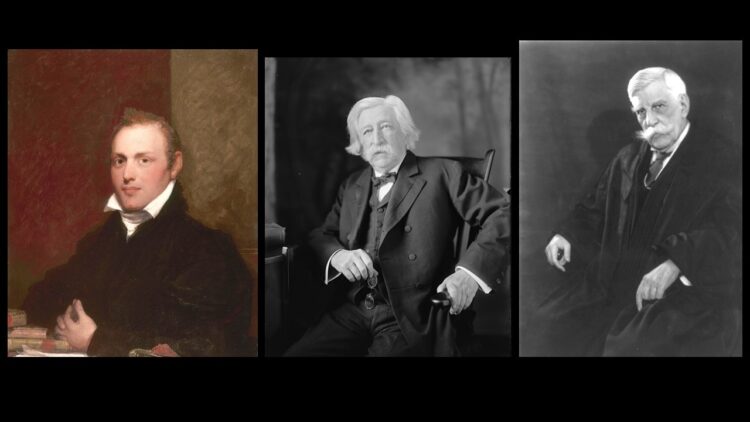
Poetic Justices: The Poetry of United States Supreme Court Justices
by Adam Sedia
In 1979, Justice John Paul Stevens of the United States Supreme Court remarked in an interview that “the best preparation for the study of law was the study of poetry, especially lyric poetry.” The relationship between law and poetry is long and storied. In Ancient Rome, the senator and advocatus (attorney) Marcus Tullius Cicero wrote poems among his many other works. The Renaissance Italian poet laureate Albertino Mussato, a contemporary of Dante, was a lawyer who found poetic inspiration in the structured order of Justinian’s Code. Two of the most widely read poets in English, John Donne and Sir Walter Scott, were both lawyers, and in German Goethe was a lawyer, as well.
This tradition continues in the United States, with poets from William Cullen Bryant and James Russell Lowell to Wallace Stevens all being lawyers. John Quincy Adams and Abraham Lincoln, two of the nation’s most prominent lawyer-presidents, were also serious poets in their own right. And Francis Scott Key, who wrote “The Star-Spangled Banner,” was also a lawyer.
Not surprisingly, then, lawyer-poets appear at the pinnacle of the American legal profession, among the members of our nation’s highest court. This essay examines the poetry of the three most prominent poets to sit as justices of the United States Supreme Court.
Joseph Story (1779-1845)
After Chief Justice John Marshall, Joseph Story shaped the law of the developing nation more than any other jurist. Born in Massachusetts as the son of a member of the Sons of Liberty who participated in the Boston Tea Party, he served in Congress and in state government while practicing law until 1812, when James Madison appointed him to the Supreme Court, where he served until his death. Taking his seat at only 33, he remains the youngest person ever to serve on the Court.
At the time Supreme Court justices served as trial judges on the federal Circuit Courts. As circuit justice for his native New England, the most rapidly industrializing part of the country, he almost singlehandedly developed American intellectual property law, with his decisions still taught in law schools today. For the Court as a whole, he authored the landmark decision of Martin v. Hunter’s Lessee (1816), which held that the Supreme Court had the power to review decisions of state supreme courts on federal issues, and United States v. The Amistad (1841), an admiralty case holding that captured Africans aboard a slave ship were not slaves, but victims of kidnapping. Story also authored Commentaries on the Constitution of the United States (1833), one of the most important and influential treatises on American constitutional law, still frequently cited in court decisions today.
Of all the justices to write poetry, Story was the most serious poet. His only volume of verse, The Power of Solitude, originally published in 1800 and revised in 1804, contains the lengthy two-part title poem and 21 shorter poems. Disillusioned after publication of the book, he reportedly obtained and destroyed all copies of the first edition he could find. Surviving copies are very rare.
“The Power of Solitude” is a discourse with an unmistakable Romantic flourish in its dramatic portrayal of nature. The poem is reminiscent of Wordsworth’s Prelude, a portrayal of scenes from nature and life with meditations on each, though Story is less personal; while his descriptions convey a sense of observation, he does not directly describe his own autobiographical details, as Wordsworth does. The following excerpt conveys a good sense of both its picturesque language and its philosophical tone:
Lo, where the torches throw reverted light,
What solemn pageants crowd the funeral rite!
Shrill winds the blast, and thro some broken cloud
Gleam the wan moonbeams o’er the flapping shroud;
Nor more is heard, save in some dismal pause
From rank to rank a sullen murmur draws,
And save, where, perch’d the neighbouring yews among,
The boding raven croaks his hateful song.
Hark! from the tombs the faultering service read,
Dust to the dust consigned, and dead to dead;
The victim fell in youth’s unblemished pride,
A darling sister, and a destined bride,
Cropped, like some flower in native beauty gay,
That greets the morn to blush its life away.
One moment hence, to freeze the soul of mirth,
On the sunk coffin pelts the rattling earth!
Ungracious sound! at whose disastrous tale
The live flesh quivers, and the moon grows pale:
Shriek follows shriek, the fainting mourners yearn,
And close the delved house, whence is no return.
Sure, if one scene in misery’s darkest hour
E’er thro the soul diffused a deadly power,
That scene were here, when midnight’s startling chill
Crawls o’er the flesh in mockery of the will!
Yet deem not hence, distempered fancy led
Such lonely rituals o’er sepulchered dead;
From glooms, like these, the kindred soul shall glean
Those holier sentiments, that work unseen,
From human ills shall snatch a zeal sublime,
Its trust in heaven, its triumph over time.
Here we see Story’s masterful description and Romantic fascination with the macabre, though couched in a style fond of poetic archaisms. Yet Story remains not like Byron the Romantic adventurer and lover, but like Wordsworth the philosopher. He draws from the funereal scene not a gruesome delight or despair at impending doom, but rather a lesson about hope and heaven as the realm transcending time and death.
Three shorter works that appear in the volume are:
On Death
In musing mood, to care a prey,
Youth’s airy visions lost in gloom,
I shuddering mark the dreary way,
Hope beckoning smiles beyond the tomb.
Then why, my heart, that wishful sigh?
Why round some well loved form entwine?
There, only there, each woe will fly;
There, only there, can bliss be thine.
To part, what, trembler, dost thou fear?
Say, art thou still delusion’s slave?
Shall lingering love not drop one tear,
What time thy form shall press its grave?
Lines
—written on a hermitage
Nymphs, who court the glowing day,
Seek with us the enchanted grove,
Where no lawless footsteps stray,
To blight the tender flowers of love.
Here content with smiling face
Weaves the myrtle wreaths of peace;
Nature charms with chastened grace,
Sighs of hope and anguish cease.
Hither bend your wildered feet,
Undisturbed by riot rude;
Kindred souls delight to meet
Mid the cells of Solitude.
Sonnet to Evening
Meek evening, wafted on thy glowing breast,
Spring’s richest perfumes scent the tranquil air:
Nor vain they strive to give his spirit rest,
Who knows no solace from supreme despair.
To me congenial swell these prospects rude,
When deepening shades embrown the dashing tide;
For here no dark unhallowed thoughts intrude,
Where love and nature still with peace reside.
Tho she has flown to death’s unthinking sleep,
Whose smile was rapture to my aching heart,
Has left her lovelorn votary to weep,
And feel an anguish, which can ne’er depart;
Yet here, VAUCLUSE, thy bard delights to rove,
And tell his sorrows to the vocal grove
The fondness for nature and solitude, as well as a fascination with the macabre seen in “The Power of Solitude,” permeate these shorter works, as well, giving a keen sense of a poet who has developed a style and deeply personal vision of the world. The other remarkable feature of these poems is their quality. Their elegance, eloquence, and depth of thought compare favorably with many poets of his time. Story’s attempt to destroy his work illustrates well how sometimes the most unjust criticism is self-criticism.
Story would abandon verse after these early works and shape the budding republic’s jurisprudence with both expository and authoritative prose. His judicial opinions are remarkably clear and precise, but lack any hint of poetic touch that might have surfaced from his earlier years. Nonetheless, his poems show a serious and devoted effort to the art as well as a fascinating glimpse into one of the Supreme Court’s most influential minds. Story would remain by far the most serious and prolific poet to sit on the Supreme Court, a distinction he carries to this day.
(The entirety of The Power of Solitude, including Story’s shorter works, is in the public domain and available on Wikisource: https://en.wikisource.org/wiki/The_Power_of_Solitude.)
Melville Fuller (1833-1910)
While Justice Story was intensely self-critical, the poetry of Chief Justice Melville Fuller became a source of persistent media attacks against his character. Fuller was born in Augusta, Maine. His paternal grandfather was a probate judge and his maternal grandfather was one of the first justices of the Maine Supreme Court. After graduating from Bowdoin College and attending Harvard Law School for six months, he was admitted to the bar in 1855 and at the same time edited his uncle’s newspaper. A staunch Democrat, Fuller moved to Chicago in 1856 for a more favorable political environment. He quickly became one of Chicago’s most influential and highly paid lawyers, as well as a well-known political fixer. After actively supporting Grover Cleveland’s 1884 presidential campaign, he became a close confidante of the president. When Chief Justice Morrison Waite died in 1888, Cleveland, wanting a justice from the Midwest on the Court, nominated Fuller to succeed as Chief Justice.
Interestingly, both Fuller’s mustache and his poetry caused controversy during his Senate confirmation. The New York Sun argued that the Court was not ready for the “modern style” of Fuller’s facial hair, and opponents of his appointment criticized him as a mediocre amateur poet unfit for the bench. Indeed, one of Fuller’s rivals for the seat, the ambassador Edward J. Phelps, was praised by the anti-Fuller press as having written better poetry than Fuller. This marked the only time a nominee’s poetry was debated as part of the confirmation process. (As for Fuller’s mustache, an amusing literary anecdote survives: a passerby mistook Mark Twain for Fuller, and Twain signed the card with Fuller’s name and the message, “It is delicious to be full, but it is heavenly to be Fuller.”)
Fuller was confirmed and served as Chief Justice until his death. He is not well-remembered as a judicial author; he assigned major opinions to the other justices and rarely wrote dissents. Nonetheless, he authored a few influential opinions: in Pollock v. Farmers Loan & Trust Co. (1895), he authored the 5-4 majority opinion that struck down the first peacetime federal income tax; and in United States v. E.C. Knight Co. (1895), he authored the majority opinion severely limiting the scope of federal antitrust laws. These opinions reflect Fuller’s general laissez-faire jurisprudence disfavoring federal power over states and economic activity.
Personally, Fuller was an enthusiastic lover of literature. His personal library contained more than six thousand books and he was a member of the prestigious Chicago Literary Club. He had been an avid bibliophile since his youth, a love that spurred him to write poetry at an early age. Upon the death of his beloved mother in 1853, the twenty-year-old Fuller, recently graduated from Bowdoin, wrote the following poem:
Remorse
I may not flee it! in the crowded street,
Or in the solitude by all forgot,
‘Tis ever there, a visitant unmeet,
Deep in my heart, the worm that dieth not.
There is no consolation in the thought
That from her lips no chiding words were spoken,
That her great soul on earth for nothing sought,
Toiling for me until its chords were broken.
Too late, the knowledge of that deep devotion!
Too late, belief of what I should have done!
Chained to my fate, to suffer the corrosion
Of my worn heart until life’s sands are run.
Why should I weep? why raise the voice of wailing?
Why name the pangs that keep me on the rack?
Or prayers or tears alike were unavailing,
She has gone hence! I cannot call her back.
And I alone must wander here forsaken—
In crowded street or in secluded spot,
From that sad dream, oh never more to waken
Or cease to feel the worm that dieth not.
This is a rare serious poem of Fuller’s, and a sincere and poignant, if not particularly profound, reflection on personal tragedy.
Fuller, however, is best remembered for the bacchanalian drinking-songs he wrote in his youth, republished decades later by his opponents to attack him after he had become a national figure. These press attacks continued even after Fuller took the bench. The following stanza from his “Bacchanalian Song,” which he published in 1856 while still a young lawyer in Maine, stirred manufactured controversy in 1891 for its use of the Christian “hosanna” to praise the wine-god in a drinking-song:
The flag at our mast-head is pleasure’s own banner,
And to the breeze boldly its broad folds we fling;
Which each stout-hearted sailor will raise the hosanna
To ivy-crowned Bacchus, our jollysouled King
After Justice David Josiah Brewer (1837-1910) joined the Court in 1890, the press was fond of attacking him and Fuller together as having written poetry in their younger years, with the implication that writing poetry was unmanly. But the muckrakers could not obtain any of Justice Brewer’s verse, so Fuller remained to bear the brunt of the attacks. In 1892, when Fuller was floated as a possible presidential nominee, the Sun obtained and published another bacchanalian song Fuller had written in his younger days:
Oh, bright is the gleam of the silv’ry stream,
_As it leaps from its native mountain;
And sweet to the taste, in the desert waste,
_Is the draught from the pure, cool fountain;
But sweeter than this, with its transient bliss,
_To me in the desert roaming,
And brighter still, than the sparking rill,
_Is the wine in our goblets foaming.
Chorus:
Then fill each glass as the moments pass,
_Let the red wine mantle high!
As pledge we here, to mem’ry dear,
_The pleasant years gone by.
Oh, hard is the strife of the battle of life,
_To the soldier youth contending!
Full soon may fail e’en the plated mail,
_He fancied himself defending,
Yet we’ll on to the fight with hearts so light,
_At the stirring trumpet’s tone.
And never will yield the battle field
_‘Till victory is our own.
Chorus:
Then drink to-night, with hearts so light,
_To the untried world before us,
And gayly laugh, as the wine we quaff,
_And join in the merry chorus.
An honest appraisal of Fuller’s poems cannot rank him among the great English-language poets, but his verse displays a keen ear for melody and a skillful use of rhyme. Though he is fond of archaisms and poetic contractions, he generally eschews grammatical inversions in favor of natural-sounding sentences. Fuller’s verse is far from the worst of its age.
Aside from his poetry, the press also criticized Fuller’s judicial style as “muddy, inelegant, and diffuse.” This reputation unfortunately survived him: Justice Felix Frankfurter called Fuller “not an opinion writer whom you read for literary enjoyment.” Yet Fuller’s opinions still bear a touch of the poetic. For example, upon his death the press, not without derision, pointed to the closing lines of his unanimous opinion in Hammond v. Hopkins as illustrative of how poetic style had crept into his judicial writing:
In all cases where actual fraud is not made out but the imputation rests upon conjecture, where the seal of death has closed the lips of those whose character is involved, and lapse of time has impaired the recollection of transactions and obscured their details, the welfare of society demands the rigid enforcement of the rule of diligence. The hourglass must supply the ravages of the scythe, and those who have slept upon their rights must be remitted to the repose from which they should not have been aroused.
Such strikingly visual and concrete language to describe an abstract legal principle represents what may be called poetic style in judicial opinions—a rare phenomenon.
Oliver Wendell Holmes, Jr. (1841-1935)
The “Jr.” suffix is necessary in identifying Justice Holmes, particularly in connection to poetry: his father, Oliver Wendell Holmes, Sr. (1809-1894), a physician by trade, remains one of the United States’ most celebrated poets. Born in Boston, the younger Holmes spent his childhood among his father’s academic circle that included Ralph Waldo Emerson. He saw active duty, rose to the rank of lieutenant colonel, and was wounded during the Civil War. He returned to Boston to recover from his war wounds, where he wrote poetry and debated philosophy until he was (in his own words) “kicked into the law” by his father.
In 1882, he was appointed to the Massachusetts Supreme Court, where he served as Chief Justice, and in 1902 President Theodore Roosevelt appointed him to the United States Supreme Court, where he served until he retired in 1932 at nearly 91 years old (he remains the oldest justice to sit on the Court). On the Court, Holmes was most notable for his deference to legislatures, often with mixed results. In Lochner v. New York (1905), he built his reputation as “the Great Dissenter,” authoring a lengthy and impassioned dissent from the majority opinion articulating the nebulous doctrine of substantive due process, arguing that the majority crafted it to reach a specific result favoring a specific economic policy. On the other hand, in Buck v. Bell (1927), he authored the majority opinion upholding Virginia’s forced sterilization of a woman the state claimed to be mentally defective, infamously authoring the line, “Three generations of imbeciles are enough.” He also originated the oft-cited example of “shouting fire in a theatre” as speech unprotected by the First Amendment. Outside of his court decisions, Holmes authored the 1881 treatise The Common Law, articulating his philosophy of “legal realism,” summarized in the aphorism on its opening page: “The life of the law has not been logic: it has been experience.”
Justice Holmes was not a prolific or widely published poet like his father, but the verse he did write was more than private or occasional; he was no mere amateur. The following two sonnets date from his service in the Civil War, the first appearing among his private letters (most of which he burned), and the second published in the Boston Evening Transcript in 1864:
Lost and long-wandering at last I brake
From a deep forest’s sullen-opening jaws,
Where hungry junipers stretched bony claws
Like traps of devils, baited with a snake—
And all around the dark rocks seemed to take
Forbidden shapes of things that man outlaws,
Speckled like toads, and patched with all the flaws
Of stormy days, and lichen-ringed, and black—
Then wearied out—“Is there no hope?” I cried—
Hearken—A soft melodious rapture thrills
As from the forest’s deepest heart replied
Their hermit—and the music multiplied
And rose reechoing upward far and wide
From the dark valleys to the sunlit hills.
H.L.A.
Twentieth Massachusetts Volunteers
He steered unquestioning nor turning back,
Into the darkness and the unknown sea;
He vanished in the starless night, and we
Saw but the shining of his luminous wake.
Thou sawest light, but ah, our sky seemed black,
And all too hard the inscrutable decree.
Yet, noble heart, full soon we follow thee,
Lit by the deeds that flamed along thy track.
Nay, art though hid in darkness, shall we say,
Or rather whisper with untrembling lips;
We see thee not, yet trust thou art not far,
But passing onward from this life’s eclipse
Hast vanished only as the morning star,
Into the glory of the perfect day.
The following poem also dates from 1864, written as a dinner address to a gathering of fellow Harvard alumni in Boston:
The Class of 1861: A Poem
How fought our brothers, and how died, the story
You bid me tell, who shared with them the praise,
Who sought with them the martyr’s crown of glory.
The bloody birthright of heroic days.
But, all untuned amid the din of battle.
Not to our lyres the inspiring strains belong;
The cannon’s roar, the musket’s deadly rattle
Have drowned the music, and have stilled the song.
Let others celebrate our high endeavor
When peace once more her starry flag shall fling
Wide o’er the land our arms made free forever;
We do in silence what the world shall sing.
Holmes appears not to have written much verse aside from these early Civil War poems. They display a competent handling of rhyme and meter, as well as a noticeable but not total avoidance of archaism and poetic contraction. The most interesting of this set is the first, unpublished sonnet, with its graphic and dramatic depiction of the wilderness and its highly personal tone—far removed from the paeans to the fallen soldiers he wrote.
But Holmes also tried his hand at light verse. The following undated piece appeared posthumously in the December 1953 issue of the Atlantic Monthly:
Cacoëthes Scribendi
If all the trees in all the woods were men;
And each and every blade of grass a pen;
If every leaf on every shrub and tree
Turned to a sheet of foolscap; every sea
Were changed to ink, and all earth’s living tribes
Had nothing else to do but act as scribes,
And for ten thousand ages, day and night,
The human race should write, and write, and write,
Till all the pens and paper were used up,
And the huge inkstand was an empty cup,
Still would the scribblers clustered round its brink
Call for more pens, more paper, and more ink.
Such a poem could only come from the hand of a lawyer and jurist who spent his career poring over reams of paper, likely birthed during a moment of particular frustration at the volume of documents overwhelming him. It is a fine example of light narrative verse, readable and humorous.
In his judicial decisions, Holmes waxed more philosophical than poetic, writing in an aphoristic, easily quotable style. Yet some of his turns of phrase certainly verge into the poetic. Some examples: “The common law is not a brooding omnipresence in the sky but the articulate voice of some sovereign or quasi-sovereign that can be identified . . . ;” and “A word is not a crystal, transparent and unchanged, it is the skin of a living thought and may vary greatly in color and content according to the circumstances and the time in which it is used.” Here he puts imagery and metaphor to apt use, illustrating the ready transference of poetic skill to jurisprudence.
Conclusion: Poets as Jurists
The three justices examined here represent the most accomplished and serious poets to sit on the Court. Aside from Justice David Brewer, mentioned above, few (if any) others among the 112 justices to sit on the Supreme Court have written poetry, but it is telling that two of the Court’s greatest luminaries, Story and Holmes, were poets outside of their careers as jurists. The poet’s sensitivity to the subtleties and effects of language and the world he observes make him a natural jurist. Shelley called poets the “unacknowledged legislators of the world,” but they may justifiably be called its judges, too. What is a poet but a critic of reality? And “critic” derives from the Ancient Greek κρῐτής, or “judge.”
It is also telling that the only serious poets to sit on the Court all had their formation in nineteenth century New England, when literature and the humanities were still deemed essential to an education that developed the entire character. After the modern era education, including legal education, became hypertechnical, with emphasis on developing skill-sets instead of character. Credentials mattered more than depth of insight or experience. That shift may be seen in the composition of all courts, including the Supreme Court, where in all but the rarest cases a highly credentialed but narrowly-focused judiciary confines itself to strict legal technicalities. Gone are the grand, philosophic pronouncements of Holmes or the engaging literary style of Cardozo and Robert Jackson. What we have is practical guidance, but nothing anyone outside of practicing lawyers would derive enjoyment from reading.
Not every jurist should be a poet, and not every poet a jurist, but the present separation of the two realms is both contrived and unnecessary. The verse of some of the greatest past justices of our highest court should remind us of what has been lost and what can still be regained: a jurisprudence crafted by those who can craft works of beauty and insight from the same words used in the statutes and contracts they construe.
Sources
Gopen, George D. “”Rhyme and Reason: Why the Study of Poetry is the Best Preparation for the Study of Law.” College English. Vol. 26, No. 4 (April 1986), pp. 333-37.
Peppers, Todd C. & Mary Crockett Hill. “‘Destructive to the Judicial Dignity’: the Poetry of Melville Weston Fuller.” 46 J. Sup. Ct. Hist. 148 (2021), pp. 148-161.
Frankfurther, Felix. “Chief Justices I Have Known.” Virginia Law Review. 39(7), pp. 883-905.
Hammond v. Hopkins, 143 U.S. 224, 274 (1892).
Schenck v. United States, 249 U.S. 47, 52 (1919).
So. Pac. Co. v. Jensen, 244 U.S. 205, 222 (1917) (Holmes, J., dissenting).
Towne v. Eisner, 245 U.S. 418, 425 (1918).
Adam Sedia (b. 1984) lives in his native Northwest Indiana and practices law as a civil and appellate litigator. He has published four books of poetry and his poems, essays, and fiction have appeared in various literary journals. He is also a composer, and his musical works may be heard on his YouTube channel.

















Great essay, Adam. I was familiar with the jurisprudential aspects of Oliver Wendell Holmes, Jr. from having studied Constitutional Law, particularly remembering “shouting fire in a theatre,” regarding the 1st Amendment. I had read one of his poems a long time ago but do not remember which one. Your essay is profound and sorely needed for excoriating modern jurists for their lack of understanding human nature and the logical consequences stemming from life reflected in literature.
Thank you! I definitely wanted to draw attention to the decline in literary breadth in our current judiciary. Notice it has been nearly a century since a serious poet sat on the highest court.
This essay was a sheer delight to read, both for its concise, pellucid prose and its careful and intelligent exposition of the poetic activity of three men who were better known for their legal careers. I knew that Holmes Jr. had produced some verse, but I was unaware of the work of Story and Fuller. Sedia lays out the history of all three of them as writers of poetry in the kind of mature, sophisticated, intellectually rigorous manner that is uncommon today. But we have come to expect that from his essays.
I was sorry to hear of Story’s attempt to destroy his own work, and glad to learn that it has survived despite his intention. His death-oriented poems (from what Sedia quotes here) call to mind the work of Thomas Lovell Beddoes (1803 – 1849), a medical doctor who became notorious for his somewhat creepy, macabre, and morbid poems of mortality, disease, and decay.
Fuller’s case made me smile, because it confirmed how steeped America is in Low-Church Protestant prudery, sometimes sincere but more often employed politically to destroy someone’s career. Imagine objecting to “hosanna” because it was used in a poem to praise Bacchus! That’s like objecting to “amen” when it is used to express finality outside of a prayer. The use by political opponents in 1892 of Fuller’s youthful bacchanalian song that (only parenthetically) praised wine is another example: the fundamentalist anti-alcohol maniacs were in the full flush of power at the end of the 19th century, and would have employed anything praising wine as a weapon against their foes. Today their descendants are the anti-male and anti-sex feminists, with the same prudery but minus the religion.
The “Cacoethes Scribendi” of Holmes is a very neat and effective piece touching on a subject that is not frequently recognized. The mad urge or bad habit of writing is very real. Some writers (both competent and inept) suffer from this disease — or blessing, if one looks at it positively — and it was recognized in the ancient world. Holmes has produced six beautiful rhyming couplets on the question that describe the syndrome perfectly.
This is a fine essay that does honor to the SCP as a teaching and learning website, as well as a place to showcase polished poetic work. I’d love to see more well-written expositions of this nature.
Thank you! I got this idea when I visited Springfield, IL, and read some of Lincoln’s poetry. I looked up president-poets, then thought, “What about the Supreme Court?” It seemed a natural place for poets. Turns out I was not disappointed, and I was delighted to learn that Justice Story, one of the Court’s greatest luminaries was also a poet. I’m delighted to see that this discovery has sparked interest and discussion.
Thanks, Adam, for this feast of American poetry from the highest lawyerly ranks. Excellent selection of poems. I very much like Cacoethes Scribendi by Holmes Junior; the interminable quantities of writing are probably law, since recording law was one of the first functions of human literacy. But they could as well be creative writing, so very widespread is that human urge among literati of any profession. I’m interested to hear the recommendation of LYRIC poetry as good preparation for law; this would naturally suggest acquaintance with music in its measured order, acknowledging poetic and legal efforts at precision in sound and meaning.
Story’s “Lines” offer an intriguing oxymoron of kindred souls delighting to meet “mid the cells of Solitude.” That kind of companionship was essential to one of the very greatest poets with legal training, namely Petrarch. And in “Sonnet to Evening” Story may be comparing himself as bard to Petrarch. The location mentioned, Vaucluse, was one of the great Italian laureate’s principal residences. It is in Provence, where his celebrated Laura lived and died. One of Petrarch’s longest and most interesting canzoni could be called “The Poet and Love Go to the Law Court.” The poet sues Love for all the evils caused him (lust, wasting of life, etc.) but Love puts up a spirited defense, bringing into evidence all Love’s noble aspirations and the great poetry written in honor of Laura. The case remains undecided, for the judge (of uncertain identity, but possibly Reason personified), says more time is required.
Thank you! I chanced on Cacoethes Scribendi as I was editing, and was grateful to have found such well-written and insightful light verse. I really think Story’s poetry deserves greater attention; I found his shorter poems quite good for their time. The reference to Vaucluse is certainly in reference to Petrarch, who would have been taught to Story at a young age. I will make sure to reach the Petrarch work you reference. Thank you for the suggestion.
It’s Canzoniere 360, “Quel’ antiquo mio dolce empio signore.”
Again you’ve written well on a topic not much explored. (I particularly appreciated, by the way, your essay on Thomas Hardy.) As to eminent jurists who wrote poetry, who would have guessed? One thing I noticed, classical poetry remains comprehensible and accessible right across the generations and even centuries. Writing within the tradition, these poets communicate easily, in contrast to those who think themselves poets nowadays and merely wish to be thought clever and iconoclastic. That judges, of all people, should write classical verse, somehow gives me a little more faith in their judgments, now in this dessicated technology-obsessed world. I wonder if, and how many, jurists are now writing in the tradition. I hope there are some. It’s a sign of healthy humanity. Thanks for shedding light on those eminent jurists.
In India today, educated persons still read the classical canon of poetry written in Sanskrit, and there are still some who can compose new poems in that language and style. In every classical language, the vocabulary, the grammar, the meters, the genres, and the rhetorical styles are fixed, and all one has to do is learn them. The great crime of modernism was the substitution of the word “dead” for “classical,” thereby propagandistically changing the literary outlook in favor of their innovations and acts of destruction.
Normally a classical tradition, no matter what culture or nation has it, is preserved by its “clerisy” — that is, its professional class of teachers, writers, linguists, poets, journalists, jurists, intellectuals, and anyone else dedicated to the written word and its perpetuation. When that clerisy and its tasks are deliberately poisoned and demeaned (as has happened in the West over the past century or more), the tradition will die a slow but certain death.
Sedia’s essay speaks of jurists who lived mostly in the eighteenth and nineteenth centuries. I really wonder if (apart from Adam himself) there is any excellent lawyer writing top-notch poetry today.
To Brian Yapko, and to everyone at the SCP —
Please forgive the stupid error of a forgetful old man. I know very well that we have another EXCELLENT poet here who is also a lawyer. I made that last comment in the above post without thinking clearly, and inexcusably forgot to mention that we do have a lawyer here who is one of the best writing formal verse today: Brian Yapko.
I’m sorry, Brian. Sometimes I type so fast on the keyboard that my fingers jump ahead of my thoughts, and I say something erroneous.
Joe Salemi
Joe, this is an incredibly kind note. Thank you. It was not a stupid error — it was a mere oversight that anyone could make. We’re all human. Nor would I ever refer to you as “a forgetful old man.” In fact — lion of poetry that you are — it’s impossible to even consider such a thing, but I thank you for the gesture all the same. Yes, I too am a lawyer, though I try to make up for it with my poetry. I’m grateful to be mentioned along with Adam Sedia — a formidable poet who I have long looked up to.
Joe, I really appreciate the vote of confidence about my work. I was worried that I was going to have to step up my game!
Your observation about replacing “classical” with “dead” is insightful. Nothing had to be changed but perspective to destroy a literary tradition. I knew a professor from India (now deceased) who knew Sanskrit because he had learned it in school, and know that Sanskrit publications exist in India. Imagine what the West could do with Latin and Ancient Greek similarly venerated!
And Bhikku: I’m afraid the situation is as bleak as you fear. All of these jurist-poets were educated in pre-1900 New England. They could not have had a better education for their time — and it was an education that stressed the development of virtue and character. Poetry was essential to that.
Now, the New England educational establishment “has killed the old institution and walks around in its skin demanding respect” (to use another’s metaphor). Elite lawyers are trained in ideology, not law, though some law is still taught at less prestigious institutions. Lawyers and judges nowadays care about one thing only: career advancement. Poetry and creative arts interfere with that, so we haven’t had any poets on the Court since Holmes left nearly a century ago.
Well done, Adam. Thanks for this good piece of work, reminding us of the power of poetry to shape the way we think and the things we think about. That’s what makes this website so important.
Adam, this is an excellent essay on a fascinating subject — ideal to commemorate our nation’s 250th birthday. I had no idea that some of our Supreme Court justices were so talented as poets. But it actually does not surprise me. I do not think there is a deep connection between being a judge and a poet so much as there is a deep connection between being a LAWYER and a poet. (Judges almost universally start out as lawyers so, in my mind, the elevation is irrelevant.) At heart, both professions are deeply invested in language — meaning, nuance, etymology, appeal to the emotions as well as logic. And law demands creativity — how else could one write briefs and motions and all manner of documents concerning subjects which are not necessarily close to one’s heart. One must be a wordsmith capable of transporting one’s thoughts into the experiences of others. One must be not only an advocate but an instrument of point of view. And so the distance between the pleading and the poem is not nearly so great as many assume. I think I most appreciate Oliver Wendell Holmes, Jr. his his creative talent memorializing the Civil War. Speaking of “creative talent”, I can only cringe thinking what a piece by Ketanji Brown Jackson would sound like.
By the way, I would add the interesting fact that a great many lawyers have ended up as lyricists. Cole Porter and Oscar Hammerstein II both got their start in law, with Porter going to Harvard Law School and Hammerstein going to Columbia. Paul Simon went to Brooklyn Law and W.S. Gilbert started out as a barrister. Perhaps most consequential of all would be Francis Scott Key and his Star Spangled Banner. Also a good thing to note for America’s 250th birthday.
Poetry by Ketanji Brown Jackson! I don’t know whether to laugh or cry. Cringe might be the most appropriate reaction. Fortunately she doesn’t seem inclined to try her hand at creativity — but neither do any of the others. Nor has any other justice been so inclined for the last hundred years. I think much of it has to do with what plagued Chief Justice Fuller: poetry gives too much ammunition to potential political opponents, so one cannot write frankly if one has ambitions for a judgeship. And we cannot forget the decline in educational quality at all levels, especially in formerly elite institutions. Minds that write poetry are not welcome as products of the system, which is designed to instill conformity and compliance
The link between law and poetry is real indeed. To your list I would add that John Donne, Sir Walter Scott, William Cullen Bryant, and Wallace Stevens were all lawyers. And of course John Quincy Adams and Abraham Lincoln both wrote poetry. Beyond English, Goethe was a lawyer as well.
Thank you for your compliments on the essay. Hearing a fellow lawyer’s feedback is encouraging.
I have noted a considerable number of lawyers at the Society. In my own experience of friends and associates among the professions, attorneys tend to be more attracted to creating literature, and medical practitioners to music. Not a clear rule, of course, as medical doctors have written for this site.
I would also add that Oliver Wendell Holmes, Sr., a much more famous poet than his son, was also a medical doctor. But sometimes exceptions prove the rule.
This is a fabulous article in all sorts of ways: the research, the insight, the copious examples and more beside; and aside from that, there is that intrinsic interest in how disciplines may or may not connect. I am sure being a poet is not incompatible with being many other things as well; indeed, it is often observed that Shakespeare himself – a man of very acute business acumen – seems to have an extraordinary knowledge of legal terms and ideas in his plays. Was he not a teacher in his unknown years, but a trainee legal clerk? Who knows. But I also like Adam’s comments on the derivative nature of much of these poets, and I would add one observation: poor old Justice Fuller being attacked for his poetry, and even his written judgements infiltrating the legal process. But take the example Adam gives us: beginning “In all cases where actual fraud is not made out but the imputation rests upon conjecture …” What is that whole paragraph derivative of? More exactly, whose style was Fuller aping? Of course: the great Dr Johnson – a man whose powers of language were such that legal experts sought him out! Brilliant piece Adam – great writing.
Dr. Johnson can be called the premier stylist of English prose, in that he set a standard that all subsequent prose writers had to emulate, if not equal. Some other writers were just as good, but none had his scope and wide-ranging influence.
See my essay on Dr. Johnson at http://www.expansivepoetryonline.com/SalemiOnDrJohnson.html
Thank you! I would add that Dickens’s experience as a court reporter colored his fiction, and of course there’s Jonathan Swift’s famous diatribe against the legal system as described to the Houynhms. The English (and by extension, American) entanglement between law and literature runs deep. Dr. Johnson’s towering contribution to the English language has been sadly all but forgotten, at least here in the States. Your observation about his influence should certainly be noted.
Thanks for this highly interesting and informative essay, Adam.
I’m sorry to be late to the party, Adam; but I just read your article, and found it fascinating and enjoyable. Thank you for writing it. Since joining the Society, I’ve been intrigued by how many lawyers we have here.