


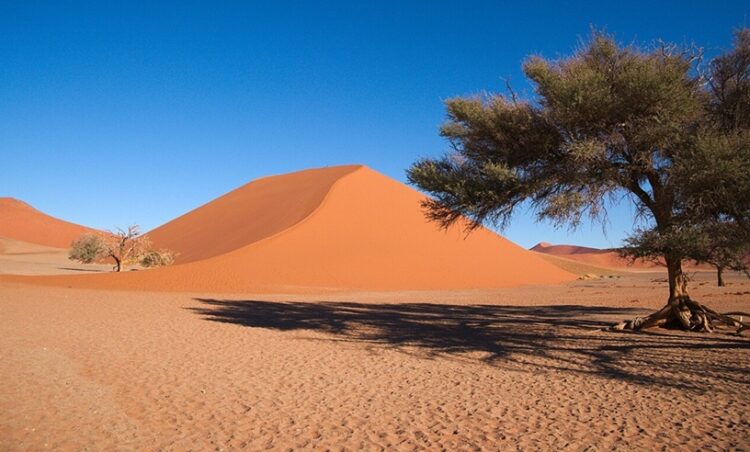
The Dunes
The dunes are marching, blown along
Saharan landscapes. Grain by grain
they stream across a barren plain,
their sibilance a desert song.
From sandstone hills, detached, they fly
and join an undulating sea
of desiccated waves, set free
beneath a steely, sun-drenched sky.
These rock-sheared motes are born again,
and as we age, so they age too.
They reach a shoreline, sink from view,
like snowmen melting in the rain.
Poet’s Note: inspired by Philip Larkin’s “The Trees”
Paul A. Freeman is the author of Rumours of Ophir, a crime novel which was taught in Zimbabwean high schools and has been translated into German. In addition to having two novels, a children’s book and an 18,000-word narrative poem (Robin Hood and Friar Tuck: Zombie Killers!) commercially published, Paul is the author of hundreds of published short stories, poems and articles.


















This is lovely. The line construction is gorgeous!
Thank you, Jenna. Appreciated.
Nicely phrased and rhymed with several inspired vibes ending in comparison to our lives.
Thanks for reading and commenting, Roy. I was quite happy with the weirdness of this one. As you can imagine, there’s not much Mauritania poetry written in English, though Mauritania is known in the Arab World as The Country of Poets.
This poem is largely imagistic, in that it depends strictly on description in the first two quatrains and in the last two lines of the final quatrain. The only place where the speaker opines with personal comment is in these lines:
These rock-sheared motes are born again.
and as we age, so they age too.
This is different from the Larkin poem on trees, where most of the words are personal comment and opining. This is not a value judgment on either poem — both are excellent. But the interplay of simple imagery with discursive comment is a perpetual feature in all poetry, with different periods favoring one over the other.
Thanks, Joseph. As always, you add a new or slightly different perspective which gives the poet pause.
This poem was also a welcome diversion from couplets and sonnets.
This is an especially attractive piece of work, Paul. It seems you have the faculty of observing all the time, and, out of that observation, somehow arises a poem. The language of this one is measured, balanced, and clear. Without going heavy on symbolism or sentimentality, you describe the migration of a grain of sand from ancient hills to the dune, and thence into the sea–there, one might guess, to be compressed to rock again in some future age. The reader cannot help but reflect on the changes that affect living beings. You don’t draw any lessons from the process, leaving that to the reader, and indeed one cannot keep from pondering the fact of impermanence. There is an economical suggestion of beauty in the “desert song” and the “rock-sheared motes,” but mainly you just hand over, as it were, striking images that resound in the mind. Very nice work!
I’ve been trying recently to write more observational poetry, especially since I live in a country that’s out on a limb, on the edge of the Sahara, bordered by the Atlantic Ocean. I’m glad the imagery seems to be resonating, Bhikkhu Nyanasobhano.
A lovely, evocative poem, Paul. You give life to inanimate things that move. The rhyme scene moves the poem, like sand, in unusual ways. Have you considered (and declined) extending it into a sonnet?
Hi, Rob. The length, rhyme scheme and meter are based on Philip Larkins’ The Trees, a poem I instantly fell in love with. Sonnets are generally my go to form, so it was nice to try something a bit different and shorter.
Thanks for reading and commenting.
A poem of motion rather than emotion, Paul, yet one asking for careful contemplation of sound and movement. S never flies out of sight. The aging of sandgrains is practically too small to observe, but must happen. They coalesce into dunes, streaming like the sea, but sink as if melting at a shoreline. Transience rather than transcendence? I had typed “transcience.” Like the word, but imagine it was not in mind for the poet.
Thanks for reading and commenting, Margaret. I feel its almost like a duty to get down on paper some of the unusual aspects of where I live before they become unexceptional through their familiarity. That said, I am writing a book set here, and I find I’m looking at everything in a new, fresh and more positive light. And of course, with the Sahara Desert at my front door, I had to have another go with sand dunes.
I am in love with this extended metaphor of “sand dunes”. The personification of the dunes has been executed immaculately with the depiction of their birth, ageing and disappearance.
One of the top imagistic poems I’ve read in a long time.
Thanks, Satyanandra. This is praise indeed. It helped that I was writing in an unfamiliar meter and rhyme scheme and had a great example to take stock of.
Paul, great use of nature imagery to convey the life of the sand dunes; I enjoyed reading it. Thanks for sharing. Have a good weekend.
Thanks, Paul.