


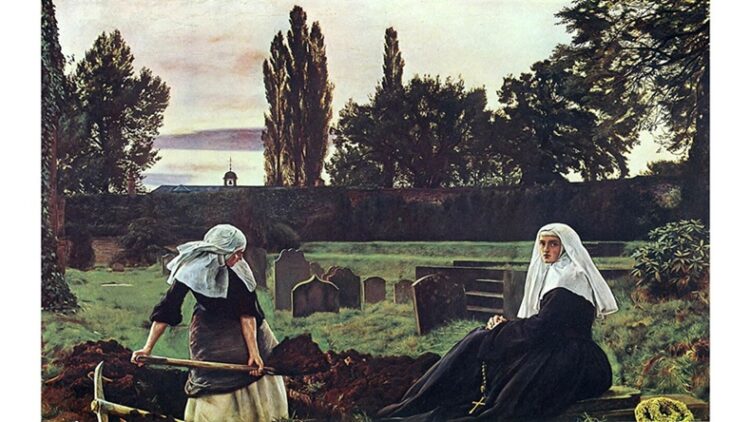
The Gravedigger
I garden to acquaint myself with graves.
Accompanying death with every turn,
my spade exhumes pharaonic tombs, engraved
by earthworms’ hieroglyphic gnaw and churn.
I learn the scrawl that’s written on old bones,
trace epitaphs inscribed with mold. I read
the spider-weave in leaves. My trowel groans
against the ghosts of roots that whitely bleed.
Out of the solemn air, the tanager
sings! And it seems the reason he has wings,
or wears his scarlet garment, stitched with ichor,
is that all winters perish into springs.
Decay transformed to tilth, my scanty plot
recants its death and trills with daffodils.
Somehow what is depends on what is not.
The river made of blood’s a river still.
I hold no claim on life. I am not proud.
The song that leads to life rolls on in waves,
awakening drowsed earth. Pull back the shroud—
Then watch: My garden resurrects its graves.
Marie Burdett is a Florida-based gardener and poet currently working on her MFA at the University of St. Thomas, Houston.


















This poem feels both ancient and alive in the way you turn something as physical as digging into a meditation on death and renewal. This is what a poet does! It takes something simple, even mundane, and makes it into something worth pondering. The metaphor that was there the whole time…but you unearthed it. The imagery of this poem was suburb, Mary. For example the “earthworms’ hieroglyphic gnaw and churn” and “ghosts of roots that whitely bleed” were vivid. This was a win.
Marie,
This is a lovely poem. The way the rhymes emerge subtly as one line runs into the next makes the poem sing in vibrant tones. The metaphors are fresh and winning. Not sure “ichor” works. As I read it, I was reminded of Wallace Stevens’ “Sunday Morning,” and its evocation that “Death is the mother of beauty.”
I love this poem! My two favorite lines: Somehow what is depends on what is not.
The river made of blood’s a river still. This poem seems to magically dance between elegant simplicity and verbal complexity. Love it!
The language here is provocative in the sense that it demands more attention from the reader than usual. There’s nothing wrong with that — in fact, it is part of the job of the poet to produce language of that strange type, rather than being simple and direct. Words like “pharaonic,” “whitely,” “tanager,” “tilth,” “recants,” and “ichor” make for an unusually intriguing experience in reading. By the way, the words “earthworms’ hieroglyphic gnaw and churn” are brilliant — they would be perfectly in place in the eighteenth-century “Graveyard School” of poetry
I too wondered about “ichor.” It can mean the clear liquid in the veins of the Olympian gods, or it can refer to a discharge of fluid corruption from a wound. Either case seems difficult to connect to the skin that covers a bird, but then again, one is going to be hard pressed to find a word that rhymes with “tanager.”
I’d love to hear what a professional gardener like Kip Anderson thinks about this piece.
First of all, Joseph, I think that “manager” would be a good rhyme with “tanager.” And “liquor” would do for “ichor.” “Decay transformed to tilth” is for me the ultimate expression of what is required to support healthy plant growth, or, for that matter, what is needed to undergird the life of a poem. Burdett’s locutions are the compost wherefrom new seeds of literacy will ultimately arise. A damn good poem, in my estimation.
This is a great gardening poem. I can completely relate to it, after a whole day of working in my garden today and then coming in to read this. There is a lot of death to confront in early spring gardening. I have no idea what “stitched with ichor” means though. We have red tanagers with black wings here in south-east Tennessee.
This poem is just beautiful, Marie, for all the reasons
so well articulated above. Wish I’d written it. The lines
already mentioned astonished me as well. I also really
like, “Somehow what is depends on what is not.”
This is truly beautiful, Marie! I love your rich imagery and metaphor.
I love the way you use an extended metaphor to create a whole world out of the confined of a garden.
Exquisite poetry! Every line is beautifully wrought, but I particularly like: “I read / the spider-weave in leaves.” Thank you, Marie!
This is a truly beautiful poem, Marie, with very delicate language. Even though I am no gardener, I can almost feel and smell the soil and roots on my fingertips, as well as the anticipation of new life growing in the garden.
A splendid exploration of the symbolism in which earth holds life, as both giver of birth and receiver of death. Excellent word choices take full advantage of symbolic association. The title, and beginning portion of the poem, focus on death, but having treated it for two stanzas, there is a turn as the tanager sings and the winter is perishing into spring. Even on the sonic level, change manifests itself. But the transformation is no mere contrast or reflection. The speaker disclaims knowledge, and remains a gravedigger, because the point and process of the poem is discovery. Sophisticated style and insight.
Wonderful to hear this read at the Thomist Poets event this evening. A very good poem, I look forward to reading more of your work!