


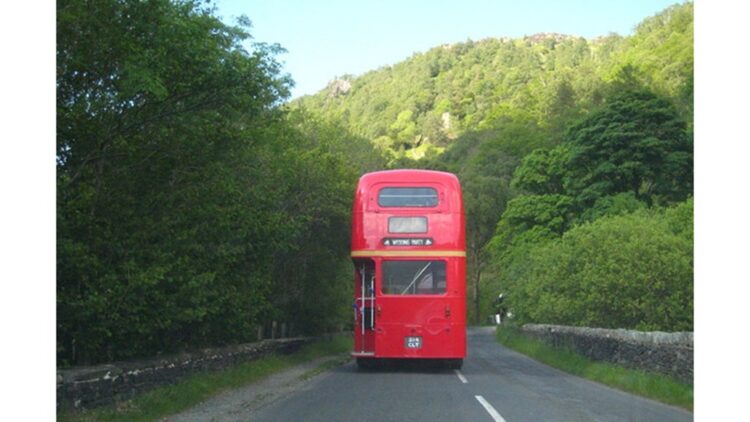
The Number 86: A Humean Tragedy
“For my part, when I enter most intimately into what I call myself, I
always stumble on some perception or other, of heat or cold, light
or shade, love or hatred, pain or pleasure. I never can catch myself
at any time without a perception, and never can observe any thing
but the perceptions.” —David Hume: A Treatise on Human Nature
‘Twas on the 86 at Chadwell Heath
While on his way one fateful day to Stratford
That S, a noted journalist from Leith,
Beheld a sight that left his spirit shattered.
Observing people by the staircase round him,
He had the strangest feeling all were dead.
And afterwards the memory would hound him
And fill him with a sense of utter dread.
He fancied that their minds were somehow vacant
As though their very souls had upped and left;
Yet in the face of this they seemed complacent,
Their lives of meaning seemingly bereft.
They had the look of robots or machines;
Automata without a conscious core;
Assembled lumps of empty cells and genes:
Appearances of men, but nothing more.
And S reflected on this awful scene
And wondered if he, too, had lost his soul;
And what, indeed, would such an absence mean
If where his soul had been were just a hole.
His mirror though provided no assistance:
It only showed his old familiar face
With nothing indicating its persistence
Nor intimating something out of place.
And so our hero set about attempting
To see this soul or self of his inside;
And at this nightly, Somnus’ charms neglecting,
Aurora’s light would find him bleary-eyed.
Unable now to work, he took retirement,
Applying himself in earnest even more;
And like a monk in self-imposed confinement
On family and friends he shut the door.
Now, S had thought the task before him easy
To find what he assumed he knew the best;
Indeed you’d say, his mood was bright and breezy
When first this new pursuit he had addressed.
For what did man perceive if not himself
Of whose existence merely thinking proved?
While nothing was more certain than the self:
A truth since Descartes no one had disproved.
Yet when he set about investigating,
Like old Macbeth, he found to his dismay
An unexpected revelation waiting
There blocking on the blasted heath his way.
He noticed when he looked inside himself
He’d stumble on some feeling or perception,
But never would he find the self itself:
The object of his search and introspection.
Hence, love or hate he’d see, or pain or pleasure,
And feelings of the like of every kind;
Yet though he might persist in his endeavour,
No feeler of those feelings could he find.
This odd and unexpected revelation
Quite took our honest Scotsman by surprise.
It filled him with unusual consternation,
As reasonably the reader might surmise.
Indeed, our hero now began to panic:
The very thing he’d feared he’d found was true;
He went from bright and breezy straight to manic,
Beside himself with what on earth to do.
He’d lost his self on which his world depended
And with it all contentment disappeared.
As when Iago fond Othello’s ended,
Irrational thoughts of every sort appeared.
His waking hours became a constant nightmare;
No purpose, sense or meaning could he find.
All avenues appeared to lead to nowhere
And S began to slowly lose his mind.
Without a self, he couldn’t get a passport,
Nor credit card, nor job, nor bank account.
They wouldn’t let him board on public transport—
On every side the problems seemed to mount!
But where in God’s Creation had he lost it?
He tries to focus now and racks his brain.
Perhaps he’d left it on a train or dropped it,
Or—Heavens!—even flushed it down the drain!
The teeming possibilities were endless
With each successive one appearing worse.
He paces up and down, disturbed and restless—
Not Cain himself endured so cruel a curse!
His searches now at Newham rubbish dump;
He looks at home through every drawer and shelf;
He roots around his local petrol pump,
But cannot find the thing he calls himself.
Deranged, he hunts in Beckton sewage plant;
He sifts the Thames’ befouled polluted shore;
He goes where others loathe to go or can’t,
Yet nowhere finds that vital missing core.
The passing weeks and months provide no answer
Nor any clue to where it’s disappeared.
Reproached by life and sounds of human laughter,
His world is bleak, untenanted and weird.
At length, he leaves his home on Chadwell Heath;
Like ancient Lear, he wanders now a tramp.
At night he lies in fields with chattering teeth
Or begs a bed at Romford travellers’ camp.
As Hamlet found his life forever shattered
On learning of the murder from the ghost,
He left behind his own and all that mattered
Because he couldn’t find what mattered most.
He’d lost his world and everything he’d owned
Yet hadn’t found that precious thing he sought.
He trudges on—distraught, despised, disowned,
His every dream and longing come to naught.
And on and on and on he trudges now—
This torment of unreason never ends!
No peace his tragic loss will S allow
Who into bottomless despair descends.
In time though, after many years of suffering,
He thought he’d try the 86 again.
He hides when boarding then, ashamed and shuffling,
Evades the driver’s eyes behind some men.
He looks about, uncertain why he’s there;
He’s feeling weak—he fears he’s going to fall!
He senses people starting now to stare:
No place to go, he’s up against the wall!
With flashing images from long before
He edges down the bus’s crowded aisle.
He keeps his gaze directed on the floor,
Yet can’t contain a melancholy smile.
Then suddenly he’s back at Chadwell Heath!
It’s once again that awful, dreadful day!
He’s standing by the staircase underneath
Reliving what has never gone away!
He finds a place to sit and settle down
And starts enjoying those long-forgotten sights:
The mums and dads with kiddies on the town;
The burly blokes with purple hair and tights.
But then he looks again with close attention
And grasps at last the truth that now is plain.
The self, he sees, is just a loose convention
That stops us all from going quite insane.
Poet’s Note: This poem is for David Sanderson, Arts Correspondent of The Times. The places mentioned are located in the eastern part of Greater London where the Number 86 runs. The poem is from the author’s unpublished work, The Bus Poems: A Tale of the Devil. An earlier version was published by New English Review.
Paul Martin Freeman is an art dealer in London. His book of whimsical verse, A Chocolate Box Menagerie, is published by New English Review Press.

















Wow, Paul! This is a “tour” de force of massive proportions that compelled me rapidly to continue to read every smooth and delicious verse while attempting to absorb every detail. One question: in verse 16 after Iago, is “fond” instead of “found” a typo? “Found” made more sense to me.
Hello Roy. I’m delighted you like the poem.
This from the internet:
“Fond” historically means foolish, silly, or unwise, originating from the Middle English word fonned, meaning to dote or act foolishly. While this archaic usage refers to being absurd or credulous, it also implies “foolishly tender” or overly indulgent. Modern usage often implies unrealistic or naive, such as “fond hopes”
Thank you for the lesson. I wondered whether it was “archaic” as you said. Great work. I needed that footnote.
Paul
Bravissimo! You’ve written 33 stanzas of perfect cross-rhymed iambic pentameter. Such clever wordplay, and such a fascinating topic. Personally, I find the quest for iambs and rhymes more formidable than either Lewis Carroll’s hunt for snarks or my own lifelong search to “find myself.”
What IS the self? I’m fascinated by the conclusion:
The self, he sees, is just a loose convention
that stops us all from going quite insane!
I am neither philosopher nor pyschologist. But these lovely lyrical lines seem just about right!
In stanza 18, S can’t get a passport, credit,card, job, bank account, or public transport. It’s scary to think that pretty soon, we won’t need a self—our smartphones and ultimately our embedded “chips” will usurp our very selves!
Most sincerely
Mary Jane
Hello Mary Jane
Thank you for taking the trouble to try to understand the poem. This is how I try to explain it.
Yes, some will say the self is the biggest mystery of all and also the most important to understand. After all, if we don’t know what we are, we cannot begin to assess what anything else is, as all we know of what’s “out there” we apprehend through what’s “in here”, with all that we are physiologically, psychologically, culturally etc giving shape to our experience and understanding.
This straightaway, though, is obviously problematic. How can there be objective knowledge if our understanding is always filtered and managed? Take one simple example. Human beings share pretty much the same visual experience of the world because our eyes are located in the front of our heads. But the world looks very different to a horse and different again to a chameleon. So how does the world really appear? How might it appear to God?
The great British philosopher Bertrand Russell wrote in The Problems of Philosophy:
“The truth about physical objects must be strange. It may be unattainable, but if any philosopher believes that he has attained it, the fact that what he offers as the truth is strange ought not to be made a ground of objection to his opinion.”
And the mystery deepens the more we look into it. Not only is the self or subject undiscoverable as Hume found, “added by the imagination” (Nietzsche), or a “logical construction” (Russell)––all putting in doubt the existence of an object as the one, logically, cannot exist without the other––but in fact we find that the “out there” is inseparable from the “in here” in that we cannot distinguish a world separate from our own experience of it.
Try this experiment. At this moment you are looking at the computer screen. Can you distinguish the screen (ie what’s “out there”) from your experience of it (ie what’s “in here”)? You can’t. So not only can we not distinguish a self from the seeing (as Hume found) but we cannot either distinguish any “world” from our visual experience.
In short, although when we think about our experience we divide it into subject, verb and object, the “world” we actually live in, reality, is undifferentiated. It’s mush.
The story was intended to explore the limits of philosophy and, more generally, thinking as a means to discovering what we are. At the end of the tale, S finds a solution to escape his madness. But all he’s found is what he isn’t. And there is more. And the study of that “more” is the province of mysticism, defined by Schopenhauer as “consciousness of the identity of one’s own inner being with that of all beings, or with the kernel of the world”.
Only here, some will say, is the search finally concluded when we realise ourselves as beyond all relativistic thinking. This is where, I believe, “the peace of God, which passeth all understanding” is to be found. Literally, because it’s on the other side of thought.
The poem was intended as an introduction to a few others I’ve written on or around the same subject.
Wow! Thank you for a thoroughly entertaining poetic bus-ride at break-neck speed from Chadwell Heath to Stratford and way beyond to those philosophical realms of enlightenment. What more could a reader ask for?! Wonderful stuff. Thank you, Paul! There’s also a huge plus – the fare was free.
Thank you, Susan. It was great to have your company!
Hume, the quintessential British empiricist, was quite dismissive of hypostatizations such as cause. He didn’t know everything and admitted he knew almost nothing, but he was not the last philosopher. Gilbert Ryle, centuries later in his The Concept of Mind presents a more modern critique of selfhood. In my opinion, both of them overlooked some curious obvious facts present in the mind of every self-reflective entity.
Paul, you’ve created a rollicking narrative out of almost nothing but “thinking.” Your Scottish speaker, I would say, places too much trust in the blank looks of other persons. While S rightfully wonders whether he may look the same, he recalls Descartes, and misinterprets the great philosopher’s, “I think, therefore I am,” to rely on thinking alone to discover the self he fears may be missing. You quickly point out that he takes “self” and “soul” to be synonymous. If he had remembered that the soul is what gives life to any living thing, he could have avoided sleepless misery. A human soul is distinguished from plant or animal souls not because it can think, but because it can reason. It is a rational soul. You ultimately specify the misery of your speaker as “the torment of unreason.” And how does he recover? By the rational expedient of getting back on the 86 again and encountering other human beings who are living in their distinctive ways. In other words, BEING themselves.
He remains an erring philosopher when he decides the self is a salvific convention that allows living. I’ll compare the error to late medieval nominalism, as opposed to the realism of Aristotle and Aquinas and Shakespeare, to whom you allude often in this poem. Things like beauty and love and life and self are real; they can’t be reduced to names. Shakespeare’s Juliet is an excellent proponent of realism when she wishes Romeo had some name other than Montague, because the name is the thing about him that is her family’s enemy. Romeo is the real man she loves. Roses are real flowers that would smell as sweet by any other name (and they do have hundreds of names in human language).
Nominalism developed into the various kinds of relativism we hear around us. As you say above, Paul, “on the other side of thought,” “we realise ourselves beyond all relativistic thinking.” Bravo!
Hello Margaret
Thank you for your most interesting and thoughtful comment which illuminates the Christian way of seeing things, notably on the difference between the self and the soul and the nature of the latter. Although S doesn’t see the world from a Christian perspective, I’m glad the story as a whole rings true to you. We also seem to agree on the main issue which is to see ourselves beyond all relativistic thinking.
On Descartes himself, although in the Cartesian philosophy he treats the self and the soul as the same, you of course are right to point out that, as a devout Catholic, he would have made a distinction between them, the latter being “eternal” in the sense of surviving death. (More on this below).
S, on the other hand, as a non-believer, following Hume, requires empirical evidence of his self (or soul) and isn’t given to speculation. When he can’t find that thing he had thought he knew better than anything else, he despairs and the contradiction pushes him into insanity. At the end of the story, he tries the bus again where he makes the discovery that there never was any such thing as a self. So he had never lost anything, and can get on with the business of enjoying life, free at last of his burden.
However, as you point out, his conclusion that the self is just a convention is not the end of the matter. There is more. And that is to plunge into one’s own inner world to see what lies behind the activity of the mind and discover its source. Where do all these thoughts come from? ‘Who’ is doing all this thinking?
At this point we have to take leave of all philosophy and conceptualisation, including constructs such as self or soul. This I take to be the nature of mysticism which is a form of direct seeing, unmediated by thought.
Although radically different in nature to philosophical inquiry, I see mysticism as the foundation of the Judeo-Christian tradition, not something opposed to it. Indeed, without it we would never have the key biblical insight that man is made in the image and likeness of God, and indeed of the soul as our connection with God.
But there appear to be other astonishing statements of dazzling profundity which, more even than Genesis 1:26-7, are difficult to explain except as pure mysticism. That is, as proceeding from an unmediated experience of that inner reality where, for example, concepts of “before” and “after” no longer apply. Hence Ecclesiastes 3:15.
Finally, I see eternal life not as surviving death and living forever––which would be immortality––but as the quintessence of what we are. Divesting ourselves of all mental baggage and possessions, plunging into that bottomless undifferentiated reality, we see––albeit imperfectly and momentarily––as God sees: sub specie aeternitatis.