


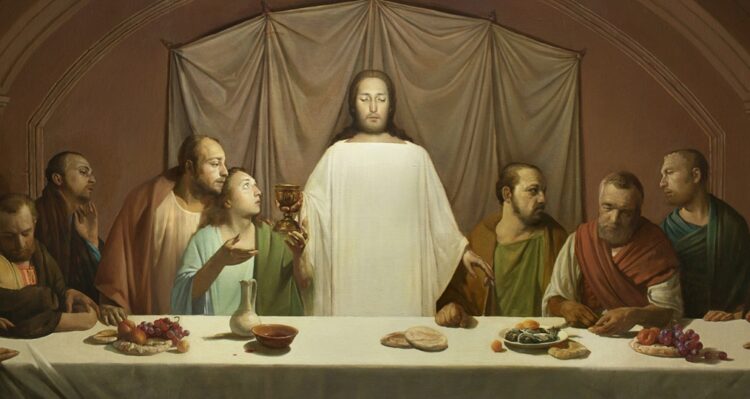
The Precious Blood
The blood of Jesus bought me from the hands
Of foes for whom I scorned divine commands.
My guilt is gone: His blood grants purest grace,
And entry to His heart’s most holy place.
His bloodshed seals our ceaseless covenant
In goodness vigilant and militant.
His royal blood draws distant rivals near,
And unifies them, quenching thirst severe.
His blood flows over walls of separation,
Securing by torrential inundation
The earth’s and heaven’s reconciliation.
The blood of Jesus cools sin-kindled wrath
Deserved by my self-righteous poisoned path,
Warring against God’s law, but justified
By faith in this blood sacrifice applied
To cleanse me from the works of death. I live
To serve the living God, whose blood will give
His Spirit’s holiness and sustenance,
Adopting me into inheritance
Beyond the blessings promised Abraham.
Riches to me (poor servant that I am)
Come by the blood of Jesus Christ the Lamb.
The precious blood of Jesus clears the way
To walk in light, with social interplay
Among all sanctified by sprinkled blood,
Who whiten sordid garments in its flood,
And win their triumph by that speaking sword,
The Word of God and everlasting Lord.
The blood He shed on Calvary excelled
The force of hell, and all its fiends repelled.
This joy-filled blood of Jesus sets me free;
His blood made Eden of Gethsemane,
And from the Cross pours forth serenity.
Margaret Coats lives in California. She holds a Ph.D. in English and American Literature and Language from Harvard University. She has retired from a career of teaching literature, languages, and writing that included considerable work in homeschooling for her own family and others.


















Margaret, I cannot imagine a more glorious sacred poem about the blood of Christ and sanctifying power. How wonderful on an Easter death and resurrection weekend to read your poem of such greatness that blessed me and all those who read it. Your serenade of serenity and overwhelming sensitivity echo throughout eternity. I wish for you and yours a special blessing this Easter as you have already blessed us.
Thank you for the blessing you always give, Roy. Much appreciate your comment as we approach Easter Day and season!
Hi Margaret. This is lovely. The rhythm pulls me in closer and closer, inviting meaning to show up.
Thanks, Jenna. That’s a lovely way to describe how the heroic couplet rhythm works here!
Margaret, this is a very profound and well expressed meditation on the sacrifice of Christ on the cross. The meter imparts a deep sense on calm and reason and the triple rhyme at the end of each stanza gives an extra sense of the abundance of grace in Christ.
Thank you so much, Morrison. The masters of the heroic couplet would occasionally put in a rhyming triplet, which I did here to bring my total number of lines to the significant 33. Honoured to share Good Friday posting with your wonderful work this year!
A wonderful meditation, Margaret: a confession of sin and a boast in the Lord, majestically flowing. It sparkles with unexpected words throughout.
Thanks, Monika. In writing, I try to think of underused words from our treasury. And to avoid repeating myself from poem to poem, if I can! Here, as you notice, the contrasting concerns of humility and majesty make a large sparkle easier.
I think my favorite surprise of the poem was the phrase “social interplay.” It brought to mind a concept I’ve loved since one of my professors in college first introduced it (teaching on Dante): the communion of intelligences in the Truth. We owe our participation in that, and our hope of participating in it forever, to the Precious Blood shed and the fullness of redemption won for us.
One of our priests on Good Friday spoke about the intermingling of Paradise and Calvary: a deep paradox. Your poem sings of the same, in the manner of an Aquinas hymn.
I had thought of “friendly interplay,” but it’s greater than that. The “communion of intelligences” you learned about in college is a spiritual society, and “social” seems more appropriate than “friendly,” as well as more metrical and more meaningful than “communal.”
Thanks for the intensity of “the manner of Aquinas.”
Thank you for this Good Friday poem, Margaret. What a lovely meditation on the salutary effects of Christ’s blood. I like the image of the blood “flowing over walls of separation”, and the phrase the “speaking sword, the Word of God.” Also, the garden imagery: “His blood made Eden of Gethsemane.”
Thank you, Cynthia. I began the poem with all the passages of the New Testament where the blood of Jesus is mentioned. The words and images you especially like emerge from those passages without being direct quotes. Especially the last: when one thinks for a while of the garden of Gethsemane where Jesus sweat blood for us, the originally perfect garden of Eden naturally comes to mind.
Thank you for this absolutely gorgeous passion poem Margaret, which I have the great pleasure of reading as I celebrate the beginning of the sacred Sabbath hours of Passover week. I wish you a blessed and joyous feast experience.
Yael, thanks for this special comment on the solemnly sacred time of the feast. The Passover sacrifice was one of a lamb, as the seder plate recalls. I am able to mention the ultimate Lamb, by reference to the book of Hebrews, intended for persons who celebrate Passover. Three times (9:14, 10:19, and 13:20) that book mentions the blood of Jesus. May you too experience joy as the celebration continues!
Yes! The precious blood of the Lamb slain from the foundation of the world, which cleanses us from all sin. In Torah we learn that “the life of the flesh is in the blood” and in 1 John 5:8 we read that the Spirit, the water, and the blood agree in one. Water and Spirit are both symbolic of life, so for the blood to agree with water and Spirit it must speak of life and not death. And we know this is true because He is risen and the tomb is empty. I have printed out your wonderful poem so I can keep reading it all week as I celebrate unleavened bread.
Thank you again, Yael! I’m delighted you like the poem so much you will continue to read it. And that it leads you to quote other significant Scripture. Therefore let us keep the feast, not with the old leaven of malice and wickedness, but with the unleavened bread of sincerity and truth. I Corinthians 5:8
Margaret! What a beautiful soul-stirring poem. ‘Sin-kindled wrath’ … such perfection!
Thank so much
Rohini, thank you for such a beautiful comment! A happy Easter season to you and yours.
Margaret,
This poem offers a beautiful meditation for this Good Friday. It was a perfect way to end my day.
Laura, thanks so much. No better place to find matter for meditation than in that speaking sword, the Word of God.
Gorgeous, Margaret, absolutely gorgeous. Thanks so much for deepening my Good Friday reflection and all blessings to you, all grace at Easter. He is risen! Jeffrey
He is risen indeed! May your Easter season bring many more graces and blessings, Jeffrey.
Margaret C.
Thank you for this devout reminder of what the crucifixion means for me.
From Margaret B.
I’m humbled and happy that the poem renewed for you, Margaret B., the personal meaning you had discovered in this supreme event. A happy Easter!
Dear Margaret
This poem is a speaker’s reflection on Jesus’s sacrifice of his blood on the cross. The first person speaker lauds the effects of this sacrifice, both in his personal situation (referencing himself 10 times: 7 times “me” ; 2 times “my”; 3 times “I”)—and also universal salvation ( “our” once; “them” once; “all” once; “their” once.)
The formal structure is 3 stanzas of 11 lines of iambic pentameter. Each stanza has 4 rhymed couplets followed by a rhymed triplet. All the rhymes are masculine, except for the triplet at the end of stanza 1 which is feminine.
The word “blood” is used 15 times in the body of the poem, plus once in the title. “Jesus” is referenced 5 times: once in stanza 1, and twice each in stanzas 2 and 3.
The Latinate language and the perfect formal structure give a sense of “right order” as developed in Christendom, especially in the (so-called) Middle Ages. Beauty is a paramount virtue, as expressed in perfectly ordered poetry; perfectly designed churches; perfectly performed ceremonies,; all oriented toward the worship of God.
I especially love the image in the penultimate line: “His blood made Eden of Gethsemane.” That is, Christ’s agony in the garden of Gethsemane is transformed by his sacrifice into the perfect garden of Eden as it existed before the Fall of Adam and Eve.
Well done, Margaret. Thank you for carrying forward Christendom’s wonderful traditions at Eastertide.
Sincerely
Mary Jane
Many thanks, Mary Jane, for the meticulous analysis of language and structure in the poem. With your customary close attention, you certainly help it to appear as a work of both care and inspiration deriving from “Christendom’s wonderful traditions at Eastertide.” I love the reflection you bring that “beauty is a paramount virtue.” And I truly value your opinion of the perfect order I strive to achieve. May you and your friends and worship communities receive abundant blessings as the season proceeds.
Thank you Dr. Coats for an inspiring Easter revelation!
Ramsey, I thank you for your appreciation, and hope we may all find much more revealed as we live out the coming blessed days.
An inspiring piece, Margaret.
Many thanks, Paul.
Others have already commented on the substance. What stood out to me about the structure of your poem was the prominence of the Marlovian line (which works so well with couplets) and the surprise of the triple rhyme following a sequence of couplets. What distinguishes your use of the triple rhyme from its occassional appearance in the poems of the English Augustans is that yours serves the important function of marking the end of each stanza, whereas theirs often had no other function than a) to embellish or b) to break up the monotony of the heroic couplets.
Daniel, thank you very much for your attention. I recall Dryden using rhymed triplets not only as a variation or embellishment in passages of heroic couplets, but also as a long pause–to complete a section or a speech. As you say, that’s what I do here, with regularity, to close each stanza. I do also set up a rhythm of couplets, again as you notice, but it’s new to me to think of these as Marlovian lines. I think I know what you mean: enjambment allowed, but never with awkward breakup of constituent elements of the sentence. Let me know if there’s more to it! I’ve violated that principle just once, for emphatic purpose, at line 16, practically the middle of the 33 lines representing the years of Our Lord’s life. His blood effects devotional life of the spirit.
My understanding of the Marlovian line is that it flows uninterruptedly until the end of the line, or even to the end of the next line. Imposed on that line are stylstic devices such as the use of polysyllabic, Latinate words (of which you are fond), exotic proper nouns and place names (also polysyllabic, e.g. Tamburlaine, Leander), which are often placed at the end of lines of blank verse, as well as mythological references (perhaps similar to you if we replace mythological with biblical).
Here is a good study on the Marlovian line and style:
Mathew Martin, “Punctuation and Style in Christopher Marlowe’s Tamburlaine the Great and Ben Jonson’s Volpone,” The Ben Jonson Journal 31.2 (2024): 140–155.
This will make me think more of exotic proper names! Thank you for the reference; I am no longer trying to keep up with Renaissance research, but I do have access to an excellent academic library when I learn of something I would like to read.
Thankyou, Margaret for the thought of entering into Jesus’s heart, “His most Holy Place”. That thought gives to me a good visual for prayer. I am grateful.
I’m grateful to you, Kathy, for your notice. A happy Easter season!
Margaret,
This is a beautiful devotional poem. Great job with landing the poem with its final line about serenity, it made me call to mind the serenity prayer that is used in A.A. Thank you so much for sharing. I hope you had a blessed Easter.
Thank you, Paul. I’m glad you point to the final word, which was a deliberate choice. The poem being devotional, as you recognize, what is it the speaker can feel poured forth by Our Lord’s precious blood? Not “eternity,” though that is also opened by means of His self-sacrifice. Not “felicity,” though He brings us happiness as well. The devout person living in the here and now, and meditating on the precious blood finds “serenity” or peace. Hope your Easter, too, is blessed with it!
A beautiful meditation on the Precious Blood and what it truly means. I was intrigued by the choice of heroic couplets. When I realized I was reading them, I thought it too light a form for such a serious subject. Then I realized: it took me time to realize I was reading heroic couplets. The poem certainly does not *seem* to be in that form, a la Dryden or Pope. Yet it is. I think you wonderfully illustrate here how much subject influences the perception of form. What ordinarily might seem light and witty becomes muted when addressing such a somber and elevates subject. This, I think, is the poem’s most striking feature.
You are right, Adam, that heroic couplets may seem witty and cunning rather than noble and profound. The subject itself certainly influences the tone; we can think of Pope’s philosophical poetry, for example. Now that you bring me to think of it, I believe the many underlying references to sacred Scripture elevate tone and mood here. They come with traditional images ready for suitable application, especially those related to flow and covering and washing. A certain devotional sobriety helps. And I am intrigued by Daniel Howard’s describing the Marlovian line as the major stylistic feature. Of its elements, I am indeed fond of Latinate vocabulary. Thank you very much for reading the poem and taking time and thought to comment!
Very beautiful! I could feel the passion and the presence of Jesus. Thank you.
Thank you, John, for your appreciation!
Margaret,
This is a lovely poem about the power in the blood of Jesus. The imagery is powerful and speaks of the whole range of blessings that flow from the blood which was once shed on Calvary´s cross. Although I have sometimes read remarks on this website that disparages religious poetry as artistically deficient or immediately “suspect” as a mere agenda-driven propagand tool “disguised” as art– as if religious poetry could not be the sincere undisguised expression of worshipful piety that inspires creative flourishing and drives artistic excellence– your poem gives the light to that irrational pooh-poohing of religious poetry. The words of your poem will undoubtedly find an echo in the heart of those who believe that the power flowing from the atoning sacrifice of Christ and the shed blood of His cross is the only power that can cancel sin, erase guilt and confer on unworthy sinners the free gift of eternal life.
Martin, thank you from the bottom of my heart for what you’ve said. Religious poetry speaks in reconciliation between heaven and earth. I have used that idea of reconciliation in this poem about the Precious Blood. I heartily agree that we are most indebted to the power flowing from Christ’s sacrifice. In poetry we use the power of language breathed into us by our Creator to make gifts to Him in return, and to others willing to listen, and simply to express ourselves as incarnational beings of body and spirit. There is much to say, and there are many kinds of religious poetry, all of which contribute to our art. We are happy in this site that publishes many kinds, and for this occasion published this personal devotion of mine. I’m very, very glad you see it as good enough to be light against unreason, as well as an echo in hearts of believers. Religious poetry, like other poetry, is meant for the whole world of readers!
The first clue, which helps to categorize “The Precious Blood” by Margaret Coats, are the lines 9-11, the only lines that utilize abstract feminine rhymes; and hence suggest a Metaphysical, or NeoClassical foundation of the poem; though here is not John Dryden or Alexander Pope; but rather more the later 18th century ruminators injected with that most serious of authors: John Milton. But could John Milton have written such a poem? I think not.
Surprisingly, her tone, her diction, and content do not remind this reader of the French, Italian, or Spanish clarity, so often found about her poetry; nor the Hebrew text from which she so meticulously draws.
Mr. Howard suggests “the structure of her poem was the prominence of the Marlovian line”; and this may well be true; however, in this poem in particular, I cannot see room for a line like this from “Doctor Faustus”:
“See, see, where Christ’s blood streams in the firmament!”
What is amazing about “The Precious Blood” is its abstract quality and its strong, normative tone. Such a potent potion, and distillation, found in the 21st century, is a remarkable thing in and of itself. Who in the last one-hundred years could have written this unique poem? No one I can think of.
Bruce, I’m most grateful for the thought you’ve given this poem, with discussion from your thorough background in aspects of English literature through the centuries. To call the work a “potent potion and distillation” supposes it has treated the subject in accord with the profundity it deserves. That’s deeply satisfying. Please let me think more of this before I respond to more of what you’ve said. Again, many thanks!
Thanks once more, Bruce, for your opinion of the poem as unique and serious. So I wrote it, and I most certainly agree that Milton would not have written anything similar, as it is Catholic or Orthodox in its incarnational qualities. I can’t call it abstract, as it reflects immediately upon Christ’s Passion as presented in New Testament images and doctrine especially taken from the writings of Saints Paul and John. They were Christian Hebrews, though the language they used was Greek. From them I take the normative tone. There is one reference back to Deuteronomy, but the poem does not rely on any Hebrew text, unless you mean the Epistle to the Hebrews, written in Greek intended for first-century Jews. Overall, it is personal to me and devotional. The Christianity is thoroughly orthodox, which is why, I believe, it has drawn positive response from many devout Christians of the Society of Classical Poets, and from many of my friends, without regard to denomination. You may be correct to refer it to 18th-century English writers who were bringing warmth to religious writing, but it derives equally or more so from our own new millennium. My immediate inspiration for the process of creating the poem came from devout discussions with an Egyptian nun living in exile in California. Therefore, it has come to me flowing from many sources! I am grateful for your considerations that themselves elevate the piece.
Margaret, I am only sorry that I did not have the opportunity to read this poem during Holy Week, as it would have served as a source for further medication and inspiration.
For me, the central energy of the poem comes from the verb “flow.” There are movement everywhere, from the physical to the psychological to the spiritual, all climaxing in a final “senerity.” And the rhyme and other formal skills you have made use of serve with the greatest skill to manifest that flow.
Thank you so much for the powerful experience in reading this poem you have given us.
Many thanks, Tom. Your judgment means a great deal. I was in fact thinking of “flow” throughout the composition of the poem–the powerful and life-giving flow of The Precious Blood, pouring forth serenity. I gave a little explanation of that final word choice to Paul Millan above, and I’m grateful it resonates with you.
Why I called Ms, Coats’ “The Precious Blood” abstract is most easily shown in the first two stanzas of Robert Burns “To a Mouse”, where the second stanza is the abstract one:
Wee, sleeket, cowran, tim’rous beastie,
O, what a panic’s in thy breastie!
Thou need na start awa sae hasty,
Wi’ bickerin brattle!
I wad be laith to rin an’ chase thee
Wi’ murd’ring pattle!
I’m truly sorry Man’s dominion
Has broken Nature’s social union,
An’ justifies that ill opinion,
Which makes thee startle,
At me, thy poor, earth-born companion,
An’ fellow-mortal!
In addition, the NeoClassicists, in general, emphasized the abstract aspect of the English language, and I believe Ms. Coats has elsewhere shown a propensity for a latinate vocabulary. I, too, have enjoyed for so many decades the latinate addition to our language in the Middle Ages to the Anglo-Saxon base. Ms. Coats did point out an error, when this author said, in a moment of distraction, “Hebrew”, and should have said “Koine Greek”.
I wonder at the importance of John Dryden’s catholic taste against John Milton’s hebraic power in the English literature of the 17th century, but I’m now embroiled in so many of the problems from the NeoClassicists to the NewMillennialists that I hardly have time to explore that era.
I see, Bruce. Thanks for the explanation. I would call the second Burns quatrain here “interpretive.” You are correct that even my references to New Testament texts may be interpretive (and thus abstract) because the apostolic authors among them interpret the shedding of Christ’s blood in an instructive and even doctrinal manner. Quotations from the Gospels are more descriptive, though these too are instructive testimony to the facts of the Crucifixion. I rely on everything said under inspiration in the earliest Christian era as tradition worthy of contemplation. In the poem, of course, it receives my own interpretation through my ordering and associations. I am inclined to Latinate vocabulary, partly due to word choice suitable for rhyme and rhythm. For example, “social interplay” above could have been Anglo-Saxon “fellowship” if it had not needed to rhyme, or Greek “koinonia” if that term (often used in more erudite church communities) were more generally understood. As it is, I wanted the Latinate adjective “social” to imply a larger community than the Anglo-Saxon “friendly” might have suggested. We are fortunate that English is so well supplied with words from all sources.