


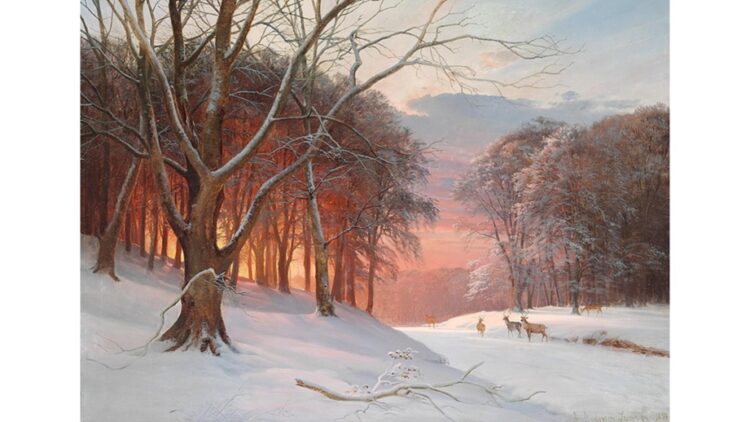
To the Captive Sun
You set now, levitating low,
Just deigning lazily to throw
Your gently flaming, scarlet glow
On empty miles of windswept snow,
Tinging the icy, barren white
With fiery red as if alight
Yet melting not, to tease the sight
Before you fade to darkest night—
So low your face peers through a wood
Of skeletal trunks long stripped nude,
Stiff, stark, straight shades, as if they could
Imprison you right where they stood.
Your softly glowing rays divide
As though indeed you meekly hide
Behind bars, sentenced to abide
Where none may freely hope to stride.
The sight of your captivity
Seems earth’s and winter’s victory
To mortal eyes that strain to see
From the low vantage of this lea—
False sight! To seem is not to be:
Your prison is illusory;
Truly you venture ever free
Far, far above the tallest tree.
And trudging through the crunching snow
I glimpse your visage from below
As though imprisoned, yet I know
You fly where I dare dream to go.
Adam Sedia (b. 1984) lives in his native Northwest Indiana and practices law as a civil and appellate litigator. He has published four books of poetry and his poems, essays, and fiction have appeared in various literary journals. He is also a composer, and his musical works may be heard on his YouTube channel.

















Adam, this is a beautiful poem with exquisite imagery of the winter sun and the effects of the sun that can dazzle our eyes.
I wholly agree with Roy. And your third stanza delightfully strikes me as a shout-out to the first stanza of Frost’s The Road Not Taken
Thank you! I did not have Frost’s poem in mind when I wrote this, but I will agree that the similarity of imagery is undeniable – even if my scene is a little later in the year.
Beautiful, sun-kissed poem.
The concept of the setting sun as captive promises much to the descriptive artist, Adam. You take full advantage of beautiful potential–and as well figure a prison in your rhyme scheme. Finding four words on the same sound makes each quatrain an enclosure. You draw attention to your bar-making ability by using the same rhyme sound eight times in quatrains five and six, yet in each of those you adhere to the rigorist rule requiring the preceding consonant (or consonants) to differ. Then you lock the sun into the poem when your final quatrain returns to the same rhyme sound as the first. Forcefully done!
Thank you! I’ve been experimenting with tighter forms lately: limited feet and end-rhymes. I am delighted to hear that you saw success in this foray. The scene that inspired this was at the height of the Hoosier winter, and I wanted to capture something of the starkness of that scene.
The crucial rhetorical facet of this poem is its heavy dependence on monosyllabic words. As I count them, here are the number of monosyllabic words in each quatrain:
1 – 13
2 – 16
3 – 26
4 – 14
5 – 19
6 – 16
7 – 21
That’s something like sixty percent of the number of words in the poem. The heavy use of monosyllables in iambic tetrameter works to slow down the pace of the poem, in such a way as to give the piece a meditative thoughtfulness. The monorhyme of each quatrain may suggest enclosure and imprisonment, but this disregards the poem’s ending, where the speaker states that the sun’s imprisonment is illusory, and that he both knows where it is going, and wishes he might escape there as well.
I love Adam’s use of the word “lea” — it’s a rarely seen noun these days.
A very incisive analysis. I confess, I did not intend to write so many monosyllables for their own sake. Looking back at the writing process, the tetrameter limited the amount of space available to express an idea fully, so the monosyllables gave me the most mileage. But their effect is undeniable. I agree with you: the austere effect they achieve helps convey a sparse, meditative atmosphere.
Nice catch on “lea,” too. I lifted it from one of my favorite poems, Wordsworth’s “The World is Too Much with Us.” It seemed to fit without sounding too obsolete, so I appropriated it.
Adam,
I truly enjoyed the poem and the pacing! I am a big fan of poems written in second person and loved that this is addressed to the sun hovering over this vast, winter landscape as you make this a commentary about freedom and purpose.
Thank you! I started the draft in the first person and shifted to the second. I believe the thought was that a subject as grand as the sun deserves to be addressed directly.
A most beautiful poem, Adam, which I read spiritually: an Easter-related poem of transcendence over being held captive in a transient Earthly existence. Your line about Earth and winter’s false victory (as it seems to mortal eyes) brings to mind the line from 1st Corinthians: “Death, where is thy sting?” It may seem like the sun is held captive, but that is only an illusion. I believe you are referring to Heaven when you talk about the sun flying where your speaker dreams to go. Happy Easter, Adam.
Happy Easter to you, Brian, and thank you! I didn’t envision this as an Easter poem, but I am amazed how well it works. The prison of death and earthly bounds are broken by Light. And Heaven indeed is is where the speaker dreams to go.
The sun/Son correspondence, used countless times in English poetry, also guarantees Adam’s poem can be read as an Easter poem. That remains true even in so-called post-Christian times. In fact, Adam, we could look at this work as a surreptitious and naturalistic mode of reviving Easter in current consciousness.
I don’t think I can add to what has been said in the comments above; but I love this poem, Adam. It is a marvel of exquisite description, musicality, and pure beauty.
Thank you so much! Reading such a compliment from you gives me great joy and encouragement.
A poem with a much written about message, but uniquely rendered and totally absorbing. The injection of the narrator into the last stanza was a great final hook.
Thanks for the read, Adam.
Thank you! The final stanza was almost an afterthought, but I thought it had to be written. I’m happy to see it made such an impression.
This is beautiful poem, Adam, with spiritual overtones and hints of Easter. I can easily visualize the scene of the sun setting behind the bare trees. I like the way that you keep the colours strong, pure and simple, with plain red and white. It makes the scene far more vivid and enables us to see it clearly.
Thank you! I wrote this in early or mid-February, so I did not intend this as an Easter poem, yet it works well. I commend Evan for his choice — as well as for the artwork, which almost captures exactly the scene I saw that inspired this poem. It is a winter poem, and I’m glad I could convey the simplicity of the colors of that season.
The extended conceit of the imprisoned sun is exquisite. I am particularly taken with that single pivot — “To seem is not to be” — which reframes all before it in an instant. Perception is everything. Superb! The closing image of the speaker trudging through snow, dreaming of a freedom he can glimpse but not reach, is haunting and moving. This poem appeals on many levels and begs to be read more than once. I will be doing so with pleasure. Adam, thank you!
Thank you! The final stanza was added after I had initially completed the poem. It demanded to be added — a “pan-out” like in film. I am thrilled you found it “haunting” and “moving” — two of the best compliments a poem can have (at least in my view).
Indeed, Adam, “To seem is not to be,” yet to seem is what the world does in many ways that feed the poetic art. We make out a picture for our own pleasure and understanding, and if it is not strictly true every time, at least we are rewarded by a fresh way of looking. I continue to wonder how nature, and most particularly nature at its most beautiful, gives rise to profound feelings. The simplicity of your fine verses serves well, and the quadruple rhymes reinforce the poet’s calm confidence in his own freedom. It’s refreshing to hear such confidence.
Thank you for your comment. As you observe, the poem is very much about how our perception affects us. I am also intrigued by your sensing confidence in the tetrarhyme. I wasn’t thinking that when I wrote it, but the effect is undeniable.
As others have commented, a very beautiful poem, and I love that last line especially: ‘You fly where I dare dream to go’. Yes, always exceeding our reach.
Thank you, James!
This poem tinkles and sparkles like crystal chimes. Its mood is contemplative and revelatory. Hell, it’s downright spine-tingling.