


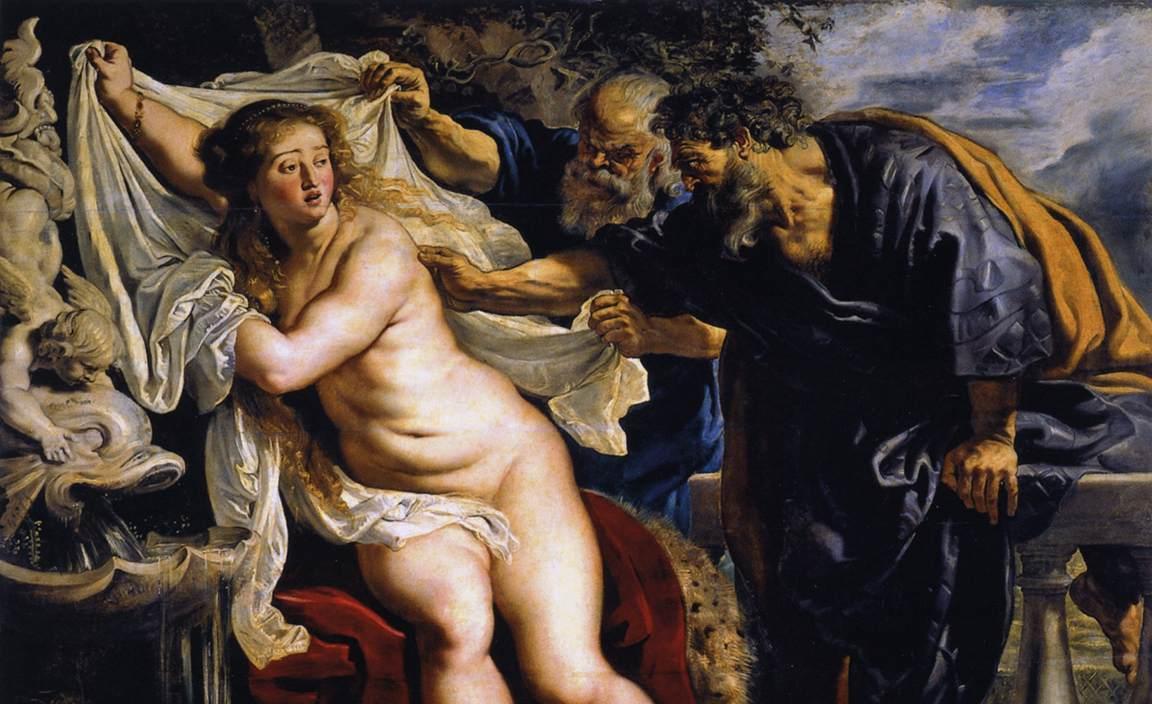
True Susanna
Susanna, beauty faithful to young love,
To marriage, and to parents’ righteous ways,
But most to God, found only one defender
Against two judges wasted by lewd gaze.
Corrupted, with no power to look above
Their loins, these lustful gaffers had aspired,
Each one alone, to force her to surrender
Enticements aging impotence desired.
But neither had much masculine attraction,
Though shyster machinations bought them awe
Attributed to their sagacity,
Such that they two could overrule the law.
Together they contrived illicit action,
A trick by which Susanna must submit
To death or to perverse rapacity,
And no one could lay blame on them for it.
Confronting her, the two laid bare their plot.
She must commit adultery with both
Or they’d bear witness of her smutty sin
With some young scamp—they’d swear a lying oath.
Susanna raised an outcry, for her lot,
Condemned to death by stoning, would be free,
At least, of foul dishonor feminine,
Though no one learned the elders’ lechery.
All Babylon gasped, utterly amazed
To hear sworn evil of Susanna true;
Her virtue like her beauty ever gracious
Had been reputed pure as heaven’s dew.
But two respected witnesses dispraised
Her loveliness, and her own kindred grieved,
Until one youth cried out against mendacious
Filth spoken that should not have been believed.
A Daniel come to judge those predators,
He separated them for questioning,
And asked exactly where each one had seen
The act about which they were bellowing.
False answers made them self-discreditors,
Condemned by law to that same stoning sentence
Susanna would have suffered by their means,
And no one listened to their sham repentance.
Susanna praised God’s justice in her case,
And thanked His inner strength that made her true.
He knows all things before they come to be,
And loves the truth of godly chastity.
Judicious Daniel with her learned to face
Iniquity, and folly to subdue,
For wisdom makes known truthful history,
Revealing law that reigns ineffably.
Poet’s note: Susanna’s history comes from the Biblical book of Daniel. Probably written in Hebrew or Aramaic, this chapter survives only in Greek, and therefore is not canonical to Jews or Protestants, though Catholics and Orthodox consider it inspired Scripture.
In Shakespeare’s The Merchant of Venice, Shylock refers to the story, crying “A Daniel come to judgment!” when Portia, garbed as a young lawyer, supports his case. Shylock had made a contract with the merchant Antonio, hoping to cause Antonio’s death legally. But when Portia explains that Shylock can be put to death for plotting murder, Antonio cries, “A Daniel come to judgment!”
Margaret Coats lives in California. She holds a Ph.D. in English and American Literature and Language from Harvard University. She has retired from a career of teaching literature, languages, and writing that included considerable work in homeschooling for her own family and others.


















A great story, Margaret, poetically and masterfully told.
Many thanks, Paul, for your appreciative reading!
Margaret, this is such a finely-wrought retelling of Susannah’s story. When I was younger, in my early music days, I sang a lute song by William Byrd that I would love to have the opportunity to sing again someday. I perused Youtube and this rendition by Tessa Bonner and the Rose Consort of Viols is better in some ways than the others– it is a 90s recording, the early music “voice” is still very evident– virtually completely straight tone, but at least she’s trying to give some emphasis to the salient words in the lyrics. The aesthetic has evolved, and solo early music singers are approaching a more operatic presentation, which I actually prefer. I would give this a real dramatic performance! Here the link, maybe you will find other performances more to your liking– she’s still not my ideal, but at least you can hear the song as it is arranged for voice and viol consort. Thank you for such beauty in your poetry, Margaret!
https://www.youtube.com/watch?v=2d2GsZ8vm9k
Susanna Fair (anonymous, attributed to William Byrd 1540-1623)
“Susanna fair some time assaulted was
by two old men, desiring their delight,
which lewd intent they thought to bring to pass,
if not by tender love, by force and might,
to whom she said, if I your suit deny,
you will me falsely accuse, and make me die.
And if I grant to that which you request,
my chastity shall then deflowered be,
which is so dear to me, that I detest
my life, if it berefted be from me,
and rather would I die of mine accord,
ten thousand times, than once offend our Lord.”
Thanks so much, Theresa, for actually quoting the Byrd poem (and I do think, for my own special reasons) the verse and the music are by him. Our corresponding titles, “Susanna Fair” and “Susanna True,” actually correspond in the focus on Susanna’s virtue and faith as well, though mine does so by presenting more of the story, and Byrd’s by giving her most of the lines as spoken in dramatic song. I can see how you could make great drama of it, starting as narrator and bursting into the glorious protest of Susanna herself. Thanks for speaking of the modes of presentation, and for recommending a fine YouTube performance.
So happy you know about the Byrd poem and song, Margaret! Now you are definitely inspiring me to find a lutenist to perform it with!!!! Thank for re-inspiring me to sing with your beautiful poem.
That Youtube channel is a gem. Thanks for posting.
Suspenseful story-telling; and I love the way you’ve woven the quatrains together by carrying some of their rhymes from one to the next.
Glad the story achieves suspense! The rhyming technique is a loose contemporary application of the usual practice in medieval sequences. Thanks for reading and commenting, Cynthia.
Margaret C.
Your very dramatic poem along with Ruben’s explicit art bring boldly to life the dilemma that Susanna faced.
from Margaret B.
Thank you, Margaret B. I consider the Rubens painting one of the best on the subject, because it shows the threatening nature of the scene.
Margaret, how such a foul act can be so beautifully told with inspired poetry is hard to fathom. The fealty to God and truth is a powerful lesson that comes through with your judicious telling.
Thank you, Roy, for recognizing the horrendous depth of filth that contrasts with truth and fidelity in Susanna’s story. I’m so glad you call my re-telling both beautiful and judicious. Law becomes beautiful when it acknowledges truth upholds beauty.
I see the parallels with The Merchant of Venice, a play I know well.
This is not a biblical story I’m that familiar with (my school was more Adam and Eve, Noah and the Good Samaritan, job done), so it has been most enlightening hearing your poetic version, Margaret.
And very topical!
Thanks for the read. As always, an education for me.
Thanks for your comment, Paul. Daniel is one of the major Old Testament prophets; this story shows the beginning of his career. It actually seems no more than common sense to question the elders before accepting their testimony against a woman of unblemished repute–but Daniel, mere youth that he is at the time, is so certain of their guilt he seems inspired with God-given knowledge of it. I’ve tried to convey his attitude in my poem with contempt for the two miscreants.
By “topical” you must mean abuse of law by persons in positions of authority. It happens. Out of respect for authentic law, I’ve concluded by associating law with wisdom.
This poem speaks to me about remaining true and to trust in God. It is written eloquently. Thank you
Thank you, Susan. The heroic Susanna is indeed true to all her obligations, even when her life is threatened–and God, in whom she trusts, raises up Daniel as an unexpectedly strong defender. I’m especially glad to have you, as one who bears the heroine’s name, consider the poem eloquent.
I had never heard the story of Susanna before. Thank you for telling it in such a compelling way. I’m very glad to see that her faithfulness was rewarded. Most people facing death by stoning (or some other more contemporary fate) would not be so courageous. I hope never to be in that situation, but if it were to happen, I can’t say with any confidence that I would act as she did.
Thanks, Warren. I like drawing attention to forgotten aspects of our culture. The story certainly made it into art, because it offers opportunity for painters to picture a nude, since the elders spy on Susanna bathing in a private garden. Evan Mantyk also told me there’s a Handel oratorio–and I discovered the librettist was a Jew who wouldn’t have found Susanna in his Scriptures. One way it survived was that the British Authorized Version of the Bible prints the non-canonical parts because they are edifying. As you say, Susanna is a fearless example of choosing death rather than wrongdoing. But in the 19th century, to reduce printing costs, Bibles intended for Protestant readers dropped this story–along with a great portion of Biblical poetry!
“Shyster” is a new word for me.
Margaret, given the religious inspiration of your verse and your interest in the old Italians, I would recommend a recent book called “The Song of Songs and its Tradition in Renaissance Love Lyric” (OUP 2024) by Camilla Caporicci. It aims to provide the first comprehensive study of the influence of the Song of Songs on Italian, French and especially English Renaissance love poetry.
“Shyster” is American slang for any unethical lawyer; the word is also used by C. B. Anderson in his most recent post. My word choices here go a little beyond usual poetic decorum to emphasize the depravity of the elders who abused their own profession, position, and reputation.
Thank you for the recommendation of Camilla Caporicci’s book! It would have taken me some time to become aware of it myself, as I no longer need speedy response to my own academic field. But I’m glad to have you point it out, as I consider Biblical scholarship and poetry to work within classical tradition. When I was active at Harvard, the classics every undergraduate English literature major had to study were not Homer and Vergil, but Shakespeare and the Bible. These account for more quotations and allusions by far than any others, though I discovered Vergil’s Aeneid ran a close third. And thank you for your attention to my Susanna!
This is a vivid description of virtue, upbringing and God’s impeccable timing. Thank you. Building up my library of new words.
Thank you, Irene, for taking note that Susanna’s virtue comes from her upbringing. She is faithful to much more, but strength like hers builds on childhood foundations. Glad the poem could offer you some new words.
Thanks for sharing this poem that is based on biblical scripture. You are deft at writing these long poems. I also like how you tend to add poet’s notes to your poems.
Thanks, Paul, your comment is much appreciated. Glad I’m readable, even when the poem is a longer one. Sometimes the material I choose naturally brings up questions, and poet’s notes get the answers to everyone reading the poem!
What a magnificent re-tellling of this story from the Book of Daniel. You truly bring the story to life with with rich color and keen probing of the sinful condition of the souls of these two judges. The latter had been selected from among the exiled Jewish elders in Babylon to settle disputes among the people. This followed the tradition first established by Moses in Ex 18:13-17 in which he appointed judges to represent him in deciding cases according to God’s law. They were to be men “who can be trusted and not be bribed.” Obviously, these two evil judges were not cut from that cloth. Daniel, on the other hand, was both a prophet and a righteous judge who would have been pleasing to God and Moses.
Your most powerful line is the last one, “For wisdom makes known truthful history,
Revealing law that reigns ineffably.” This, in my opinion, is not human wisdom but the Eternal Wisdom of God that created Heaven and earth, all things visible and invisible, gave us the knowledge of His ways through Scripture, and redeemed us through his Son. Your “truthful history” is Salvation History.
Thank you, Gary, for explaining the position of the judges and the requirements for filling it. The poem and story have much to say about law. And thanks specially for the remarks on wisdom. About
About wisdom, there are two aspects to consider. First, Daniel, though still a boy, thought of questioning the witnesses in Susanna’s case, when apparently no one else did. He was therefore wise in a practical, human sense. But we wonder as well if Daniel’s wisdom (a conviction that the judges were the guilty parties) was given by God, for the purpose of saving Susanna who trusted in Him. The line “He knows all things before they come to be” is taken directly from the story. It certainly refers to the Eternal Wisdom which plans how all human events contribute to the working out of His purposes. Thank you again for your comments!
Margaret,
This poem definitely brought to life the urgency of some sort of beneficial resolution for Susanna and came through with a sigh of relief.
Thanks, Laura! This is one of those “extreme” law cases where consequences are potentially horrifying. That’s so even when justice is served. It’s relieving indeed when Susanna is vindicated and everyone who loves her rejoices, but there are several different kinds of paintings for her story, including the wicked elders being stoned to repay them for the evil they had attempted.
This is another piece of genius interleaving of ironically diametrical meaning. It condenses the villainy of the 2 would be adulterers trying to lure Susana into lewd acts with them. I particularly love the use of the words “wisdom” attributed to the valorous Daniel and the “sagacity “ attributed to the gentlemen because of their social stature. Another brilliant work.
Thanks, Ken. There is indeed a diametrical contrast between the lewd villains and their position as judges, who should be characterized by the ability to do justice in any case brought before them. Another contrast exists between their vice and the virtue of Susanna and Daniel. Also a contrast in age: Daniel is a mere boy in this story foretelling his prophetic career. And though Susanna is a married woman, she is still young enough that her willingness to die rather than do wrong is remarkable. Appreciate your comment!