


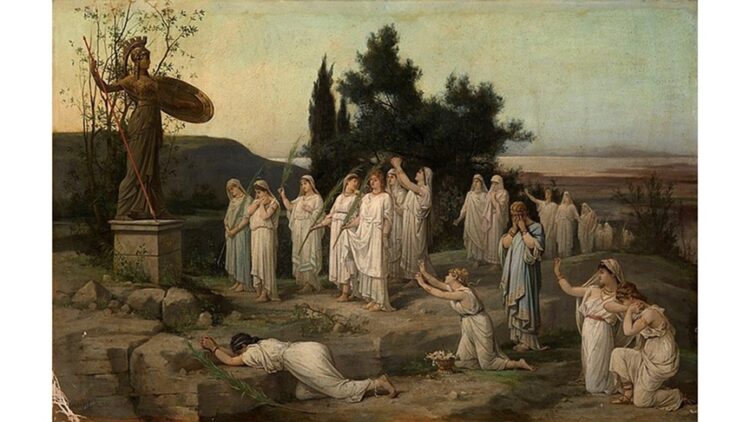
Sister Goddess and the Chimera
“In Greek myth, a chimera is a creepy combination of lion,
goat, dragon—in humans, chimeras are one person who
contains two sets of DNA.” —Susannah Cahalan
Behold the sister goddess. Her very name
is Gloria Deo—glory to God. Her blood
has now been offered: for the life indeed
is in her rich, red, teeming blood, the cells
themselves. Stem cells stemming from the source,
the DNA. The vital energy
of this blood covenant, this sacred rite,
begetting through this divine, holy sacrament.
Blood to blood, blood sisters evermore
are two-in-one.
are two-in-one. Sophia Theos—sister,
now chimera, wisdom of God, your blood
stochastically morphed from ruby red to white.
Mutations randomly over-expressed white cells
meant to protect, now strangling out the red,
immature blasts blasting through your veins.
And not just one, but four mutations changed
your blood to milky white—leukemia,
AML, acute and myeloid.
You went to war against your cells, and fought
against a nearly-ruptured spleen; then pain,
and sores, and sepsis, rashes, and fatigue.
The chemo’s been a fight all by itself.
You said that cancer took so much from you;
indeed your hair, and your fertility,
as well as medical school were tough to lose.
Yet you’ve always been a warrior. In strength
and youth you’ve overcome your adversaries
as you had done when you were lifting weights.
Your frozen ova await the future day
when they’ll be your babies; your hair long,
as long as the wig made from your own hair; Doctor
Sophia will help and heal the sick someday.
And now two sets of DNA expressed,
forever two-in one. Your second birth
through second blood, transplanting
vital spirit back to cells. Reborn,
a second birthday, second life. You stand
upon the dais as a champion,
a crown of baldness rests upon your head.
Your laurels lie upon your formidable strength.
All hail the sister goddess Gloria!
All great and glorious matching DNA!
Wisdom of the healers heals the Wisdom of God!
We bring our votive offerings of thanks
and gratitude and awe. Your sacrifice
propitiated cancer’s mortal sins.
All hail Chimera Sophia, the Vanquisher,
the Winning Warrior, our indomitable heroine!
Sophia the Fierce, Sophia the Defiant,
Sophia the Dragon-Slayer, Sophia the Conqueror!
Poet’s Note: my 25-year old daughter Sophia was diagnosed with AML (acute myeloid leukemia) in August 2025 and underwent her stem cell transplant on November 6th with my daughter Gloria as the donor.
Theresa Werba (formerly known to the SCP community as Theresa Rodriguez) is the author of eight books, including What Was and Is: Formal Poetry and Free Verse, and Sonnets, a collection of sixty-five Shakespearean, Spenserian, and Petrarchan sonnets. Her work appears in numerous journals, websites, and online publications, including the SCP Journal. She has been featured on Classical Poets Live where she discusses musicality and elocution in formal poetry. She is a contributing writer for Classical Singer Magazine. Werba’s background as a Classical singer informs her dramatic poetry readings which are available on Youtube @thesonnetqueen. Her website is www.theresawerba.com.

















This was my first attempt at blank verse– I found it to be a versatile form which bridges formal poetry and free verse, in that I am not concentrating on rhyming, but on maintaining the iambic pentameter in the lines. It is freeing in this respect in some ways, while it also forces you to make good use of alliteration and assonance to continue to try to make poetic “music”.
I am happy to report that Sophia (who is my youngest child of six) passed the all-important 100-day post-transplant milestone last week, and she is cancer-free and on her way to complete recovery. She has successfully beat four of the most lethal mutations found in AML. To see her gaining health and strength (and hair!) is the greatest relief I have felt in my entire life. Thank you Evan for giving me the opportunity to share through poetry our family’s cancer battle with the SCP audience.
I should rather say “the SCP community”– it is much more a community of poets rather than just an audience of readers. As a singer/performer I suppose I am generally thinking in musical terms about presenting my poetry, I am thinking about reading it in front of an audience. But the poets here at SCP are way more than that– they have become my colleagues, friends, and fellow sojourners.
Fantastic news, Theresa! Thank you for sharing Sophia’s progress toward complete recovery!
Thank you so much, Roy!
This poem is so very personal that I almost feel like an intruder by reading this story. It takes great confidence and courage to publish a piece this intimate. It is as much memoire as poem and, as such, invites us to consider the universality of the challenges faced both by Sophia and by you. It is a beautiful and inspiring poem, Theresa, which takes a medical situation (and all the pain and anxiety that accompanies it) and transforms it into something mythological and metaphysical in scope. I love the consideration of the name “Sophia” — how it means wisdom. (I have my own Sophia story, btw.) And, like Roy, I’m gratified to know that Sophia is doing well. One can tell that you are bursting with pride, relief and pure love. Well done!
Thank you Brian, what you said is very touching. I named Sophia (the youngest of my six children) “Sophia Theos” (Gk. “wisdom of God”), because, as I always said, “after six kids, I need the Wisdom of God!” If you feel able to share your Sophia story on this thread, I am sure the readers would like to know about it– I know I would.
I did through caution to the wind with this poem, using mythological and even theological imagery (which took a good dose of chutzpah) to give honor to Gloria for what she has done for Sophia, and to celebrate the strength, resilience, tenacity, and indomitability of Sophia’s body, mind and spirit.
I am grateful to Evan for allowing me to share it and I thank you for your comment.
I meant “throw caution to the wind”!!
Theresa, how happy you are at the successful outcome! May it continue and become a complete cure. Your blank verse deals well with the complexities of medicine and genetics. Overall, I hear a mother rejoicing in the face of a situation where human beings, with all the wise and glorious technology we’ve developed, find ourselves within the mysteries of divine plans for life and death. You gave birth to these two young women who now take what you gave them, one to help heal the other. For both, it depends on compatibility and good will in a battle for life. Therefore you tell the story less in technical terms than with heroic vocabulary. Well done!
Thank you Margaret for your kind words and as always, such interesting and thoughtful commentary! Although it was I who encouraged Sophia to get to the emergency room when her first symptoms (infections and a splenic hematoma) were presenting, most of her treatment has been out of my hands, and into her sister Gloria’s hands. As you so aptly put it, one sister truly has helped heal the other; I am just a witness to the whole phenomenon. This was even true when I spent four months in Arizona with Sophia when she was both in the hospital and living with Gloria and her husband (where I also stayed). They have grown close in an almost mystical way, it truly is a bond forged in love, and in DNA. And they both truly are indeed my heroes!!!
I agree with Margaret – the defining characteristic of this poem is the heroic vocabulary, which builds to an exultant and exuberant shout as of the victory of some Greek warrior. Very appropriate. Also, the ambition of the conceit is impressive. The poem binds Greek myth, Christian theology, and contemporary medical science into a single imaginative arc without reducing any of them to ornament. “Chimera” becomes not merely a metaphor but a rigorous organising principle: mythic hybridity, biological fact (two sets of DNA), and spiritual rebirth all reinforce one another. That conceptual coherence is not easy to achieve, and the poem sustains this across a long narrative without collapse. The diction, too, balances precision with reverence. The scientific language—“stem cells,” “mutations,” “AML, acute and myeloid,” “immature blasts”—is handled with confidence and restraint. It never feels gratuitous or cold; instead, it deepens the stakes by insisting on exactness where sentimentality would be easier. Against this, the sacramental and mythic vocabulary (“blood covenant,” “holy sacrament,” “votive offerings,” “dragon-slayer”) lifts the lived medical ordeal into a larger symbolic register. The poem trusts the reader to hold both registers at once, which is a mark of seriousness.
Formally, the verse seems disciplined rather than loose, which reflects Theresa’s overt desire for a blank verse effect. The repeated phrases (“are two-in-one”) function almost liturgically, creating a refrain that mirrors both the biological reality and the poem’s theological insistence on unity-through-gift. The lineation frequently slows the reader at moments of gravity, particularly in the catalogue of suffering, where the accumulation of pain is felt through rhythm as much as content. Very impressive, as is, emotionally, the poem is powerful because it resists self-pity. The speaker’s love and awe are evident, but the poem’s centre of gravity is the daughter’s agency and courage, not the parent’s grief. The naming of loss—fertility, hair, medical school—is sober, not indulgent, and is counterweighted by an insistence on future vocation and strength. The closing hymnic praise feels earned because it follows endurance rather than denying it. Finally, this is a poem that knows what it is doing. It is learned without being academic, reverent without being pious, and deeply personal without becoming private. It deserves attention not only as a testimony of love and survival, but as a serious contemporary poem that enlarges what medical and familial experience can mean in verse. Excellent.
Thank you so much James. What a thoughtful and thorough analysis of my blank verse poem. It means even more because you of all people– a cancer survivor yourself– have written “serious contemporary” poetry that “enlarges what medical and familiar experience can mean in verse.” Your comment means all the more to me because of this.
Theresa, I should have mentioned how much I love your blank verse. There are certain subjects so raw or otherwise emotionally fraught that rhyme becomes a distraction — almost a trivializing of the subject. I consider the use of blank verse to be somewhat analogous to recitative in opera. There are certain things which must be communicated so directly that rhyme becomes a distraction. Your daughter’s story is clearly one of them. Had you crafted rhyming poetry (which you excel at) I would have been baffled by how you had the presence of mind and lightness of heart to rhyme in a situation such as this. Rhyme implies an orderliness of thinking. The more rhyme (internal, assonance) the more order. When a subject is raw, the presence of such artifically-imposed order actually undermines the intended effect of the poem. You made the right and most tasteful artistic choice here.
That is an interesting commentary, Brian. I had never actually written in blank verse before– I think I was looking for a way to write about this subject without rhyme (as is mostly the case with free verse), yet without losing the formal structure I still wanted to employ, maybe for a sense of the majesty and grandeur that iambic pentameter can provide. So blank verse worked exceedingly well for this topic, you are right. Interesting take on recitative– there is a flexibility one has when singing recitative, in terms of “delararatory” style that makes it very speech-like in its rhythms. Rhyming recit would indeed be absurd and sound very peculiar.
While on the subject of opera, if you are interested in hearing me sing arias from Handel’s oratorio Theodora, here is my recital from 2014 on my YouTube channel. I also have three of my favorite Bach arias. Scroll down to “Playlists” and click the right arrow until you come to it.
https://www.youtube.com/@thesonnetqueen
Thanks again for your thoughtful and perceptive comment Brian!!!
What a gust of euphoria is this! I’m so glad for you and your family. Your use of poetic devices other than end-rhyme seems to work well here, and the meter keeps the poem still formal. But it was still no small thing to tell the story in dignified and vigorous lines. Your poetic talent did not desert you after adversity. I congratulate you on the poem and send my wishes for your daughter’s speedy recuperation and your whole family’s health and well-being.
Thank you very much Bhikkhu for your kind comments and well wishes for Sophia and our family, it means a lot!!! I love the phrase “gust of euphoria”– sure wish I could bottle that, I could use it from time to time… I like the idea of the poem having “dignified and vigorous lines”– I did have a lot of vigor and energy in wanting to put our family’s recent situation to poetry. I am also very glad I was able to keep it dignified and not maudlin, that would have spoiled everything. Thanks again!!
A celebration of resiliance and courage in battle. I liked the way you used ‘blood’ imagery (we usually just get squeamish with anything to do with blood) in such a positive way – ‘blood covenant’, ‘blood sisters’ – and to describe complex medical procedures – ‘blood stochastically morphed’ and ‘changed
your blood to milky white second blood’ – in a way a layman can understand.
This is one of the most uplifting poems I’ve ever read. Indeed, ‘all hail Chimera Sophia’!
Thank you Paul for your most encouraging comments. To think that this encomium to my daughters was one of the most uplifting poems you’ve ever read is truly a gift to my heart. I also am so happy that the “blood” imagery and references I utilize resonate with you. It does seem that blood has been very important to me throughout my life, and I have touched it again and again in my poetry. Thank you again for putting a smile on my inner being!