• Submit Poetry
  • Support SCP
  • About Us
  • Members
  • Join
Saturday, July 18, 2026
Society of Classical Poets
  • Poems
    • Beauty
    • Culture
    • Satire
    • Humor
    • Children’s
    • Art
    • Ekphrastic
    • Epic
    • Epigrams and Proverbs
    • Human Rights in China
    • Music
    • Performing Arts
    • Riddles
    • Science
    • Song Lyrics
    • The Environment
    • The Raven
    • Found Poems
    • High School Poets
    • Terrorism
    • Covid-19
  • Poetry Forms
    • Sonnet
    • Haiku
    • Limerick
    • Villanelle
    • Rondeau
    • Pantoum
    • Sestina
    • Triolet
    • Acrostic
    • Alexandroid
    • Alliterative
    • Blank Verse
    • Chant Royal
    • Clerihew
    • Rhupunt
    • Rondeau Redoublé
    • Rondel
    • Rubaiyat
    • Sapphic Verse
    • Shape Poems
    • Terza Rima
  • Great Poets
    • Geoffrey Chaucer
    • Emily Dickinson
    • Homer
    • Henry Wadsworth Longfellow
    • Dante Alighieri
    • John Keats
    • John Milton
    • Edgar Allan Poe
    • William Shakespeare
    • William Wordsworth
    • William Blake
    • Robert Frost
  • Love Poems
  • Contests
  • SCP Academy
    • Educational
    • Teaching Classical Poetry—A Guide for Educators
    • Poetry Forms
    • The SCP Journal
    • Books
No Result
View All Result
Society of Classical Poets
  • Poems
    • Beauty
    • Culture
    • Satire
    • Humor
    • Children’s
    • Art
    • Ekphrastic
    • Epic
    • Epigrams and Proverbs
    • Human Rights in China
    • Music
    • Performing Arts
    • Riddles
    • Science
    • Song Lyrics
    • The Environment
    • The Raven
    • Found Poems
    • High School Poets
    • Terrorism
    • Covid-19
  • Poetry Forms
    • Sonnet
    • Haiku
    • Limerick
    • Villanelle
    • Rondeau
    • Pantoum
    • Sestina
    • Triolet
    • Acrostic
    • Alexandroid
    • Alliterative
    • Blank Verse
    • Chant Royal
    • Clerihew
    • Rhupunt
    • Rondeau Redoublé
    • Rondel
    • Rubaiyat
    • Sapphic Verse
    • Shape Poems
    • Terza Rima
  • Great Poets
    • Geoffrey Chaucer
    • Emily Dickinson
    • Homer
    • Henry Wadsworth Longfellow
    • Dante Alighieri
    • John Keats
    • John Milton
    • Edgar Allan Poe
    • William Shakespeare
    • William Wordsworth
    • William Blake
    • Robert Frost
  • Love Poems
  • Contests
  • SCP Academy
    • Educational
    • Teaching Classical Poetry—A Guide for Educators
    • Poetry Forms
    • The SCP Journal
    • Books
No Result
View All Result
Society of Classical Poets
No Result
View All Result
Home Essays

Why Poetry Should be Metered

October 1, 2012
in Essays, Featured, From the Society, Poetry, Poetry Forms
A A
5
poems Why Poetry Should be Metered

Poetry should be metered, because metered poetry is, quite simply, better than free verse.  This is for the same reason that realist art trumps impressionist art and that Baroque music trumps rock and roll and hip-hop. It is because art, in its best state, is not about the experience of the individual, it is about the shared experience of all humanity.

When you read a poem that is understandable and follows the most basic conventions that are accepted in the English-speaking world then it can be widely experienced and appreciated, whether by a young woman in Iowa or an old man in New Delhi.

The same goes for realist art and Baroque music. You may not like the poem, artwork, or music and may not find it particularly stimulating, but at the very least you can generally understand what it is, what some of its goals are, how it defines goodness, and how it strives toward that goodness. It is fairly easy to tell whether it has been executed decently or not.

In the case of a poem, if it maintains a balanced meter and if it relies on the standard conventions of poetry, such as rhyme, alliteration, metaphor, simile, and others, then it is clear what it values as good. Now, whether such a conventional poem is actually good or not will depend on the contemporary message being conveyed and whether or not it is clear, engaging, and worthwhile. The prerequisite, though, is that the poem meet the basic standards for being good otherwise your poem may have a message that is clear, engaging, and worthwhile, but the amount of people it would have the potential to reach would be severely fragmented and diminished.

The poetry, art, and music proliferated today moves further and further toward fragmentation in perspective. If you do not explain to a person why a modern poem, painting, or song is supposedly good, there is a strong chance he or she will have no idea that it is good at all.

More than Words

This is not merely a philosophical discussion. The shared experience of humanity, either ignored by most modern poetry, music, and art, or embraced by most classical poetry, music, and art, is something with real scientific implications. The most obvious being the Mozart effect whereby plants and children have been scientifically shown to benefit from listening to music by 18th century composer Wolfgang Amadeus Mozart.

Yet, the Mozart effect is really just the tip of the iceberg. British scientist Rupert Sheldrake calls this connection between our fellow men morphic resonance and posits that each person and animal has a morphogenetic field. The morphic resonance and morphogenetic fields operate across time and space with the connection being stronger between organisms and things that are similar.

Sheldrake discusses these concepts in the context of the human genetic code. Modern science poured billions of dollars into the Human Genome Project with the theory being that we could find bad genes that cause diseases passed on, supposedly, in your genes from your parents and could find genes that explain your physical, and potentially mental, characteristics similarly passed on. Indeed, people today say something is “in his genes” or say someone has “bad genes” or “good genes.”

Sheldrake posits this whole approach is wrong. Mainstream science’s obsession with the human body and genes is like someone who, after seeing a television for the first time, takes it apart and wonders how the components create the images on the screen. It is the intangible signal coming in that creates the images. Similarly, it is the intangible morphogenetic fields and morphic resonance that determine what will happen. If your field is very similar to your father’s field and he had heart disease then it may be similarly warped in such a way as to create heart disease in you.

Sheldrake’s theory goes a long way in explaining inexplicable but observable phenomena in human and animal life. The implication for poetry and the arts is also profound. Regardless of what spiritual persuasion, or lack thereof, you may be from, reality as we know it is different from what mainstream science has told us. The intangible has much more power than we realize.

When poetry, art, or music aligns with the time-tested traditions left by millennia of poets, artists, and musicians and is widely accepted by people today, then it could truly have a positive impact on you and society, physically, mentally, and spiritually.  It positively activates the scientifically and undeniably real connection between all of us. Call it what you want: morphic resonance, the shared human experience, or simply good poetry.


Originally published on the Epoch Times.

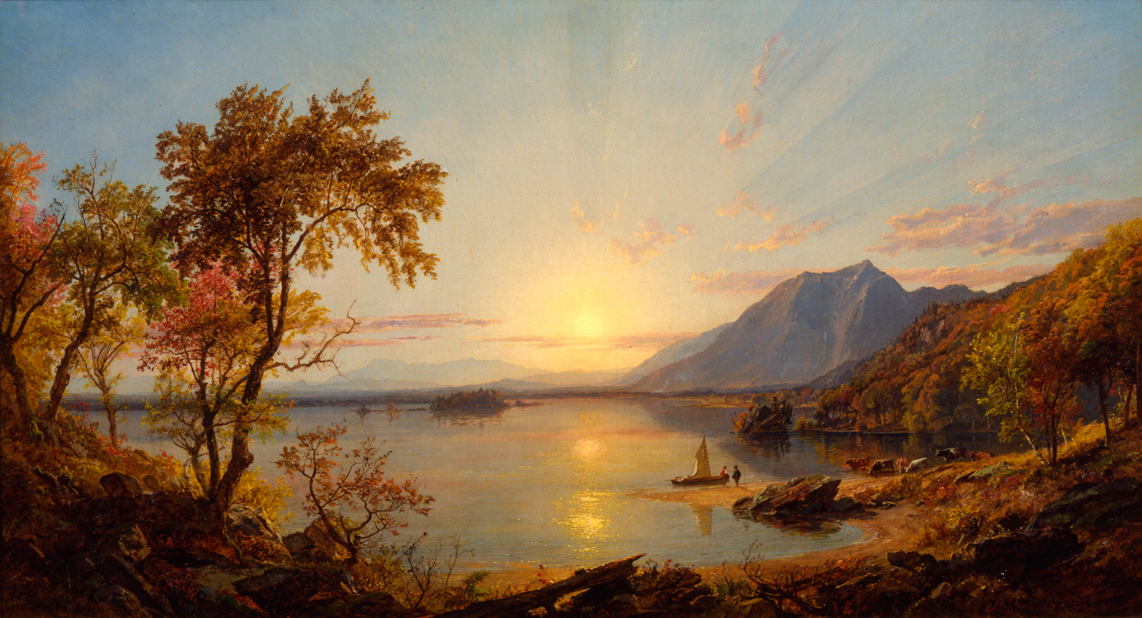
Featured Image: “Sunset, Lake George, New York” by Jasper Francis Cropsey (1823-1900). (Courtesy of New York Historical Society)


ShareTweetPin
The Society of Classical Poets does not endorse any views expressed in individual poems or commentary.
Read Our Comments Policy Here

RandomPoems

‘Mont Saint-Michel’ by James A. Tweedie (Part 3 in the Favorite Places Sonnet Series)
Beauty

‘Mont Saint-Michel’ by James A. Tweedie (Part 3 in the Favorite Places Sonnet Series)

June 25, 2020

  In triumph the Archangel stands atop __The medieval fortress church and isle __That bear his name—the legendary spot __Where...

‘Fake Sales’ and Other Poems by Russel Winick
Culture

‘Fake Sales’ and Other Poems by Russel Winick

December 6, 2024

. Fake Sales “Fifty Percent Off”The store signs all say,But I have to scoff---There is simply no wayThat the clothes...

Next Post

The Goddess of Night

Coming of Falun Holy King

Coming of Falun Holy King

Summer Houses in Winter

Comments 5

  1. Corey Browning says:
    11 years ago

    Wow! Nicely said. I agree with this. Most free verse I have ever read/written is really trash if it be called “poetry”. As the saying goes “free form can be fancy prose, fancy prose can be free form, which is which?” This really shows the problem with free form poetry, is if it’s hard to tell if it’s even poetry then I feel it shouldn’t be called poetry. Though I have a question. You mentioned dark themed poetry with no “light/good” theme. What do you feel about poetry such as Edgar Allen Poe? Yes he may break with some tradition but I find his verse very enjoyable. Not among my favorite poetry but it’s up there.

    Reply
  2. Hannah E. Reed says:
    11 years ago

    I feel as if you are too often trying to relate poetry, the art as old as language, to the modern world. Poetry should and could touch things beyond this world and all the ‘worlds’ as disparaged and empty as it. And a poem doesn’t need to rhyme or be metered to be good… I mean I love writing villanelles and I am desperately trying to understand what good means both as implied in morality and even more in art. But a poem is, I think, supposed to touch something that a mortal form never could.
    The metered voice is the tone of the ancients, free verse is the shout of today’s hipsters. Yet, you seem to have forgotten history’s favorite lesbian- Sappho, our mother of lovelorn, sandstorm free verse.

    Reply
    • Hannah E. Reed says:
      11 years ago

      And I would also like your opinion on Sylvia Plath. She is my favorite and she wrote brilliantly. When she was younger, she wrote villanelles that exalted the madness the villanelle is capable of through its obsessive repetition , and as she grew older, she began to write a sort of free verse that no poet has ever seemed to touch since her. I could go on and on about her, but I would like to know what the “Society” thinks of her poetry?

      Reply
  3. Evan Mantyk says:
    11 years ago

    Hi Hannah,

    I think your last sentence putting ” ‘the Society’ ” in quotation struck me the most. It is just me, Evan Mantyk, responding under the Society’s name and who wrote the above post. Many people have joined or contribute to the Society but running the nitty-gritty stuff is myself and just a few other people. As you might imagine, a group of poets together has a wide range of opinions. From talking with poets and reading their poems and essays, the consensus just seems to be just this: traditional poetry is still quite valuable and something that we should cherish. People have told me it is a relief to be able to submit traditional poetry and read traditional poems on the Society’s website, and that they have been told elsewhere things like “no rhyming.”

    Actually, we do publish some free verse and accept free verse submissions. Ultimately, it does come down to the meaning more than anything else. However, generally speaking, this is a poetry site for traditional poetry (I am but one man after all). We are going with the general view of English poetry throughout history (meter and rhyme) and not outliers. That’s just our modus operandi, and there are plenty of other sites out there I’m sure who will accept free verse submissions.

    The poets you mentioned have good qualities to draw upon and be inspired by. Actually, I believe that Sappho did write in meter; it is just that the translation was done in free verse, as is often necessary with translation (we have published some free verse translation as well). See this link for more info: (http://english.chass.ncsu.edu/freeverse/Archives/Spring_2013/prose/ArchaicGreekPoetsJillACoyle.html)

    Let me know if I can be of any further service to you and feel free to email me at [email protected]

    Kind Regards,
    Evan Mantyk

    Reply
  4. Daniel Kemper says:
    5 years ago

    Yes! Evan. Encore: It’s about integrity vs. disintegration. I have said for a long time now (unaccomplished as I am) that a key skill for writing a good sonnet Elizabethan Sonnet, is being able to write a good five-paragraph essay.

    Also, up for consideration/challenge: Perhaps “free verse” is not properly taxonomized as poetry at all. As put here, it’s not necessarily a remark on its value as art, just that the categorization is wrong. A lot of contradictions of “what is poetry” evaporate when the categories are cleaned up this way. Poetry, beginning as an oral tradition, distinguished itself from other speech by meter. Not by line breaks, which can’t be heard and which appear to be the only thing free verse offers to distinguish it from prose.

    As to whether free verse should have its own category or be considered a radical type of text justification on the page, that might be an interesting discussion.

    Reply

Leave a Reply Cancel reply

Your email address will not be published. Required fields are marked *

  1. Theresa Werba on ‘Two Fateful American Coin Flips’: A Poem by James A. TweedieJuly 18, 2026

    Jim, congrats on your win!!!

  2. BDW on ‘For Those We Never Meet’: A Poem by Aneesh AgarwalJuly 18, 2026

    Mr. Agawal has generalized the largest labour insurrection in America from the early 20th century—1921, that cost the lives of…

  3. Ganga Unnikrishnan on National Poetry Month Limerick ChallengeJuly 18, 2026

    Urzsula

  4. Ganga Unnikrishnan on National Poetry Month Limerick ChallengeJuly 18, 2026

    Thank you so much Ursula

  5. Geoffrey Smagacz on ‘Ben Franklin’s Copper Fugio Cent’: A Poem by Geoffrey SmagaczJuly 18, 2026

    Thank you, Margaret

Subscribe to Daily Poems

Enter your email address to subscribe to this blog and receive notifications of new posts by email.

Join 1,596 other subscribers

Recent Poems

  • Winners and Rankings of The Great American Poetry Competition
  • ‘The Gold Star Mother’: A Poem by Gerard Maritato
  • ‘An American Dash’: A Poem by Linda Ellis
  • ‘The Anonymous Soldier’: A Poem by Lucy Lind
  • ‘For Those We Never Meet’: A Poem by Aneesh Agarwal
  • ‘Ben Franklin’s Copper Fugio Cent’: A Poem by Geoffrey Smagacz
  • Three Brief Poems by Luxorius, Translated by Joseph S. Salemi
  • ‘The American Spirit’: A Poem by Dusty Grein
  • ‘The Ballad of Zebulon Pike’: A Poem by M.D. Skeen
  • ‘We Are the Ones’ and Other Poetry by Cheryl Corey
  • ‘My Pyjamas!’ and Other Poems by Susan Jarvis Bryant
  • ‘A Snowy Egret’: A Poem by Bruce Dale Wise
  • ‘The Swearing-in of Calvin Coolidge’: A Sonnet by Robert W. Crawford
  • ‘Ballad of the Sequoia’: A Poem by Lauren V. Leon
  • ‘The 51st State’: A Poem by James Sale
  • ‘La Uva’ (The Grape): A Poem by Michael Pietrack
  • ‘There’s Blood that Flows Within the Stripes’: A Poem by Lauren V. Leon
  • ‘Birdsong’: A Poem by Jeffrey Essmann
  • ‘The Melody That Lingers On’ and Other Poetry by John McPherson
  • ‘American Dreams’: A Poem by Adam Sedia
  • ‘An American Fabius’: A Poem by John Hernandez
  • ‘Vernal Clinic’ and Other Poetry by C.B. Anderson
  • ‘Omaha Beach’ and Other Poetry by Bradford Skow
  • ‘Music to Part the Veil’: A Poem by T.M. Moore
  • ‘A Gentleman’s Guide to Losing a War’ and Other Poetry by Arnon Peterson
  • ‘Black Shuck’: A Poem by Martin Briggs
  • ‘When the Last World War II Veteran Passes Away’: A Poem by N.S. Boone
  • ‘A Fallow Year at Worthy Farm’: A Poem by Paul A. Freeman
  • ‘Outstanding in Afghanistan’: A Poem by Jared S. Chang
  • ‘250 More’: A Poem by Miguel Moreno

Categories

  • Acrostic
  • Alexandroid
  • Alliterative
  • Art
  • Best Poems
  • Blank Verse
  • Chant Royal
  • Classical Poets Live
  • Clerihew
  • Covid-19
  • Deconstructing Communism
  • Educational
  • Epic
  • Epigrams and Proverbs
  • Essays
    • Interviews with Poets
    • Poetry Reviews
  • Featured
  • From the Society
  • Great Poets
    • Dante Alighieri
    • Edgar Allan Poe
    • Emily Dickinson
    • Geoffrey Chaucer
    • Henry Wadsworth Longfellow
    • Homer
    • John Keats
    • John Milton
    • Robert Frost
    • William Blake
    • William Shakespeare
    • William Wordsworth
  • Human Rights in China
  • Limerick
  • Love Poems
  • Music
  • Pantoum
  • Performing Arts
  • Poetry
    • Beauty
    • Children's Poems
    • Culture
    • Ekphrastic
    • Found Poems
    • High School Poets
    • Humor
    • Riddles
  • Poetry Challenge
  • Poetry Contests
  • Poetry Forms
    • Curtal Sonnet
    • Haiku
  • Poetry Readings
  • Rhupunt
  • Rondeau
  • Rondeau Redoublé
  • Rondel
  • Rubaiyat
  • Sapphic Verse
  • Satire
  • Science
  • Sestina
  • Shape Poems
  • Short Stories
  • Song Lyrics
  • Sonnet
  • Symposium
  • Terrorism
  • Terza Rima
  • The Environment
  • Translation
  • Triolet
  • Video
  • Villanelle

Quick Links

  • About Us
  • Submit Poetry
  • Become a Member
  • Members List
  • Support the Society
  • Advertisement Placement
  • Comments Policy
  • Terms of Use

Welcome Back!

Login to your account below

Forgotten Password?

Retrieve your password

Please enter your username or email address to reset your password.

Log In
No Result
View All Result
  • Poems
    • Beauty
    • Culture
    • Satire
    • Humor
    • Children’s
    • Art
    • Ekphrastic
    • Epic
    • Epigrams and Proverbs
    • Human Rights in China
    • Music
    • Performing Arts
    • Riddles
    • Science
    • Song Lyrics
    • The Environment
    • The Raven
    • Found Poems
    • High School Poets
    • Terrorism
    • Covid-19
  • Poetry Forms
    • Sonnet
    • Haiku
    • Limerick
    • Villanelle
    • Rondeau
    • Pantoum
    • Sestina
    • Triolet
    • Acrostic
    • Alexandroid
    • Alliterative
    • Blank Verse
    • Chant Royal
    • Clerihew
    • Rhupunt
    • Rondeau Redoublé
    • Rondel
    • Rubaiyat
    • Sapphic Verse
    • Shape Poems
    • Terza Rima
  • Great Poets
    • Geoffrey Chaucer
    • Emily Dickinson
    • Homer
    • Henry Wadsworth Longfellow
    • Dante Alighieri
    • John Keats
    • John Milton
    • Edgar Allan Poe
    • William Shakespeare
    • William Wordsworth
    • William Blake
    • Robert Frost
  • Love Poems
  • Contests
  • SCP Academy
    • Educational
    • Teaching Classical Poetry—A Guide for Educators
    • Poetry Forms
    • The SCP Journal
    • Books

© 2025 SCP. WebDesign by CODEC Prime.