• Submit Poetry
  • Support SCP
  • About Us
  • Members
  • Join
Thursday, September 3, 2026
Society of Classical Poets
  • Poems
    • Beauty
    • Culture
    • Satire
    • Humor
    • Children’s
    • Art
    • Ekphrastic
    • Epic
    • Epigrams and Proverbs
    • Human Rights in China
    • Music
    • Performing Arts
    • Riddles
    • Science
    • Song Lyrics
    • The Environment
    • The Raven
    • Found Poems
    • High School Poets
    • Terrorism
    • Covid-19
  • Poetry Forms
    • Sonnet
    • Haiku
    • Limerick
    • Villanelle
    • Rondeau
    • Pantoum
    • Sestina
    • Triolet
    • Acrostic
    • Alexandroid
    • Alliterative
    • Blank Verse
    • Chant Royal
    • Clerihew
    • Rhupunt
    • Rondeau Redoublé
    • Rondel
    • Rubaiyat
    • Sapphic Verse
    • Shape Poems
    • Terza Rima
  • Great Poets
    • Geoffrey Chaucer
    • Emily Dickinson
    • Homer
    • Henry Wadsworth Longfellow
    • Dante Alighieri
    • John Keats
    • John Milton
    • Edgar Allan Poe
    • William Shakespeare
    • William Wordsworth
    • William Blake
    • Robert Frost
  • Love Poems
  • Contests
  • SCP Academy
    • Educational
    • Teaching Classical Poetry—A Guide for Educators
    • Poetry Forms
    • The SCP Journal
    • Books
No Result
View All Result
Society of Classical Poets
  • Poems
    • Beauty
    • Culture
    • Satire
    • Humor
    • Children’s
    • Art
    • Ekphrastic
    • Epic
    • Epigrams and Proverbs
    • Human Rights in China
    • Music
    • Performing Arts
    • Riddles
    • Science
    • Song Lyrics
    • The Environment
    • The Raven
    • Found Poems
    • High School Poets
    • Terrorism
    • Covid-19
  • Poetry Forms
    • Sonnet
    • Haiku
    • Limerick
    • Villanelle
    • Rondeau
    • Pantoum
    • Sestina
    • Triolet
    • Acrostic
    • Alexandroid
    • Alliterative
    • Blank Verse
    • Chant Royal
    • Clerihew
    • Rhupunt
    • Rondeau Redoublé
    • Rondel
    • Rubaiyat
    • Sapphic Verse
    • Shape Poems
    • Terza Rima
  • Great Poets
    • Geoffrey Chaucer
    • Emily Dickinson
    • Homer
    • Henry Wadsworth Longfellow
    • Dante Alighieri
    • John Keats
    • John Milton
    • Edgar Allan Poe
    • William Shakespeare
    • William Wordsworth
    • William Blake
    • Robert Frost
  • Love Poems
  • Contests
  • SCP Academy
    • Educational
    • Teaching Classical Poetry—A Guide for Educators
    • Poetry Forms
    • The SCP Journal
    • Books
No Result
View All Result
Society of Classical Poets
No Result
View All Result
Home Poetry

‘Who Wrote Shakespeare?’: A Poem by Saad Kayani

March 1, 2026
in Poetry, Culture, William Shakespeare
A A
16
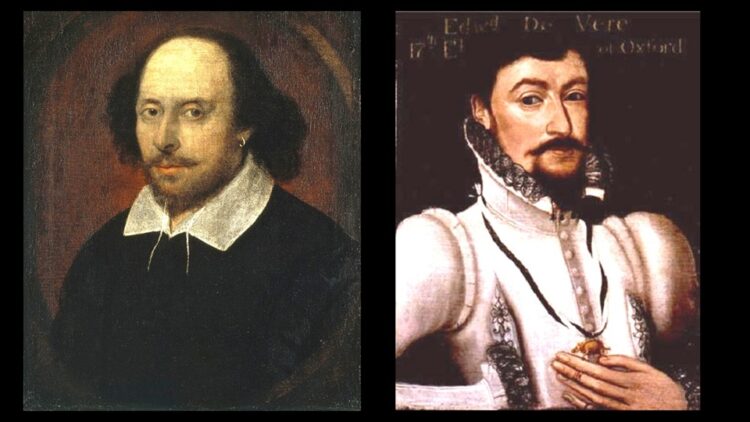
portraits of William Shakespeare and the Earl of Oxford, Edward de Vere (public domain)

portraits of William Shakespeare and the Earl of Oxford, Edward de Vere (public domain)


Who Wrote Shakespeare?


It could not be the glover’s son;
_it had to be the Earl.
To know how courts and kingdoms run
_is far beyond a churl.

The poet knew Verona well,
_the politics of Rome.
How could a Stratford merchant tell
_of things so far from home?

His father could not read a word;
_his children were the same.
The mortgage deed looks quite absurd—
_he barely scrawled his name!

So, Stratford—now the jig is up—
_return our rightful quill.
Where are those plays—the manuscripts?
_There’s nothing in this will!

“God is dead,” the thinkers say
and pour themselves a drink.__
But churches open every day
whatever thinkers think!__

So shout about your noble earl
and die upon this hill!__
It makes no difference in the world;
we’re here for William still.__

The house is full, for truth is truth;
the cash keeps rolling in.__
Go play the pompous, Looney sleuth,
and William’s going to win!__


Saad Kayani lives in Toronto. Recent poems appear in Neologism Poetry Journal and Shot Glass Journal.

ShareTweetPin
The Society of Classical Poets does not endorse any views expressed in individual poems or commentary.
Read Our Comments Policy Here

RandomPoems

‘Fishing on the Fly’: Three Poems by James A. Tweedie
Beauty

‘Fishing on the Fly’: Three Poems by James A. Tweedie

August 4, 2022

. Deschutes River Reverie The river, swift and shallow, roils its way Beneath the outstretched arms of old-growth pines, Past...

‘It’s No Surprise’ by Russel Winick
Culture

‘It’s No Surprise’ by Russel Winick

October 14, 2021

. When you see Inflation rise It’s no surprise... When you see All the goods In short supplies, Work disincentivized,...

Next Post
‘The Number 86: A Humean Tragedy’: A Poem by Paul Martin Freeman

'The Number 86: A Humean Tragedy': A Poem by Paul Martin Freeman

‘The Willow Guard’: A Poem by Isabella Simmonds

'The Willow Guard': A Poem by Isabella Simmonds

‘Nature’s Release’: A Poem by Margaret Brinton

'Nature's Release': A Poem by Margaret Brinton

Comments 16

  1. Bob Elkins says:
    6 months ago

    Thank you, Saad, for a rousingly good argument vis-a-vis Shakespearian authorship. I have watched the academicians and historians rehash this for 60+ years and this was as good as it gets IMO. Kudos to you, sir!!

    Reply
  2. BDW says:
    6 months ago

    There’s something in this Will.

    Shall I compare his language to a grave? It is more lively and more flowery. His rough-shook words refuse to be death’s slave. No tomb’s as showy or so showery. A sepulchre, though hard as rock, erodes, and shrines do often lose their lustre’s prime, while monuments, though nice, make poor abodes, and sadly catacombs decay in time. But Shakespeare’s language will not go away. Unceasingly, his lines play in the mind. They pop up even on a summer’s day. Unlike a crypt, they will not stay behind. Alas, poor Oracle, his song goes on, despite all efforts of oblivion.

    Reply
    • Cynthia L Erlandson says:
      6 months ago

      This is amazing, Bruce!

      Reply
  3. Roy Eugene Peterson says:
    6 months ago

    Moderator, the final verses are almost unseen, since they are pasted to the right-hand side.

    Reply
  4. Cynthia L Erlandson says:
    6 months ago

    This gave me a big smile. Brilliant stuff!

    Reply
  5. Paul Freeman says:
    6 months ago

    One of the earliest conspiracy theories, which really annoys me since it’s clear that credit should go where credit is due despite the waters being intentionally muddied.

    You’ve said it well, Saad.

    That said, I did write a satirical ‘Who was Shakespeare?’ story (14 years ago!), which you can read here, if you wish:

    https://everydayfiction.com/an-elizabethan-tale-by-paul-a-freeman/

    Thanks for the read.

    Reply
    • Margaret Coats says:
      6 months ago

      A five-star story, Paul, but my rating was gazumped by the sneering jackanapes pretending to technology knowledge.

      Reply
      • Paul Freeman says:
        6 months ago

        Thanks, Margaret. That was one of the most enjoyable pieces of writing I have ever done. In Sudan in 1986-87, Sudanese English teacher’s used to joke about Sheik Uzubier of Morocco being Shakespeare. It took a while to put him into a story – like 30 years!

        Some of the older stories do have technical issues when it comes to rating.

        Reply
  6. Joseph S. Salemi says:
    6 months ago

    This is expertly done, and right on target. The rhythm and diction are both as smooth as oil.

    It amazes me how many otherwise intelligent people are anti-Stratfordians. Like the Flat Earth Society, they always seem to have some deluded scholar popping up to argue for them.

    Reply
  7. Roy Eugene Peterson says:
    6 months ago

    Saad, this is an excellent poem of logic about Shakespeare’s ability to write plays. Your logical poem makes a lot of sense. There are so many good arguments he did or did not write them though most concede the sonnets were his, since they seemed personal, although published after his death. Here are some of my thoughts both pro and con:
    1. Signatures of doctors and their prescriptions are even less readable.
    2. Some people from austere beginnings have been successes in life.
    3. He could have interviewed merchants who traveled to Rome and then written down their stories.
    4. Some of the wealthy of his day were afraid to publish under their own name thinking they would be made fun of.
    Two long poems “he wrote” were sexually almost obscene: “Venus and Adonis,” and “Rape of Lucrece.”
    5. A contemporary, Ben Jonson called him “The soul of our age,” although “soul” may have been an entendre.
    6. Perhaps Shakespeare had some great ideas, and they became ghost written while credited to him.

    There are so many more theories presented over the 410 years since his death. These are just some of my musings.
    Your poem is entertaining and plausible.

    Reply
  8. Susan Jarvis Bryant says:
    6 months ago

    Beautifully crafted, highly entertaining, and very clever indeed! Thank you!

    Reply
  9. Michael Pietrack says:
    6 months ago

    I don’t want this to be true, but these are great questions–questions that may never be answered.

    Reply
  10. Margaret Coats says:
    6 months ago

    Pure entertainment, Saad, always welcome at the Shakespeare Authorship Roundtable. For a short while, my work required me to attend that fun at The Francis Bacon Library. Oxford was the favored earl, but do you have any feeling for the fair Southampton?

    Reply
  11. BDW says:
    6 months ago

    Mr. Kayani’s enjoyable balladic couplets prompted these:

    He was no Francis Bacon, the first English essayist.
    He was no Euclid demonstrating proofs, like SAS.
    He was no Aristotle breaching philosophic spans.
    He did not have the gravity that Newton would command.
    He was no Thomas Edison who helped light up the Globe,
    nor gaseous discoverer frocked in a Priestley Robe.
    He was no sage Herodotus creating history,
    nor Leonardo in his notebooks, or his artistry.
    He was no Einstein with his relativity in tow,
    yet he held firm his brandished lance, as any matched with those.

    Reply
  12. DAVID ATKINS says:
    6 months ago

    Just to add that William Shakespeare attended Stratford Grammar School and would have been familiar with the classics and Renaissance Europe, especially Italy.

    Reply
    • Joseph S. Salemi says:
      6 months ago

      There are two magisterial scholarly texts that deal (in great and intricate detail) with the kind of education that was available to someone like Shakespeare. They are “William Shakspere’s Small Latine and Lesse Greeke” by T.W. Baldwin (in two massive and heavily footnoted volumes); and “William Shakspere’s Petty School,” by the same author.

      Both of these studies were published by The University of Illinois Press in the 1940s, long before scholarship in English literature degenerated into a politically correct joke.

      The anti-Stratfordians claim that Shakespeare must have been uneducated or ignorant or just a country bumpkin. These solidly researched books by Baldwin blow that claim right out of the water, like a broadside from a man-of-war.

      Reply

Leave a Reply Cancel reply

Your email address will not be published. Required fields are marked *


  1. David Whippman on ‘Government Issue’ and Other Poems by Joseph S. SalemiSeptember 3, 2026

    Joseph, "The Final Checkmate" depressed me. Not because of the subject matter, but because I've been working on a poem…

  2. Bob Elkins on The Society of Classical Poets 2026 Haiku CompetitionSeptember 3, 2026

    Summer bridal veil mists embrace green hills and alps, fading from sun’s kiss. Palouse winter wheat summer ripe before the…

  3. Ravi Kiran on The Society of Classical Poets 2026 Haiku CompetitionSeptember 3, 2026

    Haiku 1: Spring Kigo The unmarked border Between the warring nations Full of spring blossoms Haiku 2: Summer Kigo -…

  4. Anna J. Arredondo on ‘Realistic Reflections’ and Other Poetry by Anna J. ArredondoSeptember 3, 2026

    Forsooth. Of all the lines I have read that are attributed to the fabled Mother Goose, these are my favorite:…

  5. Rohini Sunderam on ‘A World Without the Wednesday Child’: A Poem by Kimberly ForeSeptember 3, 2026

    This is so beautiful. I must admit I smiled at: "Friday's altruists... hemorrhaging what misers lose." And thank you for…

Subscribe to Daily Poems

Enter your email address to subscribe to this blog and receive notifications of new posts by email.

Join 1,633 other subscribers

Recent Poems

  • ‘The Estuary’: A Poem by Jeff Eardley
  • ‘A World Without the Wednesday Child’: A Poem by Kimberly Fore
  • The 2026 Society of Classical Poets International Poetry Competition
  • The 2026 SCP International High School Poetry Competition
  • ‘Realistic Reflections’ and Other Poetry by Anna J. Arredondo
  • ‘China Made’: A Poem by Theresa Werba
  • ‘The Savage Moon’ and Other Poetry by Brian Yapko
  • Poetry Book Review: Love Found, Yearned For, and Lost by James A. Tweedie
  • ‘When Opportunity Knocks’: A Poem by Roy E. Peterson
  • ‘Legend of the Griffin’: A Poem by Iryna Hall
  • ‘Government Issue’ and Other Poems by Joseph S. Salemi
  • ‘Chaucer Announces His Desire to Retire’: A Poem by Paul A. Freeman
  • ‘Advantages of Restaurants’ and Other Poems by Russel Winick
  • ‘Bone China’: A Poem by Mary Gardner
  • ‘On the Death of One Too Young to Die’: A Poem by Jeffrey Essmann
  • ‘This Too Shall Pass’ and Other Poetry by Justin Dasher
  • ‘Humdrum and Harum-Scarum’: A Lecture on Free Verse, by Robert Bridges (1922)
  • ‘Unrest On the Floodplain’: A Poem by Bhikkhu Nyanasobhano
  • ‘Latitude and Loss’: A Poem by Martin Briggs
  • ‘Act III’ and Other Poetry by C.B. Anderson
  • ‘God’s Funeral’: A Poem by James Sale
  • ‘Star Festival’: A Poem by Margaret Coats
  • ‘Song of the Frog Princess’: A Poem by Scharlie Meeuws
  • ‘The Odyssey: Nolan and Solot Compared’: An Essay by Michael Curtis
  • ‘Solitude’ and Other Poems by Mary Jane Myers
  • ‘The River Not Taken’ and Other Poetry by Brian Yapko
  • ‘Totentanz’: A Poem by James A. Tweedie
  • ‘In God Is Our Trust’: A Poem by Roy E. Peterson
  • ‘Confession’: A Poem by Jeffrey Essmann
  • ‘Religious Poetry, and Religionist Poetry’: An Essay by Joseph S. Salemi

Categories

  • Acrostic
  • Alexandroid
  • Alliterative
  • Art
  • Best Poems
  • Blank Verse
  • Chant Royal
  • Classical Poets Live
  • Clerihew
  • Covid-19
  • Deconstructing Communism
  • Educational
  • Epic
  • Epigrams and Proverbs
  • Essays
    • Interviews with Poets
    • Poetry Reviews
  • Featured
  • From the Society
  • Great Poets
    • Dante Alighieri
    • Edgar Allan Poe
    • Emily Dickinson
    • Geoffrey Chaucer
    • Henry Wadsworth Longfellow
    • Homer
    • John Keats
    • John Milton
    • Robert Frost
    • William Blake
    • William Shakespeare
    • William Wordsworth
  • Human Rights in China
  • Limerick
  • Love Poems
  • Music
  • Pantoum
  • Performing Arts
  • Poetry
    • Beauty
    • Children's Poems
    • Culture
    • Ekphrastic
    • Found Poems
    • High School Poets
    • Humor
    • Riddles
  • Poetry Challenge
  • Poetry Contests
  • Poetry Forms
    • Curtal Sonnet
    • Haiku
  • Poetry Readings
  • Rhupunt
  • Rondeau
  • Rondeau Redoublé
  • Rondel
  • Rubaiyat
  • Sapphic Verse
  • Satire
  • Science
  • Sestina
  • Shape Poems
  • Short Stories
  • Song Lyrics
  • Sonnet
  • Symposium
  • Terrorism
  • Terza Rima
  • The Environment
  • Translation
  • Triolet
  • Video
  • Villanelle

Quick Links

  • About Us
  • Submit Poetry
  • Become a Member
  • Members List
  • Support the Society
  • Advertisement Placement
  • Comments Policy
  • Terms of Use

Welcome Back!

Login to your account below

Forgotten Password?

Retrieve your password

Please enter your username or email address to reset your password.

Log In
No Result
View All Result
  • Poems
    • Beauty
    • Culture
    • Satire
    • Humor
    • Children’s
    • Art
    • Ekphrastic
    • Epic
    • Epigrams and Proverbs
    • Human Rights in China
    • Music
    • Performing Arts
    • Riddles
    • Science
    • Song Lyrics
    • The Environment
    • The Raven
    • Found Poems
    • High School Poets
    • Terrorism
    • Covid-19
  • Poetry Forms
    • Sonnet
    • Haiku
    • Limerick
    • Villanelle
    • Rondeau
    • Pantoum
    • Sestina
    • Triolet
    • Acrostic
    • Alexandroid
    • Alliterative
    • Blank Verse
    • Chant Royal
    • Clerihew
    • Rhupunt
    • Rondeau Redoublé
    • Rondel
    • Rubaiyat
    • Sapphic Verse
    • Shape Poems
    • Terza Rima
  • Great Poets
    • Geoffrey Chaucer
    • Emily Dickinson
    • Homer
    • Henry Wadsworth Longfellow
    • Dante Alighieri
    • John Keats
    • John Milton
    • Edgar Allan Poe
    • William Shakespeare
    • William Wordsworth
    • William Blake
    • Robert Frost
  • Love Poems
  • Contests
  • SCP Academy
    • Educational
    • Teaching Classical Poetry—A Guide for Educators
    • Poetry Forms
    • The SCP Journal
    • Books

© 2025 SCP. WebDesign by CODEC Prime.