


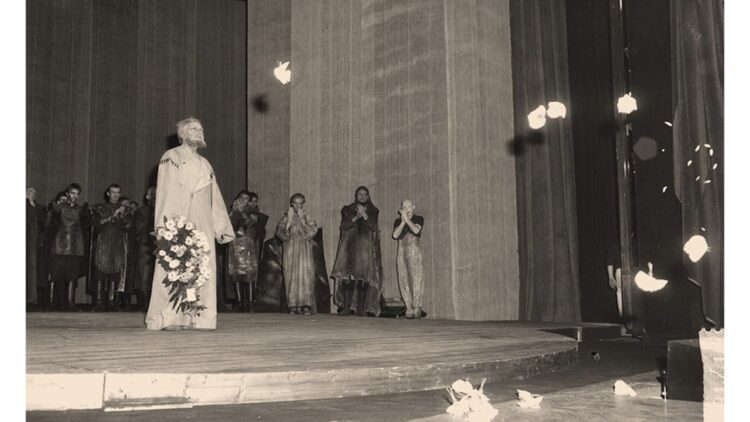
Act III
The signs suggested that my time was short,
To which I gave a disbelieving snort.
My future debts were paid in full, they say,
Before I was required to join the play.
The time has come for me to act my age
And to rehearse my exit from the stage.
Although I wonder where the years have slipped,
Till curtains close I’m sticking to the script.
A lot of things don’t matter anymore—
For good or ill, I’m headed out the door.
A Refusal to Grow Old Gracefully
—after Peter Pan
The best I can is not the best I could
When I was made of sturdy gopher wood.
This wave-wracked ark, once clad in sinewed brawn,
Will with its pilot someday soon be gone.
The doors of my perception flap like boards
Unhinged, foreboding what I’m heading towards.
Though some have said my judgment’s gone awry,
Well, so has theirs, and it’s no wonder why
I get to laugh when laughter is de trop,
And no one cares if I don’t say hello.
I’m sure it has to do with newfound youth,
A second childhood, if you want the truth.
C.B. Anderson was the longtime gardener for the PBS television series, The Victory Garden. Hundreds of his poems have appeared in scores of print and electronic journals out of North America, Great Britain, Ireland, Austria, Australia and India. His collection, Mortal Soup and the Blue Yonder was published in 2013 by White Violet Press.


















It’s hard to imagine old age and approaching mortality as being the subjects of facetious, playful verse. But Kip Anderson has shown how it can be done.
If I can’t laugh at it, Joseph, who will? You must have noticed that your family gives you a lot more leeway than they used to. It’s one of the unlegislated benefits of old age. I still don’t know how to do it; I just got lucky again.
I agree with Joseph. “Act III” and “The Refusal to Grow Old Gracefully” both are poems of the way I hope to be.
C.B.
Nice reflections on mortality. I particularly liked the provocative title, “Act III.” It could refer to the final act, of course, (Comedy of Errors) but the play could, in fact, have IV acts (Chekhov’s The Seagull) or maybe even V acts (normative for Shakespeare and most plays), giving a hint that the final page of the script–while in sight–lies further afield and, since the show must go on, there will be more to come before the final “exuent, stage right.” I trust this will be true for you as well as for myself!
Last weekend when my youngest daughter and family were visiting, I referenced my poem, Totentanz, just posted here on SCP. I segued into some personal end-of-life comments and was told to redirect the conversation to something else. I’m glad to see that you are keeping the conversation going!
As always, James, you are much too thoughtful, which is a virtue, not a vice. Mortality is always the elephant in the room, whether people want to talk about it or not. I don’t know much about Chekhov, but I haven’t checked him off my list. In another life, in closer proximity, I think we might have become good friends. In this life I hope you regard me as a grateful colleague.
I most certainly do and the gratitude is all mine.
“Please dad don’t die”, my daughter once said to me. “I’ll try my best not to”, I replied. Nobody cares if we laugh de trop or if we don’t say hello. Nice way of putting the gradual isolation of advanced ageing. Well, we’re all in this together.
Absolutely, Gerard. It’s the way of all flesh. We do our best to allay the fears of our younglings and try not to let any of our own creep up on us. No matter what eschatological stance one takes, the future is not all that threatening. Que sera, sera. As a “seasoned citizen” I don’t feel so much isolated as surrounded. My grandkids call me Poppy.
I like these reactions to the condition of aging; they seem to me to express a somewhat lighthearted view, more than dark humor, though that aspect is there too. “The doors of my perception flap like boards unhinged” creates such a good visual and auditory image.
I think longevity is highly overrated;
I’d rather make my exit before I’m fully faded.
(Although a second childhood sounds like quite a lark!)
You remind me of many things, Cynthia, and provoke several new thoughts. I suspect that you are getting up there too, but still are eager and willing to arm-wrestle Father Time. The time of our passing is not determined by medical authorities or any actuary. Like you, I’m good to go, if necessary. It strikes me that forty-year-olds don’t know how short time is.
Don’t hope too hard, Roy. It will catch up to you before you know it, and you will be lucky if you’re prepared. But old guys deserve a little slack, unless they were once generals.
These are two wonderfully candid poems on both the anxieties and the acceptance of ageing. The intricate thought process and wording of these poems does not indicate any ‘boards unhinged’, but quite the opposite.
I was particularly taken by ‘wave-wracked ark’, which I’m sure Shakespeare would have loved to have included in King Lear.
Thanks for the reads.
You sound, Paul, as you should, like a man whose whiskers have become white. I’m glad you still think that my hinges are intact. It’s a pity that Shakespeare is no longer around to answer our questions. Somehow, life goes on.
Both well-wrought. It strikes me that of late many of your poems are very philosophical musings on the ageing process.
Could be, Cheryl. If you want to read a truly great poem on the subject, then go here:
https://www.blueridgejournal.com/poems/ah-sarab.htm
Thanks for these well-written poems. I try to be positive about advancing age, but yes we’re all heading in the same direction, and your work faces that fact with honesty and humour.
The good news, David, is that going downhill is easier than going uphill. See you at the bottom. Bring water.
When mortality ends, redeemed life begins, as you eloquently put it, “My future debts are paid in full, they say, before I was required to join the play.” So all the hope, joy, and levity in these two wonderful poems fits perfectly. The worn, mortal clay house belies the vibrant, perceptive, immortal life within. I love both of these treasures, C.B. Thank you.
Well, thank you Jan. Before I read your comment I was about to throw these poems in the trash can, but now I’ll let them live another day.
Why? They’re honest, relatable, great reads. I’m glad to get to read them.
You are right, Jan. At times I doubt myself and write foolish things.
My future debts were paid in full, they say,
Before I was required to join the play.
Intriguing logic attributed to a Houdini them. Good find, C. B.
Who ever said that being a Christian was easy? These things are everywhere for the taking.
Thanks for these two accomplished poems, CB. I like your take on the Shakespearean “the world’s a stage” idea.