• Submit Poetry
  • Support SCP
  • About Us
  • Members
  • Join
Saturday, October 10, 2026
Society of Classical Poets
  • Poems
    • Beauty
    • Culture
    • Satire
    • Humor
    • Children’s
    • Art
    • Ekphrastic
    • Epic
    • Epigrams and Proverbs
    • Human Rights in China
    • Music
    • Performing Arts
    • Riddles
    • Science
    • Song Lyrics
    • The Environment
    • The Raven
    • Found Poems
    • High School Poets
    • Terrorism
    • Covid-19
  • Poetry Forms
    • Sonnet
    • Haiku
    • Limerick
    • Villanelle
    • Rondeau
    • Pantoum
    • Sestina
    • Triolet
    • Acrostic
    • Alexandroid
    • Alliterative
    • Blank Verse
    • Chant Royal
    • Clerihew
    • Rhupunt
    • Rondeau Redoublé
    • Rondel
    • Rubaiyat
    • Sapphic Verse
    • Shape Poems
    • Terza Rima
  • Great Poets
    • Geoffrey Chaucer
    • Emily Dickinson
    • Homer
    • Henry Wadsworth Longfellow
    • Dante Alighieri
    • John Keats
    • John Milton
    • Edgar Allan Poe
    • William Shakespeare
    • William Wordsworth
    • William Blake
    • Robert Frost
  • Love Poems
  • Contests
  • SCP Academy
    • Educational
    • Teaching Classical Poetry—A Guide for Educators
    • Poetry Forms
    • The SCP Journal
    • Books
No Result
View All Result
Society of Classical Poets
  • Poems
    • Beauty
    • Culture
    • Satire
    • Humor
    • Children’s
    • Art
    • Ekphrastic
    • Epic
    • Epigrams and Proverbs
    • Human Rights in China
    • Music
    • Performing Arts
    • Riddles
    • Science
    • Song Lyrics
    • The Environment
    • The Raven
    • Found Poems
    • High School Poets
    • Terrorism
    • Covid-19
  • Poetry Forms
    • Sonnet
    • Haiku
    • Limerick
    • Villanelle
    • Rondeau
    • Pantoum
    • Sestina
    • Triolet
    • Acrostic
    • Alexandroid
    • Alliterative
    • Blank Verse
    • Chant Royal
    • Clerihew
    • Rhupunt
    • Rondeau Redoublé
    • Rondel
    • Rubaiyat
    • Sapphic Verse
    • Shape Poems
    • Terza Rima
  • Great Poets
    • Geoffrey Chaucer
    • Emily Dickinson
    • Homer
    • Henry Wadsworth Longfellow
    • Dante Alighieri
    • John Keats
    • John Milton
    • Edgar Allan Poe
    • William Shakespeare
    • William Wordsworth
    • William Blake
    • Robert Frost
  • Love Poems
  • Contests
  • SCP Academy
    • Educational
    • Teaching Classical Poetry—A Guide for Educators
    • Poetry Forms
    • The SCP Journal
    • Books
No Result
View All Result
Society of Classical Poets
No Result
View All Result
Home Poetry Beauty

‘Latitude and Loss’: A Poem by Martin Briggs

August 21, 2026
in Beauty, Poetry
A A
20
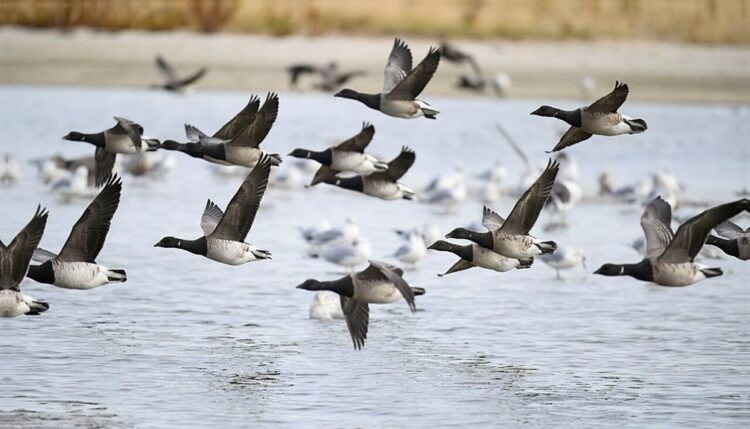
a photo of brent geese flying (public domain)

a photo of brent geese flying (public domain)


Latitude and Loss

One spring morning they announced themselves
at last: a faintly murmured intercourse
emerging surely from the shoring waves
like ancient spells incanted in Old Norse.
And there they came, low-beating over crests
intently on beneath the broken cloud,
a skein of purpose following the coast,
straining northward, urgent, calling loud
with high excited clamour in full flight.
Strong wingsweeps passing sighed of Arctic wind,
then faded into silence beyond sight,
leaving only emptier sky behind.

Innately charted constellations guide
their impulse to a reacquainted strand,
where old unfrozen birthrights recognised
anew are nurtured in a nightless land
of cloudberry, moss and watery wilderness.
Wanderers brooding on the edge of earth
sense instincts pulsing in each downy nest,
around them all the backcloth of rebirth –
seas where narwhal surge, bog where bears
roam like famished snow—and, sweetly harsh,
wild voices on the quaking tundral air,
whose echo haunts an empty Essex marsh.


Martin Briggs lives in Suffolk, England. He only began writing in earnest after retiring from a career in public administration, since when he has been published in various publications on both sides of the Atlantic.

Tags: Martin BriggsPoetry on Birds
ShareTweetPin
The Society of Classical Poets does not endorse any views expressed in individual poems or commentary.
Read Our Comments Policy Here

RandomPoems

‘Heritage as Hope’ and Other Poetry by Phillip Whidden
Beauty

‘Heritage as Hope’ and Other Poetry by Phillip Whidden

May 23, 2018

Heritage as Hope I saw the cricket scene in evening light, In Windsor light with calm men moving through The...

‘Old School’ and Other Poetry by Allan Heller
Beauty

‘Old School’ and Other Poetry by Allan Heller

January 24, 2017

  Old School I saw two women at a table in a small café Not making eye contact or talking,...

Next Post
‘Unrest On the Floodplain’: A Poem by Bhikkhu Nyanasobhano

'Unrest On the Floodplain': A Poem by Bhikkhu Nyanasobhano

‘Humdrum and Harum-Scarum’: A Lecture on Free Verse, by Robert Bridges (1922)

'Humdrum and Harum-Scarum': A Lecture on Free Verse, by Robert Bridges (1922)

‘Cain’s Daughter’: A Poem by Patricia Rogers Crozier

'This Too Shall Pass' and Other Poetry by Justin Dasher

Comments 20

  1. Roy Eugene Peterson says:
    2 months ago

    This is an erudite expression of international bird migration with sensory images of their pilgrimages. The birds are seen to sally forth as they continue to the north. Their flight from England must seem harsh, since their echo haunts an Essex marsh. Well-constructed are the words as we follow this flight of birds.

    Reply
    • Martin Briggs says:
      2 months ago

      Though it’s not a masterpiece – just a picture of some geese on their seasonal migration – thanks for your appreciation.

      Reply
  2. Rohini Sunderam says:
    2 months ago

    This is exquisite in its rhythm and imagery. I particularly loved ‘famished snow’

    Reply
  3. Mary Gardner says:
    2 months ago

    Martin, what is famished snow?

    Reply
    • Joseph S. Salemi says:
      2 months ago

      My guess is that it means snow that is metaphorically “hungry,” and that bites intensely with its cold. There’s an Iranian poet who writes of the hungry snow “biting the mountains” — i.e. making things unpleasant and uncomfortable.

      Reply
      • Martin Briggs says:
        2 months ago

        Precisely. But a legitimate question. Famished snow is hungry and predatory, like the white bear which it symbolises. The image might be obscure at first sight, but greater writers than I have noticed that fog prowls, cloud smothers, heat chokes, and so on. Sorry if it doesn’t work.

        Reply
        • Joseph S. Salemi says:
          2 months ago

          It works perfectly, just like Eliot’s image of the yellow smoke moving and curling like a cat, in one of his famous poems.

          Reply
        • Mary Gardner says:
          2 months ago

          Thank you, Martin.

          Reply
  4. Josh Olson says:
    2 months ago

    This is a truly beautiful poem! All the imagery is wonderfully and thoughtfully rendered—a real gem! One thing I particularly enjoyed was your occasional use of partial rhyme, as for example in lines 1 and 3 (“themselves…waves”). First, there is real beauty in that rhyme. And second, I’ve felt for a while that partial rhyme (slant-rhyme, half-rhyme, etc.) is a great underused technique in English poetry—not only does it help mitigate how desperately rhyme-poor the language is, but it can also conjure up a softer, more delicate music. Phenomenal work!

    Reply
    • Martin Briggs says:
      2 months ago

      Thank you, Josh. I’m grateful for your thoughts.

      Reply
  5. Cynthia L Erlandson says:
    2 months ago

    I agree with Josh; I like many slant rhymes for their interesting musicality. There are many beautiful things about this poem, Martin. Among them: your description of the sound the birds make as “like ancient spells incanted in Old Norse” (brilliant comparison!); “a skein of purpose following the coast” (so visual!)

    Reply
    • Martin Briggs says:
      2 months ago

      Thank you Cynthia. I agree with you – and Josh: I’m a great believer in slant/imperfect rhymes. When appropriate, they allow you some flexibility without overstepping the bounds of formality. And yes, they can enhance the musicality of a piece.

      Reply
  6. Levi Warren says:
    2 months ago

    I’ve never read or heard the word “tundral” before but I love it for its sound. I’m wondering also if the words “crest” and especially “brooding” are pulling a little double duty here.

    Reply
    • Martin Briggs says:
      2 months ago

      Thanks for these perceptive comments, Levi. I thought I’d invented “tundral”, but was disappointed to discover that it actually exists….

      Reply
  7. Paul Freeman says:
    2 months ago

    So much fine imagery, Martin. Three of my faves – ‘ancient spells incanted in Old Norse / a skein of purpose / Wanderers brooding on the edge of earth’.

    Re, ‘tundral’, I was writing a poem about butterflies a couple of months back and from the noun ‘lepidoptera’ there were three adjectives – lepidopterous, lepidopteral and lepidopteran. Spoiled for choice, I went for the latter.

    Thanks for you wonderful, evocative poem.

    Reply
    • Martin Briggs says:
      2 months ago

      Thanks Paul. As far as butterfly lore is concerned, I think it’s hard to beat the Danish “sommerfugl”, or “summer bird”.

      Reply
  8. Bhikkhu Nyanasobhano says:
    2 months ago

    And while we’re talking about the forces of nature, here’s a fine poem on the subject–atmospheric, wild, looking to history, with a rich evocation of “a nightless land.” An example of what nature and a poet can do together. I enjoyed it.

    Reply
    • Martin Briggs says:
      2 months ago

      Thanks for your appreciation. I think we’re on the same page.

      Reply
  9. Margaret Coats says:
    2 months ago

    Martin, the poem is a masterpiece of descriptive suggestion. You never say it is about birds or geese or migration, but provide an avalanche of words and images that, taken together, reveal the subject. The departure point is identified in the final words as an “empty Essex marsh,” and while you do mention “north,” you wouldn’t need to. That is, if we know where cloudberries grow and narwhal congregate. A nice puzzle that makes your reader feel like a successful investigator.

    As for “famished” snow, it may technically be a misplaced modifier–using a technique allowed in verse. Considering what I’ve said about the poem overall, I’d be surprised if you did NOT use misplacement!

    Reply
    • Martin Briggs says:
      2 months ago

      Thank you Margaret. I did deliberately omit specific information: to introduce factual detail would have reduced the piece to mere reportage. I’m glad you approve.

      Reply

Leave a Reply Cancel reply

Your email address will not be published. Required fields are marked *


  1. Josh Olson on ‘Invocation’: A Poem by D.R. RainboltOctober 10, 2026

    This is a beautiful poem—I especially like "Come fan my little spark / Of holy wonder..." It reminds me of…

  2. Josh Olson on Faust Part Two, Act One: ‘A Pleasant Landscape’ by Goethe, Translated by Josh OlsonOctober 10, 2026

    Thank you, C.B. Anderson, for your exceedingly generous words.

  3. Richard Lackman on ‘Gun Control’: A Poem by Kevin AhernOctober 10, 2026

    As an avid supporter of the SCP and a competitive pistol shooter, I can tell you that no responsible legal…

  4. charles southerland on ‘The Martyrdom of Saint Cassian’: A Poem by Joseph S. SalemiOctober 9, 2026

    Hi, Joe I enjoyed the poem. Damn bloody poem. What might become of us? Email me please. [email protected]

  5. C.B. Anderson on ‘Enjoy the Peace, Prepare for War’: A Poem by Roy E. PetersonOctober 9, 2026

    The author isn't kidding, however much I might wish he were. War exists on many levels, but intrafamilial wars are…

Subscribe to Daily Poems

Enter your email address to subscribe to this blog and receive notifications of new posts by email.

Join 1,661 other subscribers
No Result
View All Result

Resources

       1. A Guide to Writing Poetry

      2. The Best Poems of 2020      

      3. Poetry and Writing Contests

      4. Journals Accepting Formal Verse

Recent Poems

  • ‘Gun Control’: A Poem by Kevin Ahern
  • ‘Power of a Pen’: A Poem by Janice Stanley
  • The Best Haiku of 2026
  • ‘One Night in Bangkok’ and Other Poetry by Brian Yapko
  • ‘Invocation’: A Poem by D.R. Rainbolt
  • ‘Enjoy the Peace, Prepare for War’: A Poem by Roy E. Peterson
  • Faust Part Two, Act One: ‘A Pleasant Landscape’ by Goethe, Translated by Josh Olson
  • A Song Inspired by Robert Frost’s ‘The Road Not Taken’, by Gunny Markefka
  • ‘Reappraisals of Mortality’: A Poem by C.B. Anderson
  • ‘What Is the Measure of My Days?’: A Poem by Peter Venable
  • ‘Polar Coordinates’: A Poem by Adam Sedia
  • ‘It Never Lies!’: A Poem by Paul A. Freeman
  • ‘The Mahjong Flowers’: A Set of Sonnets by Margaret Coats
  • ‘The Martyrdom of Saint Cassian’: A Poem by Joseph S. Salemi
  • ‘Mind Versus Beauty’: A Poem by Johann Wolfgang von Goethe, Translated by Eric v.d. Luft
  • ‘Summer Sails’: A Poem by Paulette Calasibetta
  • ‘Aquarius’: A Poem by Patricia Rogers Crozier
  • ‘No Body Here on Earth’: A Poem by Gerard Maritato
  • A Visualized Reading of The Odyssey: Book 1, Produced by Andrew Benson Brown
  • ‘Now?’ and Other Poetry by Stephen DiLauro
  • ‘From California to Louisiana’: A Sonnet by Mark F. DeWitt
  • ‘A Pot of Tea’ and Other Poetry by Samuel Gregg
  • Eight Riddles for the 2026 Mid-Autumn Festival, by Evan Mantyk
  • ‘Swallowtails’ and Other Poetry by Mary Jane Myers
  • ‘All Flesh Is Grass’: A Poem by Cynthia Erlandson
  • ‘May a Smile Be Your Umbrella’: A Poem by Roy E. Peterson
  • ‘Flexibility’ and Other Poems by Russel Winick
  • ‘Sabin Howard’ and Other Poetry by Bruce Dale Wise
  • ‘Ode to a Dragonfly’ and Other Poetry by Adam Sedia
  • ‘Hobby Horse’: A Poem by A.R. Pereira

Categories

  • Acrostic
  • Alexandroid
  • Alliterative
  • Art
  • Best Poems
  • Blank Verse
  • Chant Royal
  • Classical Poets Live
  • Clerihew
  • Covid-19
  • Deconstructing Communism
  • Educational
  • Epic
  • Epigrams and Proverbs
  • Essays
    • Interviews with Poets
    • Poetry Reviews
  • Featured
  • From the Society
  • Great Poets
    • Dante Alighieri
    • Edgar Allan Poe
    • Emily Dickinson
    • Geoffrey Chaucer
    • Henry Wadsworth Longfellow
    • Homer
    • John Keats
    • John Milton
    • Robert Frost
    • William Blake
    • William Shakespeare
    • William Wordsworth
  • Human Rights in China
  • Limerick
  • Love Poems
  • Music
  • Pantoum
  • Performing Arts
  • Poetry
    • Beauty
    • Children's Poems
    • Culture
    • Ekphrastic
    • Found Poems
    • High School Poets
    • Humor
    • Riddles
  • Poetry Challenge
  • Poetry Contests
  • Poetry Forms
    • Curtal Sonnet
    • Haiku
  • Poetry Readings
  • Rhupunt
  • Rondeau
  • Rondeau Redoublé
  • Rondel
  • Rubaiyat
  • Sapphic Verse
  • Satire
  • Science
  • Sestina
  • Shape Poems
  • Short Stories
  • Song Lyrics
  • Sonnet
  • Symposium
  • Terrorism
  • Terza Rima
  • The Environment
  • Translation
  • Triolet
  • Video
  • Villanelle

Quick Links

  • About Us
  • Submit Poetry
  • Become a Member
  • Members List
  • Support the Society
  • Advertisement Placement
  • Comments Policy
  • Terms of Use

Welcome Back!

Login to your account below

Forgotten Password?

Retrieve your password

Please enter your username or email address to reset your password.

Log In
No Result
View All Result
  • Poems
    • Beauty
    • Culture
    • Satire
    • Humor
    • Children’s
    • Art
    • Ekphrastic
    • Epic
    • Epigrams and Proverbs
    • Human Rights in China
    • Music
    • Performing Arts
    • Riddles
    • Science
    • Song Lyrics
    • The Environment
    • The Raven
    • Found Poems
    • High School Poets
    • Terrorism
    • Covid-19
  • Poetry Forms
    • Sonnet
    • Haiku
    • Limerick
    • Villanelle
    • Rondeau
    • Pantoum
    • Sestina
    • Triolet
    • Acrostic
    • Alexandroid
    • Alliterative
    • Blank Verse
    • Chant Royal
    • Clerihew
    • Rhupunt
    • Rondeau Redoublé
    • Rondel
    • Rubaiyat
    • Sapphic Verse
    • Shape Poems
    • Terza Rima
  • Great Poets
    • Geoffrey Chaucer
    • Emily Dickinson
    • Homer
    • Henry Wadsworth Longfellow
    • Dante Alighieri
    • John Keats
    • John Milton
    • Edgar Allan Poe
    • William Shakespeare
    • William Wordsworth
    • William Blake
    • Robert Frost
  • Love Poems
  • Contests
  • SCP Academy
    • Educational
    • Teaching Classical Poetry—A Guide for Educators
    • Poetry Forms
    • The SCP Journal
    • Books

© 2025 SCP. WebDesign by CODEC Prime.