


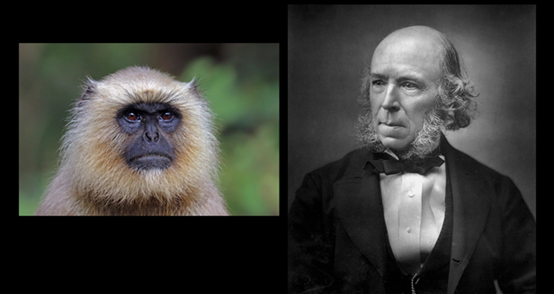
God’s Funeral
“When George Eliot complimented [Herbert] Spencer on the
lack of wrinkles on his forehead, he replied that nothing had
ever really puzzled him” —God’s Funeral, A.N. Wilson
“The riddles of God are more satisfying than the solutions
of man” —G. K. Chesterton
How smooth the forehead, sharp the wit
That’s never had a problem with
Explaining goodness, or piles of shit,
Or felt the mystery of myth.
A tonic for the ages—cure
For maladies, ladies lament,
Etched upon their foreheads. Sure,
Men, too, abhor those wavy dents
Which show virility’s recess:
Simply, in hubris-fashion, say,
‘There are no puzzles—I am blessed.’
See signs of age wither away!
If only… for no gods are mocked
As desolate, depressed, alone,
Poor Spencer found—death had him clocked;
Hell cared less for the books he’d done.
Along with other sages then,
‘We don’t need God and God is dead,’
They bleated—goats stuck in a pen
By some God to destruction led.
Whose funeral, and who has died?
Whose ideas really still have sway?
Who’s heard of Spencer and his pride?
Let’s solve the puzzle, live today.
James Sale has had over 50 books published, most recently, “Mapping Motivation for Top Performing Teams” (Routledge, 2021). He has been nominated by The Hong Kong Review for the 2022 Pushcart Prize for poetry, has won first prize in The Society of Classical Poets 2017 annual competition, and performed in New York in 2019. He is a regular contributor to The Epoch Times. His most recent poetry collection is DoorWay. For more information about the author, and about his Dante project, visit https://englishcantos.home.blog. To subscribe to his brief, free and monthly poetry newsletter, contact him at [email protected].

















I know that Spencer was extremely popular in his own day, and may have been the first to speak of “the survival of the fittest.” Unlike most late Victorians, he was extremely anti-imperialist. He seems to have fallen out of favor soon after his death.
I like the ABAB tetrameter couplets — always good for attack.
My observation is that wrinkle cream marketing ads are almost exclusively aimed at female sentiments, but as you so wisely said, “Men, too, abhor those wavy dents.” The cited quotes were apropos and tied the meaning in a bow.
Thanks Roy – FYI I am a big Bee Gees fan. Their first album release in the UK was in 1967, appropriately entitled Bee Gees First. A wonderfully odd, virtually unknown and idiosyncratic, Robin Gibb track was the crazy: ‘Craise Finton Kirk Royal Academy of Arts’, a sort of parody of the English upper classes, and it contains this wonderfully poetic line that I have always loved: “And his wavy hair continues not to grow”. Ha ha!! Who can plumb the influences in our lives?
Irony in your final questions about Spencer and fellow “sages,” James. They are dead, but their godless ideas live on in many, with or without furrowed brows, although these today think nothing of Spencer. And why is that? A son of Adam who is his own god needs Spencer no more than any other god. We get on with life when we puzzle over God, you would seem to say with Chesterton.
James,
Thanks for the wit and humor you show in putting the spotlight on Spencer’s forehead.
Chesterson’s wit is telling insofar as the hubris of those who posit a non-existent God leaves them with little or nothing to laugh at but themselves (a la Beckett’s Waiting for Godot or for good measure, anything be Nietzsche, Sartre, or Camus). Ginsberg can only Howl, while Chesterton finds joy, humor, comedy and playful fun in anything and everything. If, like Spencer, with unfurrowed brow we are no longer surprised or puzzled by anything, it follows that it would most likely become difficult if not impossible to enjoy a good joke.
When God dies, it seems the better angels of our nature die along with him.
Hi James, thanks for picking up on the GKC reference. Just as I consider WB Yeats the greatest English language poet of the C20th, so I think of GKC as the greatest prose writer of that period. I have probably read only a half of his total output, but when you consider how large it is, I am not doing too badly! Wherever I look, I find more of intense interest and insight – he needs re-discovery, but the secularists won’t allow that: he is far too clever for them to defeat in argument.
Reminds me of Willian F. Buckley’s book “God and Man at Yale”. Most Americans say they believe in God, but I don’t think they believe in a living God. Just an abstraction. We’ve become a secular country at our peril. My friend says he’s “agnostic”. I guess that means an atheist with a college degree!
This poem combines wry humor while provoking thought and discussion about “the riddles of God”.
You are very right Gerard – we become secular at our peril! Thanks for your thoughts!
When we stop ‘puzzling’ over the world and the things around us, we are indeed mired in the mundane of life. What a thought-provoking poem, James.
The stand out image, I thought, was ‘goats stuck in a pen’, five words that encapsulate how most of us live our lives when that world wonder diminishes.
Thanks for the reminder to contemplate what’s around us.
Thanks Paul – yes, let’s contemplate and wonder too: we need more of it!
I loved this one, an intricately carved piece of work, if I may say so. It puts the author right beside Hecht and Wilbur as a contemporary master of verbal artistry.
This is very, very generous of you CB – thank you so much! Have I got your permission to use this adapted version of your comment in future publicity for my poetry publications: “James Sale stands beside Hecht and Wilbur as a contemporary master of verbal artistry.”
— C. B. Anderson, Society of Classical Poets. ?
Yes, permission granted, though I think that very few will give a damn about anything I have to say.
Well, we need to change that CB: we need to get them to care about what you say – you are obviously a very perceptive person!
“Hell cared less for the books he’d done” – that is quite the Dantean put-down!
And much like Dante, there is a weird and delicious irony in devastating poetic character assassinations such as these: the poet ironically does grant their subject immortality, but not in the form that they would have chosen!
I agree with C B Anderson: this is very tightly wrought indeed, with so many quotable lines and witticisms and subversions. I like that it chooses to end on a positive note, however, a sort of hopeful cleansing of the palate as we step away from intellectualism into imminence.
Yes, a vital step: thank you for the observation.
I really like the way you turn Spencer’s smooth forehead into a joke with a serious point behind it. Extraordinarily clever. Enjoyed the reversal at the end. I also enjoyed the reversal at the end. Who has really disappeared: God or Spencer? “Who’s heard of Spencer and his pride?” is funny, but it has some bite to it too. Spencer’s certainty has largely faded with his reputation, while the questions he thought modern thought had settled are still very much with us.
Always good to hear from you ABB: anyone who says they have the answer – with Spencer’s level of confidence – clearly has never understood the question.