


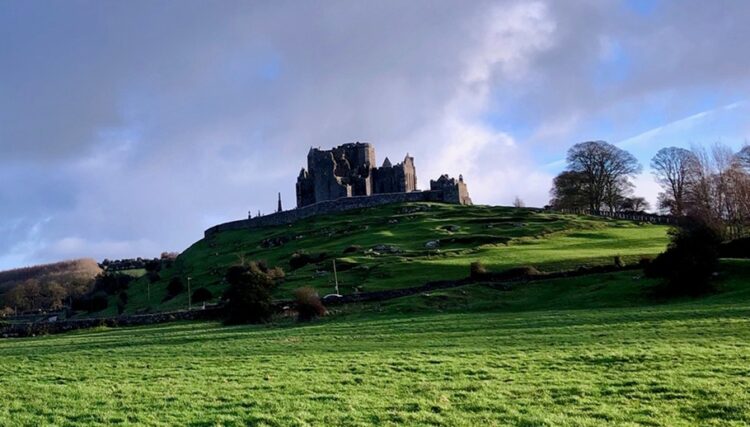
The Tomb on the Hill
The ancient tomb sits brooding all alone
Atop a rocky hill, remote and bare.
Perched like a vulture on a dismal throne,
It overlooks a valley green and fair
With baleful gaze, as if to guard its own.
Dark, slippery steps of crumbling cobblestone
Lead to the summit of that lonely hill
Where, wrapped in vines, by thick weeds overgrown,
It sits in silence, sinisterly still,
As grasses whisper, by the chill breeze blown.
.
No stone engraved with fading words makes known
The names of those whose bodies lie confined
Within those barren walls, which now disown
The memory of those who’ve been consigned
To molder there like seed that has been sown.
Who built this tomb, abandoned and moss-grown?
A legend says that, many years ago,
A wealthy couple, in their day well known,
Were blessed to see their only daughter grow
To womanhood. Beloved, but sadly prone
To fainting spells, she oft would make a moan,
Then fall into a state of seeming death,
Whose grim effects could not be overthrown
Until she, with a sudden gasp of breath
And fleeting quake, would wake up on her own.
Her somnolence and deathly pallor flown,
She’d rise renewed, as from refreshing sleep,
Her face then glowing with a rosy tone,
Unconscious of the terrifying deep
In which she’d lately plunged to depths unknown.
One day, her parents found her lying prone;
And though they waited for their lovely lass
To rise again, when all their hopes had gone—
Since neither pulse, nor breath stain on clear glass
Appeared, to show her life was still on loan—
They let the earth reclaim her as its own,
And buried her upon her favorite hill.
They spent a time of mourning to bemoan
Their loss; then with resolve, of their own will,
They made this tomb her memory to enthrone.
Then on a chosen day, cold and windblown,
They brought her to her final resting place,
With solemn dirges and a bagpipe’s drone
Directing steps at elegiac pace
To where, with darkness as her chaperone,
She’d lie in peace. But when the deed was done,
And all had turned to leave that sacred space,
They clearly heard a faint, blood-curdling groan
Emitted from her casket, now in place,
A sound that chilled all hearers to the bone.
With haste they pried the lid, and there was shown
Before them all a sight none could forget—
The corpse of her whose posture made it known
She had been still alive and conscious yet
When she was sealed inside, in days now flown!
Her parents never could accept, nor own
The truth they learned about their daughter fair—
The pain she had endured, left there alone
Beneath the ground, was more than they could bear.
Their reigning grief, mere time could not dethrone.
The fact they could do nothing to atone
For what had taken place, cut like a knife,
So, when their final years had quickly flown
And broken hearts had sapped them both of life,
They went to join her in that house of stone.
Since then, from time to time, reports are sown
Of sojourners who stumble on that place
And hear at night a tragic, muffled groan,
Emitted from inside that eerie space,
That echoes in the midnight breezes blown.
They often see a woman in that zone
Who paces on that windy hill on high,
And weeps aloud while nightingales intone
A song before they soar into the sky.
She walks and weeps before the tomb, alone.
Poet’s Note
Edgar Allan Poe was born in the depth of winter on January 19, 1809. Poe’s Gothic poems and stories are often pervaded by a sense of melancholy, dread, and fear. His own life was marked by frequent tragedy and sorrow. He lost four dearly beloved family members to untimely deaths while they were yet in their twenties—his mother, foster mother, brother, and cousin, whom he had taken as his wife. Another sister of Poe lived to be 63 years old, but she lived a very hard life and became indigent and confined to an institution before her death. Poe lost other people who were near and dear to him, and this frequent acquaintance with death and loss, coupled with recurring struggles with poverty and alcoholism most likely influenced the darkness of the themes he chose to address so frequently in his writing.
There is rarely a redemptive ray of hope in his writings, though in his later life, he began to address more theological themes in his writing, especially in the 150 page prose poem “Eureka,” in which he sought to find a resolution to the problem of pain by appealing to the unfinished unfolding of God’s plan for history. If we can believe the testimony Dr. John Moran, who was the attending physician during Poe’s final days in Washington College Hospital in Baltimore, Poe’s final words were, “Lord, help my poor soul.” Could it be that Poe’s grief-haunted soul found peace at the end? The above poem, reminiscent of Poe in mood and theme, addresses a subject that appears in several of his works, which was of concern to many in the nineteenth century—the fear of premature burial.
Martin Rizley grew up in Oklahoma and in Texas, and has served in pastoral ministry both in the United States and in Europe. He is currently serving as the pastor of a small evangelical church in the city of Málaga on the southern coast of Spain, where he lives with his wife and daughter.



















Edgar would be proud, Martin … beautiful story, meter, rhyme … You OWN the THRONE for this one!
Thank you for your encouraging feedback, Paul!
It would be easy to believe that Poe himself wrote this chilling poem. The suspense keeps one reading! “With darkness as her chaperone” is brilliant.
Cynthia, I´m glad you found the poem suspenseful enough to keep reading it to the end. That tone of suspense is what I was hoping to achieve. Thanks for your appreciative words.
Chillingly beautiful. What an amazing tribute to the master of macabre, as Cynthia Erlandson says, it could well have emanated from Poe’s pen.
Rohini, The description “chillingly beautiful” was precisely the mood I wanted to convey. I had originally included in the poem a couple stanzas describing in rather graphic terms the corpse of the young girl, but I removed them because they seemed to transform the mood of the poem from “chilling” to horrifically lurid and sensational. I wanted to leave a bit more to the imagination of the reader, to underscore the mood of eerie melancholy, grief and tragedy.
In college I used to read Poe in the library when I ought to have been studying chemistry and biology. He is still my favorite poet. I agree with Rohini’s description of your tribute as “chillingly beautiful.” Thank you for sharing!
Hi Jeff, Thanks for your comments. I remember borrowing from the school library when I was a teenager a recording of Basil Rathbone reading poems and stories of Edgar Allan Poe. Since then, I have been a fan. Here is a link to Rathbone´s classic reading of the Raven: https://youtu.be/BuL1xhUp0Gk?si=vghzAu7FaxJ1CVYE
His reading of Annabel Lee– which you can hear on YouTube as well is also masterful.
This is somber in the way we would expect for the Poe-like Gothic theme. It’s a narrative poem, come to think of it, a kind not practiced much these days, but you carry it off admirably, holding the reader’s interest or expectation to the end. The driving, repetitive rhyme scheme certainly helps in sustaining the creepy mood. Very well composed.
Bhikku, You mention the “driving, repetitive rhyme scheme” which is one of the aspects of the poem I found most challenging, but also enjoyable, in writing it. I knew that there were a limited number of words in English that end with the “-one” sound, so it was a challenge not to reuse the same word too often– although some words are repeated in the course of the poem. It seemed to me that the mournful sound of the “-one” ending underscored the melancholy and mysterious mood of the poem.
Martin, this is a perfectly fitting poem for this Poe anniversary with the dark overtones and spine-chilling burial of one still alive who now in ethereal pain paces at night before her tomb weeping.
Thank you, Roy, for your remarks. I´m glad you found the poem effectively “spine-chilling.” I would point, however, that in the final image of the woman who weeps before the tomb, there is a certain ambiguity. Since three are buried in the tomb– the girl and her parents–, is the ghostly figure pacing on the hill the girl who was buried prematurely, or the mother of the girl, weeping with unresolved grief over the fate of her beloved daughter? Ghosts often serve as the literary symbol of unresolved issues. Since the three unhappy dwellers in the tomb are united in their grief, a certain mystery hangs over the identity of the feminine ghost.
You nailed it, Martin; Gothic atmosphere, pace, sense of dread – everything.
Thanks for the read.
Thank you, Paul, for sharing with me your response to the poem. I´m glad you enjoyed it!
I’ve come a few days late to this masterful poem, Martin, and in my opinion, “The Tomb on the Hill” and previous comments on it, show you as a true master poet, successful at taking on a style and a theme a far from your usual, not to mention constructing a backstory drama with appropriate ambiguity. My hearty congratulations on the achievement!