


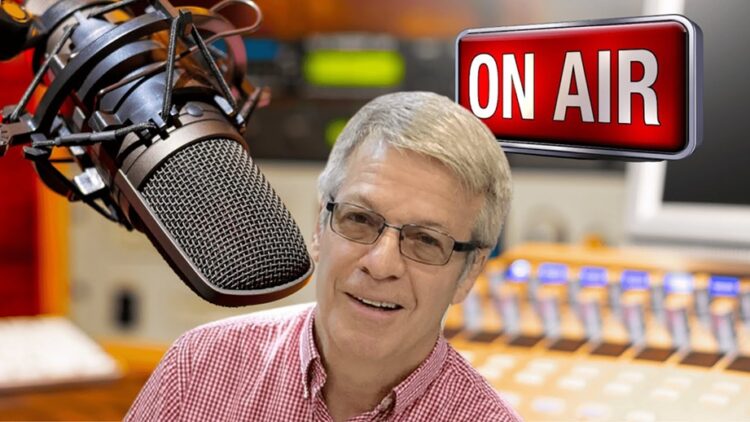
Poet Mark F. Stone delivers a speech on reading poetry live on the radio. His remarks were given at the Society of Classical Poets’ in-person Poetry Symposium held in Naperville, Illinois on September 5-6, 2025:
Video created by Andrew Benson Brown.
Transcript of the YouTube video of the Presentation by Mark F. Stone on
“Advice for Reading Poems Live on the Radio”
Note: The presentation was made at the symposium of the Society of Classical Poets in Naperville Illinois, on September 6, 2025.
Hello, everyone. My name is Mark Stone. My presentation today is entitled “Reading Poems on the Radio.”
So what do I do? In the city where I live, there is a radio station that every Saturday morning has a call-in show from 6 AM to 8 AM. And so every Saturday morning, I call the radio show and I read two poems that I’ve written myself.
I started in July of 2023, so I’ve been doing it for about 26 months. For the first year, I didn’t do it every week. I was kind of sporadic, but then, after a year into it, I thought “I really need to get disciplined.” So now, for the last year or 14 months, I call every Saturday. Because I kind of treat it like a part-time job. Most of the time I’ve been doing one poem, but then about two months ago, they had a dearth of callers, so I offered to do two poems. They said, “Sure, yeah, that’d be great.” So ever since then, in the last two months, I read two poems. The first one is one that I’ve already read, and the second one is a new poem. I’ve called probably 80 times in the last 26 months and read a total of about 70 poems that I’ve written myself.
How did I get started? Well, back in July of 2023, there was a journal that I wanted to get a poem into, and I thought, “If I can succeed in that quest, I will be a luminary in the poetry firmament. I will be a big shot.” And so over three years, I sent them probably 15 poems. All were kindly rejected. And then I thought, “OK, let me give it one more shot.”
And so I sent three poems and their standard response was: “We will get back to you in four to six weeks.” Two days later, I get a kind email thanking me for my submission, but they are not accepting the poems, but feel free to send more in the future. Anyway, so at that point, I was just frustrated. I said, “I am done with his journal.” And I’ll just refer to it as the XYZ Journal. I said, “I don’t need these people. I am going to go straight to my audience.” So I had been listening to this call-in show for years and I thought, “Why don’t I call in, and maybe I can read a poem?” So I did, and that’s how it got started.
What type of poems do I read on the radio? I choose to read basically light verse or occasionally some fairly light political poems. And I think those go best, because you’re reading for a broad audience. You want to entertain them and boost their morale early on a Saturday morning. So I don’t read any poems about cleaning the gunk out of my soul. No, I save those for a poetry conference. I try to read different from what the other folks do. So, for example, most of the callers talk political issues during this two-hour period. So I mostly stay away from politics, just to have a change of pace, just to make me different from the rest.
Also, I virtually always write in rhyming couplets. Because the people who are listening, they’re driving a car; they’re cooking; they’re changing the baby’s diaper. They don’t have the poem in front of them, and so it’s easier for them to follow, if it’s rhyming couplets.
And now the length. I go for about one-and-a-half to two minutes. My wife says all my poems are too long and I say, “Well, I can’t shorten it because, when you call the radio station, your purpose, in their mind, is to provide content, hopefully entertaining content.” So an eight-line poem is not going to cut it, cause between commercial breaks, they’ve got about eight minutes to fill. And so they need you to go at least two, three or four minutes. And now I typically go four minutes, so two two-minute poems. I also stick to family friendly poems: G or PG or PG-13. The R ones I save for a poetry conference, or other zooms, not for the public.
Presentation practices. I do several things differently because it’s on the radio. You want to try to be entertaining, so if I’m doing a romantic or dating poem, I’ll use the phrase: “Doctor Love is back in the house.” And then I also have a dedication for every poem, just to give them an idea of what it’s about. So, for example, I’ll say: “Today’s poem is dedicated to all football fans.” Or I might say: “Today’s poem is dedicated to everyone who is over 50, or who hopes to be one day.” And so, just to kind of let them know what the poem is about, rather than just starting totally cold.
I also mention the length of the poem. So I will say, “The following poem is one minute and 55 seconds long.” And the reason I do that is because they are watching the clock. The host, the producer and the call screener are watching the clock. They know they have to go to commercial break at 7:58 AM. So when they put you on at 7:55 AM, they’re watching the second hand go around, and they’re hoping that you’ll finish the poem before they have to go to commercial break. And I have been cut off in the middle of a poem on a couple of occasions. So that’s why I now say “the poem is one minute and 55 seconds long,” so they’ll know that we can fit it in.
And then I mention the rating. So I say, “The poem is rated G or PG or PG-13,” just to let the parents know that maybe they want to turn off the radio, if the kids are there and it’s a PG-13.
I also explain references, like historical, literary, mythological, artistic. Because not every audience is as well educated as all of we are, or all of you are, at least. So, for example, if I have a poem, if I’m going to say the phrase “Sisyphus Rock,” I’ll explain what that means. Or if I am going to make a reference to “Samson and Delilah,” I’ll explain what that means.
And then, at the end of every poem, I say: “The End.” Because I learned early on that they don’t know when the poem ends. They don’t have the script in front of them, and they’re not
really used to hearing poems, and they can’t see my facial expression. So I’ll say “The End” at the end.
Advice on calling the radio station. First of all, get some sleep. I find if I’m well slept, I can read with more energy. I read better. I enunciate better and I pause better. The whole thing goes better if I’m well slept, but that’s not always the case.
Next point. Try to relax. If you’re nervous when reading in public — like I am — then you should try to relax. And after 26 months, I’m actually at the point where I can almost read it in a relaxed state.
Next point. You’ve got to believe in the poem. You have to sell it. You don’t want to read a poem, if you have questions about whether it’s good enough to read on the radio. You’ve got to believe in it. And so when one editor says he or she likes it, and the other editor says “No, it’s a stinker,” just block that negative critique out of your mind. You have to go and think, “This is a great poem.” And sometimes, I’ll write on the bottom “great poem” because my editor said that. You want to read it with confidence.
Call early. They tend to take callers on a first-come, first-served basis. I always call typically about 7:10, because the show goes from 6 to 8 AM. I used to have to call before seven, but now they know me. They actually put me in front of other callers because they like the poems — usually, sometimes — and they know I’m a regular. I call every week. But I still need to call in by about 7:10.
Also, one thing about calling the radio. You can call from anywhere. One time we were in Australia visiting a relative. I called from there. You got to keep in mind, there’s a 14-hour difference. And I called from Massachusetts once. I’m calling from Illinois today, this morning. You can also call from the car. There have been two or three occasions when I had to be somewhere — someone else was driving, fortunately — and so I just read it from the front seat.
And finally, you want a quiet environment. I turn off all the noise in the house. I’ll turn off the furnace. I’ll try to keep the dog from barking. I’ll have a pile of dog biscuits, so if the dog comes up and starts whining at me, and I’m about to read, I’ll throw a biscuit on the floor on the other side of the house, and then she’ll run over there and chew on the biscuit, instead of whining at me.
And there was one time, horrendous. I was in the dining room, and it faces the street. The neighbor dogs were out there. My dog was going crazy loud, so I actually had to pick up my poem and walk to the back of the house while reading the poem, just to get away from the crazily barking dog. I’ve even put the dog in the kennel on a couple of occasions on Friday night, just so I can be sure I have a quiet house in the morning.
Who is the audience? The immediate audience is just the radio host, the call screener and the producer. But this radio station, its coverage is all of Ohio and the western third of Indiana. I googled the Nielsen ratings and it has a 5.5 share. So basically that means five-and-a-half percent of the people listening to the radio listen to this station. It’s probably the third or fourth highest one in my city. There are a lot of commercials, so that suggests there a lot of listeners.
And occasionally, I actually meet someone out in the real world who has heard my poems on the radio. I was at a political meeting recently. I was going to read a political poem. And the guy next to me said, “Oh, you’re a poet? Have you heard that guy who reads poems on the radio on Saturday morning?” I said, “Yeah, I’ve heard him.” I said, “What do you think of his poems?” And he said, “Yeah, they’re OK.” And then I admitted that I was the guy, the culprit.
Poem preparation. Basically I committed, two months ago, to write a new poem every week. So I read one repeat poem and then one new one. My process: I basically start on Wednesday. I write it all out. Thursday I’ll email it to my editor, my primary editor. She’ll give me comments. Then I’ll take it on Friday morning to my writing group. Those people will give me comments. Then I send it back to my primary editor to look at it again. And then Friday evening I show it to my wife. She says, “Make it shorter.” I say, “I can’t. I’ve got to fill up time.” I’ve even had to make edits on Saturday morning. I’m on hold and my sister, my primary editor, will send me a text and say, “Why don’t you change line 3 to this and this.” So I’ll actually make a change while I’m on hold on the radio.
Does reading a poem on the radio make it a “previously published poem”? Normally, you’d think the answer is no. But iHeartRadio publishes the full transcript of this radio show on its website. And it’s an AI-produced transcript. If you look it up, it doesn’t identify me. I’m just Caller 7 or Caller 3 or whatever. And the transcript is not really that good cause it’s an AI thing and it’s a little bit garbled.
So my answer is no, it’s not a “previously published poem.” Because it’s an inaccurate transcript. My last name is never used. The poem is not in the final form because usually I finish it the night before or the morning of. It’s not the final version. I almost always make changes after I read it on the radio. Also, most listeners don’t know about this website, unless they watch this podcast. And most audiences for poetry don’t listen to the radio program at 7 AM on a Saturday.
However, I’ve asked three editors whether they consider this situation a “previously published poem.” Two editors, and these are all journals you’ve heard of, have said, “No, we don’t because it’s not curated. It has to be curated, selected by someone for quality.” No, when I call in, they don’t screen my poems. They just put me on the air. But then one editor said, if he or she can google the title and it shows up on the iHeartRadio website, then he or she considers it to be a “previously published poem.”
Coming to a close, what is ahead for me? I plan to keep doing it. I did have a couple listeners call in and say: “Hey, I’d really like to buy a book of all the poems that Mark has read.” So I should put them in a book. And then I want to branch out to other radio stations. I did on one occasion call an FM station and read a poem there. I’ve got some sports poems. Some good baseball and football poems. And so I could call a sports radio show.
And lastly, opportunities for you. If you want to do this in your town, just listen to your radio stations. Find one that has a call-in program and just call them and see if they’re interested in hearing your poems. And, whatever you do, please don’t call my radio station. Because if you call my radio station, they might say, “Well, who needs Mark’s poems? We’ve got these really good ones.” And then I’m going be back to submitting poems to the XYZ Journal. But actually, I do have to thank the XYZ Journal, because if they had accepted one of my poems, I never would’ve gone to the radio, and I’ve had a tremendous amount of fun.
And this morning I got up at 5:30 to call the radio station cause they’re an hour ahead of where we are here in Central time zone. And so here are exactly the two poems I read this morning on the radio, at 6:20 Central time.
Today’s first poem is dedicated to everyone who is a fan of the Ohio State Buckeye
football program. The poem is one minute and 45 seconds long. It’s rated G and it’s
called:
The Soul of the Scarlet and Gray
In every field, near every stream,
a young boy yearns to live the dream
that one day he’ll grow up to play
for the team that wears the Scarlet and Gray.
The team enjoys a rich tradition,
vanquishing the competition.
Stunning stats reflect success.
Their fervent fans demand no less.
To be a Buckeye is much more
than yards and wins, a football score.
It’s more than just gridiron strife.
It’s all about one’s score in life.
The players earn a prized degree
and serve the whole community.
They Pay It Forward to help others,
with their band of Buckeye brothers.
They’re boys when they matriculate
and men by when they graduate.
Integrity, trust, and a passion to play.
These are the soul of the Scarlet and Gray.
Last Saturday, at noon, we screamed
at the game against the Texas team.
With seconds left, would the score be tied?
A test of Buckeye will and pride.
They’ve dreamed of this, since high school days.
They win the game with amazing plays.
A roar erupts throughout the stands.
The Horseshoe is full of cheering fans.
The Carmen Ohio performance beguiles,
while Coach Woody Hayes gazes downward and smiles.
The End
And today’s new poem is dedicated to everyone who has a spouse or significant other, or
who would like to have one someday. The poem is one minute and 15 seconds long, is
rated PG-13 and is called:
Why Did I Kiss You?
I kissed my wife with little warning.
She softly asked me why.
I said that passion baffles, and
that it can mystify.
The reasons why I kiss you are
like petals on a rose.
There are so many that it’s hard
to pin it down. Who knows?
It’s not because I love you,
though I am your loving man.
It’s not because I like you,
though you know I am a fan.
It’s not because I had to work,
and it was time to go.
It’s not because we stood beneath
a Christmas mistletoe.
It’s not because I like to tease,
to hint at something more.
It’s not because I like to please,
though that has worked before.
I have for nearly 20 years
been your adoring gent.
And gradually you’ve given me
your generalized consent.
So when I kiss you there’s no scheme,
no calculus or plan.
I feel the urge and so I do it…
just because I can.
The End
That is the end of my presentation. Thank you for your attention!
Mark F. Stone worked as an attorney (active duty and civil service) for the United States Air Force for 33 years and is retired. He began writing poems in 2005, as a way to woo his bride-to-be into wedlock. His poems have been published by The Epoch Times, Light, Lighten Up Online, The Ohio Poetry Association, The Road Not Taken: The Journal of Formal Poetry, Ric Edelman’s The Truth About Your Future podcast, and the Seeking Alpha Alpha Picks podcast.


















Hi Mark – wonderful advice – especially the doing couplets because the average listener will want something they can identify as poetry – and rhyme is it!!! Perhaps when I next get to America, I’ll phone in with you – and we’ll do one together (I am sure they’ll like the backstory in Bryant Park)!!
James, I have very fond memories of our reading poems together in the park in New York City during the 2019 SCP conference. I am looking forward to our next opportunity to work together!
Thanks for taking the time to write this, Mark. It is full of wisdom of the kind that only experience can yield, from stating in advance the time length of the poem to the use of rhyming couplets, the selection of poetic subjects that contrast with and provide relief from the political matter of the radio program, and making explicit that you have arrived at ‘The End’. You are doing an important public service in your local area.
A significant number of the great poets in history were courtly poets or poets-for-hire, and the pressure of always having to produce ceremonial poems within a short span of time allowed them to develop and refine their craft much more quickly than they otherwise would have. Moreover, the pressure of having to please an audience provides a no-nonsense quality check (not that the poet must write to please his audience).
Even Shakespeare himself wrote his plays in order to meet the insatiable demands of the commercial playhouse.
Daniel, This is great analysis. Thank you for your detailed and thoughtful comment!
I just love this so much that I am thinking of reaching out to my local radio station. Mark, well done getting great poetry to a wider audience, and thank you for your priceless advice.
Susan, Thank you. I hope you will. I think the listeners will enjoy your poems.
All: I want to express my appreciation to Andrew Benson Brown, who, as a creator of videos, is phenomenally talented!
Yes, Mark, thank you and thank Andrew Benson Brown for putting this together. Some of the advice suits any kind of reading, and indeed performances of other kinds. My early Saturday mornings involve singing. It’s good to get enough sleep, but even more important to be wide awake and calm enough to enunciate well and maintain volume and tempo. Enjoyed hearing this presentation when you first made it, and I’m very glad it’s here on the Society site for reference.
Margaret, Thank you for your kind words. Mark
That was great, Mark. Full of practical advice and some wonderful anecdotes.
I always make a point of commenting (and occasionally being published) on a site that publishes short stories and has been going through an extended hiatus until recently.
Community radio, writers’ groups, chains of editors – we keep humanity alive.
Thanks for your service to the arts.
Paul, You’re welcome. I am happy to serve. Thank you for dropping by!