


Canzone of Parting
I
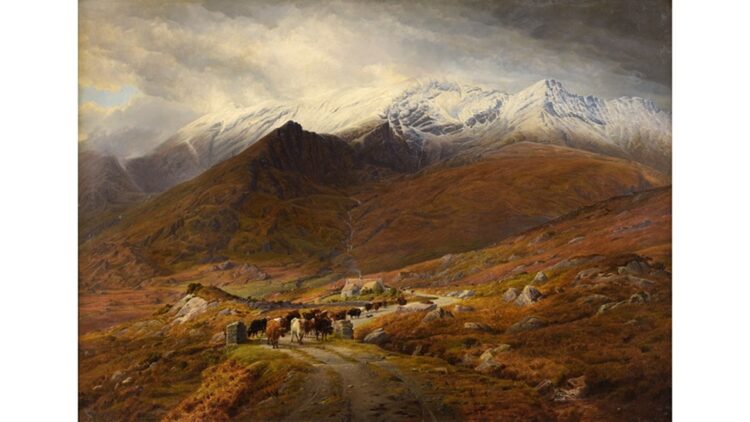
There are secluded places in the wild
Where the breeze settles, like a weary child,
Down on the mossy blanket of the heath,
Ceasing to stir the surface of the leith;
Nor can one hear the babbling of the rill
__Where all the world is still;
And here it is that time has been beguiled
To play the statue, the suspended wreath,
__And the unmoving hill;
Upon myself, unblinking eyes now dwell,
Awaiting the arrival of the drips
__That down my eyes will spill
When I must break the atemporal spell,
Letting my heart resume the beat it skips
And my delayed goodbye to you depart my lips.
II
It matters not how far, how deep one goes
Into the forests that the trees enclose,
Nor in the pretty grasses of the prairies
That hares and rabbits name their sanctuaries:
Of all the animals, there is not one
__That faces down the sun;
Yet my poor infant self would point my nose
Towards the eye’s immortal adversary,
__And afterwards would run
My squinting eyes across the Earth again,
Their vision blurred to all but heaven’s light;
__Oh, could it now be done,
I’d blind me to the robin and the wren
By gazing at the face, so warm and bright,
Heading for the horizon, vanishing from sight.
III
Brought into this bad world all unawares,
Mammalian young will roam in groups or pairs;
The wolf’s, the lion’s and the vixen’s cubs
Emerge out of the den, the lair, the shrubs,
__And follow one another as they go
Through woods, through heat, through snow;
How often we ourselves reduced our cares
Guiding each other through the barley stubs,
__Through glens where thistles grow,
And through the endless, inundated plain;
But even as the thriving pup conspires
__To wander to and fro
All on her own, in sunshine and in rain,
Through life’s most thorny and most piercing briars,
You left me here to roam unfollowed through the shires.
IV
In regions baking at the noon’s bright hour,
The bark, the root, the branchlet and the flower,
Like loyal soldiers, stand their ground to fight
A losing war against midsummer’s might,
Until the farmer or the thoughtless child
__Burns the unwatered wild;
And even as the peasant has the power
To set the laboured, stubbled land alight,
__As if it were reviled;
To gather up the waste, and then to sow
Another seed, another lis-de-fleur,
__Where the fresh hay was piled;
So has my love set our rich past aglow:
The ashes of the life I had with her
Disperse into the air, as things that never were.
V
Amidst the herd of cattle idling through
The emerald hills, in search of grass to chew,
A bull calf breaks away from the formation,
And falls beneath the layers of vegetation
Hiding a chasm from whose caverns deep
__The creature cannot leap;
Look how he groans, not knowing what to do;
Look how he charges forth in agitation
__Against the walls that seep;
Look how the rock resists relenting hope,
Then, how the beast’s mad spasms are subverting
__The quietude of sleep;
Thus do I pass the time, thus do I cope,
When in the depths of memory trapped and hurting,
From woe to wrath, from wrath to woe each hour reverting.
VI
And as the body of an ancient river
(That in the morning sunlight seems to shiver)
Is bounded in by some unnatural force,
Until the waters flowing from its source
Through the obstruction secretively leak
__In an innocuous streak;
So do the bags beneath my eyes now quiver,
Straining to keep each tear from its old course
__Down the unwatered cheek:
Thinking the troubled peace and horrid silence
Would be unharmed by some small drops descending
__In streamlets slow and meek,
I let there flow as swift a flood of violence
As Nature washes over those intending
To bend it from its course, or bring about its ending.
VII
The moon is hardly ever to be seen
Amidst the summer’s bright and melting scene;
Though out of sight, and even out of mind,
He who upon the hay bales is reclined
Will, of a sudden, spy a visage fair
__Hovering in the air;
So in the minutes and the hours between
The dawn and dusk, unwittingly I find
__The one at whom I stare
During the sleepless seconds of the night;
Beyond the haze, beyond the dusty storm,
__There is a face out there
Visible when the moment is just right:
Near, though afar; bright, but no longer warm;
Poignantly beautiful and elegant in form.
VIII
There wants a cloud, long absent from the sky,
To end the drought that drains the meadows dry;
No longer does the spring flow unimpeded
Into the lakes whose waters have receded;
And in the ponds that nourish the gazelle
__Unseen diseases swell;
Towards the stagnant brook the stag draws nigh,
Gulping the water that his throat long needed,
__Only to fall unwell;
Further downstream, a shower of brackish rain
Pollutes the pure lagoons of memory
__Where I have come to quell
An inner craving and an inner pain;
And there I parch my thirst impulsively,
Only to vomit up what once had nourished me.
IX
Look how the shepherd desperately will strive
His close, unconscious canine to revive,
Pressing against its unresponsive heart
That neither can, nor ever will restart,
While passing to its lungs sweet oxygen
__Once more and once again;
So do I work in vain to keep alive
The beating passion of my better part
__By sighing through my pen;
Better it were, as I myself well know,
To search the desert sands of the Sudan
__For traces of a glen;
To seek in clouds, or underneath the snow,
The origin of where this world began,
Than any thought in her for her abandoned man.
X
No longer sing of what you held most dear,
Grief is not heard, except in love’s own ear,
That is to say, in mine, and mine alone,
Which echoes back, in answer to my moan,
‘That sun has set, and nevermore shall rise
__Before my waking eyes’.
She has been lost—and yet I find her near:
Love is a hoarder, dares not to disown
__Its treasured truths and lies.
Let storms disturb the surface of the ocean:
The bottom-feeding fish can each be sure
__That none among them dies;
Though my face be disfigured by emotion,
In my heart’s depths, inscrutably obscure,
My love lies undisturbed, and there it shall endure.
XI
Before you fly away from me, Canzone,
Sad as the bard that brought you into being,
__Resound another while
Within the eardrums where you long have dwelt;
Discordant thoughts, harmonious melodies
__Make sadness seem to smile
When led from what it feels to what it felt,
Turning my black and golden memories
From swarms of stinging into sorrow-sucking bees.
Daniel Joseph Howard studied law in his native Ireland and earned an MA in philosophy at King’s College London. He worked for the European Commission and was a pensionnaire étranger at the École Normale Supérieure in Paris. He is currently a Teaching Fellow and PhD candidate in the United States.
















Just lovely; I especially like stanza 10. it’s as though the content somehow gets larger there, more universal, before settling in for 11.
“By sighing through my pen” may be the most evocative and trenchant poetic phrase of such a morose poem about having lost a loved one who meant the most in the world while brilliantly pining away and retaining both the memory and pain in the heart.
My goodness, what a rich and beautifully expressed poem.
Thank you for the pleasure or reading it.
A very exquisite expression of suffering, Daniel.
A magnificent labor of love, Daniel, requiring more than one reading. After this first reading, I can say it’s a true canzone petrarchescha in form, feeling, and style, and an Irish one in landscape. The beautiful views of nature flow in and out, allowing the poet to return to his thoughts–and in this poem of parting, to memory. The final image and lines leave an exceptionally powerful (or should I say “sharp”?) impression. That’s uncommon. Your chosen stanza structure is unique, as is that of every canzone, but I could not help but look through my notes on the characteristics of comparable works by Petrarch and Dante. They never begin rhyming aabbcc . . . It’s always abb . . . or abc . . . And the length is rare indeed, with only Petrarch’s celebrated Metamorphosis Canzone being longer (169 lines to your 159 here). Fifteen lines per stanza is not unusual, but the number of such stanzas is more likely to be five or six or seven. You present several very striking ones, that I hope to notice soon, when I have time to read again.
Thanks, Margaret. You are right that the ‘fronte’ is usually not written in couplets. The rhyme scheme of each stanza here is AABBCc ABcDEcDEE. Usually, the rhymes in the fronte are not repeated in the sirma. By collapsing the couplet while subtly repeating its rhymes (‘ABc’, followed by a final ‘c’), I intended to imitate the decaying echo of memory. In addition, the couplets create the effect of consonance (AABBCc), which I wanted to dissolve into dissonance (ABcDE) before returning to overall consonance, which contrasts with the overall discordance of feeling. The ‘c’ rhyme interlinks the fifteen lines, and draws attention to itself by occurring in short lines. That, coupled with the extended metaphor, was my solution to the problem of unity in a long stanza.
The longest original canzone in English is, to my knowledge, Spenser’s Epithalamion (a canzone in substance rather than in name), which consists of 433 lines. So there was no chance of writing the longest one in English. My ‘Canzone of Parting’ was originally longer than any of Petrarch’s, but I lost my only copy of it, and what you read here is all that remained in my memory (though I don’t think anyone will complain that it is not longer).
You have sighed through your pen in a way that exquisitely intertwines sorrow and beauty. I think this is a marvel— too many wonderful lines and phrases to cite; but using “ stagnant” and “ stag” in the same line is one thing that captured my notice , as did “The ashes of the life I had with her / Disperse into the air as things that never were”.
There’s a very relaxed story-structure (sometimes but not always present in a canzone) here to tell of tension felt by the lover in the love itself and in the parting which inspires the poem. It starts (Stanza I) in motionless and “atemporal” expectation of a goodbye. This is what I mean by “very relaxed.” Fifteen lines just to give the topic an introductory touch! All throughout the poem is an Irish country landscape whose features and creatures appear as suits the progress of the story that moves back and forth from nature to memory again and again, describing and developing profound feeling. Stanza II speaks of the sun as a bright warm face that can blind the lover–and which is setting. Stanza III sees pairs of young animals “guiding each other” in the landscape, but the lover complains he has been left to himself. Stanza IV tells of fires that may happen, including those purposely set. My favorite line of the poem comes right before the two Cynthia Erlandson has chosen as hers: “So has my love set our rich past aglow.” This is heart-rending remembrance of love’s rich, glowing past, now set afire to burn it as waste. Stanza V speaks of the lover as a bull calf caught in a wild Irish version of what would be a haha in an English landscape garden, where the pit is intended to keep animals away from the house. The lover can do no more than struggle, imprisoned by alternate wrath and woe. These emotions generate the river of tears in Stanza VI. Nonetheless, the lover in Stanza VII observes in nature a face, lovingly described in the final line (my next-to-favorite) as “poignantly beautiful and elegant in form.” Stanza VIII carries onward the image of water from Stanza VI, but this water has become poisoned. In Stanza IX the image changes to air, as a shepherd tries desperately to revive his dead dog, perhaps drowned or poisoned by waters in recent stanzas. Rising from that scene, the air turns out to be sighs recorded by the pen of the lover. Stanza X explains their intent to assert the lasting nature of his love, with the explanation. “Love is a hoarder, dares not to disown/Its treasured truths and lies.” The word “lies” is caught up personally in the stanza’s burial line as “My love lies undisturbed, and there it shall endure.” Stanza XI enlivens the poem’s shorter commiato or farewell with the black bees of memory that sting, and memory’s equally active golden bees engaged in “sorrow-sucking.” Sad and rather uncomfortable conclusion to a splendid canzone!
The richness of the language here is staggering. I don’t often like to read long poems, but sometimes I am simply held in thrall.
Some wonderful lines and turns of phrase in this epic poem. ‘The ashes of the life I had with her / Disperse into the air, as things that never were’, was a particularly moving two lines.
To have kept going for eleven stanzas and keeping the quality of the poem consistent was a great feat, Daniel.