


Canzone Sung from the Mountains
I
Above the source of the refreshing fountain,
The sloping forest of the soaring pine,
And all the clouds, with careful steps I climb,
Passing each root and crevice in the mountain,
Until at last, I look upon the brine
As might a bird, from distances sublime;
__And there I pass the time,
Asking old rocks that overlook the world
Whether or not they like to recollect
The moment that the flowers first unfurled,
That birds took flight, that mammoths roamed unchecked;
__But I myself suspect
That of these things they have no memory:
Neither, alas, does anyone of me.
II
The April sun awakes the mountain spring,
Which rouses slowly from its frozen sleep;
Last summer’s vistas, vanished as a dream,
Incline its memory to the blossoming
Of fruits and herbs, for which its teardrops seep,
Slowly at first, until they form a stream,
__Making the valleys teem
With brand-new life in all its lovely breeds;
Look how no fish can find the inner force
To swim up to the spout that floods the reeds,
So no one follows my affection’s course
__Back to its flowing source;
Fresh spring! You give, get nothing, yet forgive,
Is this the life that nature bids me live?
III
Many a mile below, the sound of life
Begins to shake the stillness with its bellow,
The prey’s last cry, though not himself, lives on,
Echoing through the valley of the strife,
In which is also heard the ritornello
Of a more joyful tune in praise of dawn;
__And as the stream is drawn
Over the fallen trees and mossy stones,
The rhythm of its gushing down the steep
Brings to a hush the energetic tones
The warblers sang on waking from their sleep;
__Would any out there weep
Out of fond sadness for the music’s end,
Were mine the voice to which the ear did bend?
IV
The clouds are mighty, and a mist is falling:
The rain now leads the robin and the wren
To little puddles made of pelted snow;
There shall one hear their singing and their calling,
There shall one see them bathe, time and again,
Their outer feathers as they come and go,
__As if their wintry woe
Had in a moment melted with the ice;
Witnessing this, I wonder quietly
If anyone now calls it paradise
To wash away their cares in thoughts of me;
__If it could really be
That someone in this world delights to swim
Deep in my eyes, and float from rim to rim.
V
Far in the distance, there are now emerging
Meadows and pastures of an emerald beauty,
There shall the rose be smelled, there shall be seen
The rain-soaked flocks of woolly sheep converging
In endless lawns, as is their happy duty,
Yet I look on in anguish at the scene;
__Are not my eyes as green
As any grass that grows upon that glen?
Why does no darling creature flock to me?
Beautiful are the lakes where, now and then,
A young gazelle beholds admiringly
__The image she can see;
But in two mirrors of a lesser size,
Loving reflections would have met her eyes.
VI
Towards my left, and in my line of sight,
A little chick now twitters from his nest,
Waiting for food, he feeds upon the thought
That mother buzzard’s next returning flight
Is slow but sure to come, as is the rest
Awaiting him soon after worms are brought;
__How long a time I sought
The slow, the swift, the wonderful return
Of what my thoughts had cast upon the breeze,
Yet still I wait in hunger, still I yearn,
To have an answer and be put at ease;
__Great winds, I ask you please,
To bring the voice, if any, to my ear
Of one who thinks of me and holds me dear.
VII
__Away upon the wind
That wanders ever gently to the West,
Oh simple, melancholic song of mine;
Sustain the beat long buried in my breast,
Let it be heard from every little shrine
__Across the Apennine,
Within whose valleys, let there always ring
My long-unechoed love, when I lack breath to sing.
Daniel Joseph Howard studied law in his native Ireland, earned an MA in philosophy at King’s College London and worked for the European Commission. He is currently a pensionnaire étranger at the École Normale Supérieure in Paris, as well as a Teaching Fellow and PhD candidate in the United States.


















Daniel, a canzone is a tremendous challenge, but you succeeded here. Very nice! I like the way each stanza blends the elements of nature into your own yearning spirit.
Thanks for your comment, Paul. Part of the challenge is to settle on the rhyme scheme, the number of long and short lines, and the number of stanzas, since there is no fixed rule. In my view, this makes the canzone form all the more interesting. The same goes for the much smaller madrigal with respect to the rhyme scheme and number of long and short lines. Tasso has written several such canzoni and madrigali.
There is a feeling of purity and innocence and natural beauty running through this poem which is especially refreshing. Man isn’t present, mucking things up, which is again refreshing in a poem of this scope and magnitude. The narrator seems to be a greater being, Nature perhaps, or God, or an alien being, seeking a perfection or an answer beyond Earth’s evolutionary creation.
Thanks for a poem, Daniel, that’s enthralling not in spite of its simplicity, but because of it.
Thank you for your generous comment, Paul. I deliberately tried to keep man out of the descriptions of nature in order to give no advance indication of the turn inwards at the end of each stanza.
Thanks, Paul. I deliberately avoided mentioning man in the descriptions of nature in order not to give away in advance the turn inwards at the end of each stanza.
Daniel, you gave us a great gift with this poem that stirs the soul with the infinite images of nature and the wondering within of one’s place in this world. As one who lived in the Alpine region and hiked their mountains and valleys in Bavaria and Austria, I can readily identify with the scenes you beheld. Wonderful poem laden with beauty and sensitivity.
That’s very kind of you, Roy. Happy to hear that the scenes in the poem bring to mind your own experiences in the Alps.
This is an extremely ambitious canzone, and the ambition achieves its goal. It’s no easy task to put together a complex structure of this sort, and the more complexity, the greater the chance for imbalance or confusion. Here everything fits together perfectly, as the careful detail of nature is neatly linked to human feeling at the close of each section.
Perhaps part of the difficulty in writing a canzone consists in the lack of technical analysis of the form, relative to its Italian counterparts like the sonnet, in English. There is a chapter in Peter Hainsworth’s ‘Petrarch the Poet’ which is instructive.
I love this layered poem. The ever-present poet’s (God’s?) unrequited love and the teeming life of the mountain. Beautiful and a bit melancholy.
Thanks, Rohini; it makes for an interesting interpretation to imagine God as the speaker.
The lyrical quality of this is truly beautiful; and the imagery immerses the reader in the richness of the natural scenes. The visual and the musical elements blend together so well. I felt like I was reading Wordsworth, perhaps, or Thomas Gray. I love the use of “ritornello” (in section II), which seems to describe the way the poem keeps coming back around to the similar theme at the end of each section, as well as the musical elements portrayed here, such as the sound of the mountain streams.
Well observed, Cynthia; the end of each stanza makes a ‘ritornello’ to the same theme. I had been listening to a certain piece of music that created a lot of pathos by sustaining a note over a couple of bars, and I was wondering how one might produce the same effect in poetry. My idea was to mimic that effect by sustaining the same sentiment over several long stanzas.
Daniel, this is a great poem, and a much needed canzone in English following Petrarchan form. Best known in English at present is Auden’s, which has something of the Petrarchan spirit, and Petrarchan length of five stanzas plus commiato, but taking up endwords (like the sestina) rather than rhymes, it has led to a truncated idea of the canzone as two and a half stanzas meditating on five words.
There are English followers of the Petrarchan model in the 16th and 17th centuries, but your canzone is very simply better in its exalted contemporary simplicity, as noted by Paul Freeman above. Cynthia Erlandson also notices the artistry of “return” in your canzone, emphasized by the word “ritornello,” though there is no particular refrain in the order of the material. You are bold in choosing several feminine rhymes here, though they appear natural and not overdone.
The canzone is “sung from the mountains,” beginning at the peak. I notice a structure of central concerns for each stanza: rocks in I, spring in II, sound in III, water in IV, green in V, and food in VI. Some of the stanzas (II for example) could stand alone as perfect poems, but they are woven together as a whole song, not as a sequence. I like the choice of April for the time of the whole, a tiny allusion to Petrarch for whom April 6, 1327 started everything. The commiato is a fine understated example of invoking the canzone, and eternizing the love expressed in it. You call on the “simple melancholic song,” sending it “away upon the wind” to carry the lover’s heartbeat rhythms through the landscape visible from the mountain, so that it may “always ring” even when he no longer has “breath to sing.”
The natural detail of the description is touching, and well accommodates the theme of unrequited love, while suggesting inner peace as the lover’s mood. You do mention “anguish” in stanza V and “hunger” in stanza VI, but the calm overview of nature seems to balance the yearning for love in return. The beloved appears only in stanza V, personified as a young gazelle looking into a lake, while the lover says “loving reflections” in his eyes could have met hers. “Eyes” link stanzas V and IV, where the lover has said thoughts of love can “wash away cares.” Does this affect his continually expressed wish for love in return? Perhaps not, but he has passion under control of the spirit of the place.
The canzone’s sustained interior peace is what makes the poem such a joy to read.
It was you, Margaret, who had prompted my re-discovery of the canzone with your recently published translation of Petrarch’s ‘Canzone at Evening’. That led me, either for the first time or the first time in years, to the canzone “Di pensier in pensier, di monte in monte”. Like the Canzone at Evening, it echoes the same sentiment over a number of stanzas. That, to me, had the effect of elevating and deepening its pathos. I also thought that Petrarch’s use of only two short lines in each stanza contributed to these qualities.
You’re right that there appear to be few Italian canzoni in English. In a way, it is very surprising, given the prevalence of the form in the Italian Renaissance poets that so influenced the European lyric. Undoubtedly the form is much more demanding than several of its Italian counterparts, presenting problems of 1) how to unify the substance over so many stanzas, 2) how to create musical complexity and unity within the long stanza, 3) how many long and short lines to use, 4) how many stanzas to write, and 5) how to integrate the commiato in such a way that it is not merely a formal and redundant addition to the whole. In my view, all of these problems resolve themselves upon arriving at a theme that merits the extended treatment afforded by the canzone.
More direct allusions to Petrach than the reference to April are the gazelle (which appears in the sonnet Wyatt translates as “Whoso list to hunt”), and my echoing of the sentiment behind the lines
Che sai tu, lasso? forse in quella parte
or di tua lontananza si sospira.
Et in questo penser l’alma respira.
which appear in the canzone “Di pensier in pensier”.
Thank you for your detailed analysis of the poem and for your past translations of Petrarch.
Thank you, Daniel, for attributing so fine a poem as this, even in part, to my influence. Your own familiarity with great Italian poetry seems equally important from my point of view. Your paragraph on the demands of the canzone outlines it challenges well, and no one was so capable at meeting them as Petrarch. You led me to re-read “Di pensier in pensier,” where I hear close correspondences to your work here. Interesting that you mention the gazelle in this context. I’ve just been reading Hebrew poetry written in Europe at this time and earlier; the graceful animal (gazelle, doe, hind) figures very often in it.
Lyric, melic and extravagantly profound in its musings, this poem begs to be lived. But the wind generally blows east, counter to the earth’s rotation.
Thank you, Mr. Anderson. If only the winds of fortune would also blow in one constant direction.
The poem clearly conveys the time, work, and devotion required to write it. Beauty at its finest! Daniel, you have a tremendous skill of creating poetry!
Thank you, Shamik. You’re very kind. As it happens, I wrote it in a single sitting, though I did subconsciously chew on it for about a week prior.
Daniel:
Bravo! This poem demonstrates your remarkable technical skill. Your poem (a traditional canzone or “song”) is structured as follows:
• 6 stanzas of 14 rhyming lines in the pattern: a/b/c/a/b/c/c/d/e/d/e/e/f/f/ The meter is pentameter, except lines 7 and 12 are trimeter.
• Final envoi of 8 lines in the pattern: a/b/c/b/c/c/d/d/ The meter is pentameter, except lines 1 and 6 are trimeter.
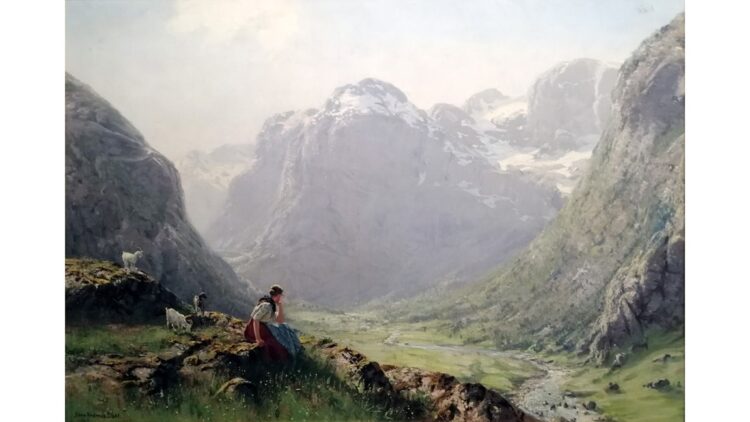
The first-person narrator (I’ll use “he” in this discussion) has climbed a high mountain somewhere in the Apennines and is gazing at the landscape. Note: I immediately pictured the 1818 painting “Wanderer above the Sea of Fog” by Casper David Friedrich. (However, the mountain in this poem is not as high, and though the narrator says in stanza IV “The clouds are mighty and a mist is falling: the rain now leads…” by Stanza V the rain has cleared.)
It is morning in April, and the snow has not entirely melted in the high regions. The narrator describes the visuals of the landscape, and the sounds of streams rushing, and of animal life, including a “last cry” of an animal being killed by a predator. The narrator muses about the “memory” of nature “asking old rocks that overlook the world whether or not they like to recollect the moment that the flowers first unfurled….but I myself suspect that of thee things they have no memory.”
In each stanza, the narrator describes (beautifully!) the beauties and mysteries of wild nature. Toward the end of each stanza, he laments the fact that he has no romantic partner. Finally, in Stanza 6, the narrator addresses nature to assist him in his search for love: “Great winds, I ask you please, to bring the voice, if any, to my ear of one who thinks of me and holds me dear.” Then in the envoi, the narrator asks that the wind carry the narrator’s “simple melancholic song” of loneliness across the Apennines so that it echoes in all the valleys.
In your poem, this sensitive and verbally gifted narrator has sought out a gorgeous “view” to contemplate by himself. He reveals his own passionate character through the objects he notices, and his interpretation of their meaning. Your poem also brings to my mind ad Ann Radcliffe’s 1796 novel The Italian. I am currently discussing this novel with a book group. The setting is Italy, and specifically in the middle of the novel, the characters are traveling through the exotic wilds of the Apennines. Radcliffe uses the landscape both to evoke feelings of “the sublime” (and important concept in British landscape painting at the time) in the reader, and to develop the interior life of the characters, who react to the landscape.
Most sincerely,
Mary Jane
Thank you very much for your comment, Mary Jane; I’ll have to get my hands on Radcliffe’s novel.
The basic unit of the canzone, the stanza, is divided into two parts: the fronte and the sirma. In each of my stanzas, the fronte reads ABCABC (the fronte is itself divisible in two), and the sirma cDEDEeFF. Petrarch’s envois usually replicate, in form and rhyme scheme, the sirma. My envoi only departs from the sirma in its final line, which is extended to an alexandrine in order to mimick the echoing of the song within the valleys of the Alps.
Daniel.
Daniel
I forgot to include the following comment. I’m not sure if a pattern shift was meant: but in Stanza II you change the pattern. There are 13 lines rather than 14. Also, the pattern is different in the final 6 lines(beginning with line 8): d/e/d/d/f/f. Note that the “e” rhyme “source” in line 9 has no rhyme.
Sincerely
Mary Jane
Dear Mary Jane, I am very grateful for your eye for detail. The second stanza is indeed missing a line. I have emended it as follows:
II
The April sun awakes the mountain spring,
Which rouses slowly from its frozen sleep;
Last summer’s vistas, vanished as a dream,
Incline its memory to the blossoming
Of fruits and herbs, for which its teardrops seep,
Slowly at first, until they form a stream,
Making the valleys teem
With brand-new life in all its lovely breeds;
Look how no fish can find the inner force
To swim up to the spout that floods the reeds,
So no one follows my affection’s course
Back to its flowing source;
Fresh spring! You give, get nothing, yet forgive,
Is this the life that nature bids me live?
I would be grateful if the moderator could use the above to replace the original second stanza.
Thanks Mary Jane,
Daniel.
Perfectly lovely! How do these miscounts happen? Every so often, in final edit, I somehow delete a word or even a line. Why is this? ‘Tis a puzzlement!
Mary Jane