


Mythology and Modernism
Many years ago I attended a poetry reading by my friend Psyche Ceres. This was the pen name for a woman who had a Ph.D. from the University of Chicago, who taught philosophy at a college here in New York, and who was pursuing another degree in Classics at the C.U.N.Y. Graduate Center. Psyche and I had become acquainted during a Greek poetry seminar at the latter school.
A great many of Psyche’s poems had mythological themes and allusions. She loved the old stories and made free use of them in varied ways. When the reading was over, she fielded a few questions from the audience.
One came from a hostile listener. He was a hulking oaf in a plaid shirt, dungarees, work boots, and a SANE button. He identified himself as “Jerry,” and as the director of a poetry workshop at some community college.
“Why are you writing about these old myths?” Jerry snarled. “Couldn’t you find something more relevant to our times?” He emphasized the word relevant in that accusatory way that a lot of faux radicals did back then. “I mean,” Jerry added, “it’s not as if this stuff was contemporary.” He then folded his arms and smirked, Oxford-Debating-Union style.
Psyche looked at him and sniffed. She was from the University of Chicago, and a disciple of Allan Bloom. She had nothing but contempt for left-liberal morons. “The myths are relevant to me,” she enunciated with precision, “and I happen to be a contemporary.” I immediately clapped loudly, and continued until a wave of applause was generated from the audience. Jerry in his plaid shirt kept quiet for the rest of the session.
This little incident is meaningful because the attitude expressed by Jerry has, in my experience, only become more widespread and virulent over the years. Among many poets and editors there is a visceral loathing of any reference in a poem not just to myth but to anything historical, learned, literary, or arcane—in short, to anything that is not part of the immediate personal experience of the poet. Some of this is due to the long-standing hegemony of the confessional lyric, with its fixation on the authentic and the first-hand. And some of it is due to despair—nobody learns this stuff anymore, say poets, so why the hell should we mention it? However, some of it is also due to a kneejerk American populism that fiercely resents intellectual achievement and aesthetic intricacy as elitist and undemocratic.
Just recently a poet and editor for whom I have great respect wrote to me saying that he had eliminated a number of poems from his forthcoming book, on the grounds that they contained references that many readers would probably not understand. I was appalled at this decision, and wrote back that it was absurd for him to immolate the products of his art on the altar of our failed educational system. But he was adamant. He wrote to me “The audiences of tomorrow will know who Jesus Christ was. They might know who Hercules, Ulysses and Achilles were from animated cartoons. But to pretend that they will know or care about the more esoteric subjects of Greek mythology is sheer folly.”
After reading his words, I realized what a terrible thing it was to be obsessed with audience and reader-response, and how damaging to one’s art such an obsession can be. Imagine discarding an intrinsically good poem on the hypothetical grounds that Joe Blow or Doris Dingbat might not understand it fully. Is a poem like an Alka-Seltzer commercial? Does it have to appeal to “the Wad,” as TV advertisers call the lowest common denominator of viewers?
Besides populism, Whitman’s barbaric yawp, and a generalized sense of futility, another enemy that poets literate in mythology must face is the notion that the old myths are “played out” or “dead” or “sterile.” The argument goes something like this: The myths may have been valid and meaningful in the past, but they have long since become fossilized relics, useless to any poet seeking to express the tenor of our times.
This argument is predicated on the notion that inherited mythology is somehow canonically fixed, like the text of Petrarch or the Declaration of Independence. But that is simply untrue. Mythology was always a living thing in the ancient world. The old stories were retold so many times that it was pretty much expected every poet utilizing a myth would vary it in some idiosyncratic way, either to suit the work at hand or to satisfy his personal preferences. No classical writer tells the exact same story as it appears in Hesiod or the other early mythographers. Pindar sometimes rewrote an inherited myth in accordance with his own sense of propriety; and Ovid refashioned stories in whatever manner he pleased. That isn’t a sign of sterility or hidebound conservatism. That’s a sign of vigor and fruitfulness.
In fact, in late antiquity Graeco-Roman mythology had become so complex and protean that even educated persons needed handbooks like the Pseudo-Apollodorus in Greek or Hyginus in Latin to keep up with the bewildering number of stories and their variants. These handbooks or enchiridia were the Cliff’s Notes of the time, allowing readers to get some kind of a handle on what had become a jungle of intertwined and conflicting narratives.
That sort of complexity is highly useful. It means that myths are a mix of disparate and conflicting things, just as C.G. Jung imagined the collective unconscious to be. Or to use a homelier image, they are like the contents of a catch-all drawer in someone’s kitchen or workshop—a drawer filled with a jumble of tools, utensils, and odds and ends. You can always find something there to serve your purpose.
The same thing can be true today. Myths can be catalysts for a wide range of new ideas and imaginative re-creations. They don’t have to be another strumming of the same old chords. In fact, they can signal a rebirth and reinvigoration of culture, as happens in Ezra Pound’s 1913 “The Return,” a magnificent piece on the coming back of the gods:
See, they return; ah, see the tentative
Movements, and the slow feet,
The trouble in the pace and the uncertain
Wavering!
…
These were the “Wing’d-with-Awe,”
Inviolable,
Gods of the wingèd shoe!
This is a dazzling poem on the reflowering in European consciousness of its classical roots, and of that consciousness waking up from the stupid dreams of rationalism and Enlightenment pieties. Once again in the West, the primal forces of blood, instinct, history, and sacrifice were rising, and Pound’s poem both records and celebrates this phenomenon.
Frankly, anyone who says that mythology is a dead end for modern writers hasn’t read a lot of modern literature. Jean Anouilh retold the story of Antigone in wartime France, making it intensely relevant to contemporary issues of state authority, tyranny, and the limits of obedience. Rilke’s Sonnets to Orpheus is indissolubly linked to Greek myth. Paddy Chayefsky in Gideon took the mythical Hebrew hero of that name and subverted his story into a meditation on modern man’s need to assert independence of God. Derek Walcott used Homeric epic to configure a story set in his island home of St. Lucia. John Crowe Ransom’s remarkable poem “Philomela” takes the Procne and Philomela story and makes it a catalyst for a meditation on the failure of modern American poetry. Or consider Archibald MacLeish’s magnificent refashioning of the Job tale in his verse drama J.B. I’ll never forget how powerfully that story affected me as a teenager in high school, when I read the stark scriptural account resurrected with images of juvenile delinquency, drug addiction, street crime, and all the other gritty realities of New York life. Mythology a dead end? Tell that to James Joyce when he was composing the chapter titles for Ulysses.
The crux of the issue, in my opinion, lies not in mythology per se but in the manner in which allusion or reference is handled. And here again, as in so many of the structural problems that plague contemporary poetry, the difficulty is rooted in modernist quirks. When Tennyson wrote Idylls of the King, he used Arthurian legend in a straightforward and comprehensible way. The stories that he retold were clear and recognizable. He may have varied them a bit (as all storytellers do) in order to make whatever point or create whatever aesthetic effect he had in mind. But no one could have complained to him that his Idylls were unintelligible or cryptic.
Modernism changed all that. Many modernists turned allusion and reference into an intellectualized version of the old board game “Clue.” You didn’t tell an old myth; you hinted at it. You indirectly pointed at something in a way that might (or might not) be grasped by an intelligent reader. Poetry became circumspect and coy.
There are two genetic factors in modernism that led to this sea change. The first is the “show-don’t-tell” dogma, which is still repeated as a mantra in poetry workshops run by Jerry and his ilk. Originating in a laudable desire to purge poetry of overly-discursive wordiness, this dogma has now become a choke-hold on creative expression. In the case of mythology, it forced poets to dispense with the telling of an old tale, and instead touch upon it obliquely, with a wink at your supposedly knowledgeable reader.
The second genetic factor is the programmatic crypticism of modernism, traceable to its assumption that poetry is something rarefied and quintessential. I discussed this notion at length in my article “Poetry as the Philosophers’ Stone” here at the SCP, and at the Expansive Poetry On-Line website some years ago. If you believe that poetry is something precious and tiny, like a gram of pure radium, then you’re not going to have the space to do anything with a myth except make a glancing nod towards it.
Let’s look at two twentieth-century poems that make use of myth, and see how they work. There’s enough of a difference between them to give a forensic profile of how modernism has changed our myth-recounting procedures. And to avoid any recriminations, I’ll start by saying that both poems are excellent. I won’t quote them in full here, since they are well known and easily accessible.
The first is William Butler Yeats’s “Leda and the Swan.” This sonnet retells the myth of how the princess Leda was raped by Zeus, and how that act led to the hatching forth of Helen and Clytemnestra, and then to the horrors of the Trojan War. The crucial passage is this:
A shudder in the loins engenders there
The broken wall, the burning roof and tower
And Agamemnon dead.
The poem is perfectly clear. The rape of Leda will produce the two women who will be the focal points of future tragedy: Helen, whose terrifying beauty will motivate her abduction and the ultimate destruction of Troy; and her sister Clytemnestra, who will murder her husband Agamemnon upon his return from Troy. There isn’t anything vague or cryptic or hieratically aloof about this poem. Like Tennyson, Yeats is simply retelling the old story without tricks, though of course he uses the story to make a very modern point about uncertainty.
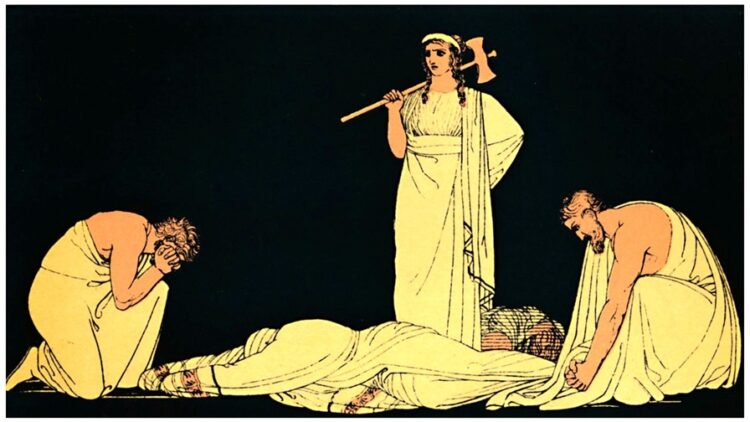
Now consider T.S. Eliot’s “Sweeney Among the Nightingales,” another poem that alludes to the death of Agamemnon. The poem is introduced by an untranslated epigraph from Aeschylus, giving Agamemnon’s last words as he is murdered. Already we are in the murky world of modernist reticence, where something is silently gestured at, as if any further explanation were somehow uncool or clumsy. Can’t handle the Greek? Well, tough luck, according to modernism.
The poem itself, however, doesn’t seem to deal with Agamemnon at all, at least not immediately. It’s a description of someone’s visit to a seedy whorehouse, and of the persons whom he meets there. The Sweeney of the poem’s title, who presumably is the visitor, is Eliot’s name of convenience for the dull, cultureless mass-man of modern times, the ordinary slob, the homme moyen sensuel who lives for nothing but his momentary fleshly pleasures. He goes to the whorehouse, deals with some of the bedraggled girls, and judiciously avoids robbery by those who run the house, since this is clearly a low haunt where clients get pickpocketed or mugged. The poem ends with two absolutely luminous quatrains:
The host with someone indistinct
Converses at the door apart,
The nightingales are singing near
The Convent of the Sacred Heart,
And sang within the bloody wood
When Agamemnon cried aloud
And let their liquid siftings fall
To stain the stiff, dishonored shroud.
Here we have the conflation or telescoping of the whorehouse story with the Agamemnon myth. The “host” (the brothel keeper) speaks with “someone indistinct” (perhaps an arriving client, but more likely a hired thug), while the “nightingales” (prostitutes) are singing near the “Convent of the Sacred Heart,” a symbol of the purity and asceticism that their degradation mocks. These images of sexual corruption and planned crime suggest the plot of Clytemnestra and her lover Aegisthus to slaughter Agamemnon, and the final vision of birds dropping their excrement on his “dishonored shroud” ties everything together (whores, birds, murder, filth, dishonor, the violation of purity) into a complex nodule of linguistic tightness that the modernists favored—in this case, a nodule that creates an unforgettable poetic expression of the squalor and cheesiness of modern life, and how it betrays a noble and heroic past.
Does it work? Yes, of course—a genius like Eliot could make it work. But notice how much is expected of the reader, from that untranslated Greek epigraph to the oblique and almost casual reference in the final quatrain. This is the sort of mythological allusion that can leave readers frustrated and impatient. But then again, apart from his book about cats, Eliot has always been “caviare to the general,” as Hamlet said.
The procedure of Yeats in “Leda and the Swan” is traditional and essentially lucid. But Yeats learned his poetic craft in the nineteenth century. It was only later in life that he tried to create those “nodules of linguistic tightness” characteristic of modernism. Eliot, on the other hand, set the pattern for the oblique and glancing use of mythic allusion, a practice that many readers find exasperating.
Now I’m not blaming Eliot in any way. It’s not a poet’s job to cater to his hypothetical readership. And I wouldn’t trade a masterpiece like “Sweeney Among the Nightingales” for a hundred “accessible” poems in Basic English. But I think it important to see, from the example of these two poems, that readers’ resentment of mythological references is due more to the procedures and stylistic tics of modernism than to anything at fault in mythology itself. If Bullfinch can make mythology accessible to all, then poets can too. It’s simply that modernism had an agenda of hieratic aloofness, elliptical phrasing, and mystery, and this agenda did a lot of what the military calls “collateral damage.” We’ve only begun to clean up the mess.
If poets are to use myth effectively, it might be a good starting point to recognize that myths are above all common property, and not the private domain of a snobbish fraternity of initiates. Modernism has already alienated enough potential readers with its stifled rhetoric and pared-down diction. And here I exclude the great modernists like Eliot, Pound, Stevens, and a few others. I mean the camp-followers of modernism, who are now the Poetry Establishment. Can we at least keep mythology as a patrimony for everyone, and one that we can make easily available to all potential readers, even the ones who are unfamiliar with it? After all, not everyone who read Tennyson’s Idylls of the King knew Malory; and not everyone who read I, Claudius by Robert Graves knew Suetonius. But Tennyson and Graves were generous enough to open the gates for those people.
Will everyone welcome the myth-telling poet? No, of course not. The systematic anti-intellectualism of types like Jerry will always be with us, but then again, when was it ever otherwise? Nevertheless, we don’t have to be complicit with that stance, which is what happens if we write with the undemocratic assumption that myths are for the chosen few. Do that, and Jerry wins.
Joseph S. Salemi has published five books of poetry, and his poems, translations and scholarly articles have appeared in over one hundred publications world-wide. He is the editor of the literary magazine TRINACRIA and writes for Expansive Poetry On-line. He teaches in the Department of Humanities at New York University and in the Department of Classical Languages at Hunter College.
















This is what I took on with my Myth Takes, through a humorous lens. I shudder to think all that heritage can be gone in a generation.
Dr. Salemi, I am in awe of your intellectual powers, lucidity of logic, and auspicious writing skills capable of mustering such a masterful essay that dissects the modernist penchant for egregiously casting aside the great lessons that history and mythology clearly tell and represent. I know this is only one facet of the idiotic modernist approach, but it nails down the coffin lid on this aspect. This is a great essay that should be required reading in every academic institution.
Here’s a verse from a song about the Taggart-Miller company’s plans to dig a landfill at a site near Carlsbad Springs in the soupy Leda Clay that underlies Ottawa and much of the surrounding area:
Boundary Road is where the Leda
stands to be raped by a Miller,
quite a come down when you think that
Zeus once had the job
“Carlsbad, stop your flapping,
Cease your endless wingeing,
For I must have my way with you
if ga-r-bage is to be immortal.
There is no reason not to squander
your resources for my profit
Set aside your squeamishness
and be commodified.”
There are similar problems with scientific terms and the names of species and higher taxa: here you’ve often got to use the technical language if you’re going to express your feelings about something, but there’s such a wide range of terminology that you have to annotate the verses for those who aren’t down your particular rabbit hole. Even Milton had to provide “arguments” in Paradise Lost, and all his readers had to be up on was classical mythology, the Scriptures, and the Galileo’s latest news about the moons of Jupiter.
Very interesting essay, Dr. Salemi, for all the reasons stated
by Roy Peterson. I enjoyed reading it. Thank you.
We knew we’d be victors, of course,
We fought hard and showed no remorse.
And now to respect us,
Because they ain’t decked us,
The Trojans have built us a horse.
Jetlagged as I am, I just thought I’d add to the pantheon in my own humble way.
More thoughts later.
Thanks for your eloquent essay, Joe. It’s hard to imagine being a complete poet without an occasional reference to mythological characters and tales.
Those who cannot abide mythological references, most likely, intersect with that crowd that eschews and belittles rhyme and meter — the Jerrys of the world. We could write formless drivel if we wanted, but most of them couldn’t write a half-decent formal poem to save their lives. They hate us because they ain’t us. Anyone who doesn’t understand that myth is at the center and is the center of the human story must be a bit clueless.
Mr Salemi, your description, “the camp-followers of modernism, who are now the Poetry Establishment,” bears appreciation. The word “now” lands strategically. When the chronology of their establishment-flourish is mapped, then the camp-followers’ wide path becomes obvious. David wrote, “the wicked strut about on every side (italics mine) when vileness is exalted,” Psalm 12. This late-regime bloom boasts the mere trappings of former generations’ sturdy labor. I would not be surprised at their envious, and resentful, silence in the presence of said worthy generations, given an outbreak of humility within the moneyed, elephantine swath of this aging, increasingly feckless, establishment.
Thanks to all of the above for your comments and analysis. They are appreciated. I have been caught up in family matters and I cannot reply to each of you.
This is a great essay, Joe, which I read as a call to arms not only to defend the presentation of mythological, classical and historical material in modern literature but for writers to reengage with such material – to embrace it and contribute to the lore of the roots of Western civilization.
I’m very much on board with your mission and have myself written poems on the subjects of Odysseus, Apollo, Orpheus and the Cyclops, not to mention a number of pieces with historical themes. All of what you say is so true here about the skittishness with which modern publishers and readers approach such material. Evan Mantyk and his Society of Classical Poets is one of the scandalously few sites to embrace such material – material which I believe is crucial to the mission of keeping Western culture alive — and honored.
You’ve identified a number of reasons why a shocking number of modern readers are uninterested in such subject matter – among other things, you zero in on questions of relevance, on the arcane nature of some of the characters and stories and on the idea that these stories have been “played out.” I’m sure you’re right about all of these points. I would like to suggest three more points:
a. A dumbing down of Western education. I first read Ovid and Vergil because I studied Latin in High School in the 1970s. By the time I was a senior, we had only 3 people in the class. Somewhere along the way in Academia, it was decided that Latin and Greek were no longer important and because of this, the literature we read to learn these languages stopped getting taught.
b. A diversification of literary experience. Diversity has long sounded like a splendid idea when it came to politics, symphonies and education. However, substituting literature from diverse countries which are not part of the foundation of Western culture for Western sources and history have created a major imbalance in what students learn and what poets now write about. It is a lovely thing that we can now study works from places as diverse as Mongolia and Zanzibar but to do so at the expense of Cicero and Sophocles nevertheless represents a loss.
c. A reviling of Western culture and everything it stands for, which has led to things as pernicious as Critical Race Theory, hatred of the Bible (both Jewish and Christian,) and knee-jerk hatred for anything smacking of colonialism (how we have to abjectly apologize over and over for Rudyard Kipling, Joseph Conrad and Edgar Rice Burroughs!) We live in a world where statues of Columbus get toppled; where Beethoven is dismissed as a racist composer whose claim to fame exists only because of white privilege. The same with Bach and Mozart. The same with Shakespeare. And – as headscratching as this may sound – the same is true of Mathematics. White-priviliged math, for heaven’s sake.
My point here is that our modern culture (if you can call it that) has decided to go to war against its own roots and values. It has decided to either cancel or rewrite its own history. And it has decided to not only ignore the Classics but to boycott them. It is the difference between neglect and actual malicious intent.
You make a strong case for why those who are antagonized by the presence of mythological, classical and historical themes are on the wrong side of history, including literary history. The fact is, these myths and this history is the foundation of our civilization. To ignore is to forget. To forget is ultimately to commit suicide. I’ve noticed that those cultures which embrace their shared commitment to remember the past have a much longer lifespan than those that do not. Ritual and remembrance are hugely important along these lines. As is respect for one’s cultural patrimony, including literature.
Furthermore, ancient and historical myth (I mean everything from Prometheus to Arthur and beyond) are a form of shorthand which allow a poet to invoke resonances of great importance. Your Eliot reference of “Sweeney Among the Nightingales” (thank you for explicating this strange poem which has baffled me since I was an undergrad) is exactly on point here. The reference to Agamemnon is not just name dropping or a pretentious “who’s who” to show how clever and well-read the poet was. It provides a shorthand to a whole series of collective memories and connotations associated with this character from the Iliad. It DEEPENS the poem because it extends its range to not encompass the year 1918 but the whole history of Mankind. It is not just an “Easter egg” for the cognoscenti but an invocation of a whole series of associations, experiences and ideas that could not otherwise be done so efficiently. It acknowledges participation in the march of history and it does so with enormous economy.
Furthermore, ancient mythis and history are FUN. You mentioned many allusions in your essay. I would also go a bit beyond poetry to mention the play Pygmalion by George Bernard Shaw which gets transformed into Lerner and Loew’s My Fair Lady. Or their Camelot. The old myths are far from dead or “used up.”
How do we ever know who we are unless we know who we have been – and still are? My series of poems in the voices of historical characters has not been an attempt to show-off historical knowledge or to simply educate readers about facts they might not know. My point – over and over again – is to show how who we WERE is who we ARE. The histories we have experienced before not only may be repeated but are in fact being repeated. And it is my intention to draw light to the insidious nature of chronocentrism – that absurd but pervasive sense that we who are living are the sum result of all history, the summation, the apex and that we have been blessed with insights that no prior generations were given. Such nonsense. We are human beings, whether we live in caves, catacombs, castles or condominiums. We have not changed much in these thousands of years since writing began. I think that our embrace of history and mythology is essential to clarify this point and drive it home.
Ignore classical subjects? Ignore history or mythology to please the modernists out there who simply don’t like the subject? They might as well tell us that the English language is no longer relevant.
Brian, you always manage to get right to the core of what I had in mind. My essay is not just about different uses of mythology, but also about the ongoing well-planned collapse of Western education, and the ingrained, dyed-in-the-wool HATRED of the West and its cultural heritage.
A traditional humanistic education was designed to make one a cultured individual who was familiar with the bedrock and foundations of Western thought, literature, art, and folkways. It wasn’t absolutely necessary to know Latin and Greek, but it helped, and was a useful marker of seriousness — just as a knowledge of ancient Sanskrit still is in Hindu culture, and Old Church Slavonic is in Eastern European cultures.
There were two people who were responsible for the collapse of humanistic education in the United States, and by extension elsewhere in the West. One was Charles Eliot, the president of Harvard in the 1880s and 90s, who cancelled the school’s requirement of basic competence in Latin and Greek for incoming freshmen. Eliot’s personal fields of study were chemistry and mathematics, and he didn’t think the classical languages (or any of the humanities) were essential at all. Eliot was from a family of Boston merchants and businessmen, and his only interests were in the fields of scientific progress, technology, and money-making utility.
The second culprit was the infinitely more malignant figure of John Dewey, who had no use at all for ANY education involving books or memorization or the mastery of skills. All he wanted was total socialization, the inculcation of proper and approved behavior patterns, and loyalty to democratization and socially progressivist ideology.
Both of these men were distilled products of the very worst kind of New England puritanism, but in different ways. Eliot was the hard-driving capitalist money-maker, interested in economic and technological growth, and wanting an educational program that would make them happen quickly. Dewey was the idealist fanatic, half-parson and half-smalltown crank, furiously engaged in tearing elitist American education down, and reducing it to the level of the crackerbarrel grocery store run by his father.
Naturally both of these men were going to make the humanities a thing of the past, and they were going to make most public schools today the joke that they are: a baby-sitting service in the K-9 sequence, and nothing but a credentialing service in the upper levels. Graeco-Roman mythology? Who needs it the brave new world of moneymaking and democracy?
Since mythology lies at the deepest strata of Indo-European culture, cutting it from general public consciousness is a form of racial suicide. You are absolutely right about that.
Not to understand myths is not to understand ourselves; poetry to myth is hand to glove, a perfect fit, though the metaphor falls far short of the power that combined they produce. The example of Leda and the Swan is particularly telling (and btw technically the use of anapaests in this poem by Yeats is genius) and is why Yeats is almost certainly the greatest English language poet of the C20th: much greater than Eliot – and the ‘fragments shored’ – as we see comparing the Swan with the Nightingale. The extra quality of Yeats is lucidity – light, and we as poets must strive for this. This is a great essay written with great skill and in terms of its central contentions, I absolutely agree.
Thank you, James. I have always loved Yeats, because of all that you say about his work — but also because he is on the cusp of fin-de-siecle decadence and early modernism. I love Eliot too, but his work is different, and more elaborately difficult.
My son got into Greek mythology through the Percy Jackson books which spawned a short-lived film franchise. And in Zimbabwe, my deputy head, a devout pastor who somehow ended up in Worthing in the UK heading a church, picked up an old book (1950s, I believe) I’d been reading called Myths that Live Today (or something similar) that put the focus on statues and the like incorporated into the architecture of modern buildings that are based on ancient myths before relating and explaining the myths.
But you’re right. Most folk only know the most popular stories, like Medusa and the Labyrinth. That said, Hollywood has done its part in the past, with Jason and the Argonauts, The Clash of the Titans (original, remake and sequel), Troy, and now the Christopher Nolan’s The Odyssey, if I’m allowed to mention the latter.
I’m sure a lot of reinvention and reimagining goes on with mythology, just as Shakespeare was the inspiration for West Side Story, Aschenputtel was saved by the Brothers Grim and became Cinderella (I adapted this as a play, in Zimbabwe, with the fairy godmother becoming ‘Ngozi’, the protective ancestral spirit – portrayed as an old man), and every Ugly Duckling story can be traced back to Hans Christian Andersen.
As you can see, I’m not jetlagged any more – I’ve just been writing two days solid!
Great article, by the way, Joseph, with plenty of commentary to come back to!
Paul, when I was a ten-year-old in catechism class, I amused and delighted a fellow student with stories from the Odyssey. He was tough, working-class Irish kid, and he loved hearing all those tales about a Cyclops eating men, and summoning up the dead with blood sacrifice, and witches turning men into pigs, and gods wrecking your ship, and finally the mass killing of all those suitors when the hero got home to Ithaka.
For me and that kid, the myths were exciting and strange and exhilarating. Nobody could have told us that they were irrelevant or played out or boring.
Excellent and every point well stated. Another thing that always catches me in a “Jerry mood” is that so many myths, legends and lessons from them are as valid today as when they were first uttered. They are true time travelers and when someone puts them in a modern text ot subject, I find it interesting and engaging. Love of something from history in no way makes it less interesting or relevant when brought forward. Thanks for posting this.
Thank you, Carl. Myths and legends have survived because they are closely linked to important truths about human beings.
Joe, thank you very much for this entertaining and informative essay. I was reminded of something my English teacher used to say – that in every soap opera you can find the same jealous lovers, scheming relatives, and tragic downfalls you see in Shakespeare’s plays, proving that these “old stories” remain contemporary whenever a living writer finds them relevant. My hero of an English teacher enabled me to recognize that our own lives participate in patterns far older and larger than ourselves, which can deepen both understanding and emotional resonance – an integral part of analyzing literature and art in general. Because these recurring patterns expose the consequences of pride, desire, loyalty, and betrayal in many different settings, they become an enduring guide for gaining wisdom about our own choices in modern life – a huge asset in these days of subjective truth, where The Truth is often trampled on in favor of ideologies.
A mythology comes from the centuries-old soul and heritage of a race and culture. An ideology comes from a sick intellectual or academic who is festering in the poison of his narcissistic resentments.
It would do many the power of good to observe that all important distinction. Thank you, Joe! For me, your words make it crystal clear why the likes of “Jerry” want any reference to mythology struck from the syllabus.
Whenever I hear something described as “relevant,” I take that to mean it will be forgotten in 6 months. Few things delight me more than obscure mythological references. They add a level of symbolism to one’s work that makes it fun to decode.
I have noticed that those in the establishment are keen to replace traditional mythology with myths of their own. Feminists love referring to Lilith, reinventing her as some kind of empathetic icon.
Ah yes — Lilith, the night-bitch or incubus of Mesopotamian and Talmudic tradition. She was said to have been Adam’s first wife, and she gave him endless trouble. No wonder the feminists love her.
Excuse me — it should be succubus, not incubus. From “sub-cubus”, lying underneath. That’s more appropriate for a female partner.