


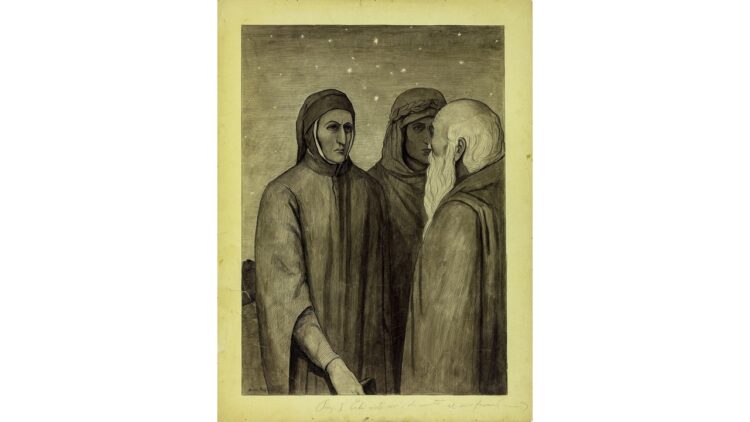
Cato of Utica: Canto I of Purgatory
by Dante Alighieri (1265-1321)
translated from Italian by Stephen Binns
Dante and Virgil emerge from the Inferno, having followed the course of the Lethe, the
river of forgetfulness. Here they are once again under sky and stars, though unfamiliar
stars: this is an isle at the base of Mount Purgatory, imagined as standing in the
Southern Hemisphere, at the exact antipode of Jerusalem. We later learn that Eden,
the earthly paradise, is atop the mount. (Unknown to Dante, Jerusalem’s true antipode is
an isle in paradisical French Polynesia.) The pilgrims soon see their first spirit: Cato of
Utica, who took his own life in 46 B.C., rather than submit to Julius Caesar. Though
a suicide and a pagan, this champion of freedom is the guardian of Purgatory.
To make a run through waters less unkind,
__my talent’s little vessel hoists her main
__and leaves a sea of cruelty behind,____Inferno
and I am singing of that second reign,____Purgatory
__where human spirit takes the needed purge
__to soar above, its Heaven to obtain.
Now let the deathly poetry resurge,
__O sacred Muses—I am yours again,
__and here, Calliope, I must needs urge____muse of epic poetry
your aid to give my song your highest strain,
__which drove the magpies to despair, they who____Pierides, changed into magpies . . .
__well knew that hope for pardon was in vain.____for challenging Muses to a singing contest
Sweet softness of the eastern sapphire blue,
__suffusing intervening peace, had blessed
__the sky up to the moon, thus to renew
my happiness on seeing we had pressed
__away beyond the dark and deadened air ____of the Inferno
__which had so burdened both my sight and breast.
That lovely planet, love’s encourager,____Venus, the morning star
__brought joyous laughter all across the east,
__which veiled the Fishes that escorted her. ____outshone the constellation Pisces
Then turning right, I gave my mind a feast
__upon that other pole, four stars in sight,____southern celestial pole
__not seen before—not since those first, at least.____Adam and Eve
Their brightness seemed to bring the sky delight.
__Oh, northern space, widowed of window to
__such joy, excluded from that blessèd light!
When I was able, I at last withdrew
__my eyes, and turned a little toward the zone,
__the north, where Wain by now was lost to view, ____Ursa Major
and saw a bearded ancient one alone,____Cato of Utica
__quite worthy of a reverent address;
__no father, clearly, earned more from a son.
The beard was long and mixed with hoariness,
__as was the flowing hair upon his head,
__which fell down to his chest in double tress.
“Who guided you, what lamp behind,” he said,
__“as you came out of that profoundest night
__which keeps the evil valley closeted?”
Those four stars overhead shone down their light____perhaps representing the cardinal virtues
__upon his face and gave it such a glow
__he looked as one with full sun in his sight.
“Who are you who, against the hidden flow, ____River Lethe
__who from that deepest night, now freely walks?”
__he asked, and shook his head and beard below.
“The laws of Hell are broken, or the locks?
__Or has from Heaven come a new decree
__that you, though damned, approach me on my rocks?”
And then my leader took a hold of me,____Virgil
__and with his words and gestures bid me give
__respect with lowered brow and bended knee,
and then he answered: “I did not arrive____Virgil answers for Dante
__unasked for, but a heavenly lady’s prayer ____Beatrice
__has brought me to bring care to one alive. ____to Dante
But as it is your wish and will to hear
__a detailed answer, as I would believe,
__I honor this and speak now full and clear.
This man has not yet seen his final eve, ____has not died
__but through his errant folly drew so near
__that little time was left for his reprieve.
As I have said to you, it’s been my care
__to save him, with no other salvation
__than this course that we took, this long wayfare.
I’ve showed him all the damned, the guilty nation;
__I now will show him all the spirits here
__who under your dominion seek purgation.
To tell our tale would take too long, I fear.
__Aid from on high has fallen down below
__to bring him now to see you and to hear.
Now if it please, bid welcome, bid him go
__in search of liberty, which is so dear,
__as he who would refuse his life must know.
You know, for you, who thought a death for her____for liberty
__in Utica would leave no bitter taste, .
__shed clothes that one great day you’ll brighter wear.____Cato will be resurrected in Heaven
Eternal edicts have not been displaced:
__he’s living still, and Minos does not bind,____judge of the Inferno does not control Virgil . . .
__for I am from the ring where eyes most chaste____who resides in Limbo
of your own Marcia are; she prays to find ____Cato’s wife
__your hold on her is something you maintain.
__For love of her receive us well, in kind.
Allow us through the seven, every reign, ____seven levels of Purgatory
__that I may tell her of a grace granted,
__if talk of you below you won’t disdain.” ____in Limbo, below Purgatory
“Marcia was pleasing to my eyes,” he said. __says Cato
__“When I was on the earth, any favor
__that she required and__ asked of me, I did.
Now that she dwells beyond the evil river
__she cannot move me, as by that decree
__made when I was released by Christ the Savior. at the Harrowing of Hell
But if your guide be that heavenly lady, ____Beatrice
__as you have said, you need not ask for grace.
__For her own sake, I will of course agree.
Go now, and take this man and round him place
__a supple simple reed our shore supplies.____symbol of humility
__You must then rigorously wash his face.
For it would not be seemly, with his eyes
__still clouded, to approach that first renowned
__custodian: he is from Paradise. ____angel at the gate of Mount Purgatory
Upon this little isle and all around,
__where waves beat fiercely on the shore in heaves,
__the reeds are growing on the muddy ground.
No other plant, none other sprouting leaves
__or standing stiff, too woody, could there be,
__not bending to the blows that this receives. ____
Now, afterwards do not return to me;
__the sun that is now rising will reveal
__how you may climb the mount most easily.”
He disappeared; I got up from my kneel
__without a word, drew closer to the one
__who guided me. On him my gaze took seal.
He said: “My son, now follow hard upon.____says Virgil
__We must turn back, for that way we would see
__the ground, toward water, sloping down then gone.____shore where they will find reeds
The hour of matins had begun to flee
__before the break of dawn, when I could strain
__for distant sight of ripples on the sea.
We made our way across the lonesome plain
__like those returning to a road they’d passed,
__who till that time had seemed to walk in vain.
We came to where the dew had made a last
__contention with the sun, not fully spent,
__because the shadows there were darkly cast,
and there my gentle master stopped and bent
__to touch both hands upon the grass with care,
__and I, now full aware of his intent,
raised up my tear-streaked cheeks to him, and there
__he cleansed me, so that once again I wore____cleansed with the dew on the grass
__the color darkened by Inferno air.
We moved on then to that deserted shore
__which never yet has seen upon its sea____according to Inferno, Canto XXVI . . .
__a crew of boatmen turned to home once more.____Ulysses and crew arrived but didn’t survive
As pleased Another, there he girded me,____as pleased God; girded with a reed
__and then a miracle! Where he had torn
__that humble plant, another, instantly,
arose there from the very root, reborn.
Italian Original
1 Per correr miglior acque alza le vele
2 omai la navicella del mio ingegno,
3 che lascia dietro a sé mar sì crudele;
4 e canterò di quel secondo regno
5 dove l’umano spirito si purga
6 e di salire al ciel diventa degno.
7 Ma qui la morta poesì resurga,
8 o sante Muse, poi che vostro sono;
9 e qui Calïopè alquanto surga,
10 seguitando il mio canto con quel suono
11 di cui le Piche misere sentiro
12 lo colpo tal, che disperar perdono.
13 Dolce color d’orïental zaffiro,
14 che s’accoglieva nel sereno aspetto
15 del mezzo, puro infino al primo giro,
16 a li occhi miei ricominciò diletto,
17 tosto ch’io usci’ fuor de l’aura morta
18 che m’avea contristati li occhi e ’l petto.
19 Lo bel pianeto che d’amar conforta
20 faceva tutto rider l’orïente,
21 velando i Pesci ch’erano in sua scorta.
22 I’ mi volsi a man destra, e puosi mente
23 a l’altro polo, e vidi quattro stelle
24 non viste mai fuor ch’a la prima gente.
25 Goder pareva ’l ciel di lor fiammelle:
26 oh settentrïonal vedovo sito,
27 poi che privato se’ di mirar quelle!
28 Com’ io da loro sguardo fui partito,
29 un poco me volgendo a l’altro polo,
30 là onde ’l Carro già era sparito,
31 vidi presso di me un veglio solo,
32 degno di tanta reverenza in vista,
33 che più non dee a padre alcun figliuolo.
34 Lunga la barba e di pel bianco mista
35 portava, a’ suoi capelli simigliante,
36 de’ quai cadeva al petto doppia lista.
37 Li raggi de le quattro luci sante
38 fregiavan sì la sua faccia di lume,
39 ch’i’ ’l vedea come ’l sol fosse davante.
40 “Chi siete voi che contro al cieco fiume
41 fuggita avete la pregione etterna?”
42 diss’ el, movendo quelle oneste piume.
43 “Chi v’ha guidati, o che vi fu lucerna,
44 uscendo fuor de la profonda notte
45 che sempre nera fa la valle inferna?
46 Son le leggi d’abisso così rotte?
47 o è mutato in ciel novo consiglio,
48 che, dannati, venite a le mie grotte?”
49 Lo duca mio allor mi diè di piglio,
50 e con parole e con mani e con cenni
51 reverenti mi fé le gambe e ’l ciglio.
52 Poscia rispuose lui: “Da me non venni:
53 donna scese del ciel, per li cui prieghi
54 de la mia compagnia costui sovvenni.
55 Ma da ch’è tuo voler che più si spieghi
56 di nostra condizion com’ ell’ è vera,
57 esser non puote il mio che a te si nieghi.
58 Questi non vide mai l’ultima sera;
59 ma per la sua follia le fu sì presso,
60 che molto poco tempo a volger era.
61 Sì com’ io dissi, fui mandato ad esso
62 per lui campare; e non lì era altra via
63 che questa per la quale i’ mi son messo.
64 Mostrata ho lui tutta la gente ria;
65 e ora intendo mostrar quelli spirti
66 che purgan sé sotto la tua balìa.
67 Com’ io l’ho tratto, saria lungo a dirti;
68 de l’alto scende virtù che m’aiuta
69 conducerlo a vederti e a udirti.
70 Or ti piaccia gradir la sua venuta:
71 libertà va cercando, ch’è sì cara,
72 come sa chi per lei vita rifiuta.
73 Tu ’l sai, ché non ti fu per lei amara
74 in Utica la morte, ove lasciasti
75 la vesta ch’al gran dì sarà sì chiara.
76 Non son li editti etterni per noi guasti,
77 ché questi vive e Minòs me non lega;
78 ma son del cerchio ove son li occhi casti
79 di Marzia tua, che ’n vista ancor ti priega,
80 o santo petto, che per tua la tegni:
81 per lo suo amore adunque a noi ti piega.
82 Lasciane andar per li tuoi sette regni;
83 grazie riporterò di te a lei,
84 se d’ esser mentovato là giù degni.”
85 “Marzïa piacque tanto a li occhi miei
86 mentre ch’i’ fu’ di là,” diss’ elli allora,
87 “che quante grazie volse da me, fei.
88 Or che di là dal mal fiume dimora,
89 più muover non mi può, per quella legge
90 che fatta fu quando me n’usci’ fora.
91 Ma se donna del ciel ti muove e regge,
92 come tu di’ , non c’è mestier lusinghe:
93 bastisi ben che per lei mi richegge.
94 Va dunque, e fa che tu costui ricinghe
95 d’un giunco schietto e che li lavi ’l viso,
96 sì ch’ogne sucidume quindi stinghe;
97 ché non si converria, l’occhio sorpriso
98 d’alcuna nebbia, andar dinanzi al primo
99 ministro, ch’è di quei di paradiso.
100 Questa isoletta intorno ad imo ad imo,
101 là giù colà dove la batte l’onda,
102 porta di giunchi sovra ’l molle limo;
103 null’ altra pianta che facesse fronda
104 o indurasse, vi puote aver vita,
105 però ch’a le percosse non seconda.
106 Poscia non sia di qua vostra reddita;
107 lo sol vi mosterrà, che surge omai,
108 prendere il monte a più lieve salita.”
109 Così sparì; e io sù mi levai
110 sanza parlare, e tutto mi ritrassi
111 al duca mio, e li occhi a lui drizzai.
112 El cominciò: “Figliuol, segui i miei passi:
113 volgianci in dietro, ché di qua dichina
114 questa pianura a’ suoi termini bassi.”
115 L’alba vinceva l’ora mattutina
116 che fuggia innanzi, sì che di lontano
117 conobbi il tremolar de la marina.
118 Noi andavam per lo solingo piano
119 com’ om che torna a la perduta strada,
120 che ’nfino ad essa li pare ire in vano.
121 Quando noi fummo là ’ve la rugiada
122 pugna col sole, per essere in parte
123 dove, ad orezza, poco si dirada,
124 ambo le mani in su l’erbetta sparte
125 soavemente ’l mio maestro pose:
126 ond’ io, che fui accorto di sua arte,
127 porsi ver’ lui le guance lacrimose;
128 ivi mi fece tutto discoverto
129 quel color che l’ inferno mi nascose.
130 Venimmo poi in sul lito diserto,
131 che mai non vide navicar sue acque
132 omo, che di tornar sia poscia esperto.
133 Quivi mi cinse sì com’ altrui piacque:
134 oh maraviglia! ché qual elli scelse
135 l’umile pianta, cotal si rinacque
136 subitamente là onde l’avelse.
Stephen Binns is an editor at the Smithsonian (the institution, not the magazine).


















Stephen, I am always overwhelmed, not only at the many varied kinds of knowledge you (and Dante) must have of history, astronomy, mythology, and more — but at the almost incredible ability you have to weave these things together in such a way as to tell this amazing story. Your artistic phrases, such as “which veiled the fishes that escorted her”; “This man has not yet seen his final eve”; “The laws of Hell are broken, or the locks?”; “where the dew had made a last contention with the sun”; and your imagery, your musicality with the language, are all breathtaking.
Thanks so much, Cynthia! High praise indeed from one whose work has reached such heights.
I recently came upon your “Forsythia Fading,” published here at this very time last year. What a beautiful lament for the brevity of the blooming season and the longevity of the “monochrome” of “dark green.” I myself always feel a melancholy over the passing of the yellow month of April, the month of forsythia, daffodils, and dandelions–even when it has not yet passed!
Hope to see your work again soon, whether here or in First Things.
I feel deeply honored by your comments about my poetry, Stephen. Thank you so much.
This is quite an accomplishment, being done in terza rima. The English is as fluent as the Italian original, and a pleasure to read. Also, the italicized notes and explanations on the right-hand side are a great help to students.
Thanks very much, Joseph. Kudos for your recent translations from Greek, and your canny choice of trochaic, with its vigor, its alacrity. I know not one iota of Greek (except, perhaps, for “kudos” and “iota”) but I’ve always been struck by how much ancient vigor there is in the trochaic rhythms of Latin.
It’s a rare treat to get a chunk of The Comedy rendered in well-crafted, fluent terza rima—thank you for sharing this lovely translation! (I’ve always found Purgatorio the best of the three canticles, IMHO)
Thanks so much, Josh, for your nice words and close reading. I agree with you on “Purgatory.” It contains much of Dante’s best action writing, perhaps because of the uphill climbing and the need of some of the spirits to race downhill to greet the pilgrims.
Thanks again!
And congrats on your recent, well-deserved first place!
Just had time to read this, Stephen. It does flow beautifully, which is as much to your credit as Dante’s, since you have to arrange the structure of grammar and logic in English. The first few lines create an admirable introduction to a new portion of your epic–again something that encourages the reader to proceed, as I was encouraged before I had leisure to meet Cato.
Thank you, Margaret! And speaking of matters supernal:
I very much admired your beautifully rhythmic, highly musical, and quite uplifting Good Friday poem, especially the final couplet: “His blood made Eden of Gethsemane, / And from the Cross pours forth serenity.”
Thank you, Stephen, for your gracious response to “The Precious Blood.” It’s good to have opinions from respected fellow poets about a poem I gratefully feel is my masterpiece of the year.