• Submit Poetry
  • Support SCP
  • About Us
  • Members
  • Join
Saturday, July 18, 2026
Society of Classical Poets
  • Poems
    • Beauty
    • Culture
    • Satire
    • Humor
    • Children’s
    • Art
    • Ekphrastic
    • Epic
    • Epigrams and Proverbs
    • Human Rights in China
    • Music
    • Performing Arts
    • Riddles
    • Science
    • Song Lyrics
    • The Environment
    • The Raven
    • Found Poems
    • High School Poets
    • Terrorism
    • Covid-19
  • Poetry Forms
    • Sonnet
    • Haiku
    • Limerick
    • Villanelle
    • Rondeau
    • Pantoum
    • Sestina
    • Triolet
    • Acrostic
    • Alexandroid
    • Alliterative
    • Blank Verse
    • Chant Royal
    • Clerihew
    • Rhupunt
    • Rondeau Redoublé
    • Rondel
    • Rubaiyat
    • Sapphic Verse
    • Shape Poems
    • Terza Rima
  • Great Poets
    • Geoffrey Chaucer
    • Emily Dickinson
    • Homer
    • Henry Wadsworth Longfellow
    • Dante Alighieri
    • John Keats
    • John Milton
    • Edgar Allan Poe
    • William Shakespeare
    • William Wordsworth
    • William Blake
    • Robert Frost
  • Love Poems
  • Contests
  • SCP Academy
    • Educational
    • Teaching Classical Poetry—A Guide for Educators
    • Poetry Forms
    • The SCP Journal
    • Books
No Result
View All Result
Society of Classical Poets
  • Poems
    • Beauty
    • Culture
    • Satire
    • Humor
    • Children’s
    • Art
    • Ekphrastic
    • Epic
    • Epigrams and Proverbs
    • Human Rights in China
    • Music
    • Performing Arts
    • Riddles
    • Science
    • Song Lyrics
    • The Environment
    • The Raven
    • Found Poems
    • High School Poets
    • Terrorism
    • Covid-19
  • Poetry Forms
    • Sonnet
    • Haiku
    • Limerick
    • Villanelle
    • Rondeau
    • Pantoum
    • Sestina
    • Triolet
    • Acrostic
    • Alexandroid
    • Alliterative
    • Blank Verse
    • Chant Royal
    • Clerihew
    • Rhupunt
    • Rondeau Redoublé
    • Rondel
    • Rubaiyat
    • Sapphic Verse
    • Shape Poems
    • Terza Rima
  • Great Poets
    • Geoffrey Chaucer
    • Emily Dickinson
    • Homer
    • Henry Wadsworth Longfellow
    • Dante Alighieri
    • John Keats
    • John Milton
    • Edgar Allan Poe
    • William Shakespeare
    • William Wordsworth
    • William Blake
    • Robert Frost
  • Love Poems
  • Contests
  • SCP Academy
    • Educational
    • Teaching Classical Poetry—A Guide for Educators
    • Poetry Forms
    • The SCP Journal
    • Books
No Result
View All Result
Society of Classical Poets
No Result
View All Result
Home Poetry Beauty

‘Christmas Eve’ by Christina Rossetti: Poetry Analysis

December 19, 2016
in Beauty, Culture, Educational, Essays, Poetry
A A
3
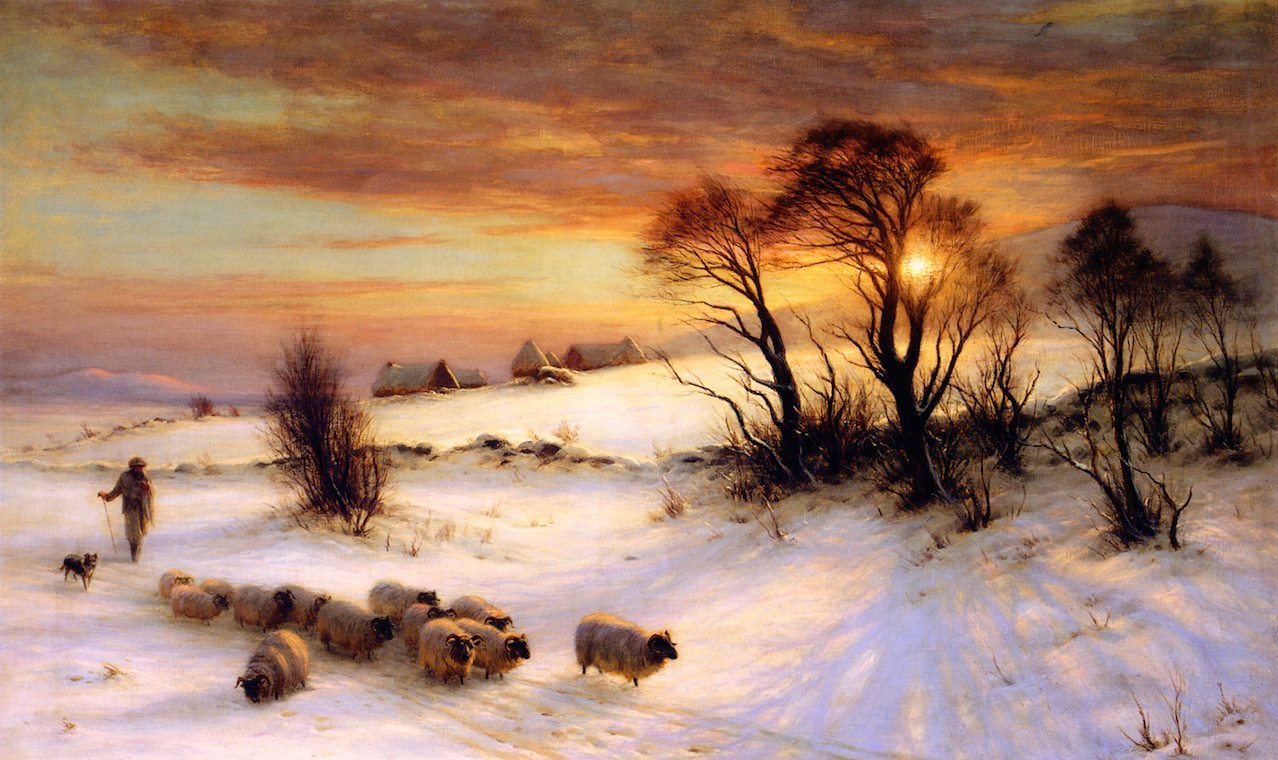
Joseph Farquharson 1846-1935 Scottish painter

Joseph Farquharson 1846-1935 Scottish painter

By Jane Blanchard

On December 5, 1830, Christina Rossetti was born in London to an Italian-English mother married to an Italian poet in exile.  The youngest of four children, all of whom grew up to be published authors, Rossetti became so well regarded for her work that she was mentioned in literary circles as a possible Poet Laureate of England upon the death of Alfred, Lord Tennyson, in 1892.  At this time, though, she was suffering from breast cancer, which caused her own death on December 29, 1894.

Rossetti lived with various members of her family throughout her life.  She declined to marry any of several suitors, presumably because none of them shared her devotion to Anglicanism.  Her collections of poetry, all infused with her faith and dedicated to her mother, display an amazing variety of styles and subjects.  The following verse is representative of the spirituality that she often artfully expressed:


Christmas Eve

By Christina Rossetti

Christmas has a darkness
Brighter than the blazing noon,
Christmas has a chillness
Warmer than the heat of June,
Christmas has a beauty
Lovelier than the world can show:
For Christmas bringeth Jesus,
Brought for us so low.

Earth, strike up your music,
Birds that sing and bells that ring;
Heaven has answering music
For all angels soon to sing:
Earth, put on your whitest
Bridal robe of spotless snow:
For Christmas bringeth Jesus,
Brought for us so low.


Rossetti’s “Christmas Eve” is a poem of anticipation:  at the very end of Advent, the speaker looks forward to the hour that Christmas begins.  The poem opens with three comparisons involving imagery.  The first two are paradoxes in which “darkness” becomes light and “chillness” becomes warmth.  The third is more abstract:  Christmas surpasses any “beauty” of the “world.”  These comparisons—all claims—are true because, according to line seven, “Christmas bringeth Jesus.”  At this point of the poem, Christmas gains agency:  it not only appears; it also acts.  However, the use of the passive participle “Brought” in line eight suggests a hidden higher agent behind the special delivery “for us so low.”   In addition, this line finally introduces the speaker, but only by integrating her into the plural pronoun “us” as one of many recipients of God’s embodied grace.  Moreover, the last phrase “so low” is marvelously ambiguous; it can modify “us” just before it or “Jesus” in the previous line or, most likely, both.

The second stanza starts with a direct address to a personified “Earth” and alternates between imperative and declarative clauses.  First, “Earth” is ordered to make “music” with “Birds” and “bells,” and the alliteration of these words, as well as the internal rhyme between “sing” and “ring” in the same line, creates even more sound effects.  Once Earth begins, then Heaven can and will respond with the “music” of “angels,” and the inversion of the adverb “soon” and the infinitive “to sing” in line twelve implies that the angels are eagerly awaiting their turn.  Next, “Earth” is ordered to dress for the occasion, to wear not just winter white, but the “whitest” of white, that which is “bridal” or virginal, “spotless” or pure.  This allusion to the biblical and allegorical “Bride of Christ” makes these lines much more than a wish for holiday “snow”; the “Earth” can only “put on” such pristine clothing because “Christmas bringeth Jesus, / Brought for us so low.”

Rossetti’s “Christmas Eve” can seem simple, even simplistic, upon a first reading.  But its few words, arranged in short, metrical, rhyming lines, resonate with meaning.  The two stanzas abound in repetition—of consonants, vowels, syllables, words, phrases, and clauses—all contributing to the coherence and significance of the whole work.  Perhaps most importantly, the use of the present tense throughout the poem, including the refrain, indicates that each celebration of Christmas is a re-enactment of the original nativity, an annual reminder of God’s gift.


Jane Blanchard lives and writes in Georgia.  Her chapbook Unloosed is available from Kelsay Books. 

ShareTweetPin
The Society of Classical Poets does not endorse any views expressed in individual poems or commentary.
Read Our Comments Policy Here

RandomPoems

‘In Favour of Form’ by M. P. Lauretta
Beauty

‘In Favour of Form’ by M. P. Lauretta

April 15, 2019

  Today poetic form is ostracised. It’s stifled and suppressed, deemed obsolete; classed as archaic, stuffy and effete, a vestige...

‘Pinhead’ and Other Poetry by Michael Curtis
Beauty

‘Pinhead’ and Other Poetry by Michael Curtis

December 6, 2018

Pinhead While sitting on a pinhead __Stuck in an angel's wing Holding still a piece of thread __I tap my...

Next Post
‘Scrabble-ism’ and Other Poetry by Ron L. Hodges

'Scrabble-ism' and Other Poetry by Ron L. Hodges

‘On the Winter Solstice’ and Other Poetry by Alec Ream

'On the Winter Solstice' and Other Poetry by Alec Ream

‘In the Forest’ by Margaret O’Driscoll

'In the Forest' by Margaret O'Driscoll

Comments 3

  1. James Sale says:
    10 years ago

    Thanks for this. C Rossetti is a seriously underrated poet, a real poet, with a feel for form and words. I like your analysis; there are many lovely subtleties of sound in this. Notice too the lovely interweaving of ‘b’ sounds throughout: brightness, beauty, bringest, brought, birds, bells, bridal, bringeth, brought – semantically all lovely, and just delicately connected with the consonantal sound. Of course, the great Gerard Manley Hopkins was impressed by CR – especially her The Convent Threshold.

    Reply
  2. carlie rogers says:
    4 years ago

    Hello, my name is Carlie Rogers. My dad used to quote part of a poem with these words, “It’s Christmas Eve my Tildie Sue and you must stay right here for tomorrow is Christmas.”

    My dad is no longer with us.

    Can you help me find this poem?

    Reply
  3. Carmen says:
    7 months ago

    My grandfather had a similar one… “It’s Christmas Eve my darling dear and you may sit right here…”
    I wonder if it’s the same one. My grandpa died in 1976.
    I was very young. My mother has since passed as well, but she didn’t know either.
    I too have often wondered how the rest of it went and have never been able to find it.
    Merry Christmas to you and your family!

    Reply

Leave a Reply Cancel reply

Your email address will not be published. Required fields are marked *

  1. Marguerite on ‘When the Phone Rings’ and Other Short Poems by Russel WinickJuly 18, 2026

    Amen on "Apologies!"

  2. Susan Jarvis Bryant on ‘My Pyjamas!’ and Other Poems by Susan Jarvis BryantJuly 18, 2026

    Jan, thank you very much for your encouraging comment. I'm so glad you enjoyed the poems and especially glad they…

  3. James Sale on ‘The 51st State’: A Poem by James SaleJuly 18, 2026

    Not quite a win, Theresa, but thank you for the thought, and congratulations yourself on your "Finalist' status for your…

  4. Susan Jarvis Bryant on National Poetry Month Limerick ChallengeJuly 18, 2026

    Beautifully written and hilarious, Jan! You have inspired me to have a go. Thank you!

  5. Jan Mennite on ‘My Pyjamas!’ and Other Poems by Susan Jarvis BryantJuly 18, 2026

    Susan, I always feel that my poetic intelligence increases while I read your work. I laughed and learned and felt…

Subscribe to Daily Poems

Enter your email address to subscribe to this blog and receive notifications of new posts by email.

Join 1,594 other subscribers

Recent Poems

  • Winners and Rankings of The Great American Poetry Competition
  • ‘The Gold Star Mother’: A Poem by Gerard Maritato
  • ‘An American Dash’: A Poem by Linda Ellis
  • ‘The Anonymous Soldier’: A Poem by Lucy Lind
  • ‘For Those We Never Meet’: A Poem by Aneesh Agarwal
  • ‘Ben Franklin’s Copper Fugio Cent’: A Poem by Geoffrey Smagacz
  • Three Brief Poems by Luxorius, Translated by Joseph S. Salemi
  • ‘The American Spirit’: A Poem by Dusty Grein
  • ‘The Ballad of Zebulon Pike’: A Poem by M.D. Skeen
  • ‘We Are the Ones’ and Other Poetry by Cheryl Corey
  • ‘My Pyjamas!’ and Other Poems by Susan Jarvis Bryant
  • ‘A Snowy Egret’: A Poem by Bruce Dale Wise
  • ‘The Swearing-in of Calvin Coolidge’: A Sonnet by Robert W. Crawford
  • ‘Ballad of the Sequoia’: A Poem by Lauren V. Leon
  • ‘The 51st State’: A Poem by James Sale
  • ‘La Uva’ (The Grape): A Poem by Michael Pietrack
  • ‘There’s Blood that Flows Within the Stripes’: A Poem by Lauren V. Leon
  • ‘Birdsong’: A Poem by Jeffrey Essmann
  • ‘The Melody That Lingers On’ and Other Poetry by John McPherson
  • ‘American Dreams’: A Poem by Adam Sedia
  • ‘An American Fabius’: A Poem by John Hernandez
  • ‘Vernal Clinic’ and Other Poetry by C.B. Anderson
  • ‘Omaha Beach’ and Other Poetry by Bradford Skow
  • ‘Music to Part the Veil’: A Poem by T.M. Moore
  • ‘A Gentleman’s Guide to Losing a War’ and Other Poetry by Arnon Peterson
  • ‘Black Shuck’: A Poem by Martin Briggs
  • ‘When the Last World War II Veteran Passes Away’: A Poem by N.S. Boone
  • ‘A Fallow Year at Worthy Farm’: A Poem by Paul A. Freeman
  • ‘Outstanding in Afghanistan’: A Poem by Jared S. Chang
  • ‘250 More’: A Poem by Miguel Moreno

Categories

  • Acrostic
  • Alexandroid
  • Alliterative
  • Art
  • Best Poems
  • Blank Verse
  • Chant Royal
  • Classical Poets Live
  • Clerihew
  • Covid-19
  • Deconstructing Communism
  • Educational
  • Epic
  • Epigrams and Proverbs
  • Essays
    • Interviews with Poets
    • Poetry Reviews
  • Featured
  • From the Society
  • Great Poets
    • Dante Alighieri
    • Edgar Allan Poe
    • Emily Dickinson
    • Geoffrey Chaucer
    • Henry Wadsworth Longfellow
    • Homer
    • John Keats
    • John Milton
    • Robert Frost
    • William Blake
    • William Shakespeare
    • William Wordsworth
  • Human Rights in China
  • Limerick
  • Love Poems
  • Music
  • Pantoum
  • Performing Arts
  • Poetry
    • Beauty
    • Children's Poems
    • Culture
    • Ekphrastic
    • Found Poems
    • High School Poets
    • Humor
    • Riddles
  • Poetry Challenge
  • Poetry Contests
  • Poetry Forms
    • Curtal Sonnet
    • Haiku
  • Poetry Readings
  • Rhupunt
  • Rondeau
  • Rondeau Redoublé
  • Rondel
  • Rubaiyat
  • Sapphic Verse
  • Satire
  • Science
  • Sestina
  • Shape Poems
  • Short Stories
  • Song Lyrics
  • Sonnet
  • Symposium
  • Terrorism
  • Terza Rima
  • The Environment
  • Translation
  • Triolet
  • Video
  • Villanelle

Quick Links

  • About Us
  • Submit Poetry
  • Become a Member
  • Members List
  • Support the Society
  • Advertisement Placement
  • Comments Policy
  • Terms of Use

Welcome Back!

Login to your account below

Forgotten Password?

Retrieve your password

Please enter your username or email address to reset your password.

Log In
No Result
View All Result
  • Poems
    • Beauty
    • Culture
    • Satire
    • Humor
    • Children’s
    • Art
    • Ekphrastic
    • Epic
    • Epigrams and Proverbs
    • Human Rights in China
    • Music
    • Performing Arts
    • Riddles
    • Science
    • Song Lyrics
    • The Environment
    • The Raven
    • Found Poems
    • High School Poets
    • Terrorism
    • Covid-19
  • Poetry Forms
    • Sonnet
    • Haiku
    • Limerick
    • Villanelle
    • Rondeau
    • Pantoum
    • Sestina
    • Triolet
    • Acrostic
    • Alexandroid
    • Alliterative
    • Blank Verse
    • Chant Royal
    • Clerihew
    • Rhupunt
    • Rondeau Redoublé
    • Rondel
    • Rubaiyat
    • Sapphic Verse
    • Shape Poems
    • Terza Rima
  • Great Poets
    • Geoffrey Chaucer
    • Emily Dickinson
    • Homer
    • Henry Wadsworth Longfellow
    • Dante Alighieri
    • John Keats
    • John Milton
    • Edgar Allan Poe
    • William Shakespeare
    • William Wordsworth
    • William Blake
    • Robert Frost
  • Love Poems
  • Contests
  • SCP Academy
    • Educational
    • Teaching Classical Poetry—A Guide for Educators
    • Poetry Forms
    • The SCP Journal
    • Books

© 2025 SCP. WebDesign by CODEC Prime.